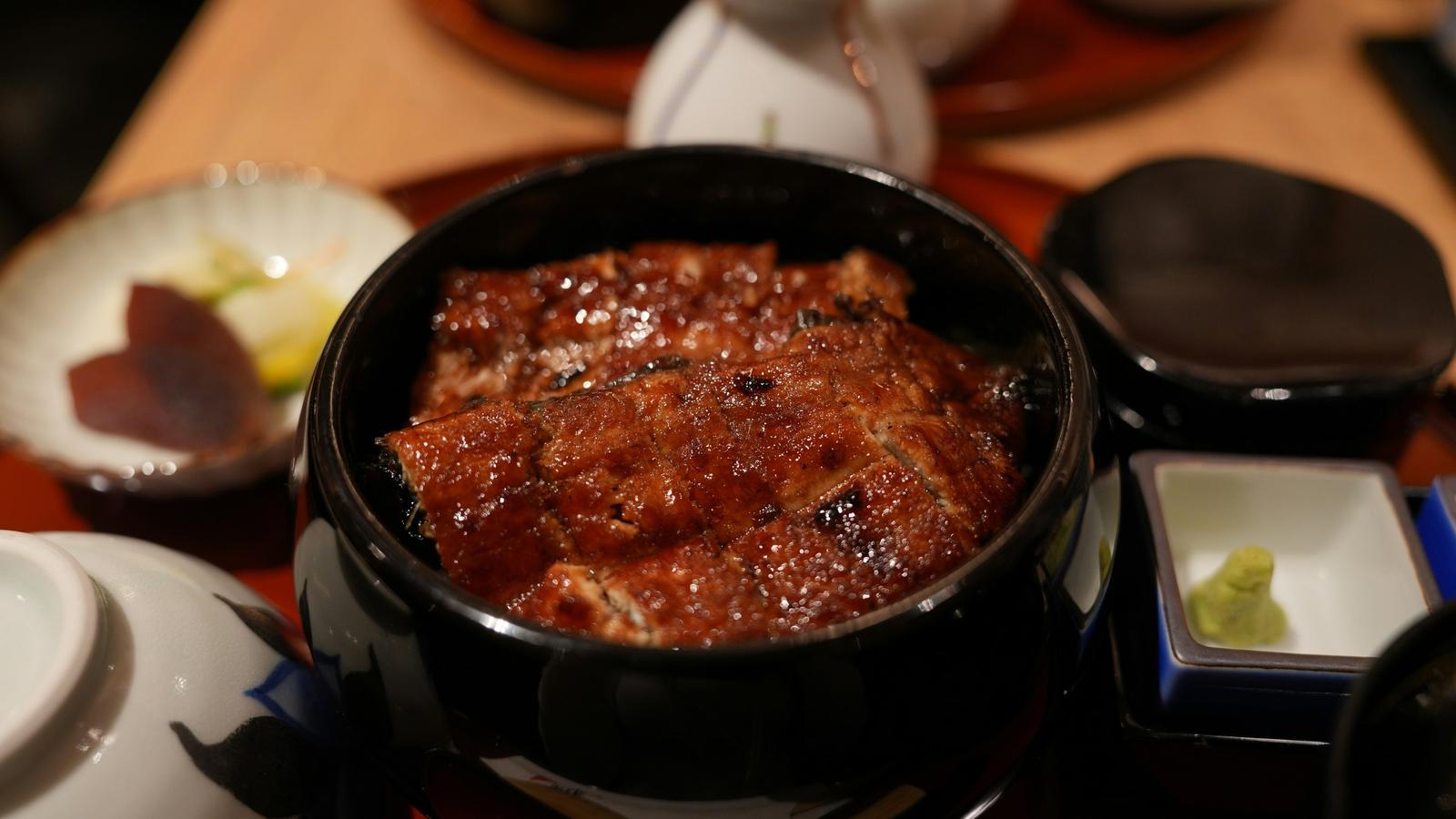
Eel is one of the oldest pleasures of the Japanese table. The same fish is opened along the back in Tokyo and along the belly in Osaka, steamed before the glaze in one city and taken straight from the fire in the other, and in Nagoya it is chopped into rice and finished with tea.
This article follows the eel from Tokyo to Nagoya and Lake Hamana and looks plainly at the state of the fish. We read the pages of two eel houses, the MICHELIN Guide, Hamamatsu City, Japan's agriculture and environment ministries, the Fisheries Agency, a research station and an eel scientist on November 5, 2026, and contacted none of them; the sources are listed at the end. For the conger eel rice of Miyajima, a different fish from the sea, see The Table in Hiroshima and the Inland Sea.
Key points
- In the Kanto style the eel is split along the back, grilled, steamed and glazed; in the Kansai style it is split along the belly and glazed without steaming. Hamamatsu, between the two, serves both.
- Nodaiwa in Tokyo dates from the Kansei era of the Edo period and holds one MICHELIN star. Its fifth-generation master, still at the grill at 97, received the guide's Mentor Chef Award in 2025.
- Atsuta Horaiken in Nagoya, founded in 1873, holds the registered trademark for hitsumabushi, chopped eel over rice eaten plain, with condiments and with tea.
- Japan's environment ministry listed the Japanese eel as Endangered in 2013, and the IUCN did the same in 2014. Farming is licensed and capped under an East Asian agreement.
- The midsummer Day of the Ox falls on July 21 and August 2 in 2027, the busiest days of the eel year.
ASK US TO PLACE THE EEL IN YOUR JOURNEY →
TWO WAYS TO OPEN AN EEL
Hamamatsu City, halfway between Tokyo and Osaka, describes the two schools clearly. In the Kanto style the eel is opened along the back, grilled plain, steamed, and grilled again with the sauce. In the Kansai style it is opened along the belly, grilled plain and glazed, with no steaming. Because Hamamatsu lies between the two regions, its restaurants serve both.
Steaming leaves a soft fillet; the western grill keeps the skin crisp and the flesh firmer. For a first eel meal we usually suggest the Tokyo style, which shows most clearly why the dish is prized, and a western grill later in the journey for contrast. The city also recommends shirayaki, eel grilled without sauce and eaten with wasabi and soy, where the quality of the fish shows most.
NODAIWA AND THE TOKYO STYLE
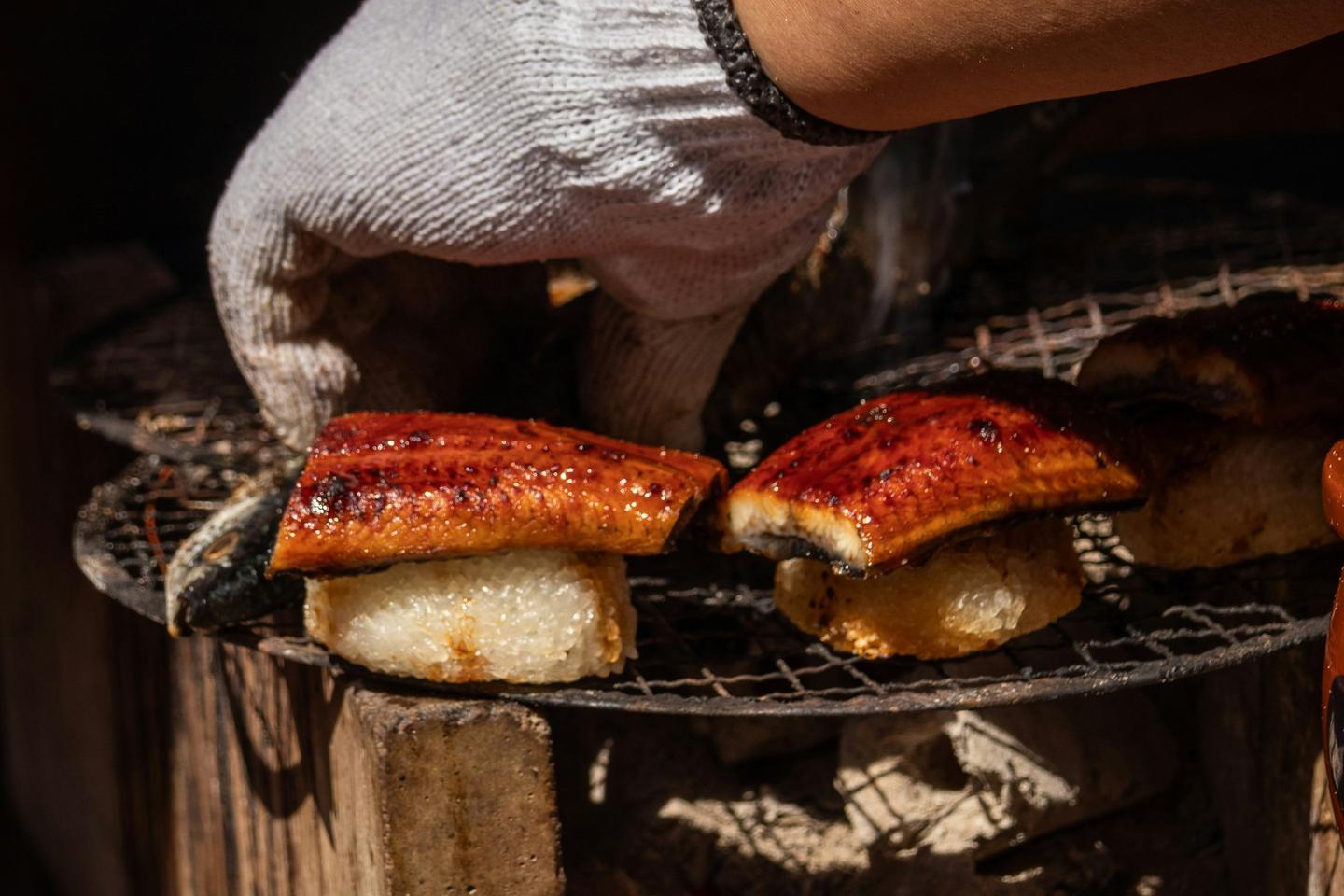
Nodaiwa, in Higashi-Azabu, says it was founded about two hundred years ago, in the Kansei era under the eleventh shogun, Tokugawa Ienari. Its own account of the work is the Tokyo method in its purest form: the eel is split and skewered, grilled plain, steamed slowly to remove excess fat and plump the flesh, then dipped in a sauce of mirin and soy alone and grilled again and again over binchotan charcoal.
The MICHELIN Guide gives Nodaiwa Azabu Iikura Honten one star, and in 2025 gave its fifth-generation master, Kanejiro Kanemoto, the Mentor Chef Award. The guide describes him at 97, still at the grill, and quotes the saying of the trade: three years to learn the skewer, eight to learn the knife, a lifetime to learn the grill. The house still serves his shirayaki with caviar and chilled white wine, a pairing from his many journeys in France. When we read its menu, Nodaiwa was serving wild and farmed eel side by side. For a guest who wants to understand eel, a lunch in one of its tatami rooms upstairs is the meal we would arrange first.
HITSUMABUSHI IN NAGOYA
Atsuta Horaiken was founded in 1873 as a ryotei and states that hitsumabushi, chopped grilled eel mixed into rice in a wooden tub, is its registered trademark. The ways of eating it, plain, with condiments, and as ochazuke with tea or broth poured over, were settled in the Meiji era, so one tub becomes three meals.
Horaiken has its main house, Jinya, a Jingu branch and a branch in the Matsuzakaya department store. Its kaiseki courses are taken only by telephone, at least three days ahead, and may be declined in busy periods; at New Year, Golden Week and Obon it can stop serving early once the eel sells out. A hitsumabushi lunch fits the day you travel between Tokyo and Kyoto.
LAKE HAMANA, WHERE FARMING BEGAN
Hamamatsu City traces eel farming at Lake Hamana to Kurajiro Hattori, who began raising eels in the lake in the Meiji era, more than 120 years ago. Glass eels came into the brackish lake, the climate was warm, the flat land suited ponds, groundwater was plentiful and the silk industry supplied silkworms as feed.
Hamanako Unagi is registered as Japan's geographical indication No. 177, for live eels farmed in Hamamatsu and Kosai. The registration records that heated pond farming was established here in 1971, and that the farmers' own staff meal, bokumeshi, became a local dish. Other prefectures now farm more: in 2025 Kagoshima produced 7,342 tonnes, Aichi 4,279, Miyazaki 3,128 and Shizuoka 1,827.
AN ENDANGERED FISH
Japan's Ministry of the Environment moved the Japanese eel from Data Deficient to Endangered on February 1, 2013, noting that the Red List carries no direct legal effect such as catch limits. The IUCN listed it as Endangered in June 2014. It hatches near the Mariana Islands, about 2,000 kilometres away, and its spawning ground was identified only in 2011.
Eel farms in Japan still begin with wild glass eels. Japan's fisheries research agency completed the full cycle in 2010, but hatchery glass eels cost about three times the price of wild ones even in expensive years. In 2014 Japan, China, Korea and Chinese Taipei agreed to cut farm stocking by 20 percent, and since 2015 farming has required a ministerial licence. Japan's stocking cap is 21.7 tonnes; the 2026 season stocked 16.6. In late 2025 a proposal to list all eel species under CITES Appendix II was rejected, 100 votes to 35. We set out these facts for guests who ask, and leave the choice with them.
THE DAY OF THE OX AND WHEN TO GO
Japan eats the most eel on the Day of the Ox in the hot weeks of high summer. In 2026 it fell on July 26; in 2027 there are two, on July 21 and August 2. The houses are full then, so for a calm meal we prefer the weeks either side, or the cooler months.
Within Signature, our planning for journeys of 7 to 21 days, an eel lunch usually sits in Tokyo and another in Nagoya or by Lake Hamana on the day between Tokyo and Kyoto. We ask the houses for a room or a table on your behalf; the seating is each house's decision, and each meal is settled in the simplest way available, usually on your hotel bill or on the day.
SOURCES AND HOW WE CHECKED
We read the pages below on November 5, 2026. We did not contact any restaurant, agency or other body. The IUCN Red List site requires an account to search, so the IUCN listing is taken from the Fisheries Agency, the Shizuoka research station and the lecture below.
- Nodaiwa (Japanese): Kansei era founding, the Tokyo method, sauce and charcoal, wild and farmed eel
- MICHELIN Guide, Mentor Chef Award (Japanese): one star, the master at 97, the saying of the trade, shirayaki with caviar
- Atsuta Horaiken (Japanese): founded 1873, the hitsumabushi trademark, ways of eating, branches, kaiseki by telephone
- Hamamatsu City (Japanese): Kanto and Kansai styles, Kurajiro Hattori, glass eel season
- Ministry of Agriculture, Forestry and Fisheries, GI No. 177 Hamanako Unagi (Japanese): area, live eels, heated farming in 1971, bokumeshi
- Fisheries Agency, eel (Japanese): licensing since 2015, the 2014 agreement to cut stocking by 20 percent
- Fisheries Agency, eels and measures, July 2026 (Japanese): life cycle, farming by prefecture, stocking, IUCN 2014, CITES 2025, the full cycle in 2010
- Ministry of the Environment, Red List of brackish and freshwater fish (Japanese): Endangered on February 1, 2013, no direct legal effect
- Shizuoka Prefectural Research Institute of Fishery and Ocean, Lake Hamana Branch (Japanese): the 2013 and 2014 listings, eel stock research
- Kenzo Kaifu, Chuo University, on the IUCN assessment of the Japanese eel (Japanese): Endangered in June 2014
- Best Calendar, Day of the Ox (Japanese): July 26, 2026; July 21 and August 2, 2027
QUESTIONS TRAVELLERS ASK
What is the difference between Kanto and Kansai unagi?
Kanto eel is split along the back, grilled, steamed and glazed, which makes it soft. Kansai eel is split along the belly and glazed without steaming, which keeps the skin crisp.
Is the Japanese eel endangered?
Japan's environment ministry listed it as Endangered in 2013 and the IUCN in 2014. Its farming is licensed and capped, and we leave the choice with you.
How do you eat hitsumabushi?
Plain first, then with condiments, then as ochazuke with tea or broth poured over, as Atsuta Horaiken describes it.
When is the Day of the Ox in 2027?
Twice in summer 2027, on July 21 and August 2. We usually suggest the weeks around it.
Can you arrange a table at Nodaiwa?
We ask on your behalf for the dining room or a tatami room upstairs. Whether the house can seat you is its decision.
ASK US TO PLACE THE EEL IN YOUR JOURNEY
Tell us when you are coming, who is travelling and how you like to eat. We will set out the eel houses of Tokyo, Nagoya and Lake Hamana with the reasons for each, so that you can choose.
Begin planning →We reply within 24 hours, in writing
Some of the restaurants and bars we arrange seat guests only by introduction or membership. We ask on your behalf; the table and the evening are the house's decision. We do not publish their names.