Australians go to Hiroshima far more than most visitors do. Japan's tourism agency found that 18.6 percent of leisure travellers from Australia visited Hiroshima Prefecture in 2025, about twice the rate for travellers from the United States. Most come for the Peace Memorial Park and the shrine on Miyajima, and many leave on the evening train. They miss the table.
This article is about eating and drinking well in Hiroshima and on the Inland Sea: the oysters, which share a surprising history with Australia; the conger eel rice of Miyajimaguchi; and the sake town of Saijo, a short train ride east of the city. We read the pages of Japan's Fisheries Agency, the prefecture, the National Research Institute of Brewing, Saijo's brewers, a restaurant, and Australian fisheries and seafood sources on November 5, 2026, and contacted none of them; the sources are listed at the end. For the Peace Park, the tides at the great torii and the ryokan of Miyajima, see Hiroshima & Miyajima, Beyond the Narrative; for the lemon islands and the floating inn guntû, see Onomichi and Setoda.
Key points
- Hiroshima produced 60 percent of Japan's farmed oysters in 2023, about 89,200 tonnes, grown hanging from rafts in the Inland Sea.
- The Pacific oyster grown in Tasmania, South Australia and New South Wales was introduced to Tasmania from Japan in the 1940s, so an Australian at a Hiroshima table meets a familiar oyster in its home water.
- Anagomeshi Ueno at Miyajimaguchi has served conger eel over rice since 1901. The dining room takes no reservations; the bento can be reserved.
- Saijo, in Higashihiroshima, has seven breweries within about a kilometre and counts with Nada and Fushimi as one of Japan's three great sake towns.
- Arrivals from Australia are highest in January and December and strong again in September and October, the cooler months of the oyster.
ASK US ABOUT A HIROSHIMA TABLE →
THE OYSTER AND A LINE BACK TO TASMANIA
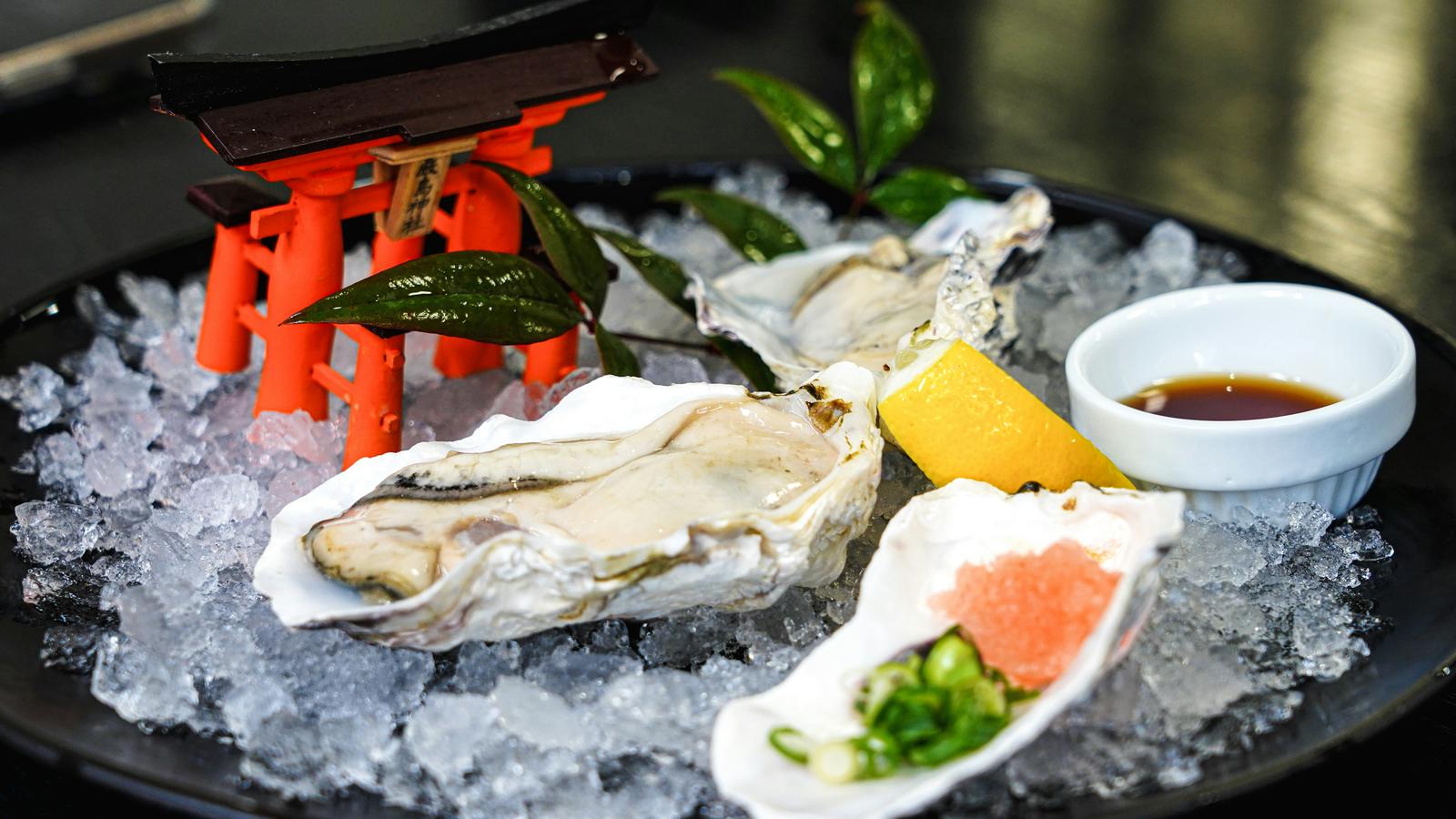
Japan's Fisheries Agency puts Hiroshima at 60 percent of the country's farmed oyster production in 2023, well ahead of Miyagi at 14 percent and Okayama at 8. By value the share is 47 percent. Hiroshima's oysters are grown by the hanging method, on ropes beneath rafts moored in the sheltered bays, which lets the farmers move the rafts and use the depth of the water.
Australians will recognise the oyster. The Pacific oyster, the species farmed across Japan, was introduced to Tasmania from Japan in the 1940s, as the Sydney Fish Market and the Tasmanian government both note, and Australian scientists published a study of its acclimatisation in 1952. Today it is farmed in Tasmania, South Australia and New South Wales. In Hiroshima you taste the same species where its story began, raw on ice in the cold months, grilled in the shell, fried, or cooked into rice.
MIYAJIMA AND THE CONGER EEL
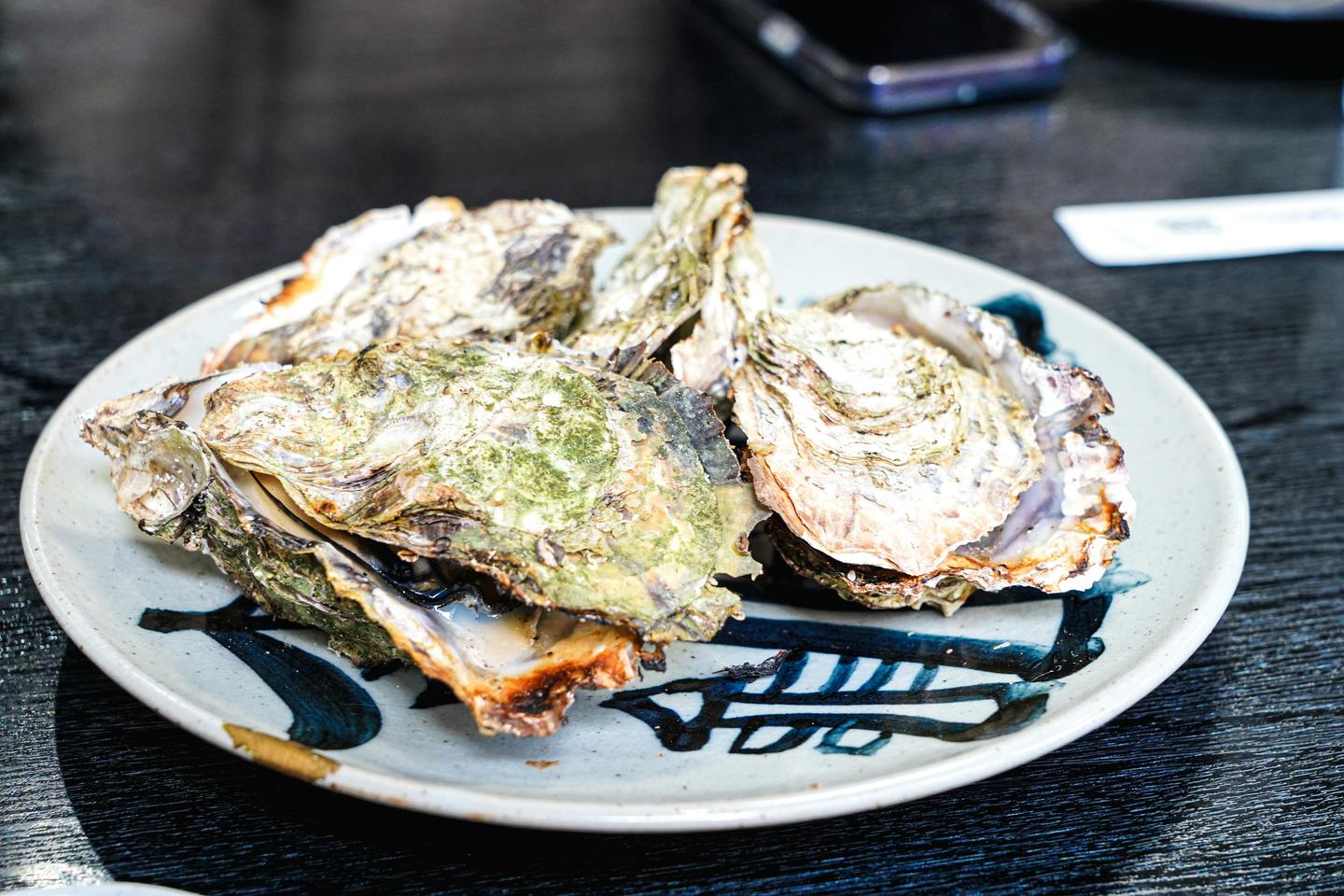
On Miyajima the oyster is grilled in the shell and served at the tables of the island's restaurants, often with a view across the strait. The other dish of this shore is anagomeshi, conger eel grilled and laid over rice cooked in its broth. Anagomeshi Ueno, at Miyajimaguchi on the mainland side of the ferry, was founded in 1901. Its own history says the dish began as a station bento that Tanikichi Ueno sold at Miyajima Station, which opened in 1897.
Ueno's dining room is open every day and takes no reservations, while its bento can be reserved, and both sell out. We usually arrange the bento and collect it on the way to the ferry, or plan an early lunch before the queue forms.
SAIJO AND THE SAKE OF THE INLAND SEA
Saijo, in the city of Higashihiroshima, is a sake town. The prefecture describes seven breweries standing within about a kilometre of each other near JR Saijo Station, with white walls, latticed plaster and red-brick chimneys that carry the names of their sake, and counts Saijo with Nada in Hyogo and Fushimi in Kyoto as one of Japan's three great sake regions. The brewers' own site advises visitors simply to follow the chimneys.
The National Research Institute of Brewing, the government body for the science of sake, is also in Higashihiroshima, and publishes the results of Japan's national new sake competition. For a guest who knows wine from the Barossa or the Yarra, Saijo is the place to taste how water, rice and yeast shape a sake. We ask the breweries for a quieter tasting or a walk through the cellars on your behalf; what each brewery can offer, and when, is its decision.
THE INLAND SEA BEYOND THE CITY
East of Hiroshima, the islands of the Inland Sea carry the table further. Setoda on Ikuchijima grows the lemons that Hiroshima Prefecture is known for, and guntû, the floating inn that sails from Onomichi, serves the sea's fish to 17 suites; both are described in Onomichi and Setoda. The art islands of Naoshima and Teshima are in Beyond Naoshima.
A good Hiroshima week often runs from the city to Miyajima, out to Saijo for a day, and east to Setoda or onto guntû. We place one meal of oysters early, one of anagomeshi on the Miyajima day, and leave room for a counter that the hotel concierge or a brewer recommends to us when we are there.
WHEN TO GO FROM AUSTRALIA
Arrivals from Australia in 2025 peaked in January, at 140,185, with 121,329 in December and about 96,000 in each of September and October. The cold months of the oyster fall across the Australian summer holidays, and the cool, clear weeks of autumn suit both the walking on Miyajima and the sake town. For the season's other table, the winter fugu of Shimonoseki, see Fugu in Japan.
Within Signature, our planning for journeys of 7 to 21 days, Hiroshima and the Inland Sea usually take three to five nights between Kyoto and the west. We arrange the hotels, cars, boats and tables, and settle each in the simplest way available, usually on your hotel bill or on the day.
SOURCES AND HOW WE CHECKED
We read the pages below on November 5, 2026. We did not contact any restaurant, brewery, agency or other body. The Australian visit rate is for leisure travellers.
- Japan Tourism Agency, Consumption Trends Survey 2025 tables (Japanese): Hiroshima visit rate, Australia 18.6 percent and United States 9.2 percent
- JNTO, visitor arrivals by month (Japanese): arrivals from Australia by month in 2025
- Fisheries Agency, oyster farming (Japanese): Hiroshima 60 percent (89,200 tonnes) and 47 percent of value in 2023, the hanging raft method
- Sydney Fish Market, Pacific oyster: introduced to Tasmania from Japan in the 1940s, farmed in South Australia and New South Wales
- Tasmanian Government, Pacific oyster: introduced to Tasmania in the late 1940s for aquaculture
- CSIRO Publishing, The Acclimatization and Growth of the Pacific Oyster in Australia (1952): the early Australian study
- Anagomeshi Ueno (Japanese): founded 1901, station bento origin, hours, no reservations for the dining room
- Hiroshima Prefecture, Hiroshima Lab (Japanese): seven breweries within about 1 km in Saijo, one of the three great sake regions
- Saijo sake breweries: the breweries of Saijo, follow the chimneys
- National Research Institute of Brewing (Japanese): located in Higashihiroshima, national new sake competition
QUESTIONS TRAVELLERS ASK
When is oyster season in Hiroshima?
The cold months, from autumn into early spring. Hiroshima grows 60 percent of Japan's farmed oysters, so they are on menus across the city and on Miyajima throughout that season.
Can we reserve a table at Anagomeshi Ueno?
The dining room does not take reservations, but the bento can be reserved. We usually arrange the bento and collect it on the way to the Miyajima ferry.
How do we get to Saijo from Hiroshima?
By JR train east from Hiroshima Station to Saijo Station, or by car. The seven breweries stand within about a kilometre of the station.
Are the oysters in Hiroshima the same as those in Australia?
The Pacific oyster farmed in Tasmania, South Australia and New South Wales came from Japan in the 1940s, so it is the same species, grown in different waters.
How many nights should we spend in Hiroshima for the food?
Three to five nights across the city, Miyajima and the islands to the east give time for the oysters, a day in Saijo and an evening on the Inland Sea.
ASK US TO SHAPE YOUR DAYS ON THE INLAND SEA
Tell us when you are coming, who is travelling and what you like to eat and drink. We will set out the tables, the sake and the islands, with the reasons, so that you can choose.
Begin planning →We reply within 24 hours, in writing
Some of the restaurants and bars we arrange seat guests only by introduction or membership. We ask on your behalf; the table and the evening are the house's decision. We do not publish their names.