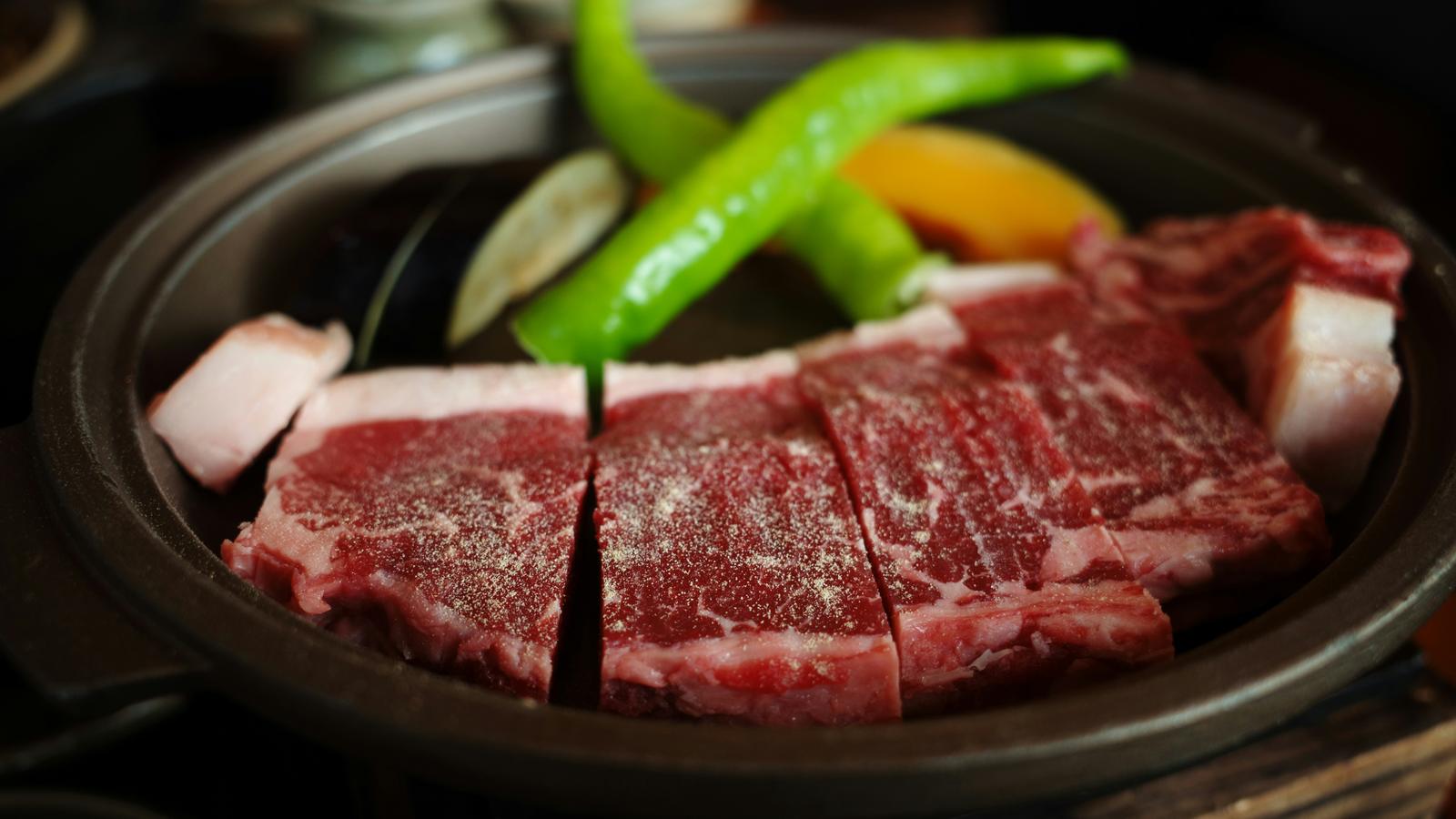
In Kyoto you can eat the region's three great beef names: Omi beef from neighbouring Shiga, Tajima beef from Hyogo, and Kobe beef, which is Tajima beef that passes a stricter grade. Each name is defined by its own association and registered with the Ministry of Agriculture, Forestry and Fisheries, while the A5 on a menu is a separate national grade. On the official menus we read, a Kyoto beef meal ran from an Omi beef sukiyaki set at ¥4,300 near Nishiki Market to 250 g of fillet at Gion Mikaku for ¥61,500.
This guide sets out what Tajima, Kobe, Omi and Matsusaka beef must be, how the grade is decided, how Kyoto restaurants describe their beef, and what six of them publish about style, beef and price. We read every rule and price on the official pages on October 28, 2026, and the sources are listed at the end. For Kobe certification and the 10-digit ID in detail, see authentic Kobe beef: how to check it and where to eat it.
Key points
- Tajima beef is Hyogo's own Tajima line, finished in Hyogo and graded A or B 2 or higher. Kobe beef is Tajima beef graded A or B 4 or higher with BMS No.6 or higher.
- Omi beef is Japanese Black cattle raised longest in Shiga and finished there. The association certifies only Omi beef graded A4 or B4 and above.
- Matsusaka beef is Japanese Black virgin heifers brought into the Matsusaka area by about 12 months of age and registered with the council.
- A5 is a grade any carcass can earn. The brand describes the animal's origin and rearing; the grade describes how the carcass scored.
- Official prices on October 28, 2026: Shinagawatei Omi beef sukiyaki set ¥4,300, Mishima-tei lunch course ¥8,591, Mouriya Gion Kobe beef rump lunch ¥9,000, Teppanyaki Aoi dinner from ¥17,457, Gion Mikaku three-style course ¥30,000.
LET US ARRANGE YOUR WAGYU TABLE IN KYOTO →
THE FOUR NAMES ON A KYOTO MENU
Some definitions fix the bloodline, some fix where the animal lived, and some set a minimum grade.
| Name | Who defines it | What it must be |
|---|---|---|
| Tajima beef, GI No. 2 | Kobe Beef Marketing & Distribution Promotion Association, Hyogo | Tajima cattle bred only from Hyogo's prefectural sires, finished in Hyogo, heifers or steers of 28 to 60 months, graded A or B 2 or higher |
| Kobe beef, GI No. 3 | The same association | Tajima beef graded A or B 4 or higher, BMS No.6 or higher, carcass under 500 kg |
| Omi beef, GI No. 56 | Omi Beef Production and Distribution Promotion Association, Shiga | Japanese Black cattle raised longest in Shiga and finished there; certified Omi beef grades A4 or B4 or higher |
| Matsusaka beef; Tokusan Matsusaka, GI No. 25 | Matsusaka Beef Council, Mie | Japanese Black virgin heifers brought into the area by about 12 months and registered; Tokusan calves come from Hyogo and are fattened 900 days or more |
Tajima beef: the bloodline. The ministry's specification says the cattle are crossed only with Hyogo's prefectural sires and that Hyogo avoids crosses with wagyu from other prefectures. Each carcass is stamped and receives its own Tajima-gyu certificate.
Kobe beef: the upper band of Tajima beef. The same association certifies it with a stricter grade. It says that of about 7,000 Tajima cattle taken to market each year, about 5,500 are certified as Kobe beef; the rest is sold as Tajima beef.
Omi beef: where the animal lived. Its registration sets no bloodline. The animal must spend the longest part of its life in Shiga, be finished there, and be given rice straw as its main roughage from the middle of fattening. The association registered the name as a regional trademark on May 11, 2007, and the ministry registered it on December 15, 2017. Its certificate also requires a member producer and grading at the Shiga Meat Center or Tokyo's Shibaura slaughterhouse.
Matsusaka beef: sex, age and registration. Heifers are fattened only in the production area and sold with a certificate and seal that diners can check online. Matsusaka is in Mie, and it is the name you will see least often in Kyoto.
HOW THE GRADE IS DECIDED
The letter and number come from the Japan Meat Grading Association, which grades every carcass against one national standard.
- The letter is yield. A is a yield score of 72 or more, B is 69 to just under 72, and C is under 69.
- The number is quality, 1 to 5. Marbling, meat colour, firmness and texture, and fat quality are each scored, and the carcass takes the lowest of the four.
- BMS is the marbling scale. Grade 5 needs BMS No.8 or higher, grade 4 No.5 or higher, and grade 3 No.3 or higher.
So Tajima beef starts at grade 2, certified Omi beef at grade 4, and Kobe beef at grade 4 with BMS No.6. A restaurant can serve A5 beef that carries none of these names, and Omi or Tajima beef graded A3.
HOW KYOTO RESTAURANTS DESCRIBE THEIR BEEF
Kyoto's beef restaurants describe their beef in four ways.
- Brand and grade together. Mouriya Gion prints its Kobe beef and its own A5 selection as two lists, at different prices for the same cut and weight.
- A designated shop. Teppanyaki Aoi at the RIHGA Royal Hotel Kyoto calls itself a certified designated Omi beef restaurant and is on the association's list. Its current dinner courses are named for Japanese Black wagyu, so we ask which beef a course uses.
- The house's own selection. Mishima-tei says it chooses beef without fixing the place of origin and ages it by its own method. Its top course can use prize-winning cattle or Kobe beef.
- Whole animals bought direct. Gion Mikaku buys whole heifers raised in Sanda, Hyogo, registered by nose print, and ages and bones the meat itself. Its English page states that it serves Kobe beef, and it is on the Kobe association's list.
Two checks work everywhere. Japanese law requires restaurants serving yakiniku, shabu-shabu, sukiyaki or steak to display each animal's 10-digit ID, and each of the four associations issues a certificate a restaurant can show.
SIX KYOTO TABLES AND WHAT THEY PUBLISH
All six publish menus and prices on their own websites; prices are per person.
| Restaurant | Style | Beef as stated | Published prices |
|---|---|---|---|
| Mishima-tei Honten, Teramachi Sanjo | Sukiyaki, oil-yaki, mizutaki | Japanese Black wagyu of any origin, aged in-house; Kobe beef possible on the top course | Lunch course ¥8,591; courses ¥17,545, ¥21,780, ¥24,200 and ¥28,435; tax not stated |
| Gion Mikaku, Nawate | Teppanyaki, 16-seat counter | Heifers only, Tajima line from Sanda; Kobe beef per its English page | Steak lunch 100 g ¥5,000 to 250 g ¥9,500; three-style course ¥30,000 tax included; steak course rump 150 g ¥26,500 to fillet 250 g ¥61,500 |
| Mouriya Gion | Steak | Kobe beef, designated No. 898, and Mouriya's own A5 selection | Lunch Kobe rump 120 g ¥9,000; dinner Kobe A5 sirloin 120 g ¥24,500 to fillet 180 g ¥44,300; tax included |
| Teppanyaki Aoi, RIHGA Royal Hotel Kyoto | Teppanyaki, 35 seats | Designated Omi beef restaurant; dinner courses listed as Japanese Black wagyu | Lunch from ¥7,084, dinner from ¥17,457, tax and service included |
| Shinagawatei Kyoto, by Nishiki Market | Butcher with a tatami dining room | Omi beef; croquettes from certified Omi beef | Omi beef loin sukiyaki set ¥4,300; gyudon set ¥2,200; tax included |
| Hafuu Honten, south of the Imperial Palace | Steak and beef cutlet, Western style | Wagyu from a family butcher business; brand not named | Lunch sirloin steak ¥5,200; dinner courses ¥9,200 and ¥11,300, tax included; ¥500 table charge at dinner |
Mishima-tei opened on Teramachi Sanjo in 1873, after its founder learned beef hot pot in Nagasaki, and the fifth generation runs it in a Meiji townhouse with a small garden. Courses come as sukiyaki, oil-yaki or mizutaki, a form of shabu-shabu. It opens 11:00 to 21:00, last entry 20:00, and closes Wednesdays and some other days.
Gion Mikaku opened in 1929 and faces the Shirakawa. Lunch, 12:00 to 14:00, must be booked; dinner is from 18:00, and it closes on Mondays. Its English booking form takes a deposit of ¥20,000 plus tax per person, and children under six are not admitted. The three-style course cooks rump as griddle shabu-shabu, fillet as steak and loin as sukiyaki.
Mouriya Gion is the Kyoto branch of the Kobe house in our Kobe beef guide. At lunch, 120 g of A5 sirloin costs ¥11,400 from Mouriya's own selection and ¥21,000 as Kobe beef: the same grade, priced apart by the name and what it certifies.
Teppanyaki Aoi is on the basement floor of the RIHGA Royal Hotel Kyoto, on Horikawa Street west of Kyoto Station. Weekday lunch runs 12:00 to 15:30, with last order moving to 14:00 from November 1, 2026; dinner is 17:00 to 21:30.
Shinagawatei is an Omi beef butcher whose family has traded since the Taisho era. Its Kyoto shop, on Yanagibamba south of Nishiki Market, serves its sukiyaki set in a back room from 11:30 to 18:00 and closes on Wednesdays.
Hafuu grew out of a Kyoto butcher's business. Its Original Dinner ends with 190 g of sirloin or 170 g of fillet, the fillet ¥500 more. The main shop closes on Wednesdays; the Shogoin branch has private rooms.
BEEF-ONLY MENUS PORK AND DIETARY NEEDS
None of the six states on its website that its kitchen is free of pork, so we do not describe any as pork-free.
- Gion Mikaku says it has served only heifer beef since 1929, and every course on its menu is built on beef. It notes soy, wheat, milk and egg in its dishes.
- Mishima-tei's main dishes are all beef; the kaiseki starters change monthly and include seafood.
- Shinagawatei is a full butcher: its Otsu shop sells pork cutlets, ham and bacon, and its hamburger mixes Omi beef with pork. The Kyoto dining menu is Omi beef.
- Mouriya Gion states that its kitchen is not fully separated and that cross-contact of allergens cannot be ruled out.
For halal wagyu, see halal fine dining in Japan.
HOW WE ARRANGE A WAGYU MEAL IN KYOTO
We arrange the table in your name and write to the restaurant in Japanese beforehand.
- The beef by name. If a course says Japanese Black wagyu, we ask whether it is Omi, Tajima, Kobe or the house's selection, and ask for the certificate and ID at the table.
- Terms. Mishima-tei's Hana course needs two days' notice, Gion Mikaku takes a deposit and no children under six, and most close one weekday.
- Diet. We send allergies and pork or alcohol restrictions in writing and ask the kitchen to confirm.
For the rhythm of a long Kyoto dinner, see kaiseki etiquette.
SOURCES AND HOW WE CHECKED
We read each definition, list and menu on the official websites below on October 28, 2026. We did not contact the restaurants. Prices change; we confirm the current menu when we arrange the table.
- Ministry of Agriculture, Forestry and Fisheries, GI No. 2 Tajima beef: bloodline, age, meat centres, grade
- Ministry, GI No. 3 Kobe beef: names and area
- Ministry, GI No. 56 Omi beef: definition, feeding, history
- Ministry, GI No. 25 Tokusan Matsusaka Ushi: production area
- Kobe Beef Marketing & Distribution Promotion Association, FAQ and certification: criteria, numbers, certificates
- Kobe association, designated store list: Mouriya Gion and Gion Mikaku
- Omi Beef Production and Distribution Promotion Association, definition and certification and designated shops: Teppanyaki Aoi, Shinagawatei
- Matsusaka Beef Council: definition, registration, Tokusan
- Japan Meat Grading Association, beef carcass standard: grades, BMS
- Ministry, beef traceability: ID display rule
- Mishima-tei, cuisine, about and main shop: courses, sourcing, hours
- Gion Mikaku, menu, about and English page: prices, sourcing, deposit
- Mouriya Gion, menu: prices
- RIHGA Royal Hotel Kyoto, Teppanyaki Aoi and dinner menu: designation, prices, hours
- Shinagawatei, menu: Kyoto prices, hours
- Hafuu, menu and main shop: prices, closing day
QUESTIONS GUESTS ASK
What is the difference between Tajima beef and Kobe beef?
They come from the same Hyogo cattle. Tajima beef is any carcass of that line finished in Hyogo and graded A or B 2 or higher. Kobe beef is the part graded A or B 4 or higher with BMS No.6 or higher. One association certifies both.
Is Omi beef the same as Kobe beef?
No. Omi beef is Japanese Black cattle raised longest in Shiga and finished there, with no bloodline rule. Kobe beef must be Tajima cattle born and raised in Hyogo.
Does A5 mean the beef is Kobe, Omi or Matsusaka?
No. A5 is a national grade any carcass can earn. Mouriya Gion lists 120 g of A5 sirloin at lunch for ¥11,400 from its own selection and ¥21,000 as Kobe beef.
How much does a wagyu dinner in Kyoto cost?
On the official menus we read on October 28, 2026, a steak dinner course was ¥9,200 at Hafuu, Teppanyaki Aoi started at ¥17,457, a Kobe beef sirloin dinner at Mouriya Gion was ¥24,500, and Gion Mikaku's three-style course was ¥30,000. Drinks are extra.
Can I eat Matsusaka beef in Kyoto?
It appears far less often than Omi, Tajima or Kobe beef, and none of the six restaurants we checked names it. Its council's certificate and seal let you check any you are served.
LET US ARRANGE YOUR WAGYU TABLE IN KYOTO
Send us your dates, where you are staying, how many are dining and any dietary needs. We will come back with two or three restaurants that fit the day, the style and beef we suggest at each, and the published price per person, and we arrange the one you choose.
Begin planning →We reply within 24 hours, in writing