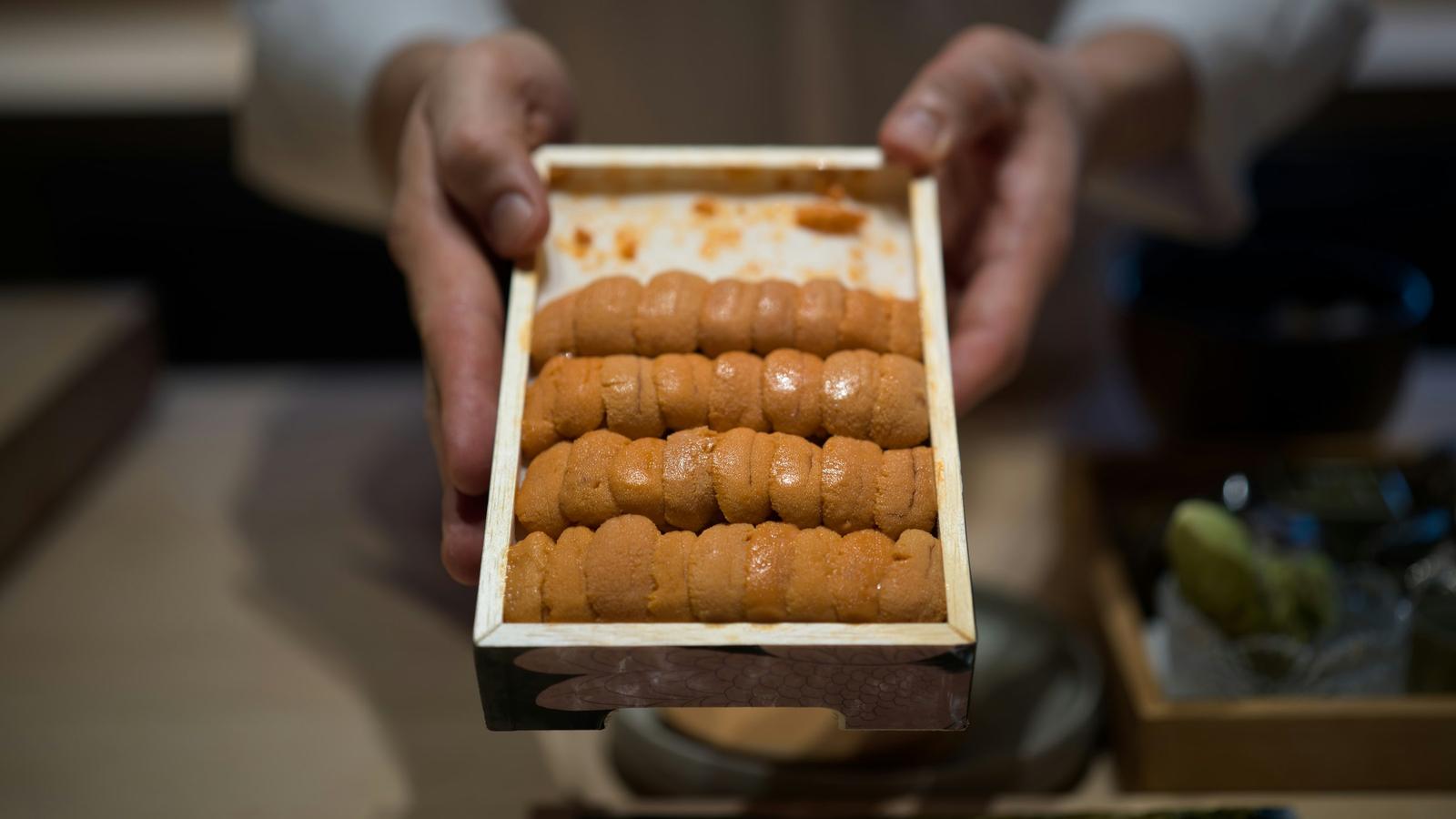
Most of the sea urchin eaten in Japan is imported. Hokkaido's own research institute says so plainly, and puts the island's catch at about 700 tonnes of shelled roe in the 2013 fiscal year. That is the reason to go north for it. In the summer months, on the cliffs of the Shakotan Peninsula and on the islands of Rishiri and Rebun, the urchin is eaten close to the boats that bring it in, from beds of the kelp it feeds on.
This article is about Hokkaido's sea urchin: the two species and how they differ, the summer season in Shakotan, the kelp islands of the far north, the forms in which uni reaches a sushi counter, and where to stay. We read the pages of Hokkaido's fisheries research institute, the prefecture, Shakotan's tourism association and its town fisheries officer, Yamaguchi Prefecture's fisheries centre, a ferry company, two inns, a sushi house, food magazines and the Hokkaido Shimbun on November 5, 2026, and contacted none of them; the sources are listed at the end. For Hokkaido's private baths and the whisky of Yoichi, see Hokkaido in Summer and Winter: Private Baths, Whisky and Powder; for the winter crab of the Sea of Japan, see Snow Crab in Japan.
Key points
- Hokkaido fishes two urchins: the northern purple urchin, kita-murasaki, whose roe is pale and called white, and the ezo-bafun, whose roe is deep orange and called red.
- In Shakotan, the season for fresh urchin runs from June to August. The town's fisheries officer counts about 700,000 visitors in those three months.
- On Rishiri, the fishing cooperative says urchin may be taken for only about three months a year, and the urchin there grows on Rishiri kombu, the kelp used for the clear stocks of Kyoto kaiseki.
- Salt-water uni is roe kept in brine of seawater strength; board uni, laid in rows on a wooden tray, is usually treated with alum to hold its shape.
- The ferry from Wakkanai to Rishiri takes 1 hour 40 minutes, and Shakotan is about 80 km by road from Sapporo.
ASK US TO SHAPE A SUMMER ON HOKKAIDO'S URCHIN COAST →
RED AND WHITE: THE TWO URCHINS OF HOKKAIDO
Hokkaido's fisheries research institute names two species as the island's catch. The kita-murasaki, or northern purple urchin, lives along the Pacific coast from Cape Erimo to Sagami Bay and along the Sea of Japan from Hokkaido to Tsushima. Hokkaido is Japan's largest producer of it, and in the Kanto markets its pale roe is traded at high prices as white uni. Locally it is also known as nona. The ezo-bafun is adapted to colder water; in the cold east of Hokkaido it is almost the only urchin. Its roe is the deep orange that the Shakotan tourism pages call red.
The institute gives Hokkaido's seasons as June to August for the ezo-bafun and March to September for the kita-murasaki, with each district setting its own days. Both are taken from one-man boats with long-handled nets, at depths of one to seven metres for the ezo-bafun and up to twelve for the kita-murasaki. Dancyu, the Japanese food magazine, describes the red as rich and the white as a little lighter. We find guests settle the question most happily by tasting both side by side at one counter.
SHAKOTAN IN SUMMER
The Shakotan Peninsula reaches into the Sea of Japan west of Otaru, with water so clear that the colour has its own name, Shakotan blue. Shakotan's tourism association and the Higashi Shakotan fishing cooperative both give the season for fresh urchin as June to August. The town's fisheries officer, writing in the Ocean Newsletter of the Sasakawa Peace Foundation in May 2026, counts about 700,000 visitors in those months. He also explains why the catch has fallen: the urchins live on hosome kombu, and as the kelp beds thinned, so did the roe. Since 2009 the town has grown a kelp forest of 1.5 hectares, and urchins taken from it carry about one and a half times as much roe as those from the bare ground.
The dish of the peninsula is uni-don, roe laid over rice, sometimes half red and half white. Hokkaido's tourism organisation lists it as a summer speciality. At Misaki, in Hikida, the owner takes the urchin himself and serves it without preservatives, and the shop opens from May to October, 9:45 to 16:00. Fuji Zushi's main shop in Bikuni began as a diner in 1967 and now has five branches across Shakotan, Niseko, Otaru, Susukino and Yoichi. Dancyu quotes a sushi chef in neighbouring Furubira who warns that an inexpensive bowl may be made with urchin from elsewhere, which is one more reason to eat where the boats come in. The tourism association advises weekdays, when the queues are shorter; we plan the drive from Otaru or Niseko to arrive before the lunchtime crowd.
RISHIRI, REBUN AND THE KOMBU
Off Hokkaido's northern tip, the islands of Rishiri and Rebun are the other great urchin coast. The Rishiri fishing cooperative writes that the island's ezo-bafun is counted among the finest in Hokkaido, that its urchins grow on Rishiri kombu, and that to protect the stock, fishing is allowed for only about three months a year. Rishiri kombu itself is the kelp of the clear, fragrant stock used in Kyoto kaiseki, so the urchin on the plate and the dashi of Kyoto's kaiseki kitchens come from the same rocks.
Rebun, the smaller island to the west, lands about 50 tonnes of shelled urchin, close to a fifth of Hokkaido's catch, according to the fisheries research institute. The Hokkaido Shimbun reported in July 2026 that visitors come to Rebun from May to July for its alpine flowers and its ezo-bafun. A summer day on these islands can join a morning among the wild flowers with a lunch of the island's urchin.
SALT WATER, THE BOARD AND THE SUSHI COUNTER
Away from the shore, urchin travels in two forms. Board uni, or ita-uni, is laid in neat rows on a shallow wooden tray. Yamaguchi Prefecture's fisheries centre, in its handling manual for board uni, includes an alum treatment as one step of the process, and the food magazine macaroni explains why: alum holds the soft roe in shape, and it is also the source of the faint bitterness some people taste in uni. Salt-water uni, or ensui-uni, is roe kept in brine of seawater strength, usually without alum, and it reaches the counter closer to how it tasted on the boat. Macaroni notes that some salt-water packs still contain alum, so the label is worth reading. In Hakodate, Uni Murakami builds its menu on uni without alum, as the restaurant guide SAVOR JAPAN records.
For sushi, Otaru lies between Sapporo and Shakotan. Isezushi, a family house founded in 1967, opens at 11:30 for lunch and at 17:00 for dinner, and takes reservations from two months ahead, on the same date, from 11:00. It closes on Wednesdays and on the first three Tuesdays of the month. A summer counter in Otaru, after a morning on the Shakotan coast, is the natural end to an urchin day. Some of Hokkaido's most sought-after counters seat guests only by introduction; we ask on your behalf, and the evening is the house's decision, as described in How to Get Into Introduction-Only Restaurants in Japan.
WHEN TO GO AND WHERE TO STAY
June to August is the window in Shakotan, and the ezo-bafun season across Hokkaido falls in the same three months. Shakotan lies about 80 km from Sapporo, about an hour and forty minutes by car, and is an easy day from an inn in Otaru or from Niseko. The ferry from Wakkanai to Oshidomari on Rishiri takes 1 hour 40 minutes; in the summer timetable of 2026 there were three sailings a day from Wakkanai, and Rishiri also has its own airport, ten minutes by taxi from the port.
For the Shakotan days, Otaru Retreat Kuramure at Asarigawa Onsen gives each of its 19 rooms its own hot spring bath. In Niseko, Zaborin has 15 villas, each with its own indoor and open-air bath, and its kitchen serves Kita Kaiseki, a northern kaiseki by chef Yoshihiro Seno; it is about two hours by car from New Chitose Airport. Within Signature, our planning for journeys of 7 to 21 days, an urchin summer usually takes four to six nights in Hokkaido. We arrange the inns, the drivers, the ferry and the counters, and settle each in the simplest way available, usually on your hotel bill or on the day. Couples will find rooms compared in Hokkaido Honeymoon.
SOURCES AND HOW WE CHECKED
We read the pages below on November 5, 2026. We did not contact any restaurant, inn, fishing cooperative, agency or other body. Fishing seasons are set each year and depend on weather and sea conditions.
- Hokkaido Research Organization, urchin fishery (Japanese): seasons of both species, districts, boats, poles and depths, Rebun's 50 tonnes and share of the catch
- Hokkaido Research Organization, Hokusuishi Dayori 84, 2012 (Japanese): range of the kita-murasaki, Hokkaido as largest producer, white uni in Kanto, the name nona, ezo-bafun in the cold east
- Hokkaido Research Organization, Hokusuishi Dayori 91, 2015 (Japanese): about 700 tonnes of shelled urchin in fiscal 2013, most uni in Japan imported
- Hokkaido Government, Higashi Shakotan fishing cooperative (Japanese): fresh urchin from June to August
- Hokkaido Government, Rishiri fishing cooperative (Japanese): Rishiri ezo-bafun, urchin grown on Rishiri kombu, about three months of fishing a year, kombu in Kyoto kaiseki
- Shakotan Tourism Association, urchin season (Japanese) and weekday advice (Japanese): the season from June to August, weekday visits
- Shakotan Tourism Association, Misaki (Japanese) and Fuji Zushi (Japanese): the owner's own catch, season and hours; 1967, five branches
- Sasakawa Peace Foundation, Ocean Newsletter 605, May 2026 (Japanese): Shakotan town fisheries officer on 700,000 summer visitors, hosome kombu, the 1.5 ha kelp forest and roe yield
- Hokkaido Tourism Organization, Shakotan uni (Japanese): ezo-bafun as red, kita-murasaki as white, the summer uni-don
- dancyu, red and white urchin of Shakotan (Japanese): the taste of each, roadside uni-don, the Furubira chef's warning
- Hokkaido Shimbun, July 24, 2026 (Japanese): visitors to Rebun from May to July for alpine flowers and ezo-bafun
- Yamaguchi Prefecture Fisheries Research Center, board uni handling manual (Japanese): alum treatment in the making of board uni, storage at 10°C or below
- macaroni, salt-water uni (Japanese): salt-water uni in brine of seawater strength, alum in board uni and its bitterness
- SAVOR JAPAN, sea urchin in Hokkaido: Uni Murakami in Hakodate and uni without alum
- Isezushi, Otaru (Japanese): founded 1967, hours, closing days, reservations from two months ahead
- Heart Land Ferry, timetable and Rishiri terminals (Japanese): Wakkanai to Oshidomari in 1 hour 40 minutes, three summer sailings, taxi from Rishiri Airport
- Sapporo Travel, Shakotan feature (Japanese): about 80 km and 1 hour 40 minutes from Sapporo by car
- Otaru Retreat Kuramure, rooms (Japanese): 19 rooms with hot spring baths, Asarigawa Onsen
- Zaborin and access: 15 villas with indoor and open-air baths, Kita Kaiseki, chef Yoshihiro Seno, about two hours from New Chitose
QUESTIONS TRAVELLERS ASK
When is sea urchin season in Hokkaido?
Summer. In Shakotan, fresh urchin is in season from June to August, and Hokkaido's research institute gives June to August for the ezo-bafun across the island. On Rebun, visitors come from May to July.
What is the difference between red and white uni?
Red is the ezo-bafun, with deep orange roe and a rich taste. White is the kita-murasaki, the northern purple urchin, with paler roe and a lighter taste. Some uni-don in Shakotan are served half and half.
Is salt-water uni better than board uni?
It is closer to the taste of the urchin on the boat. Board uni is usually treated with alum to keep its shape, which can leave a faint bitterness; salt-water uni is kept in brine of seawater strength, usually without alum.
How do we reach Rishiri and Rebun?
By ferry from Wakkanai, 1 hour 40 minutes to Oshidomari on Rishiri, or by air to Rishiri's own airport. Rebun is reached by ferry from Wakkanai or from Rishiri.
Can we eat Hokkaido uni outside the summer?
Partly. Hokkaido's research institute gives the kita-murasaki season as March to September, so white uni from Hokkaido can appear in spring and early autumn. The red ezo-bafun is fished from June to August.
ASK US TO SHAPE A SUMMER ON HOKKAIDO'S URCHIN COAST
Tell us when you are coming, who is travelling and how you like to eat. We will set out the coast, the islands, the counters and the inns, with the reasons, so that you can choose.
Begin planning →We reply within 24 hours, in writing
Some of the restaurants and bars we arrange seat guests only by introduction or membership. We ask on your behalf; the table and the evening are the house's decision. We do not publish their names.