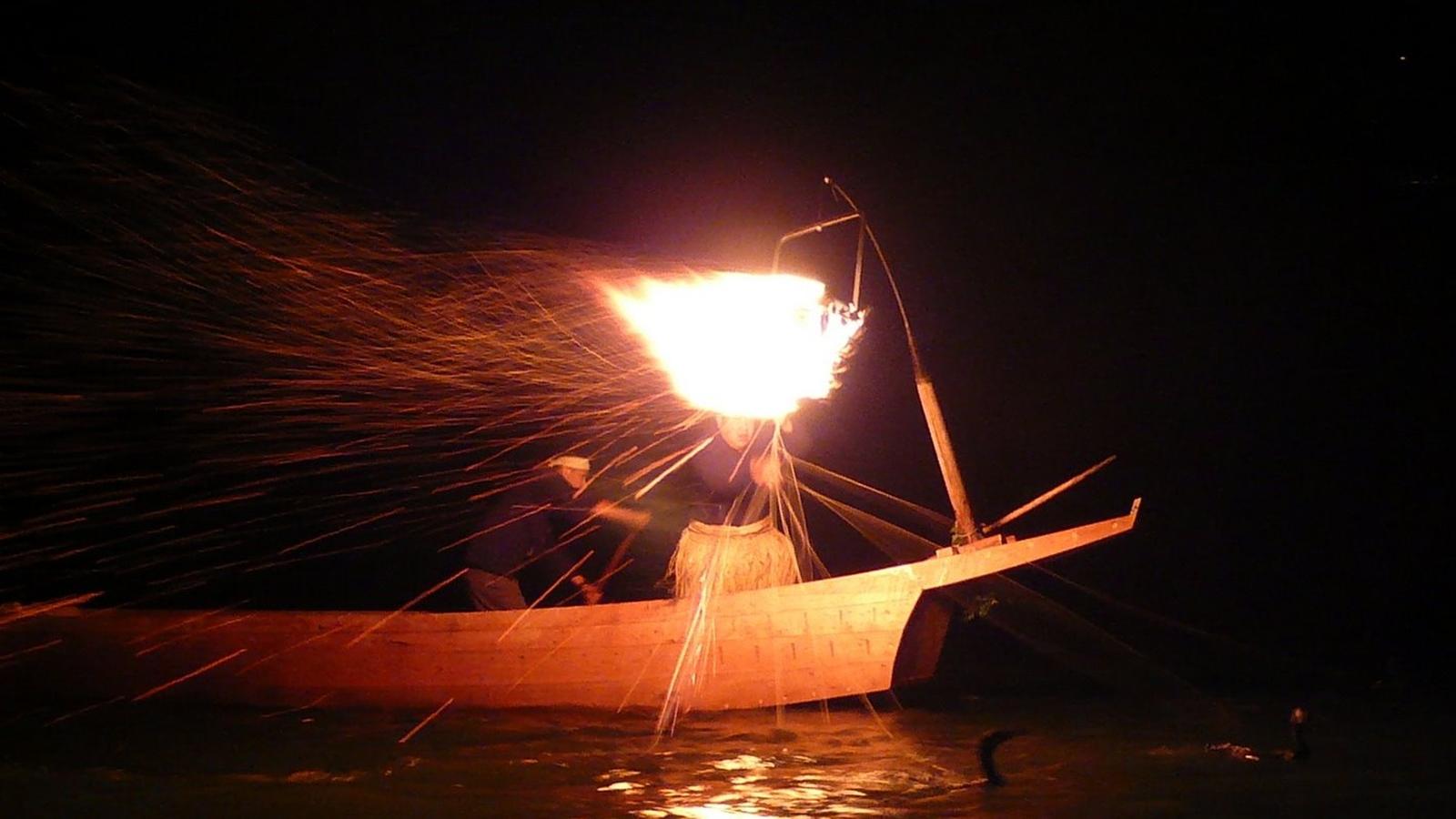
On summer nights in Gifu, a wooden boat comes down the Nagara River with a fire burning at its bow. Beneath the fire a cormorant master works ten to twelve birds on lines, and the birds dive for ayu, the sweetfish of Japan's clear rivers. Gifu City traces the practice on this river back more than 1,300 years, to a register of Mino Province from 702 that names a member of a cormorant-keeping household.
This article is about ukai, cormorant fishing, on four rivers within reach of Kyoto and Nagoya: the Nagara in Gifu, the Oi at Arashiyama, the Uji, and the Kiso at Inuyama. It covers when each river fishes, how the evening runs, where to stay, and the closest view a guest can have. We read the pages of Gifu City and its boat office, the Nagara River Ukai Museum, the boat operators of Arashiyama, Kyoto and Aichi prefectures, the Uji tourist association, a Gifu ryokan, two Kyoto hotels and a newspaper on November 5, 2026, and contacted none of them; the sources are listed at the end. For Uji's tea, which fills the afternoon before the river's evening, see Uji Matcha at the Source.
Key points
- Gifu City gives the Nagara River season as May 11 to October 15. Its six cormorant masters hold a hereditary post, one to a family, and are the only ones in Japan with the title of cormorant master of the Imperial Household Agency's Board of Ceremonies.
- Gifu's boat office keeps three boats for private hire, for ten or fifteen guests. They leave at a time you choose between 17:30 and 19:15, and the fishing begins at about 19:45.
- Kyoto has two rivers of its own: Arashiyama fishes from July 1 to September 23, and Uji fished from July 1 to September 30 in 2026, closed on Wednesdays.
- At Inuyama the boats come down the Kiso River below Inuyama Castle, a National Treasure, and the city employs its cormorant masters as staff, the only city in Japan to do so.
- In 2026 Gifu added GIFU PREMIUM, an evening with dinner on the river and a closer view of each master's fishing, for up to 12 guests on 14 nights from August to October.
ASK US FOR AN EVENING ON THE RIVER →
THE NAGARA RIVER AND ITS MASTERS
Gifu City describes its cormorant masters as the only fishermen in Japan who carry the title of cormorant master of the Board of Ceremonies of the Imperial Household Agency. There are six today. The post passes only to a man born into a cormorant master's house, one to each family. They work with the Japanese cormorant, a sea bird larger and sturdier than the river cormorant. Eight times a season they fish for the Imperial household in a stretch of the river at Nagara Kotsu that is otherwise closed to fishing, and on those nights the evening for visitors begins once the imperial fishing has finished. The technique, carried on at Nagara in Gifu and at Oze in the city of Seki, is an Important Intangible Folk Cultural Property of Japan.
The guests have been remarkable for a long time. Gifu City records that Oda Nobunaga invited an envoy of Takeda Shingen to watch in 1568, that Matsuo Basho came in 1688 and wrote of the boats that they were thrilling and then, soon after, sad, and that Charlie Chaplin watched twice, in 1936 and 1961. The Nagara River Ukai Museum stands in Ukaiya, the quarter where the masters still live, and is the place to spend the late afternoon before the boats.
AN EVENING ON THE NAGARA
The evening follows a fixed shape. At 17:45 a cormorant master explains the fishing at the boat landing, on every night except those of the imperial fishing. The shared boats leave at 18:15, 18:45 and 19:15. At about 19:45 a firework marks the start. Depending on the river, the viewing boats either travel downstream in a line beside a single cormorant boat, or stay moored while the cormorant boats pass one by one. The evening ends with sogarami, when the cormorant boats form a line across the full width of the river and drive the ayu into the shallows together. Guests come ashore at about 20:30.
We would take a private boat. The city's three boats for private hire are named Shiratsuki, for ten guests, and Aiyama and Hanakagari, for fifteen each, with benches along both sides and lighting that can be dimmed. Guests bring their own dinner aboard, and the boat office itself advises arranging a caterer, since few shops stand near the landing. With a private boat you choose when to leave, so the meal on the water can be unhurried before the fire comes down the river.
STAYING BY THE RIVER IN GIFU
Juhachiro, on the bank of the Nagara, has received guests since 1860, when an inn called Yamamotoya took its present name. The inn says the name is said to come from an essay Basho left during his stay in Gifu. A private passage, Ukai Koji, runs from the inn down to the boat landing, which the inn describes as something only Juhachiro offers; it has steps, and the inn arranges another route for wheelchairs. Guests can take dinner aboard, or eat a kaiseki dinner at the inn and board afterwards. For a first evening we prefer the second: dinner without watching the clock, then a short walk to the water.
For 2026 the city added GIFU PREMIUM, an evening that begins with a cruise on the river, a walk through the old streets, and dinner from a Gifu restaurant served on the water, then a special viewing in which guests compare the fishing of each master and see the catch shown when the masters come in. It ran on 14 nights from August 11 to October 9, for up to 12 guests, shared or private. Whether it returns in 2027, and on which nights, is the city's to announce.
ARASHIYAMA AND UJI FROM KYOTO
Arashiyama has fished by firelight since the Heian period; the boat company quotes a poem by Ariwara no Narihira on the fires of the boats beneath Mount Ogura. Arashiyama Tsusen runs the season from July 1 to September 23, with sailings at 19:00 and 20:00 until August 15 and at 18:30 and 19:30 from August 17. Its private boats with dinner seat 8, 15 or 20 for two hours. Two hotels on the river also send guests out: in 2026 Hoshinoya Kyoto offered its own private boat, Hisui, and Suiran paired dinner with an hour on the river at 20:00. For a couple staying in Arashiyama, this is the evening we would place on the night of arrival.
Uji is quieter and starts a little earlier. In 2026 the boats left at 19:00 until August 31 and at 18:30 in September, with the fishing over by about 20:00 in summer. Uji has four cormorant masters, three of them women, and among its birds are the Ucchy cormorants: the first was hatched artificially in 2014, a first in Japan, and nine now work the river. Private boats seat 10, 15 or 20. We pair Uji with a day of tea, so the guests come to the river already in the town.
INUYAMA AND THE KISO RIVER
Aichi Prefecture describes the Kiso River fishing at Inuyama as a tradition of 1,300 years, said to be the oldest in Japan, watched with the lit castle of Inuyama, a National Treasure, rising behind the boats. The viewing boats come right up to the cormorant boats, close enough, the prefecture says, to feel the heat of the fire on your cheek. In 2026 the season ran from June 1 to October 15, and since 2003 Inuyama has also fished by day, which the prefecture says it began ahead of the rest of the country.
The city employs its masters as city staff. In July 2026 it appointed two new masters, the first such hiring in 34 years, after two veterans retired, and the newspaper reported 17,153 passengers in the previous year, second only to the Nagara River. Inuyama is an easy evening from Nagoya, and the castle above the river gives it a setting of its own.
WHEN TO GO AND HOW WE ARRANGE IT
The four seasons overlap from July to September, and Gifu and Inuyama carry on into mid-October, when the evenings are cooler. The boats do not sail when the river runs high after rain, as Gifu City notes, so we keep a second evening free in the plan. Each body publishes its own dates for 2027; Gifu City describes its season as May 11 to October 15, and Arashiyama as July 1 to September 23.
Within Signature, our planning for journeys of 7 to 21 days at USD 3,500 for your group, we arrange the private boat, dinner aboard from an inn or caterer, the car from Kyoto or Nagoya, and the inn by the river. We also ask whether a cormorant master can spend a few minutes with you before the boats leave; that is for the master and the boat office to decide. Each part is settled in the simplest way available, usually on your hotel bill or on the day.
SOURCES AND HOW WE CHECKED
We read the pages below on November 5, 2026. We did not contact any boat office, inn, hotel, museum or other body. Dates for 2027 had not been published for every river when we read them.
- Gifu City, Nagara River cormorant fishing (Japanese): season May 11 to October 15, the title of the Imperial Household Agency's cormorant masters, imperial fishing eight times a season at Nagara Kotsu
- Gifu City, the evening on the river (Japanese): master's talk at 17:45, departures, start at about 19:45, kari-kudari, tsuke-mise and sogarami, ashore at about 20:30
- Gifu City, boats for private hire (Japanese): Shiratsuki for ten, Aiyama and Hanakagari for fifteen, departure between 17:30 and 19:15
- Gifu City, the masters and the birds (Japanese): six masters, hereditary, one to a family, Japanese cormorants
- Gifu City, history (Japanese): the register of 702, Oda Nobunaga in 1568, Basho in 1688, Chaplin in 1936 and 1961
- Gifu City, GIFU PREMIUM (Japanese): introduced in 2026, programme, up to 12 guests, the 14 nights
- Gifu City, dining aboard (Japanese): meals brought aboard, few shops near the landing
- Gifu City, cultural properties (Japanese): Important Intangible Folk Cultural Property, Nagara and Oze, ten to twelve birds
- Nagara River Ukai Museum (Japanese): in Ukaiya, the quarter where the masters live
- Juhachiro (Japanese): founded 1860, the name and Basho, the passage Ukai Koji, dinner aboard or after
- Arashiyama Tsusen (Japanese): season July 1 to September 23, sailing times, private boats with dinner for 8, 15 or 20, the Heian history and Narihira's poem
- Hoshinoya Kyoto, summer (Chinese): private viewing boat Hisui, July 1 to September 23, 2026
- Suiran, a Luxury Collection Hotel, press release (Japanese): 2026 dinner and an hour of ukai at 20:00
- Kyoto Prefecture, events for July 2026 (Japanese): Uji dates, Wednesday closing, times, private boats
- Uji City Tourist Association (Japanese): four masters, three of them women, Ucchy hatched in 2014, nine birds
- Aichi Now, Aichi Prefecture (Japanese): Kiso River season 2026, Inuyama Castle, the boats close to the fire, daytime fishing since 2003
- Akita Sakigake Shimpo, July 1, 2026 (Japanese): Inuyama's two new masters, the first hiring in 34 years, 17,153 passengers
QUESTIONS TRAVELLERS ASK
When is the cormorant fishing season in Japan?
Gifu City gives the Nagara River season as May 11 to October 15. Inuyama ran from June 1 to October 15 in 2026, Arashiyama runs from July 1 to September 23, and Uji ran from July 1 to September 30 in 2026. July to September is when all four overlap.
Can we take a private boat on the Nagara River?
Yes. Gifu's boat office has three boats for private hire, for ten or fifteen guests, which leave at a time chosen between 17:30 and 19:15. Dinner is brought aboard, and we arrange it from an inn or caterer.
Can we meet a cormorant master?
A master explains the fishing at the Gifu landing at 17:45 on most nights. A private moment with a master is something we ask for on your behalf; it is for the master and the boat office to decide.
Gifu or Kyoto for a first evening of ukai?
If you are staying in Arashiyama, its river is the natural evening. For the masters of the Imperial Household Agency, a private boat and an inn on the bank, we would choose the Nagara River in Gifu and give it a night of its own.
What happens if it rains?
The boats do not sail when rain raises the river. We keep a second evening open in the plan for that reason.
ASK US FOR AN EVENING ON THE RIVER
Tell us when you are coming and who is travelling. We will set out which river suits your route, the boat, the dinner and the inn, with the reasons, so that you can choose.
Begin planning →We reply within 24 hours, in writing
Some of the restaurants and bars we arrange seat guests only by introduction or membership. We ask on your behalf; the table and the evening are the house's decision. We do not publish their names.