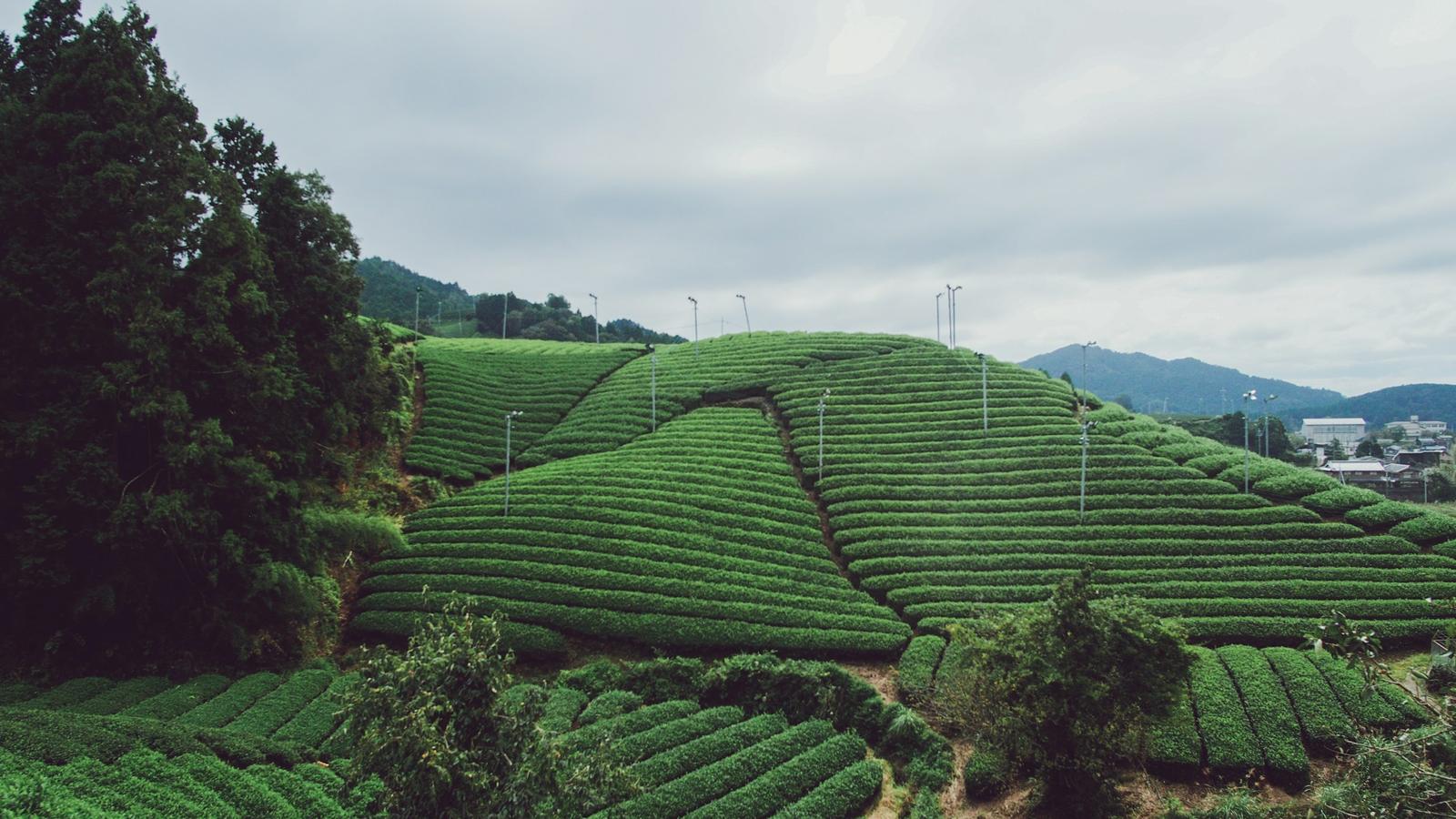
Matcha comes from the hills south of Kyoto, the area once called Yamashiro, where tea has been grown for about eight hundred years. Japan's Agency for Cultural Affairs recognised this tea country as Japan Heritage in 2015 and credits it with three of Japan's great teas: matcha, sencha and gyokuro. In 2025 and 2026 matcha has also become one of Japan's most sought after exports, and supply has struggled to keep up.
Below is how matcha is grown and ground, why it is scarce now, and where to see it at the source: the old tea houses of Uji by the river and the mountain tea fields of Wazuka. We read the Agency for Cultural Affairs, Kyoto Prefecture, Osaka Customs, Uji City's tourist association, the tea houses' and farms' own pages, a Reuters report and a Japanese food industry newspaper on October 31, 2026, and did not contact any tea house; the sources are listed at the end. For tea as a ceremony, see A Private Tea Ceremony in Kyoto, Step by Step →.
Key points
- Matcha is ground from tencha, tea grown under shade for about twenty days or more and dried without rolling, according to Kyoto Prefecture's tea research institute.
- Reuters reported a record ¥8,235 per kg at a Kyoto tencha auction in May 2025, after heat in 2024 cut yields. Osaka Customs counted 6,889 tonnes of powdered green tea exported from January to October 2025.
- In Uji, the city tea room Taihōan serves usucha for ¥1,500, and Kanbayashi Sannyu lets visitors grind matcha on a stone mill for ¥1,650 with sweets.
- In Wazuka, Obubu runs a two-hour matcha factory and tea farm tour in English for up to five people at ¥30,000 each.
ASK US ABOUT A DAY IN TEA COUNTRY →
HOW MATCHA IS MADE
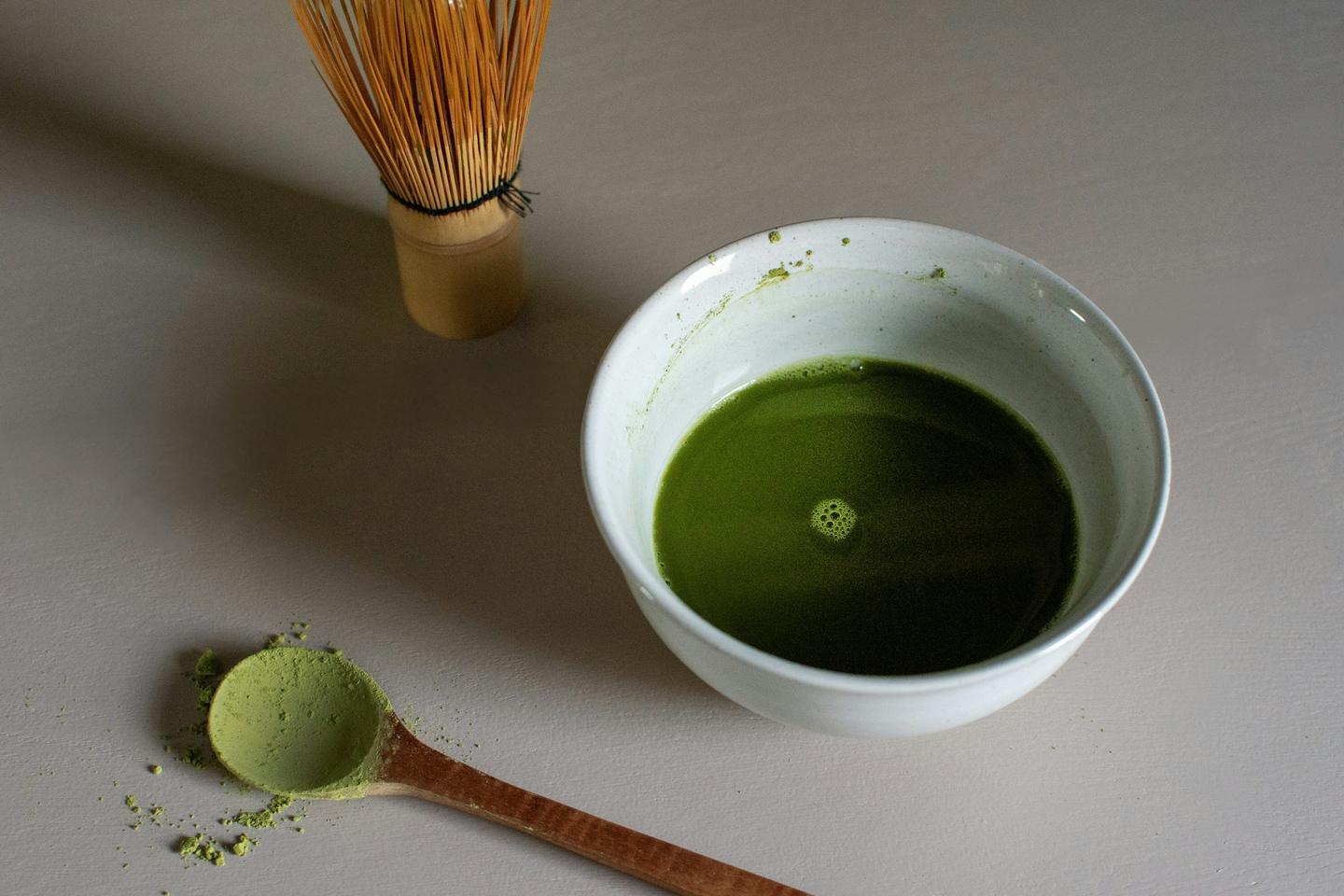
Matcha begins weeks before the harvest, when the tea rows are covered. Kyoto Prefecture's tea research institute defines tencha, the leaf that becomes matcha, as tea picked after about twenty days or more under shade, then steamed and dried. Osaka Customs adds the next step in its December 2025 report: tencha is dried without rolling and ground to a fine powder with a stone mill. Tea ground from any other leaf is sold as powdered tea, and only tencha makes matcha.
The shading is old. The Agency for Cultural Affairs writes that in the sixteenth century Uji growers began covering their fields with screens woven from reeds, at the request of tea masters such as Sen no Rikyū, to soften bitterness and deepen the green. At Shirakawa in Uji, it notes, fields are still covered with natural reed screens. The first leaves of the year are picked in May; the prefecture's tea institute ran its own first flush picking from May 2 to 23 in 2022.
EIGHT HUNDRED YEARS IN SOUTHERN KYOTO
The Japan Heritage story traces Uji tea to the thirteenth century, when the monk Myōe is said to have taught the people of Uji how to plant tea. By the fifteenth century Uji tea was favoured by the Ashikaga shoguns, and later by Oda Nobunaga, Toyotomi Hideyoshi and the Tokugawa. In the eighteenth century Nagatani Sōen, in Yuyadani in Ujitawara, developed the steamed and hand rolled method that produced sencha, and growers later joined shading to that method to make gyokuro.
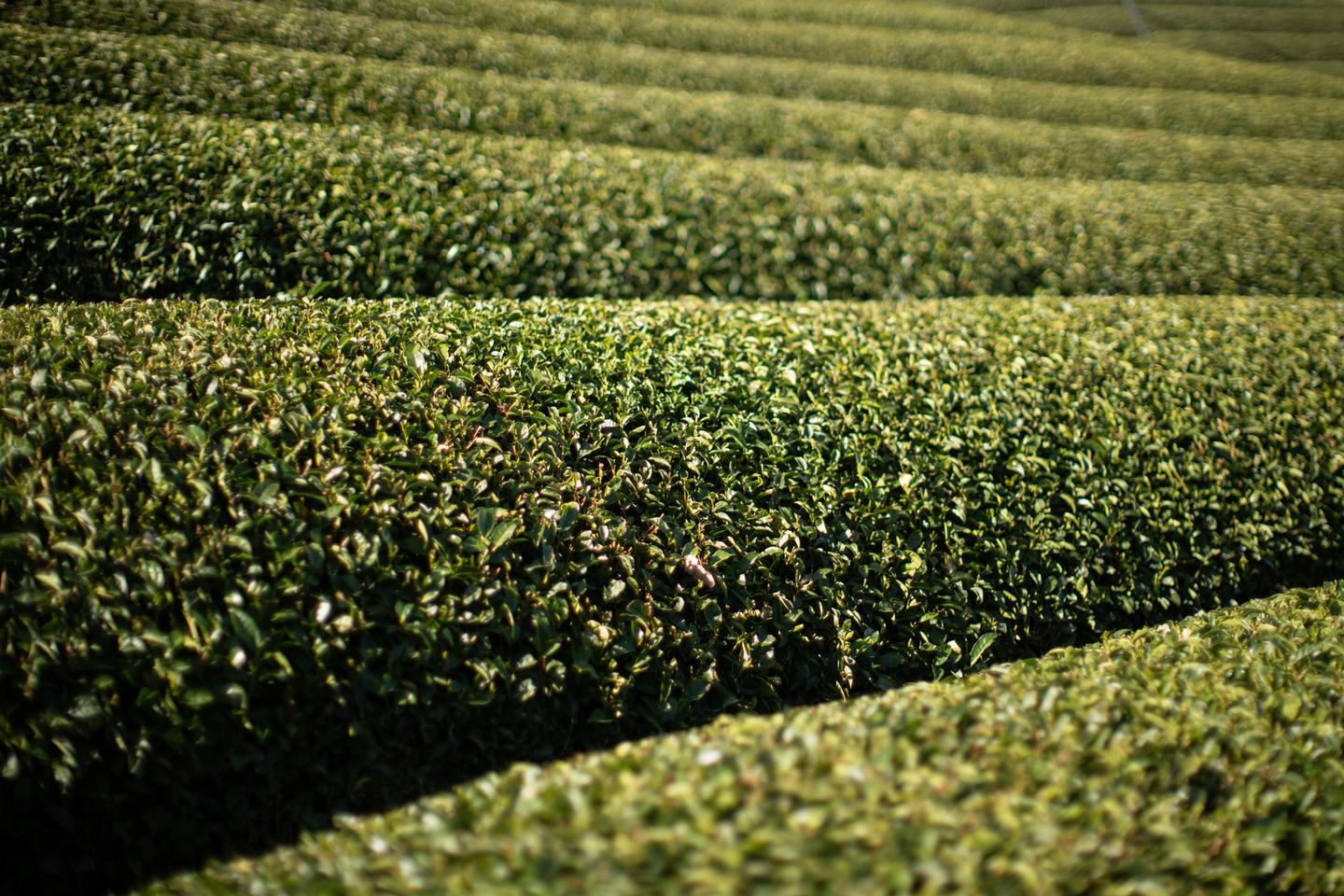
The story ends in the landscape. As demand for sencha grew, farmers in the hills of Wazuka cleared their slopes and planted rows along the contours, creating the mountain tea fields that the heritage listing names, among them the fields of Ishidera. By the Uji Bridge, Tsūen, which the Agency describes as the oldest tea house in Japan, still serves tea from its twenty fourth master.
WHY MATCHA IS SCARCE NOW
Reuters reported from Uji in July 2025 that record heat had curbed matcha output while demand abroad soared. The Kyoto region produces about a quarter of Japan's tencha, and heatwaves in the summer of 2024 weakened the April and May harvest. One sixth generation farmer told Reuters he picked 1.5 tonnes against his usual 2. Japan produced 5,336 tonnes of tencha in 2024, about 2.7 times the figure of a decade earlier, according to the Japanese Tea Production Association, and the Global Japanese Tea Association reported a May 2025 auction price in Kyoto of ¥8,235 per kg, 170 percent higher than a year before. A trader quoted in the report said new fields take about five years to ease supply.
The export figures tell the same story. Osaka Customs reported that Japan's green tea exports reached a record 8,798 tonnes and ¥36.4 billion in 2024, and that from January to October 2025 powdered green tea, which includes matcha, made up more than 80 percent of green tea export value, about double the share a year earlier. The food industry newspaper Nihon Shokuryō Shimbun reported in June 2026 that green tea exports for 2025 reached about ¥72.1 billion, a new record, and that growers in Shizuoka have been switching from sencha to tencha since 2024. For a visitor, the simplest way to taste this year's tea is where it is grown.
UJI: TEA HOUSES BY THE RIVER
Uji is a small town on the Uji River, with Byōdō-in on one bank and tea merchants along its approach. Taihōan, the city's tea room, was built to face the Phoenix Hall of Byōdō-in, which gives it its name. Uji's tourist association lists usucha with a seasonal sweet for ¥1,500, served to walk-in guests in seatings of up to ten, and a matcha preparation lesson for ¥3,600 that must be requested three days ahead. Kyoto Prefecture gives its hours as 10:00 to 16:00, with last entry at 15:30, and notes that it closes on the last day of each month and from December 21 to January 9.
On the Byōdō-in approach, Kanbayashi Sannyu, a family that served tea to the shogunate from the early Edo period, keeps a third floor tea room where guests grind Uji matcha on a stone mill and whisk their own bowl. The house prices the experience at ¥1,650 per person with sweets, or ¥2,200 for one guest alone or for same day requests, and asks for a phone call in advance. Its small museum shows letters from feudal lords, tea jars and Uji stone mills. By the Asagiri Bridge, Fukujuen's Uji tea workshop offers hand rolling and stone mill matcha making from 10:00 to 17:00, and the Uji tea association's Takumi no Yakata teaches how to brew tea from 11:00, closed on Wednesdays. For fees at these two, the prefecture asks visitors to enquire.
WAZUKA: THE MOUNTAIN TEA FIELDS
Wazuka lies in the hills to the south east, a town where tea rows follow the contours of the slopes. Obubu, a farm run by tea growers, offers two tours in English. Its matcha factory and tea farm tour lasts two hours, twice on scheduled days, for up to five guests aged ten and over, at ¥30,000 per person including tax: tea in the fields, a look at the stone milling room in a white coat, and a tasting of seven teas. Its guided tea tour, for up to 18 guests, adds the fields, a sencha factory, lunch and a tasting of nine teas; from December 1, 2026 it is priced at ¥19,800 when arranged at least 30 days ahead, ¥22,000 up to 73 hours before, and ¥27,500 after that.
Closer to Uji, Marukyu Koyamaen's Makishima factory shows a matcha film with an English version, then its factory and tea room, with a taste of freshly ground matcha and a chance to whisk a bowl. Kyoto Prefecture lists tours on Mondays, Tuesdays, Thursdays and Fridays at 10:00 and 13:30 for groups of two to ten.
WHEN TO GO
May is the month of the first flush, when the shaded fields are covered and the open fields of Wazuka are at their brightest green. The tea houses are busiest then. Osaka Customs, in its December 2025 report, points to a quieter season: by old custom the jars of spring tea are opened in November at a ceremony called kuchikiri, and November and December are said to be when matcha tastes best. Obubu runs a shuttle bus from Kyoto Station from March 9 to June 14 and from October 1 to November 30, 2026; at other times a car is the simplest way to reach Wazuka.
A CALM DAY FROM KYOTO
The car leaves Kyoto after breakfast and takes the road south. In Uji, a first bowl at Taihōan facing Byōdō-in, then a slow walk along the approach and an hour at the stone mill. Lunch by the river. In the afternoon the road climbs into Wazuka, where the fields are quiet and a farmer explains the year's harvest over a tasting. On the way back, a stop in Ujitawara at the house of Nagatani Sōen, and Kyoto again by evening, with a tin of the day's matcha in the car.
WHERE STAYGO COMES IN
For a day in tea country we arrange the car and driver from your Kyoto hotel, the tea room seatings, the stone mill hour, the farm tour and lunch, with a guide who speaks your language where the house does not. We ask each house for the quietest hour, and we tell you plainly when a date is already full. When you arrive, the bowls are ready and the day runs at the pace you asked for. We arrange everything in your names, and you pay the tea houses, farms, drivers and guides directly at their own prices, with no commission or markup from us. Trips are planned on the Signature plan, for 7 to 14 days, or as Bespoke for longer or more complex journeys.
SOURCES AND HOW WE CHECKED
We read the pages below on October 31, 2026: the Agency for Cultural Affairs and Kyoto Prefecture for history, cultivation and hours; Osaka Customs for export figures; Uji's tourist association and the tea houses' and farms' own pages for fees and schedules; Reuters and a Japanese food industry newspaper for the market. We did not contact any tea house or farm.
- Agency for Cultural Affairs, Japan Heritage, 800 Years of Japanese Tea (Japanese): Myōe, reed screen shading, Nagatani Sōen, the mountain tea fields of Wazuka, Tsūen
- Kyoto Prefecture tea research institute, monthly report, May 2019 (Japanese): tencha shaded about twenty days or more
- Kyoto Prefecture tea research institute, monthly report, May 2022 (Japanese): first flush picking from May 2 to 23
- Osaka Customs, green tea exports, December 2025 (Japanese): export records, powdered tea share, the definition of matcha, kuchikiri
- Reuters, Japan's heat-stressed matcha tea output struggles to meet soaring global demand, July 2025: Kyoto's share, the 2024 heat, tencha output, the May 2025 auction price
- Nihon Shokuryō Shimbun, green tea special, June 2026 (Japanese): 2025 exports and the shift from sencha to tencha
- Kyoto Prefecture, tea experiences in Yamashiro (Japanese): hours and contacts for Taihōan, Kanbayashi Sannyu, Fukujuen, Takumi no Yakata and Marukyu Koyamaen
- Uji City tourist association, Taihōan (Japanese): the tea menu, fees and booking terms
- Kanbayashi Sannyu, matcha making experience (Japanese): the stone mill, fees and cancellation terms
- Obubu Tea Farms, Matcha Factory and Tea Farm Tour: length, group size, age, language and fee
- Obubu Tea Farms, Guided Tea Tour: the day, group size, pricing from December 1, 2026 and shuttle bus dates
QUESTIONS TRAVELLERS ASK
What is the difference between matcha and other green tea?
Matcha is made from tencha, tea leaves grown under shade, steamed and dried without rolling, then ground to a fine powder, traditionally with a stone mill. Osaka Customs, in its December 2025 report on green tea exports, separates matcha from other powdered tea on exactly this point.
Is there a matcha shortage in Japan?
Supply has been tight. Reuters reported in July 2025 that heat in 2024 reduced the Kyoto harvest while demand abroad kept rising, and that a May 2025 auction in Kyoto reached a record price. Japan's exports of powdered green tea kept growing through 2025, according to Osaka Customs.
When is the best time to visit Uji tea fields?
The first flush is picked in May, when the fields are at their greenest. Osaka Customs also notes the old custom of opening the year's tea jars in November, and calls November and December the season when matcha for the tea ceremony is said to taste best.
Can visitors see matcha being ground?
Yes. Several Uji tea houses offer stone mill experiences, and Obubu in Wazuka runs a two-hour matcha factory and tea farm tour in English. Most need advance notice, and fees and days are set by each house.
How far is Uji from Kyoto?
Uji is a short train ride south of central Kyoto, and Wazuka lies further into the hills to the south east. A car makes it easy to see both in one unhurried day.
ASK US ABOUT A DAY IN TEA COUNTRY
Tell us your Kyoto dates. We will ask the tea houses and farms about a quiet hour at the stone mill and in the fields, and come back with what they were able to confirm.
Begin planning →We reply within 24 hours, in writing
Some of the restaurants, bars and private places we arrange take guests only by introduction or membership. We do not publish their names.