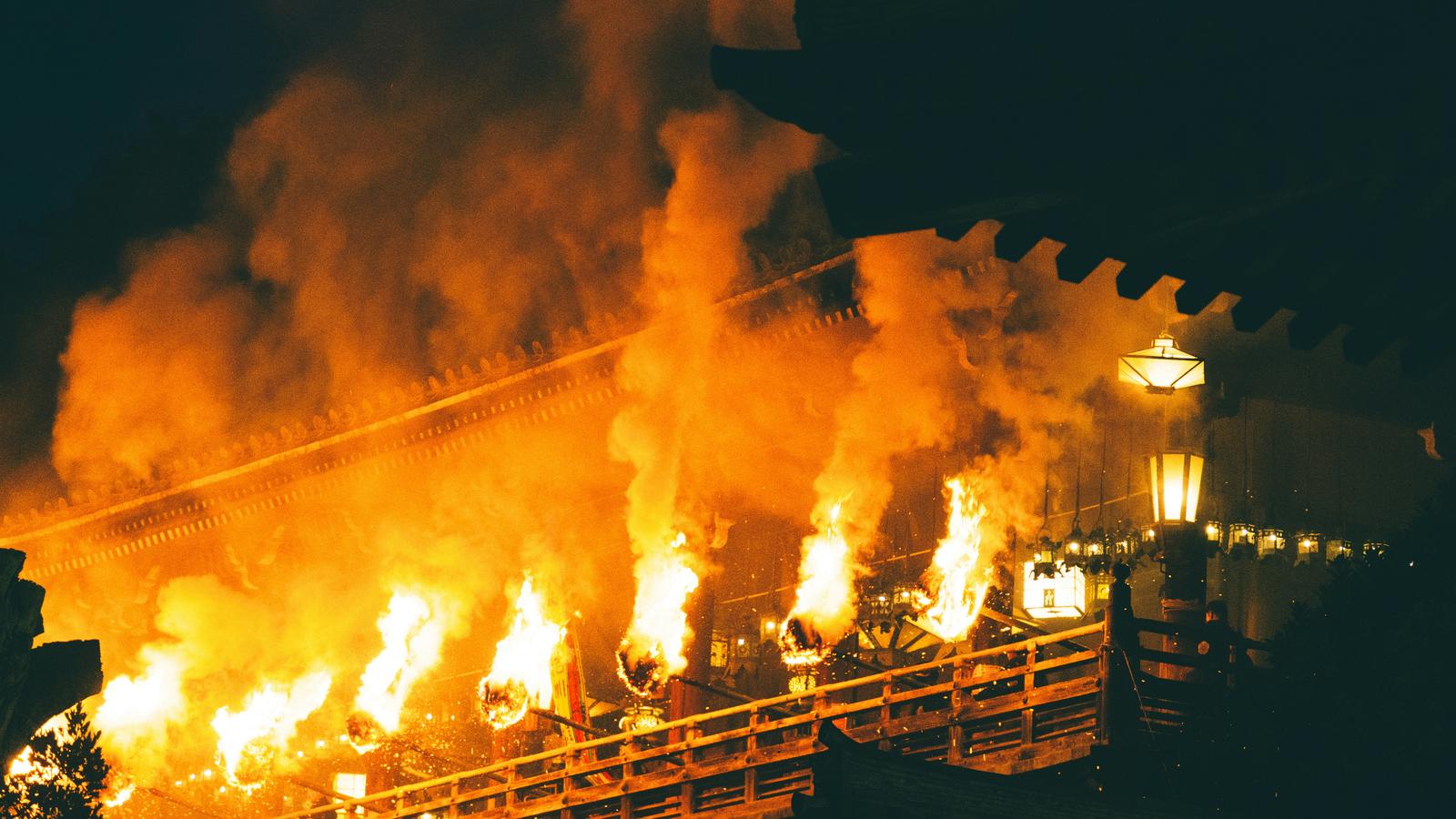
Omizutori is the popular name for Shuni-e, the rite of repentance held every year from March 1 to 14 at Nigatsu-dō, the hall on the hillside of Tōdai-ji in Nara. Each night, burning torches carried up the covered stairway light the monks into the hall: ten torches at about 7 pm on most nights, eleven great basket torches at 7:30 pm on March 12, and a quick run of ten at 6:30 pm on March 14. The water drawing that gives the rite its name takes place in the early hours of March 13, at about 1:30 am. Tōdai-ji dates the rite to 752 and counts 2026 as its 1,275th year without a break. For 2027 the temple had not yet published its times, crowd rules or visiting notice on October 31, 2026; the figures below are the 2026 ones, as a guide to a normal year.
Below are the dates and torch times, what happens on March 12 and 13, how to choose a night, how to listen to the rite from inside the hall, and how to stay in Nara afterwards. We read Tōdai-ji's own pages and its 2026 visiting notice again on October 31, 2026, together with the Nara City Tourism Association, the Japan National Tourism Organization, the Agency for Cultural Affairs, a Japanese encyclopedia, Serai and HugKum magazines, the Mainichi newspaper and the hotels' own pages, and did not contact the temple or anyone else; the sources are listed at the end. For a daytime visit to Tōdai-ji, Kasuga Taisha and the park, see A Day in Nara from Kyoto: Todai-ji, Kasuga Taisha and the Quiet Hours →.
Key points
- Shuni-e runs at Nigatsu-dō from March 1 to 14 every year, with a torch procession every night. The 2027 times and rules were unpublished on October 31, 2026; the 2026 notice came out on February 3.
- In 2026 the torches lit at 7 pm on March 1 to 11 and 13 (ten torches, about 20 minutes), at 7:30 pm on March 12 (eleven basket torches, about 45 minutes) and at 6:30 pm on March 14 (ten torches, about 10 minutes).
- March 12 is the night of the great basket torches and the most crowded. The temple restricts entry, reserves the listening rooms for its supporters' associations, and itself recommends another night.
- The water is drawn from the Wakasa-i well at about 1:30 am on March 13. No one but the monks and their attendants may enter or look into the well house.
- There are no reservations and no saving of places for the torches. Cars and taxis are restricted around the temple during the rite.
WHAT SHUNI-E IS
The formal name of the rite is Jūichimen Keka, repentance before the Eleven-headed Kannon, the hidden image enshrined at Nigatsu-dō. Tōdai-ji explains that it was begun in 752 by Jitchū, a senior disciple of Rōben, the temple's founding abbot, and that when it began it was a rite for the whole country: natural disasters, epidemics and rebellions were seen as illnesses of the state, and the monks prayed to cure them and to bring good harvests and peace. The temple calls it the fu-tai no gyōbō, the rite that does not retreat, and writes that even when most of the great temple was lost, twice, it was never once interrupted. Tōdai-ji counts 2026 as the 1,275th time it has been performed.
Serai, a magazine of Japanese culture, recounts how close it came. After the fire of 1180, which destroyed the Great Buddha Hall, the abbot decided to cancel the next year's rite, and fifteen monks refused and carried it out. The temple burned again in 1567. In 1667 a fire broke out inside Nigatsu-dō itself on the thirteenth day of the rite; the Agency for Cultural Affairs, writing about the Nara National Museum's yearly exhibition, notes that the monks rescued the small Kannon image from the flames and completed the rite the following year. Tōdai-ji's page on the hall says the present building was raised two years after the fire. In 1945, Serai writes, when blackout rules forbade any light at night, the temple hung black curtains inside the hall so that the rite could continue.
The name Shuni-e means the service of the second month, because it once began on the first day of the second month of the old calendar; the hall took its name from the rite. The encyclopedia entry in Kotobank notes that such services were once held at many temples, that most have lapsed, and that those still held were moved a month later when Japan adopted the modern calendar in the Meiji era. The Nara City Tourism Association writes that spring is said to come to Nara once the water has been drawn.
Eleven monks take part, called the rengyōshū. Tōdai-ji names them each year on the morning of December 16, the anniversary of Rōben's death, so the monks for 2027 will be named on December 16, 2026. Their preparation, called bekka, or separate fire, begins on February 20 in a lodging at the Kaidan-in. The temple describes the first part as rehearsing the chant, making paper camellias for the altar and preparing wicks, and the second part, from February 26, as stricter: robes of paper, silence outside set places, and no fire except a brazier lit from a flint. On the afternoon of February 28 the monks move to the lodgings below the hall, and the rite itself begins that night.
THE 2027 DATES AND THE 2026 TIMES
The dates do not move: the main rite is held at Nigatsu-dō from March 1 to 14, and in 2027 those days run from a Monday to a Sunday. What changes from year to year is the visiting notice. On October 31, 2026, the temple's news page had no notice for 2027. The 2026 notice was dated February 3, 2026, so look for the 2027 one in early February. The table gives the 2026 times as Tōdai-ji published them; the temple says they can change on the day.
| Date in March | Torches | Lit at | About | Hall closed to visitors from |
|---|---|---|---|---|
| 1 | 10 | 7:00 pm | to 7:25 pm | 4:45 pm |
| 2 to 6 | 10 | 7:00 pm | to 7:25 pm | 6:00 pm |
| 7 | 10 | 7:00 pm | to 7:25 pm | 6:30 pm |
| 8 to 11 | 10 | 7:00 pm | to 7:25 pm | 6:00 pm |
| 12 | 11 basket torches | 7:30 pm | to 8:10 pm | 4:15 pm |
| 13 | 10 | 7:00 pm | to 7:25 pm | 6:00 pm |
| 14 | 10 | 6:30 pm | to 6:40 pm | 5:30 pm |
The last column is when visitors can no longer go up to the hall itself. The temple explains that during the torches and for a while either side, no one can approach Nigatsu-dō, and that after the torches it takes time, and on some nights the end of a particular ceremony, before visitors are let back in. From then until the next evening's cut-off the hall is open again, and Tōdai-ji's page on Nigatsu-dō says the hall is normally open around the clock.
The torches light the way for the monks. Tōdai-ji writes that on weekdays the great bell is struck at 7 pm as the signal to light them. The tourism association describes torches about seven metres long carried up the covered stairway and then run along the balcony, scattering sparks over the crowd below. The Japan National Tourism Organization notes that the torch photographs on its page are long exposures. The temple notes that weekends are especially crowded, and that on Saturdays and Sundays the police may send visitors to the second viewing area. The open ground below the hall holds about 3,000 people.
MARCH 12 AND THE WATER DRAWING
On March 12 the torches change. Eleven basket torches, kago-taimatsu, are lit at 7:30 pm and the procession lasts about 45 minutes. HugKum, a Shogakukan magazine, gives them as about eight metres long and about 60 kilograms each. The torch wood has its own history: the Mainichi newspaper reported in 2022 that a torch association in Ichinoi, in Nabari in Mie Prefecture, splits hinoki cypress into torch pieces each February, a custom it then counted at 774 years, and the Mie tourism site describes the wood being carried in procession to Nigatsu-dō in March.
Tōdai-ji is direct about this night. Many people, it writes, believe from the news that the torches can be seen only on March 12, so the crowds are very heavy and some visitors will not see them at all. There are traffic restrictions around Nara Park and entry restrictions near the hall, and visitors are asked to follow the police. In its 2026 notice the temple explains that March 12 is traditionally the day of its kōsha, the lay associations that support the rite: they view the torches from their own area and then listen inside the hall, while general visitors watch from the plaza, moving along continuously, for a very short time. The notice ends that paragraph by recommending another day.
Later that night comes the water drawing. Tōdai-ji's page describes it. The monks break off the late-night service, and after 1 am on March 13 a procession leaves the hall, led by a torch, with bonfires and music: the monk in charge of rites, five more monks carrying staffs and conch shells, attendants, and members of the associations carrying offerings and the water buckets. They go down the stone steps, stop to pray at a shrine on the way, and reach the Akai-ya, the well house over the spring called Wakasa-i. No one but those on duty may enter or look in. The water is carried up in three trips, and the service then resumes.
The temple tells the story behind it. When Jitchū first called the gods of the land to the hall, Onyū Myōjin of Wakasa, on the Sea of Japan coast, came late because he had been fishing, and in apology made a spring rise beside the hall, from which a black and a white cormorant flew. One jar in the inner sanctuary holds water added to every year since the rite began, and a little of each year's water, diluted, is later given out at the hall.
MARCH 14 AND THE QUIETER NIGHTS
On the last night the torches are lit earlier, at 6:30 pm, and go up one after another with little gap, so that the whole procession takes about ten minutes. The temple calls this shiri-tsuke taimatsu, and says it is done so that the monks can begin clearing up after the final services. Its torch page describes the ten torches lined up in a row along the balcony rail. It is also expected to be crowded, and in 2027 March 14 falls on a Sunday.
On the other nights the torch procession is the same: ten torches at 7 pm, about twenty minutes. For a first visit, a weeknight early in the fortnight is the calmest choice. In 2027, March 1 to 5 and March 8 to 11 fall on weekdays. The torches are short, and the cold is long: it is a night rite in early March, and the temple asks anyone unsure of their legs or strength to think carefully before coming. HugKum suggests clothes of cotton or wool, which sparks are less likely to melt, a hood or hat, and gloves.
Photographers are asked to keep to the west end of the second viewing area. Tripods, monopods, stepladders and flash are banned around the hall, including the whole of the back approach, and the temple asks that equipment not be left to hold a place. For the setting and the history before you go, the temple recommends the Nara National Museum's exhibition on Omizutori, held each year from mid February to mid March; in 2026 it ran from February 7 to March 15, for ¥700.
LISTENING FROM THE TSUBONE
The torches are the part most people see. The rite itself goes on inside, six times a day, from noon until the monks come down between 1 am and about 4:30 am. Tōdai-ji writes that after their noon meal the monks take no food or even water until they leave the hall. In the evening services they read the register of the gods and the register of the dead, and on certain nights perform the hashiri, running around the inner sanctuary, and the dattan, in which a great torch is swung inside the hall.
Visitors can listen from the tsubone, the side rooms of the hall. On every night except March 12, the temple says, anyone may go in. Its 2026 notice set out how: no phones or other devices, and no photographs, film or recording; no food, drink or smoking; no talking, and no noise; masks recommended, since the rooms become crowded. Bring a bag for your shoes that does not rustle and a folding umbrella in a cover, close the room doors each time, and choose shoes that come off quickly. Boots, the notice says, are unsuited to listening. Space is limited, groups are asked to stay small, and there are nights when the rooms are full.
What reaches the tsubone is mostly sound: the chant and the conch shells, close by in the dark. Tōdai-ji's English page calls the chanting a form of Buddhist music. It is a religious service, and the temple asks travel companies to make sure their guests understand that before they come.
NARA AFTER THE TORCHES
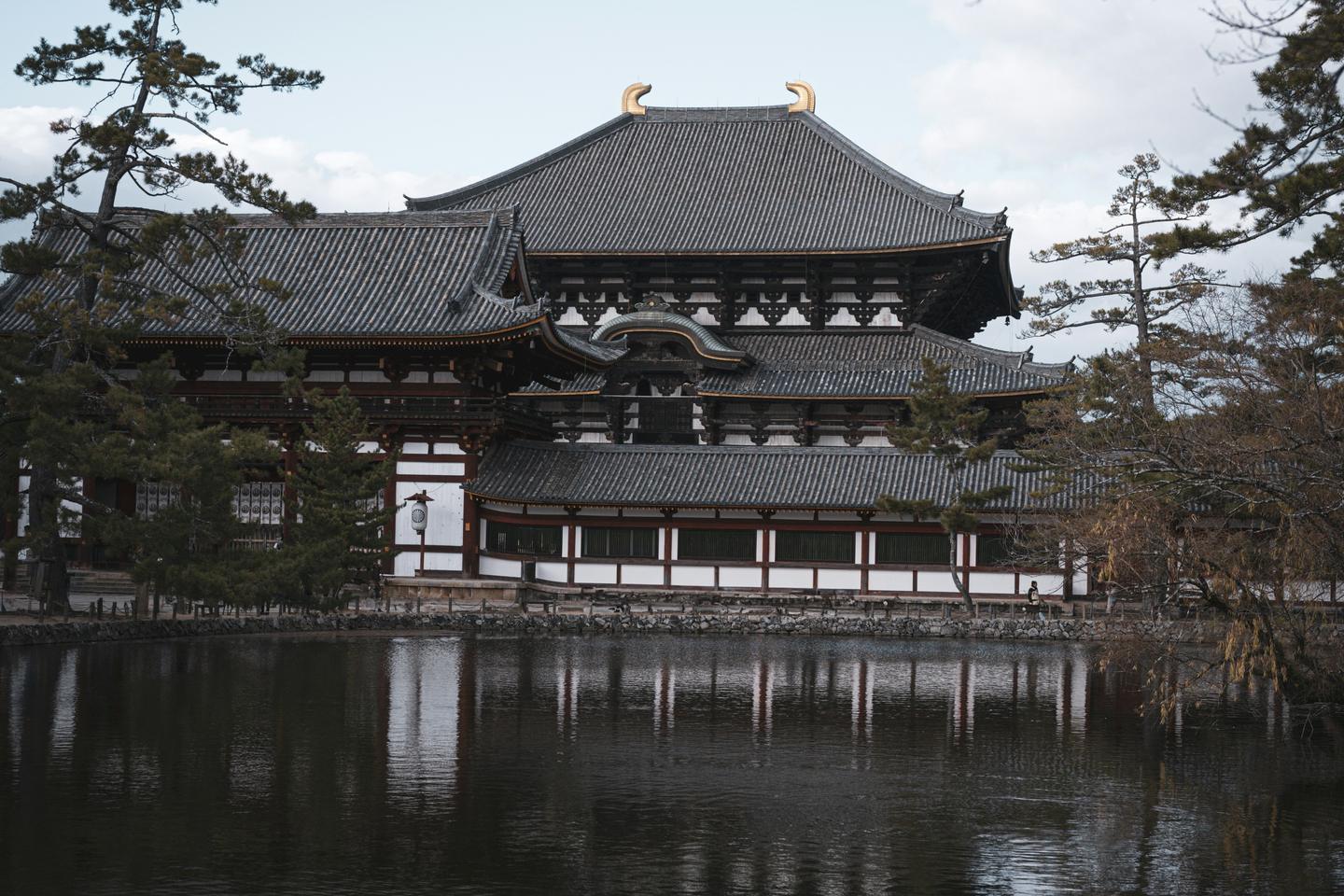
By 7:30 pm on most nights it is over. Staying the night lets you walk back down the hill slowly and come back the next morning, when the hall is open again and the crowds have not yet arrived.
Two hotels stand at the edge of the park. The Nara Hotel, founded in 1909, keeps its wooden main building by Tatsuno Kingo, the architect of Tokyo Station, and has reopened its West Wing. It is about five minutes by taxi from Kintetsu-Nara Station. Dinner in its main dining room, Mikasa, runs from 5:30 pm to 9 pm with last orders at 8 pm, which leaves little time after the 7 pm torches. Shisui, a Luxury Collection Hotel, opened on August 29, 2023 on the western edge of the park, with 43 rooms around a Taishō-era former governor's residence, some with their own hot-spring baths. Its developer, Mori Trust, puts it about 15 minutes on foot or five minutes by taxi from Kintetsu-Nara Station.
From Kyoto or Osaka the trains are simple. Tōdai-ji gives the Kintetsu line as about 40 minutes from Osaka-Namba and about 50 minutes from Kyoto to Kintetsu-Nara, and the station as about 20 minutes on foot from the temple. The tourism association gives a bus ride of seven minutes from the Nara stations and a ten-minute walk from the Daibutsuden stop up to Nigatsu-dō. By road, the temple gives about 60 minutes from the Kyoto-Minami interchange. During the rite, though, the temple restricts private cars and taxis as well, it has no car park, and on March 12 traffic around the park is restricted. A car brings you to the edge of the restricted area, and the last part is on foot, up the hill in the dark.
WHERE STAYGO COMES IN
STAYGO plans private trips across Japan. If your dates include early March, tell us, and we will help you choose a night, usually a weeknight and away from March 12, and plan the evening around it: a driver from Kyoto, Osaka or your Nara hotel to the nearest point cars may reach and back again afterwards, a guide to walk up with you and explain the rite, a room in Nara for the night, and a quiet dinner after the torches. Mikasa at the Nara Hotel takes its last dinner orders at 8 pm, so we ask the restaurant you choose what it can do on your night and tell you plainly what it said. No one can hold a place for the torches or a seat in the tsubone, and we will not suggest otherwise. We arrange everything in your names, and you pay the hotels, restaurants, guides and drivers directly at their own prices, with no commission or markup from us. Trips are planned on the Signature plan, for 7 to 14 days, or as Bespoke for longer or more complex journeys.
SOURCES AND HOW WE CHECKED
We read the pages below on October 31, 2026: Tōdai-ji's own pages and its 2026 visiting notice for the dates, times, rules and the rite itself; tourism bodies, a government magazine and an encyclopedia for background; and two magazines and a newspaper for history and practical detail. We did not contact the temple, the hotels or anyone else. Figures taken from the press are marked as such in the text. The times are those of 2026, published as a guide; the 2027 notice had not appeared on October 31, 2026, and the temple says times can change on the day.
- Tōdai-ji, Shuni-e (Japanese): 752, the 1,275th rite in 2026, the unbroken rite, the water drawing at about 1:30 am on March 13, the yearly schedule from December 16
- Tōdai-ji, torches (Japanese): times, number and length of the torches on each day, crowds on March 12 and weekends
- Tōdai-ji, visiting notice for Shuni-e 2026, February 3, 2026 (Japanese, PDF): hours the hall is closed, March 12, rules in the tsubone, no reservations or saving places
- Tōdai-ji, notes for visitors (Japanese): car and taxi restrictions, the second viewing area, tripods and flash, 3,000 people in the plaza, the tsubone
- Tōdai-ji, Omizutori (Japanese): the procession, the well house, the legend and the sacred water
- Tōdai-ji, glossary of the rite (Japanese): the eleven monks, bekka, the six daily services, the basket torches and the last night
- Tōdai-ji, The Shuni-e Ceremony: the move to the lodgings on February 28 and the chant as Buddhist music
- Tōdai-ji, Nigatsu-dō (Japanese): the fire of 1667, the rebuilding and opening hours
- Tōdai-ji, access (Japanese) and news (Japanese): trains, the drive, parking, and no 2027 notice on October 31, 2026
- Nara City Tourism Association, Shuni-e: the torches on the balcony, the bus and the walk, spring after the water drawing
- Japan National Tourism Organization, Omizutori: the torch photographs as long exposures
- Agency for Cultural Affairs, Bunkaru, on the Nara National Museum's Omizutori exhibition (Japanese): the 1667 fire and the rescued Kannon
- Tokyo Art Beat, Treasures of Tōdaiji's Omizutori Ritual (2026): the museum exhibition's 2026 dates and price
- Kotobank, Shuni-e, from the Heibonsha World Encyclopedia (Japanese): Shuni-e at other temples and the change of calendar
- Serai, Shogakukan, on the history of Omizutori (Japanese): 1180, 1567, 1667 and 1945
- HugKum, Shogakukan, on Omizutori (Japanese): size of the basket torches and what to wear
- Mainichi Shimbun, torch making in Nabari, February 2022 (Japanese, archived): the Ichinoi torches and their 774 years
- Mie Prefecture tourism, the Iga Ichinoi torch offering (Japanese): the torch wood carried to Nigatsu-dō
- Nara Hotel, about the hotel (Japanese), access and Mikasa: 1909, Tatsuno Kingo, the West Wing, taxi time and dinner hours
- Mori Trust, Shisui, a Luxury Collection Hotel, Nara: opening date, 43 rooms, location and baths
QUESTIONS TRAVELLERS ASK
When is Omizutori in 2027?
Shuni-e is held at Nigatsu-dō from March 1 to 14 every year, so in 2027 from Monday, March 1 to Sunday, March 14. Tōdai-ji had not published its 2027 torch times or visiting rules on October 31, 2026. The 2026 notice appeared on February 3, 2026.
What time are the torches?
In 2026 they were lit at 7 pm on March 1 to 11 and 13, for about 20 minutes, at 7:30 pm on March 12, for about 45 minutes, and at 6:30 pm on March 14, for about 10 minutes. The temple says times can change on the day.
Is March 12 the best night to go?
It is the night of the eleven basket torches, and the most crowded. Tōdai-ji restricts entry, keeps the listening rooms for its supporters' associations, and says general visitors see the torches only briefly while moving along. The temple itself recommends another night.
Can I see the water being drawn?
The procession down to the well house passes after 1 am on March 13, with the water drawn at about 1:30 am. No one but the monks and their attendants may enter or look into the well house itself.
Can seats or places be reserved?
No. Tōdai-ji says there are no reservations and no saving of places for the torches, and the listening rooms are open to all on every night except March 12, until they are full.
ASK US ABOUT OMIZUTORI
Send us your March dates and where you will be staying. We will suggest a night for the torches, ask about a driver, a guide, a room in Nara and a table after the torches, and come back with what we were able to confirm.
Begin planning →We reply within 24 hours, in writing
Some of the restaurants, bars and private places we arrange take guests only by introduction or membership. We do not publish their names.