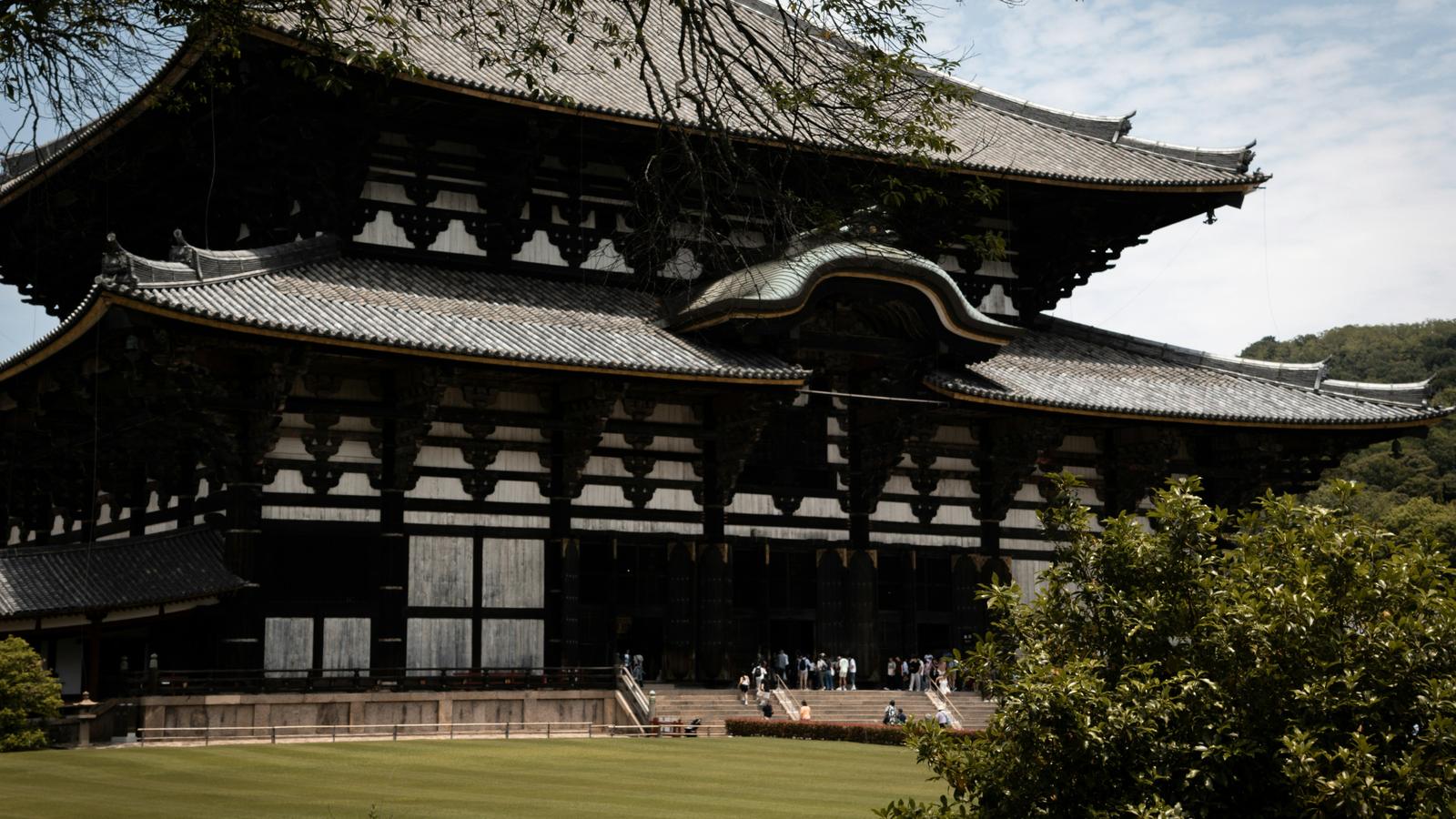
Nara is an easy day from Kyoto: the Kintetsu limited express reaches Kintetsu-Nara in 34 to 39 minutes for ¥1,280 per adult, and the ordinary express takes about 47 minutes for ¥760. Todai-ji's Great Buddha Hall opens at 7:30 from April to October and at 8:00 from November to March, the main sanctuary of Kasuga Taisha opens at 6:30 or 7:00 depending on the month, and both sit in Nara Park among 1,687 wild deer. Arrive before 9:00, lunch in a garden or a hotel dining room, and return to the park in the last hour before closing.
This guide covers the trains and the drive from Kyoto, Todai-ji, Kasuga Taisha, Isuien and Naramachi, the deer rules as Nara Prefecture writes them, hours and fees, three places for lunch, and an order for the day that keeps you ahead of the crowds. We read every rule and price on the official pages on October 28, 2026, and the sources are listed at the end. If Nara sits inside a longer stay in Kyoto, Kyoto in 2026: what's changed covers the city you will return to in the evening.
Key points
- Kintetsu from Kyoto: ¥1,280 by limited express (34 to 39 minutes) or ¥760 by express (about 47 minutes). The sightseeing train Aoniyoshi is ¥1,490 per adult.
- Todai-ji: Great Buddha Hall from 7:30 (April to October) or 8:00 (November to March), ¥800 per adult, cash only.
- Kasuga Taisha: the main sanctuary is free from 6:30 or 7:00; the special inner worship area is ¥700, from 9:00 to 16:00.
- Isuien garden: 9:30 to 16:30, last entry 16:00, closed Tuesdays, ¥1,200 including the Neiraku Museum.
- Deer: feed them only shika senbei, never touch or chase them, take your rubbish home, and keep your distance from the stags in autumn.
LET US ARRANGE YOUR DAY IN NARA →
GETTING THERE FROM KYOTO
For the temples and the park, Kintetsu is the more practical line: Todai-ji gives the walk from Kintetsu-Nara as about 20 minutes, east along Nobori-oji.
Kintetsu
Limited express. On Kintetsu's own route search for a weekday in November 2026, limited expresses from Kyoto reached Kintetsu-Nara in 34 to 39 minutes, either direct or with a change at Yamato-Saidaiji. The fare is ¥760 plus a ¥520 limited express charge, ¥1,280 per adult. Every limited express seat is reserved, and Kintetsu opens seat reservations at 10:30 one month before the day of travel.
Express. The ordinary express needs no reservation and costs only the ¥760 fare. It took 47 to 48 minutes on the same search, with a change at Yamato-Saidaiji.
Aoniyoshi. Kintetsu's sightseeing limited express has twin seats and salon booths for three or four. Kyoto to Kintetsu-Nara is ¥1,490 per adult when two share twin seats or three or four share a booth. It runs only a few times a day and in general not on Thursdays, so the timetable decides your arrival.
JR
JR's Nara Line runs from Kyoto to JR Nara. On JR West's timetable, the Miyakoji Rapid that leaves Kyoto at 10:34 arrives at Nara at 11:21, about 47 minutes. JR Nara is farther from the park; Todai-ji suggests the city loop bus to the Todaiji Daibutsuden Kasuga Taisha-mae stop, five minutes from the temple. We could not read the JR fare on an official page, so we have left it out.
By private car
Todai-ji gives the drive from the Kyoto-Minami interchange of the Meishin Expressway as about 60 minutes via the Keinawa Expressway. The temple has no car park of its own, so a driver drops you and waits nearby. A car suits families, anyone who walks slowly, or a return by way of Uji. Day rates are in what a private driver in Japan costs.
TODAI-JI AND THE GREAT BUDDHA
The Great Buddha Hall, the Daibutsuden, is the temple's main hall. Todai-ji records that it burned in 1180 and 1567, and that the present building, completed in 1709, is about 60 percent of the original width. It is still 57 metres wide and 48.7 metres high, and the temple calls it one of the largest wooden buildings in the world. The bronze Buddha inside is 14.98 metres tall; the eye-opening ceremony was held in 752.
| Hall | Hours | Adult fee |
|---|---|---|
| Great Buddha Hall | 7:30 to 17:30 (Apr to Oct); 8:00 to 17:00 (Nov to Mar) | ¥800 |
| Hokke-do (Sangatsu-do) and Kaidan-do | 8:30 to 16:00 | ¥800 each |
| Todai-ji Museum | 9:30 to 17:30, last entry 17:00 (Apr to Oct); 9:30 to 17:00, last entry 16:30 (Nov to Mar) | ¥800 |
| Great Buddha Hall and Museum set | ¥1,200 | |
| Nigatsu-do | Open 24 hours | No fee listed |
Todai-ji accepts cash only at every hall, and opens every day unless a ceremony or an emergency intervenes.
Nigatsu-do. Up the hill behind the Great Buddha Hall, Nigatsu-do is open around the clock and looks west over the temple roofs and the city. Todai-ji asks for quiet around the hall at night.
The Shosoin exhibition. The 78th Shosoin exhibition at the Nara National Museum runs from October 24 to November 9, 2026, and you should expect more visitors in the park on those days.
KASUGA TAISHA AND ITS LANTERNS
Kasuga Taisha stands at the foot of Mount Mikasa, at the eastern end of Nara Park. The shrine records that its main sanctuary was built in 768 by imperial order, that it is the head shrine of about 3,000 Kasuga shrines across Japan, and that it holds about 3,000 lanterns, offered since the Heian period. The shrine and the Kasugayama Primeval Forest behind it are part of the Historic Monuments of Ancient Nara, a UNESCO World Heritage Site since December 1998.
- Main sanctuary worship area. Free. 6:30 to 17:30 from March to October, 7:00 to 17:00 from November to February.
- Special worship of the inner sanctuary. ¥700, 9:00 to 16:00. It takes you to the Chumon gate and the hanging lanterns of the corridors. It closes for set periods and on many festival mornings, including the 1st, 11th and 21st of each month, so check your date.
- Kokuhoden museum. ¥700 for adults, 10:00 to 17:00, last entry 16:30.
- Manyo Botanical Garden. ¥700 for adults, 9:00 to 16:30, last entry 16:00. Closed on Tuesdays from June to March, and open daily in April and May.
The approach from the park to the shrine is lined with these lanterns, and at 6:30 or 7:00 you share it with few people.
THE DEER AND THE RULES
The deer of Nara Park are a national Natural Monument and wild animals, and Nara Prefecture is clear that they are not kept animals. Its July 2026 count found 411 stags, 990 does and 286 fawns, 1,687 in all. The prefecture and the Nara Deer Preservation Foundation set out the rules.
- Only shika senbei. Feeding deer is forbidden in Nara Park, with one exception: shika senbei, the crackers sold in the park.
- Do not touch, chase or tease them. Give crackers quickly. The prefecture warns that deer charge, butt, bite and kick, and asks that children do not approach them alone.
- Mind the season. Does are protective after giving birth in spring, from about mid May into June. From September to November the stags are in rut and more aggressive.
- Hold on to paper and plastic. Deer will eat maps, leaflets and plastic bags, and some have died from it. There are no rubbish bins in Nara Park, so take everything home.
ISUIEN AND NARAMACHI
Isuien. A garden designated as a national Place of Scenic Beauty, next to Todai-ji on its western side and about 15 minutes on foot from Kintetsu-Nara. It joins two strolling gardens of different ages: the enclosed front garden, laid out in the 1670s, and the Meiji-era rear garden, which borrows Wakakusa-yama, Mount Mikasa and the Nandaimon gate of Todai-ji as its backdrop. The ticket includes the Neiraku Museum, which shows Chinese bronzes, Korean ceramics and Japanese tea utensils collected by the Nakamura family.
- Hours. 9:30 to 16:30, last entry 16:00. In April and May, 9:30 to 17:00, last entry 16:30.
- Closed. Tuesdays (the next weekday when Tuesday is a holiday), from late December to mid January, and in late September for garden work.
- Fee. ¥1,200 for adults. The garden cannot be visited in a wheelchair.
Naramachi. The old town of Nara, with lanes of traditional wooden townhouses. Naramachi Koshi-no-ie, a reconstructed townhouse run by the city, is free, open 9:00 to 17:00, closed on Mondays (the next day when Monday is a holiday) and on the day after a public holiday, and about 20 minutes on foot from Kintetsu-Nara. Gango-ji, a World Heritage temple, is in the same quarter, about 15 minutes on foot from Kintetsu-Nara.
WHERE TO HAVE LUNCH
Three places in or beside the park, each with its menu on its own page.
- Sanshu at Isuien. Meals are served in Sanshu-tei, an Edo-period house moved into the front garden, looking out over it. The menu centres on mugitoro, barley rice with grated yam, at ¥2,200, with an eel and yam set at ¥4,200 and matcha at ¥1,200. Isuien notes that Sanshu keeps different days and hours from the garden, so we confirm them for your date.
- Kasuga Ninai Jyaya. The shrine's own teahouse beside the Manyo Botanical Garden, open 10:30 to 16:30 (last order 16:00). Its signature is Manyo-gayu, a rice porridge in kombu stock and Nara white miso with seasonal vegetables that change almost monthly, at ¥1,200; the Yamato set, with persimmon-leaf sushi and kuzu-mochi, is ¥1,700.
- Mikasa at the Nara Hotel. The hotel's main dining room serves French cuisine and keeps the courses of its past chefs. Lunch runs 11:30 to 15:00, last order 14:00, with courses from ¥6,000 to ¥11,000 including tax and a 15% service charge.
THE QUIET HOURS: A DAY IN ORDER
In our experience Nara Park fills from mid morning, as day visitors arrive from Kyoto and Osaka, and thins again from mid afternoon. This order uses the November hours.
| Time | Where |
|---|---|
| 7:00 | Leave Kyoto by car, or take an early limited express |
| 8:00 | Great Buddha Hall at opening |
| 9:00 | Nigatsu-do, then the lantern path to Kasuga Taisha; inner sanctuary from 9:00 where open |
| 11:30 | Lunch at Ninai Jyaya, Sanshu or the Nara Hotel |
| 13:00 | Isuien garden and the Neiraku Museum |
| 14:30 | Naramachi and Koshi-no-ie |
| 16:00 | Back to the park as it empties; Nigatsu-do at dusk |
From April to October the Great Buddha Hall opens at 7:30 and the Kasuga main sanctuary at 6:30, so the same plan can start half an hour earlier. For the wider approach, see how to avoid the crowds in Japan.
Staying the night. A night in Nara gives you the park at dusk and the Great Buddha Hall at opening without an early train.
HOW WE ARRANGE A DAY IN NARA
We plan the day around the hours above and arrange the parts in your name.
- The route and the timing. We check the Kasuga inner sanctuary calendar, the Isuien closing days and the Aoniyoshi timetable for your date, and set the order of the day around them.
- Lunch. We arrange the table at the Nara Hotel, or confirm Sanshu's hours for your day, with any dietary needs written in Japanese.
- A guide. A licensed guide for Todai-ji and Kasuga Taisha; rates are in what a private guide in Japan costs.
- A car. We arrange a driver from your Kyoto hotel and back, with Uji or Byodo-in on the return if you wish. You buy your own train tickets if you prefer the rail.
SOURCES AND HOW WE CHECKED
- Kintetsu Railway, route and fare search: times, fare and charge for November 10, 2026
- Kintetsu Railway, Aoniyoshi: seats, price, Thursdays, booking from one month before
- JR West, Miyakoji Rapid timetable: Kyoto 10:34 to Nara 11:21
- Todai-ji, hours and fees: hours, fees, cash only
- Todai-ji, Great Buddha Hall: dimensions and history
- Todai-ji, Nigatsu-do: open 24 hours
- Todai-ji, access: walk, bus, drive, parking
- Kasuga Taisha, basic information: hours, fees, closures
- Kasuga Taisha, history and English page: history, lanterns
- Kasuga Ninai Jyaya and menu: hours and prices
- Nara Prefecture, how to treat the deer: the rules
- Nara Prefecture, the deer of Nara Park: July 2026 count
- Nara Deer Preservation Foundation: seasons
- Isuien, visitor information: hours, fee, access
- Isuien, Sanshu: menu and prices
- Nara City, Naramachi Koshi-no-ie: hours, entry
- Gango-ji: World Heritage temple in Naramachi
- Nara National Museum: 78th Shosoin exhibition dates
- Nara Hotel, Mikasa: lunch courses and hours
QUESTIONS GUESTS ASK
How long does it take to get from Kyoto to Nara?
On Kintetsu's route search, the limited express took 34 to 39 minutes from Kyoto to Kintetsu-Nara for ¥1,280, and the ordinary express about 47 minutes for ¥760. JR takes about 47 minutes, and the drive about 60 minutes.
Is one day enough for Nara?
One day covers Todai-ji, Kasuga Taisha, Isuien and a walk through Naramachi at an easy pace if you arrive before 9:00. A night in Nara adds the park at dusk and an unhurried start at the Great Buddha Hall.
How much does it cost to enter Todai-ji and Kasuga Taisha?
On October 28, 2026, the Great Buddha Hall was ¥800 per adult, cash only, with a hall and museum set ticket at ¥1,200. The main sanctuary of Kasuga Taisha is free, and the special inner worship area is ¥700.
Is it safe to feed the deer in Nara?
Feed them only shika senbei, the crackers sold in the park, and hand them over quickly. Nara Prefecture warns that deer can charge, bite and kick, especially does in spring and stags in autumn, so do not touch or chase them.
What is the best time of day to visit Nara?
Early morning and late afternoon. The Great Buddha Hall opens at 7:30 or 8:00 depending on the season, and Kasuga Taisha's main sanctuary at 6:30 or 7:00.
LET US ARRANGE YOUR DAY IN NARA
Send us your dates, where you are staying in Kyoto, and how you like to travel. We will come back with an order for the day that fits the opening hours on your date, a lunch table, and a guide or driver if you wish, and we arrange the parts you choose.
Begin planning →We reply within 24 hours, in writing