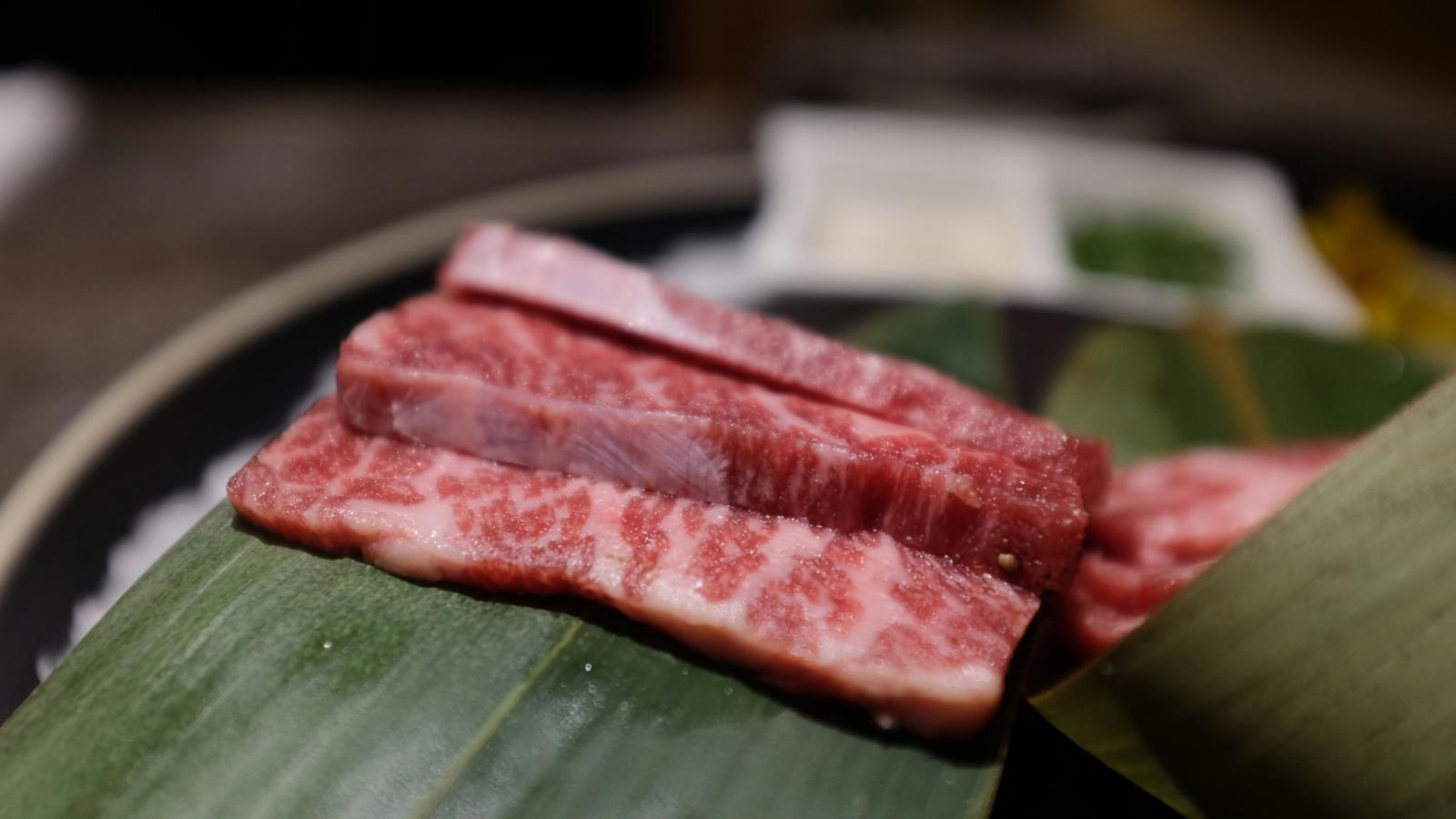
Kobe is the name most visitors know. Inside Japan the talk of beef is wider, and many of the oldest houses are in provincial towns: Matsusaka in Mie, the plain east of Lake Biwa, Yonezawa in the snow country of Yamagata, and Takayama in the mountains of Gifu.
This article sets out what each name means, how it is eaten at its source, and the long-established houses where we would take a guest. We read the pages of the producers' councils, Japan's Ministry of Agriculture, Forestry and Fisheries, five restaurants, TableCheck and National Geographic on November 5, 2026, and contacted none of them; the sources are listed at the end. For the Kobe rules, grading and teppanyaki, see Authentic Kobe Beef.
Key points
- Matsusaka beef comes only from Japanese Black heifers registered on the council's own system, which keeps 36 items of data for each animal.
- Wadakin in Matsusaka, founded in 1878, raises its own cattle and cooks sukiyaki at the table over oak charcoal, from ¥15,500 per person plus 10% service.
- Omi beef traces its trade back about 400 years. Morishima, whose founders opened a beef-pot restaurant in Tokyo in 1879, is about 40 minutes from Kyoto Station.
- Yonezawa beef must come from a heifer at least 33 months old. Tokiwa, the oldest beef shop still trading in Yonezawa, opened in 1894.
- Hida beef carries a label with its grade, producer and the 10-digit ID of the animal.
ASK US TO PLACE A WAGYU TABLE ON YOUR ROUTE →
MATSUSAKA AND THE RECORD OF EVERY ANIMAL
The Matsusaka Beef Council defines its beef by where and how the animal is raised. Farmers choose calves from breeding areas across Japan, bring them into 22 former municipalities around Matsusaka by about 12 months of age, and register them on the council's identification system. Only virgin Japanese Black heifers qualify, fattened only within the area, which must be the longest and last place they lived.
Staff of the local meat corporation visit each farm to confirm every animal, its 10-digit ID and its feed, and the record grows to 36 items, from birthplace to days of fattening. In a shop the beef carries a seal in thick red characters with the ID, the farmer's name and a grade such as Tokusan, A5 or A4; the number can be looked up online. The top category, Tokusan, is fattened for 900 days or more from heifer calves bought in Hyogo, and it is rare: 239 of the 6,951 Matsusaka cattle shipped in fiscal 2014, by the ministry's register.
WADAKIN AND THE SUKIYAKI OF MATSUSAKA
Wadakin opened as a beef shop in 1878 and has served from its address in Nakamachi since 1901. It raises Tajima heifer calves from Hyogo on its own farm in Ureshino, about a thousand head, and never freezes the beef.
The meal is the reason to make the journey. A nakai, the attendant who stays with your room, lights oak charcoal under a heavy Nanbu iron pan and cooks thick, flat-cut slices one at a time with sugar, tamari soy and a little kombu stock. Guests never touch the pan. Wadakin's history says its founder is thought to have moved Matsusaka from beef stewed in miso to this flat-cut sukiyaki. The three sukiyaki courses, ¥15,500, ¥18,800 and ¥21,200, all use loin; sirloin steak sets run to ¥32,500, with 10% service.
Matsusaka also grills. Isshobin, founded in 1962, cooks the beef over a mesh with its own miso sauce. We would place Wadakin at dinner and the grill at lunch, if the day allows.
OMI BEEF AND THE OLDEST NAME
Omi beef was registered as a Geographical Indication in 2017. The rule is short: a Japanese Black animal raised longest and last in Shiga, fed mainly on rice straw from the middle of fattening. The ministry's register traces the trade back about 400 years, to the Edo period, when the Hikone domain alone was permitted to produce beef and sent it, pickled in miso, to the shogun as medicine.
Morishima carries that history. Its founders walked cattle from Shiga to Tokyo and opened Yone-Kyu, a beef-pot restaurant in Asakusa, in 1879. In 1978 the family opened its restaurant in Omihachiman, supplied by its own farm in Ryuo, where cattle of Tajima ancestry are raised for more than two years. Sukiyaki or shabu-shabu costs ¥11,400 or ¥14,700. The house dish since opening is ishiyaki, thick steaks you grill yourself on a heated plate of stone from Mount Fuji. It closes on Wednesdays and is about 30 minutes by JR from Kyoto Station, then ten by taxi: an easy lunch from a Kyoto stay.
YONEZAWA AND THE SNOW CELLAR
Yonezawa beef must be a Japanese Black heifer, at least 33 months old at slaughter, raised longest and last in eight municipalities of the Okitama area, and graded 3 or above for quality. The register dates the name to 1875, when Charles Henry Dallas, a British teacher at the former domain school, took an animal to the foreign settlement in Yokohama and the beef was praised.
Tokiwa opened in October 1894 and is the oldest beef shop still trading in Yonezawa. Its history says that in the early years beef was sold only from autumn until about June, as long as the snow packed into its cellar lasted. The dining room upstairs serves sukiyaki, shabu-shabu and steak, and National Geographic, writing on Yamagata for 2026, notes that one family has run it for five generations.
HIDA BEEF IN TAKAYAMA
The Hida Beef Brand Promotion Council certifies an animal only when Gifu was the place it lived longest, a registered farmer fattened it, it is a Japanese Black fattened for at least 14 months, and it was graded 5, 4 or 3 for quality. Each carcass receives a label with the grade, the producer and the 10-digit ID. About 10,000 animals a year are certified, and the council lists its designated restaurants.
In Takayama we would choose Kitchen Hida, on that list. Its own method, braise and sauté, steams the steak in the moisture of aromatic vegetables before searing it, to suit the fine fat of Hida beef, and the sauce is finished with moromi soy. A5 sirloin runs from ¥6,325 for 120 grams to ¥15,235 for 300. For the town's carpenters and lacquer, see Takayama and the Woodcraft of Hida.
CHOOSING AND HOW WE ARRANGE IT
If there is room for one of these meals, we would suggest Wadakin: it joins a record kept on every animal to a sukiyaki cooked for you over charcoal where it began, and Matsusaka lies on the way to Ise-Shima. Omi suits a Kyoto stay, Hida a mountain week, and Yonezawa a winter journey north.
Within Signature, our planning for journeys of 7 to 21 days, we arrange the table, the car and the timing around the rest of the trip, and the meal is settled on your hotel bill or on the day, in the simplest way available.
SOURCES AND HOW WE CHECKED
We read the pages below on November 5, 2026. We did not contact any restaurant, council or ministry. Prices are per person as published by each restaurant; Wadakin's include tax.
- Matsusaka Beef Council, definition (Japanese): the definition and farm checks
- Matsusaka Beef Council, identification system (Japanese): 36 items, the seal, the online lookup
- Matsusaka Beef Council, Tokusan (Japanese): Hyogo calves, 900 days or more
- Ministry of Agriculture, GI No. 25 (Japanese): 6,951 shipped and 239 Tokusan in fiscal 2014
- Wadakin, history (Japanese): 1878, Nakamachi since 1901, the farm in Ureshino
- Wadakin, quality (Japanese): Tajima heifers, about 1,000 head, never frozen
- Wadakin, sukiyaki (Japanese): the charcoal pan, the nakai, prices
- Isshobin (Japanese): founded 1962, mesh grilling, miso sauce
- Ministry of Agriculture, GI No. 56, Omi beef (Japanese): definition and history
- Morishima, history: 1879, own farm, ishiyaki, access
- Morishima, menu (Japanese): sukiyaki and shabu-shabu prices
- Ministry of Agriculture, GI No. 26, Yonezawa beef (Japanese): the definition, Dallas in 1875
- Tokiwa, history (Japanese): October 1894, the snow cellar
- TableCheck, Tokiwa (Japanese): the dining room upstairs and its hours
- National Geographic, Yamagata: Tokiwa and its five generations
- Hida Beef Brand Promotion Council (Japanese): the definition, label and restaurant list
- Ministry of Agriculture, GI No. 126, Hida beef (Japanese): about 10,000 certified a year
- Kitchen Hida (Japanese): braise and sauté, sirloin prices
QUESTIONS TRAVELLERS ASK
Is Matsusaka beef the same as Kobe beef?
No. They are certified under separate rules in separate prefectures. Matsusaka beef is always a heifer, raised around Matsusaka and tracked on its own system.
How can we check the beef is genuine?
Ask for the 10-digit ID on the certificate or label and look it up online. We ask the restaurant beforehand to show the certificate at the table.
Can we combine these with Kyoto?
Omi is the easiest: Morishima is about 30 minutes from Kyoto Station by JR, then ten by taxi. Matsusaka pairs well with a stay in Ise-Shima.
How should we eat Matsusaka beef?
At its source, as sukiyaki. At Wadakin an attendant cooks thick slices over charcoal, one at a time, and you simply eat.
ASK US TO PLACE A WAGYU TABLE ON YOUR ROUTE
Tell us where and when you are travelling. We will suggest the town and the house that suit your days, with the reasons.
Begin planning →We reply within 24 hours, in writing
Some of the restaurants and bars we arrange seat guests only by introduction or membership. We ask on your behalf; the table and the evening are the house's decision. We do not publish their names.