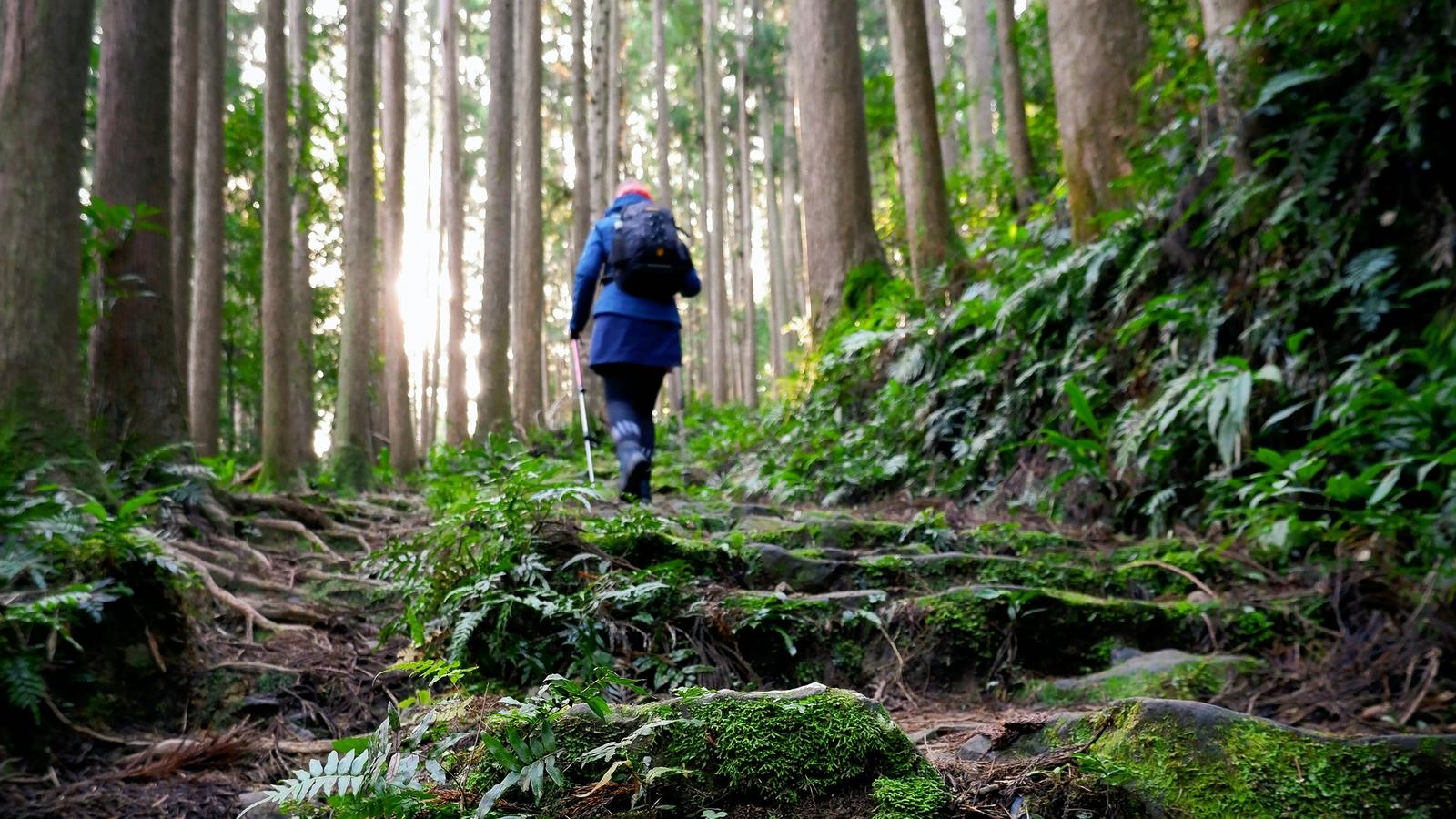
Anyone who has arrived on foot in the Praza do Obradoiro knows the question that follows a few months later: where next. For many who have walked the Camino, the answer is a mountain route in Wakayama. The Kumano Kodo and the Way of St. James are the two pilgrimage routes that the city of Tanabe and Santiago de Compostela have tied together by formal agreement, and walkers who finish both can register as Dual Pilgrims.
This article sets out the Nakahechi as a walk of several days for those who already know the Camino. We read the pages of the Tanabe City Kumano Tourism Bureau, the shrines, the inns, the airport, Japan's tourism agencies and Spanish sources, and contacted none of them; the sources are at the end. A shorter visit, with a night on Koyasan and a half-day walk into Hongu, is described in Koyasan and the Kumano Kodo: a temple night, the Nakahechi and Nachi →.
Key points
- The Dual Pilgrim programme began on February 1, 2015. By September 30, 2026, 18,331 people from 85 countries and regions had registered, 1,136 of them from Spain, the sixth largest group.
- On the Kumano side the classic qualifying walk is Takijiri-oji to Kumano Hongu Taisha, about 38 km, and only walking counts.
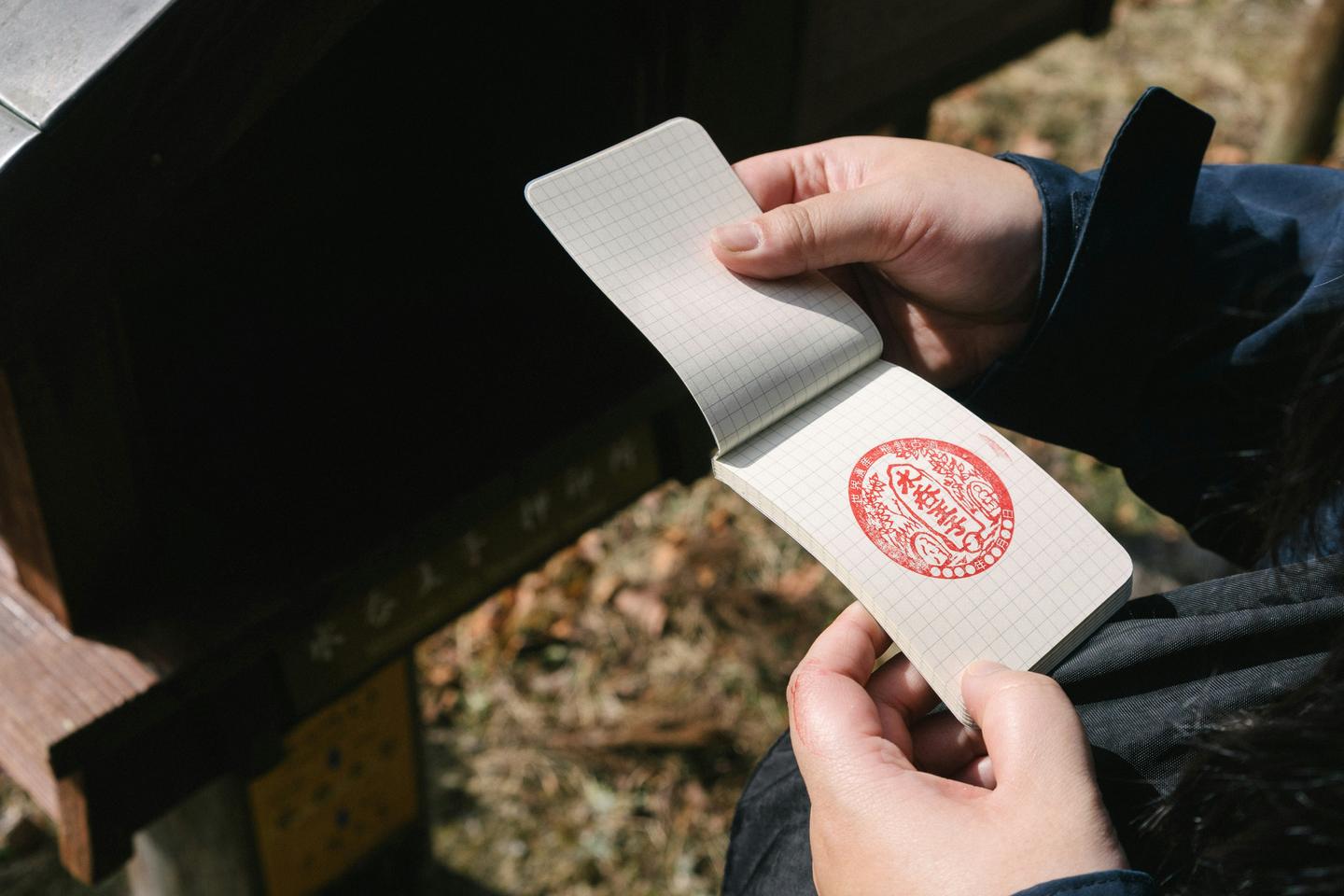
- The credential is free. Stamps wait in small wooden boxes shaped like shrines along the trail, and on the Nakahechi they are printed in red.
- The bureau splits Takijiri to Hongu into two days: about 16 km to Chikatsuyu, then about 24.5 km to Hongu. Two more days continue over the mountains to Nachi.
- Spring and autumn are the walking seasons. Summer is hot, humid and wet, and from late December to late February frost and snow are possible.
LET US SHAPE YOUR WALK TO HONGU →
WHAT THE DUAL PILGRIM ASKS OF YOU
The bureau dates the tie between the two routes to a protocol signed on October 27, 2008 to promote them together, followed by a Tourism Partnership Cities agreement signed in Santiago on May 13, 2014 and in Tanabe on July 6, 2014. The Dual Pilgrim programme itself began on February 1, 2015.
The Camino requirement will be familiar: at least the last 100 km on foot or on horseback, or the last 200 km by bicycle. On the Kumano Kodo there are several qualifying walks, and only walking is allowed. The one most Camino walkers choose is the Nakahechi from Takijiri-oji to Kumano Hongu Taisha, about 38 km. Others are Kumano Nachi Taisha to or from Hongu, about 30 km, and Koyasan to Hongu, about 65 km. The shortest option, Hosshinmon-oji to Hongu, about 7 km, counts only together with visits to the other two Grand Shrines.
You register where you finish the second route. In Santiago that is the Turismo de Santiago information centre on Rúa do Vilar 63. On the Kumano side it is the Kumano Hongu Heritage Center in Hongu or the TANABE Tourist Information Center beside JR Kii-Tanabe Station; bring proof of the Camino, a digital copy is accepted, and the completed Kumano credential. Pilgrims who register in Tanabe receive a certificate from the Head Priest of Kumano Hongu Taisha, a pin badge, and the Dual Pilgrim taiko drum ceremony at the shrine.
THE CREDENTIAL AND THE RED STAMPS
The Dual Pilgrim credential is free and is handed out at the TANABE Tourist Information Center and at other centres and inns along the Nakahechi. It works much like the credencial.
The difference is where the stamps are. On the Camino they come from the albergue, the church or the bar. On the Nakahechi they wait on the trail itself, in small waist-high wooden boxes shaped like shrines, at some of the oji and at the main sites, each with its own stamp and pad. Nakahechi stamps are printed in red; those on Koyasan and most other routes are black.
Two details matter. The Wakayama Prefecture stamp booklets are a separate scheme and do not count towards the Dual Pilgrim. And there is no certificate for the Kumano section alone: the reward comes only once both routes are done.
TAKIJIRI TO HONGU STAGE BY STAGE
The Nakahechi was the route of the imperial court. The bureau writes that from the 10th century it was heavily used by the imperial family travelling from Kyoto, and that retired emperors and aristocrats walked it over the centuries. Along it stand the oji, subsidiary shrines of the three Grand Shrines; Japan's Tourism Agency notes they were long called the "ninety-nine oji", a figure that was never an exact count.
Before the walk. The bureau suggests a night in Tanabe, or in Takahara if you come from Osaka or Kyoto. Takijiri-oji stands beside the Tonda River.
Day one: Takijiri to Chikatsuyu. About 16 km and roughly 6 hours. The trail climbs straight out of Takijiri; for the stretch from Takijiri to Tsugizakura-oji the bureau gives about 1,260 m of ascent and rates it 4 on its scale. Takahara, on the way, is a ridge village at around 300 m with a shrine whose deity was moved there in 1403 and camphor trees believed to be over 1,000 years old.
Day two: Chikatsuyu to Hongu. About 24.5 km and roughly 9 hours, the long day. There are no restaurants on the way, so lunch is carried; the bureau names the creek by Jagata Jizo and Mikoshi-toge as the usual places to stop. The descent passes Hosshinmon-oji and Fushiogami-oji, from where pilgrims first saw the shrine. Buses stop at Chikatsuyu-oji, so the day can be split, and the walk can resume the next morning where it ended.
A day in Hongu. The bureau suggests a rest day when Hongu is the middle of the journey, and it is the right day to register as a Dual Pilgrim at the Heritage Center and attend the taiko ceremony.
On to Nachi. The Kogumotori-goe runs about 13 km, roughly 5 hours 30 minutes, from Hongu to the village of Koguchi. The next day the Ogumotori-goe climbs and falls about 14.5 km, 7 to 8 hours, to Kumano Nachi Taisha. With Hayatama in Shingu, the journey reaches all three Grand Shrines; what to see at Nachi and Hayatama is set out in our Koyasan and Kumano guide.
HOW IT FEELS AFTER THE CAMINO
The distances are shorter and the days are harder. A long Camino stage across the meseta and the 17 km from Takijiri to Tsugizakura-oji, which climb about 1,260 m, ask for different legs. The trail is stone, root and cedar forest, often steep, and the bureau warns that the weather in the mountains changes quickly.
The company is different too. On the Camino the albergue and the bar are where pilgrims meet; on the Nakahechi there are long hours in the forest without a village, and the shrines are the punctuation of the day. JNTO's Spanish-language site points out that both routes have their emblem: the scallop shell on one, the three-legged crow Yatagarasu on the other, which Kumano Hongu Taisha describes as the messenger of its main deity.
And the evening has its own shape. The bureau advises leaving early to arrive between 15:00 and 17:00, because dinner at the inn is usually around 18:00. The time between is for the onsen. After Santiago, where the day ends with a meal in town, this is the change walkers remember: a hot spring bath, a yukata, and dinner brought to the table at the inn.
WHERE TO SLEEP ON THE WAY
The lodgings on the Nakahechi are mountain lodges, village inns and onsen ryokan, and the most refined rooms are at the ends of the walk, in the Hongu hot spring villages and on the coast.
Kiri-no-Sato Takahara Lodge. Built in 2007 by Wakayama Prefecture in local wood, in the village the bureau calls Kiri-no-Sato, the village in the mist. On some mornings the valley fills with cloud below the windows. Its bath uses hot spring water from Wataze, and its cooking relies on local produce. It suits the night before the walk.
Kawayu Onsen Fujiya. On the Oto River at Kawayu, near Hongu, with 31 rooms including a suite and three Kumano Modern rooms; its English site shows a Kumano Modern room with its own open-air bath. In winter the river in front becomes the Sennin-buro, a large open-air bath. Check-in is from 15:00 and guests with dinner arrive by 18:00. It suits the nights after the long day and the rest day in Hongu.
Kumano-bettei Nakanoshima. At the Nachi end, on an island in Katsuura Bay that holds a single inn. Nankai Electric Railway described it in 2020 as one island and one inn, with six springs producing 700 tonnes a day and a source-fed open-air bath, the Kishu Shiokiki no Yu. It suits the night after Nachi, as the end of the pilgrimage.
At Chikatsuyu and Koguchi the choice is narrower. There, we often arrange a car from the Chikatsuyu bus stop to an onsen inn and back to the trail the next morning, so the walk stays intact and the night is spent where the bath is best.
LUGGAGE AND A GUIDE THROUGH THE SEASONS
Luggage. The bureau lists daily luggage shuttles between inns, with two conditions: they run only between inns reserved through KUMANO TRAVEL, and must be arranged at least 20 days ahead. For our guests a private car carries the cases from inn to inn, so you walk with a day pack and the choice of inns stays free.
A guide. On the Nakahechi much of the meaning lies in shrines and old inscriptions that a visitor cannot read. A licensed guide who knows the Kumano faith explains each oji, finds the stamp boxes and paces the long descent into Hongu. The cost and value of a guide are set out in Is a Private Guide Worth It in Japan? →.
The season. The bureau names spring and autumn as the popular seasons. Summer is hot, humid and wet, the Kii Peninsula being one of the wettest regions in Japan, and typhoons can disrupt the trains. From late December to late February frost and snow are possible, and the days are short, with darkness falling early in the valleys. For a walk of several days we favour April and May, and October and November.
FROM MADRID TO TAKIJIRI
Iberia restarted direct flights between Madrid and Tokyo Narita on October 27, 2024, according to Hosteltur. From Tokyo there are two ways south. The first is by air from Haneda: the Nanki-Shirahama Airport timetable shows JAL flights several times a day, about 65 to 75 minutes. The second is by Shinkansen to Shin-Osaka and then the limited express Kuroshio to Kii-Tanabe, about two hours, or about two hours 35 minutes from Kyoto. Buses for Takijiri leave from Kii-Tanabe Station, and by car the start is close.
A Dual Pilgrim journey sits well inside our Signature planning, for journeys of 7 to 21 days: a few nights in Tokyo or Kyoto to recover from the flight, four or five days on the Nakahechi with a rest day in Hongu, and a last night on the coast. We arrange the inns, the car, the luggage and the guide, each settled in the simplest way available, usually on your bill at the inn or on the day. For those who keep a link with Galicia, the Xunta showed the two routes together in Madrid in 2023, at the Casa de Galicia exhibition Kumano y Santiago. Caminos de peregrinación.
SOURCES AND HOW WE CHECKED
We read the pages below on November 5, 2026. Distances and times are the bureau's and are rounded. We did not contact any shrine, inn, airline or other body.
- Tanabe City Kumano Tourism Bureau, Dual Pilgrim: start date, agreements of 2008 and 2014, requirements, registration places, what pilgrims receive
- Tanabe City Kumano Tourism Bureau, 共通巡礼 (Japanese): 18,331 registrations from 85 countries and regions, Spain 1,136, as of September 30, 2026
- Tanabe City Kumano Tourism Bureau, Stamps on the Kumano Kodo: red ink on the Nakahechi, the stamp boxes, the free credential, the prefectural booklets
- Tanabe City Kumano Tourism Bureau, Suggested walks: two-day plan, Hongu to Nachi, rest day
- Tanabe City Kumano Tourism Bureau, Takijiri-oji to Tsugizakura-oji: distance, time, ascent, difficulty
- Tanabe City Kumano Tourism Bureau, Tsugizakura-oji to Kumano Hongu Taisha: distance, time, lunch stops, sights
- Tanabe City Kumano Tourism Bureau, Takahara: the village, Takahara Kumano-jinja, Kiri-no-Sato Takahara Lodge
- Tanabe City Kumano Tourism Bureau, Kumano Kodo: World Heritage in 2004, the imperial route
- Tanabe City Kumano Tourism Bureau, Luggage shuttle and storage: shuttle conditions, 20 days ahead
- Tanabe City Kumano Tourism Bureau, Tips and safety: seasons, arrival time, dinner time
- Tanabe City Kumano Tourism Bureau, Train: Kuroshio times to Kii-Tanabe
- Japan Tourism Agency, Oji: subsidiary shrines along the Kumano pilgrimage route: the oji and the "ninety-nine oji"
- Kumano Hongu Taisha, official site (Japanese): Yatagarasu as the messenger of the main deity
- Kawayu Onsen Fujiya, official site: rooms, check-in, the Sennin-buro
- Nankai Electric Railway, press release on Kumano-bettei Nakanoshima (Japanese): island inn, springs and open-air bath
- Nanki-Shirahama Airport, official site (Japanese): JAL timetable from Haneda
- Hosteltur, Iberia retomará los vuelos directos entre Madrid y Tokio en 2024 (Spanish): start on October 27, 2024, to Narita
- JNTO, Rutas de peregrinación hermanadas (Spanish): the scallop shell and the Yatagarasu
- Xunta de Galicia, Kumano y Santiago. Caminos de peregrinación (Spanish): exhibition at the Casa de Galicia in Madrid, 2023
QUESTIONS TRAVELLERS ASK
How do I become a Dual Pilgrim?
Walk at least the last 100 km of the Camino de Santiago on foot or horseback, or 200 km by bicycle, and one of the qualifying Kumano Kodo walks, such as Takijiri-oji to Kumano Hongu Taisha, about 38 km. Then register with proof of the Camino and the completed Kumano credential in Santiago or Tanabe.
Where do I get the Kumano Kodo credential?
The Dual Pilgrim credential is free at the TANABE Tourist Information Center next to JR Kii-Tanabe Station and at other centres and inns along the Nakahechi. The Wakayama Prefecture stamp booklets are a separate scheme and do not count.
How many days does the Nakahechi take from Takijiri to Hongu?
The Tanabe City Kumano Tourism Bureau gives two days: about 16 km to Chikatsuyu, then about 24.5 km to Hongu. With a rest day in Hongu and two days on to Nachi, the walk takes five days.
How many Spaniards are Dual Pilgrims?
According to the bureau, 1,136 of the 18,331 registered Dual Pilgrims were from Spain as of September 30, 2026, the sixth largest group by country.
How do I get from Spain to the start of the Kumano Kodo?
Iberia flies direct from Madrid to Tokyo Narita. From Tokyo, JAL flies from Haneda to Nanki-Shirahama in about 65 to 75 minutes, or the Shinkansen and the limited express Kuroshio reach Kii-Tanabe, about two hours from Shin-Osaka. Takijiri is a short drive or bus ride from Kii-Tanabe.
LET US SHAPE YOUR WALK TO HONGU
Tell us when you walked the Camino and when you would like to be in Kumano. We will set out the stages, the inns and the car for your luggage side by side, with the reasons, so that you can choose the pace.
Begin planning →We reply within 24 hours, in writing
Some of the restaurants and bars we arrange seat guests only by introduction or membership. We ask on your behalf; the table and the evening are the house's decision. We do not publish their names.