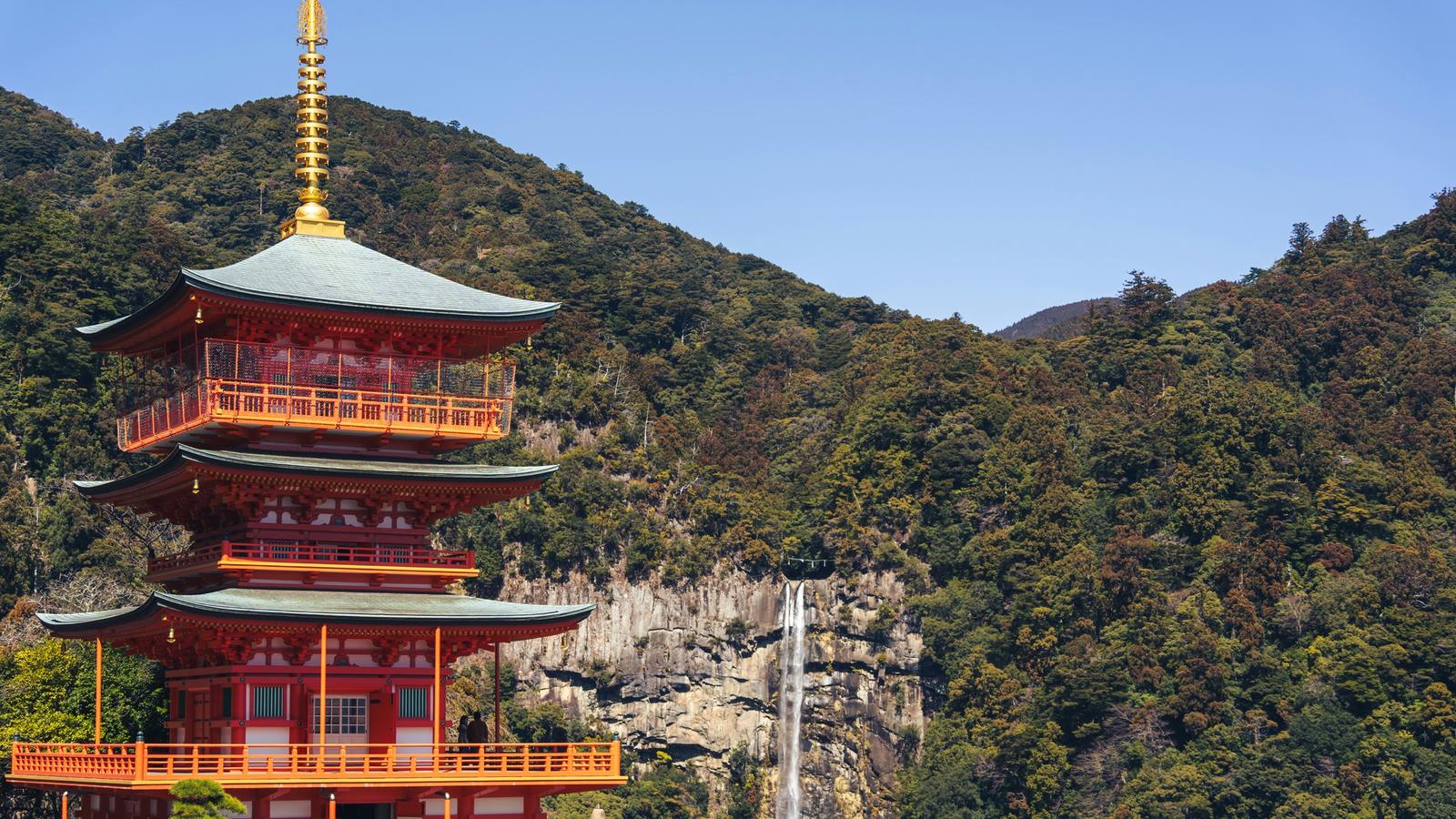
Koyasan and Kumano sit at two ends of the same mountain range in Wakayama, and UNESCO inscribed them together on July 7, 2004 as the Sacred Sites and Pilgrimage Routes in the Kii Mountain Range, with Yoshino and Omine as the third sacred site. Koyasan is about 1 hour 40 minutes from Osaka's Namba Station on Nankai's limited express Koya. The two are linked by mountain roads: the Tanabe City Kumano Tourism Bureau gives about 2.5 hours by chartered taxi from Koyasan to the Hongu area, and about 5.5 hours by train and bus.
This guide covers the train from Osaka, Okunoin and the Danjo Garan, a night at a shukubo temple lodging, Hongu and a half-day walk on the Kumano Kodo Nakahechi, the hot spring villages, Nachi and Hayatama, and how many days it all needs. We read every time and fare on official pages on October 31, 2026; the sources are at the end. If you are deciding where to go after Tokyo and Kyoto, Beyond Tokyo and Kyoto sets the region beside the other options.
Key points
- The limited express Koya from Namba is all reserved, with a ¥1,100 surcharge on top of the fare. The Koyasan Shukubo Association gives about 1 hour 40 minutes to Koyasan Station, with four round trips a day.
- The Okunoin approach runs about 2 km to Kobo Daishi's mausoleum, past more than 200,000 graves and memorials. The Torodo lantern hall is open 6:00 to 17:00.
- Fukuchiin, one of the temple lodgings, counts 52 shukubo among Koyasan's 117 temples. The morning service at a temple lodging can start at around 6:00, depending on the temple.
- The walk from Hosshinmon-oji to Kumano Hongu Taisha is about 7.5 km and takes 2 to 3 hours, mostly downhill. The bureau rates it 2 on its difficulty scale.
- Nachi Falls drops 133 m. From Kii-Katsuura Station the bus to Nachisan takes about 25 minutes, and the falls viewpoint is open 7:00 to 17:00.
LET US ARRANGE YOUR DAYS IN KOYASAN AND KUMANO →
GETTING TO KOYASAN FROM OSAKA
Koyasan is reached from Osaka by Nankai Railway, a cable car and a short bus ride.
The limited express Koya
The train. Nankai's limited express Koya runs on the Koya Line from Namba to Gokurakubashi, at the foot of the mountain. Every seat is reserved, and Nankai sells the limited express ticket from one month before the travel date, online through its reservation service, at the limited express counter at Namba and from ticket machines at major stations. The Koyasan Shukubo Association gives about 1 hour 40 minutes from Namba to Koyasan Station by limited express, with four round trips a day, or about 2 hours by express, which runs about every 30 minutes.
The cable car and the bus. At Gokurakubashi you change to the Koyasan cable car up to Koyasan Station. From there a local bus runs into the town, where the temples, the shukubo and the Okunoin approach are.
The fare. The limited express surcharge from Namba to Gokurakubashi is ¥1,100 for an adult, and ¥150 less through Nankai's ticketless service. Nankai's Koyasan World Heritage Ticket bundles a round trip from Namba to Koyasan Station, a two-day pass on the Nankai Rinkan buses in Koyasan and discount coupons for Kongobuji, the Kondo, the Konpon Daito and the Reihokan museum. From April 1, 2026 it costs ¥4,210 for an adult from Namba, or ¥5,200 with the outbound limited express ticket, and it is valid for two consecutive days.
By car
The shukubo association gives about 2 hours by car from Osaka and about 3 hours from Shirahama. A car also solves the stretch the trains do not cover, from Koyasan down to Kumano. What a driver costs by the day is set out in Private driver in Japan cost.
OKUNOIN AND THE DANJO GARAN
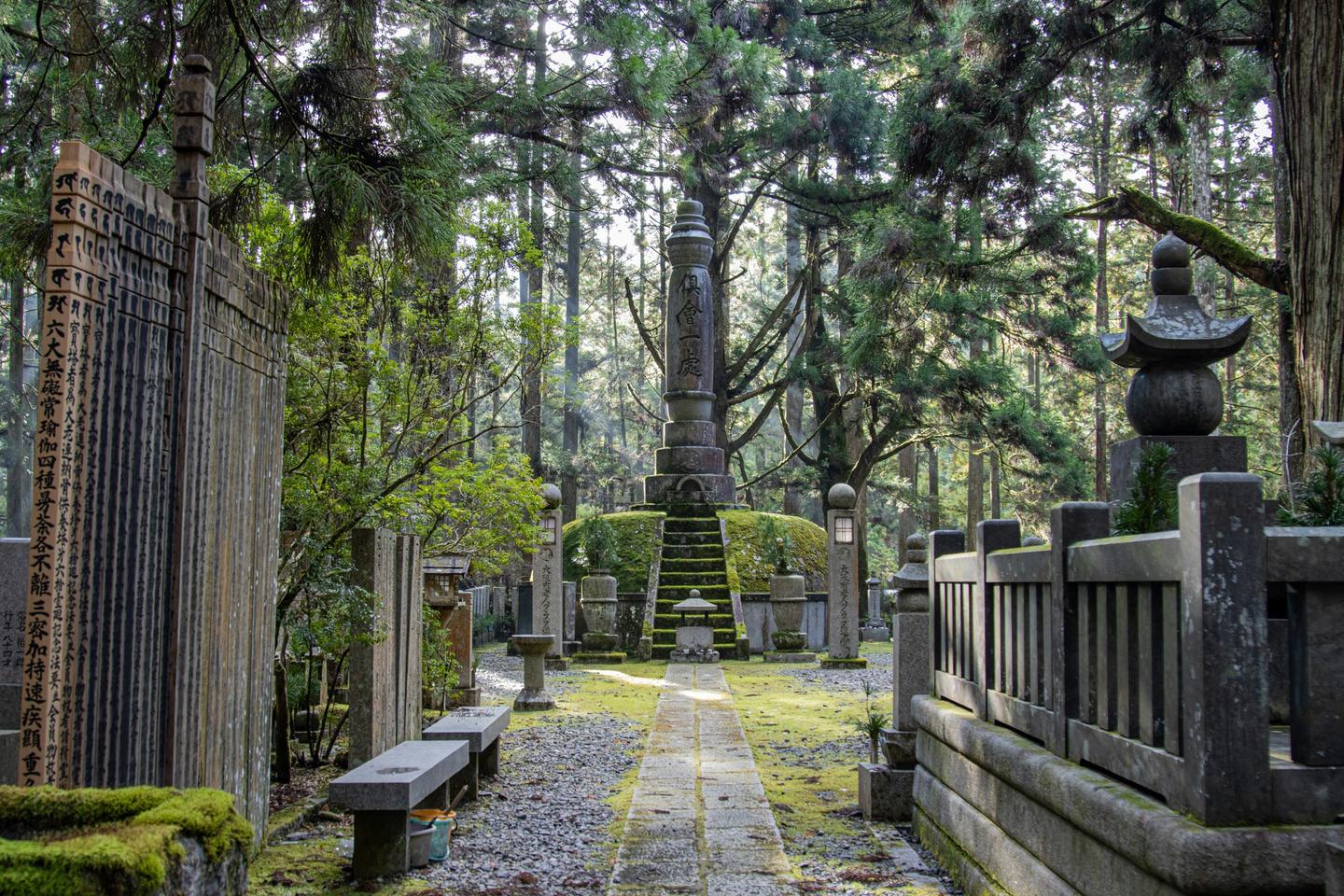
Kobo Daishi, the monk Kukai, opened Koyasan as a centre of Shingon Buddhism in the early Heian period. Kongobuji, the head temple, describes two sacred precincts: Okunoin, where Kobo Daishi is believed to remain in eternal meditation, and the Danjo Garan, where he first laid out the temple buildings.
- The Okunoin approach. The path runs about 2 km from the Ichinohashi bridge to the mausoleum, past more than 200,000 graves and memorial stones, many of them of feudal lords.
- The Torodo. The Lantern Hall stands in front of the mausoleum. It is open 6:00 to 17:00, and the hall beneath it 6:00 to 16:45. Each year on October 1 to 3 the temple holds the Manto-e, one of the few evening ceremonies on the mountain.
- The Danjo Garan. The Konpon Daito, the great pagoda of the precinct, is said to have been completed between about 816 and 887. The Kondo beside it is 23.73 m tall.
Hours and fees. Kongobuji, the Kondo and the Konpon Daito are open 8:30 to 17:00, with last entry at 16:30. Admission for junior high school age and over is ¥1,000 for Kongobuji and ¥500 each for the Kondo and the Daito. The Reihokan museum, open 9:00 to 17:00, is ¥1,300 for adults. A combined ticket for five sites is ¥2,500. The Okunoin approach itself has no admission.
A NIGHT AT A TEMPLE LODGING
Fukuchiin counts 117 temples on the mountain and 52 shukubo, lodgings run by the temples themselves; the Koyasan Shukubo Association's English site lists 31 of them.
The evening. The meals are shojin ryori, the vegetarian cooking of the temples. At Fukuchiin, for example, dinner uses local seasonal vegetables and Koya tofu, and the menu varies with the plan.
The morning service. The association writes that the chief priest and monks chant sutras in the main hall each morning, and that the service can begin at around 6:00 depending on the temple. Guests may sit in. A few temples also offer ajikan, the Shingon meditation, and sutra copying.
Choosing a temple. The temples differ more than the word shukubo suggests. Fukuchiin has natural hot spring baths, which it describes as the only ones on Koyasan; Ekoin offers ajikan to its guests at no charge, according to Mapple. In the listing of twelve shukubo we read on Mapple, one night with dinner and breakfast started at between about ¥9,600 and ¥19,551 per person, with Fukuchiin's range running up to ¥54,000. Check-in is usually 14:00 or 15:00 and check-out 9:00 to 11:00. The association notes that most shops and lodgings on the mountain do not take credit cards.
HONGU, OYUNOHARA AND A SHORT WALK
The Kumano Kodo is a network of pilgrimage routes that lead to the three Grand Shrines of Kumano: Hongu, Hayatama and Nachi. The Nakahechi, which begins near Tanabe and crosses the mountains, is the one the Tanabe City Kumano Tourism Bureau calls the main route linking the three shrines.
Kumano Hongu Taisha and Oyunohara
Hongu once stood on Oyunohara, a sandbank where the Kumano and Otonashi rivers meet. A flood in 1889 destroyed many of its buildings, and the parts that were saved were rebuilt on the hill where the shrine stands today. Oyunohara is now an open clearing, marked by a steel torii erected in 2000 that is 33.9 m tall and 42 m wide. The shrine's visiting hours are 8:00 to 17:00, and the grounds are free. The treasure hall is open 9:00 to 16:00, for ¥300 for adults.
Hosshinmon-oji to Hongu
The bureau calls this the highlight walk of the Nakahechi, and it suits a half day. The bus drops you at Hosshinmon-oji, and the trail runs about 7.5 km to the shrine in 2 to 3 hours, climbing about 190 m and descending about 460 m, through forest and the village of Hosshinmon. At Fushiogami-oji, the bureau writes, pilgrims fell to their knees on first seeing the shrine. There is no accommodation at Hosshinmon-oji, so the walk begins with a bus or a car. For a full day the bureau gives about 25 km and 9 to 12 hours from Chikatsuyu-oji.
Walking without the luggage
The daily luggage shuttles listed by the bureau run from inn to inn, only between inns reserved through KUMANO TRAVEL, and must be arranged at least 20 days ahead. For a single section, a car is simpler: the driver takes the bags on to the inn while you walk.
YUNOMINE, KAWAYU AND WATARASE
Three hot spring villages lie within a short bus ride of Hongu. Pilgrims purified themselves in the water at Yunomine before worshipping at the shrine.
- Yunomine. The bureau dates the spring to about 1,800 years ago. Tsuboyu, a small bath in a wooden hut, takes one or two people for 30 minutes at a time, first come first served. It is open 6:00 to 21:00 all year, with reception closing at 20:30, for ¥800 for an adult. Soap, shampoo and swimsuits are not allowed. For guests staying here, the bureau suggests the Dainichi-goe, about 2 km and 1 to 2 hours on foot from Hongu.
- Kawayu. Hot water rises through the riverbed, at 73 °C at the source, and guests dig their own pool in the gravel. In winter the Sennin-buro is opened, a river bath about 40 m by 15 m, open from December to February, 6:30 to 22:00, free of charge.
- Watarase. The third village, also spelled Wataze, served by the same buses from Hosshinmon-oji as Hongu, Kawayu and Yunomine.
Visit Wakayama notes that many of the inns in Yunomine are family run. How to bathe at an onsen is set out in Japan's onsen culture.
NACHI AND HAYATAMA
Kumano Nachi Taisha and the falls. Nachi Falls is 133 m high and 13 m wide. The shrine stands above it, beside Seigantoji, a Tendai temple that is the starting point of the pilgrimage to 33 Kannon temples, which began in 1161. The Daimonzaka, a stone staircase about 600 m long with 267 steps under centuries-old trees, climbs from the valley to the shrine. The shrine office is open 6:00 to 16:30. The falls viewpoint is open 7:00 to 17:00, for ¥300 for adults. Buses from Kii-Katsuura Station reach Nachisan in about 25 minutes.
Kumano Hayatama Taisha. The third shrine stands near the mouth of the Kumano River in Shingu. In its grounds is a Nagi tree the bureau gives as about 800 years old. In Shingu, a steep stone staircase climbs to Kamikura-jinja at the foot of the rock Gotobiki-iwa. Shingu is about 1 hour 20 minutes from Hongu by bus.
HOW MANY DAYS, AND THE DRIVE BETWEEN
The drive. The road between Koyasan and Hongu runs through the mountains, and the bureau warns that car navigation can suggest the wrong roads. It gives about 2.5 hours by chartered taxi, about ¥66,800 for a standard taxi for up to four people, or about ¥85,900 for a larger one for up to eight. By public transport it gives about 5.5 hours via Gojo, for about ¥4,360. A seasonal bus via Ryujin Onsen takes 4 to 4.5 hours, according to Visit Wakayama; the bureau notes that the bus between Koyasan and Ryujin does not run from December to March.
Four days is the shape that works. Visit Wakayama's own itinerary uses four days and three nights, and the timings above lead to much the same plan:
- Day 1. Namba to Koyasan in the morning. The Danjo Garan and Kongobuji in the afternoon, and Okunoin at dusk. A night at a shukubo.
- Day 2. The morning service, then the drive to Hongu. The shrine and Oyunohara in the afternoon. A night in Yunomine or Kawayu.
- Day 3. Hosshinmon-oji to Hongu in the morning, with the bags already moved. Tsuboyu in the evening, or a second night by the river.
- Day 4. Nachi and Hayatama, then on to Shirahama or Nanki-Shirahama Airport.
Ending on the coast. Shirahama, on the west coast, had the most foreign guest nights of any town in Wakayama that Honichi listed for 2025, 147,547. Hotel Kawakyu there is an all-suite hotel, according to its Rakuten Travel page, about 10 minutes by car from Nanki-Shirahama Airport. Five or six days allows a longer walk or a second night at the onsen.
The region is getting busier. Wakayama recorded a record 713,562 foreign guest nights in 2025, according to Honichi, and TV Tokyo reported about 68,000 foreign visitors on the Kumano Kodo in 2024, more than 60 times the number twenty years earlier. A night on the mountain and in the villages puts you at Okunoin and on the trail before the first trains and buses arrive.
HOW WE ARRANGE KOYASAN AND KUMANO
We plan the days around the hours above and arrange the parts in your name.
- The train. We tell you which limited express Koya fits the plan. You buy the ticket yourself, on Nankai's site or at Namba, up to a month ahead.
- The temple and the inns. We arrange the shukubo, the onsen inn and the coastal hotel in your name, and you pay each of them directly.
- A car and driver. We arrange the car for the drive from Koyasan to Hongu, for the drop at Hosshinmon-oji with the bags carried on to the inn, and for Nachi and Hayatama.
- A guide. A licensed guide who knows Shingon Buddhism and the Kumano faith can walk Okunoin with you at dusk and the trail into Hongu.
SOURCES AND HOW WE CHECKED
Read on October 31, 2026. Prices include tax and are for one adult unless stated.
- Nankai Electric Railway, Limited Express Koya: seating, surcharge, ticket sales
- Nankai Electric Railway, 高野山・世界遺産きっぷ (Koyasan World Heritage Ticket) and its notice of February 26, 2026 on revised ticket prices: contents, validity, 2026 prices
- Koyasan Kongobuji, 拝観料 (hours and fees), places to visit and English site: hours, fees, Okunoin, the Danjo Garan, the Manto-e
- Koyasan Shukubo Association, access, experiences and shukubo list: train and car times, morning service, ajikan, payments
- Fukuchiin, official site: meals, morning service, baths, number of shukubo
- Mapple (Shobunsha), 高野山の宿坊 (Koyasan shukubo): prices with two meals, check-in times
- Wakayama Prefecture, 世界遺産の追加登録 (World Heritage extension): 2004 inscription, sites and routes
- Tanabe City Kumano Tourism Bureau, Hosshinmon-oji to Kumano Hongu Taisha, Nakahechi and FAQ: distances, times, elevation, difficulty
- Tanabe City Kumano Tourism Bureau, Kumano Hongu Taisha, Kumano Nachi Taisha, Kumano Hayatama Taisha, Yunomine and Kawayu: shrine history, hours, fees, bus times, Tsuboyu, the Sennin-buro
- Tanabe City Kumano Tourism Bureau, Koyasan and Hongu access , bus and luggage shuttle: taxi time and price, public transport, winter bus closure, luggage rules
- Kumano Hongu Taisha, official site: visiting hours
- Visit Wakayama, Koyasan to Kumano itinerary: four-day plan, bus time, Yunomine inns
- Rakuten Travel, Hotel Kawakyu: all-suite rooms, distance from the airport
- Honichi (訪日ラボ), Wakayama foreign guest nights at a record high, July 1, 2026: 2025 guest nights
- TV Tokyo, ガイアの夜明け (Gaia no Yoake), January 9, 2026: Kumano Kodo visitor numbers
- The Irish Times, Kumano Kodo: walking Japan's ancient Camino, November 12, 2016: a walker's account of the Nakahechi and Tsuboyu
- Kyoto Journal, Walking the Kumano Kodo, March 1, 2020: a long walk ending at Hayatama
QUESTIONS GUESTS ASK
How do I get from Osaka to Koyasan?
Take Nankai's limited express Koya from Namba to Gokurakubashi, the cable car to Koyasan Station and a local bus into town. The Koyasan Shukubo Association gives about 1 hour 40 minutes from Namba to Koyasan Station. All limited express seats are reserved, and the surcharge from Namba is ¥1,100 on top of the fare.
How long does it take from Koyasan to Kumano Hongu?
The Tanabe City Kumano Tourism Bureau gives about 2.5 hours by chartered taxi over mountain roads, and about 5.5 hours by train and bus via Gojo. A seasonal bus via Ryujin Onsen takes 4 to 4.5 hours, and the Koyasan to Ryujin section does not run from December to March.
How many days do I need for Koyasan and the Kumano Kodo?
Four days and three nights covers a night at a shukubo, Hongu and Oyunohara, a half-day walk from Hosshinmon-oji, a night at an onsen village, and Nachi and Hayatama. Five or six days allows a longer section of the Nakahechi.
Is the Hosshinmon-oji walk difficult?
It is the bureau's highlight walk: about 7.5 km in 2 to 3 hours, with about 190 m of climbing and 460 m of descent, rated 2 on its scale. A car can carry your bags on to the inn.
Can I join the morning service at a shukubo?
Yes. Guests at a temple lodging can sit in as the monks chant sutras in the main hall. The Koyasan Shukubo Association says it can begin at around 6:00, depending on the temple.
LET US ARRANGE YOUR DAYS IN KOYASAN AND KUMANO
Send us your dates and where you will be before and after, in Osaka, Kyoto or elsewhere. We will come back with a plan for the four days or more, with two or three temples and inns for each night and their published rates, and we arrange the stays, the car and the guide you choose.
Begin planning →We reply within 24 hours, in writing
Some of the restaurants, bars and private places we arrange take guests only by introduction or membership. We do not publish their names.