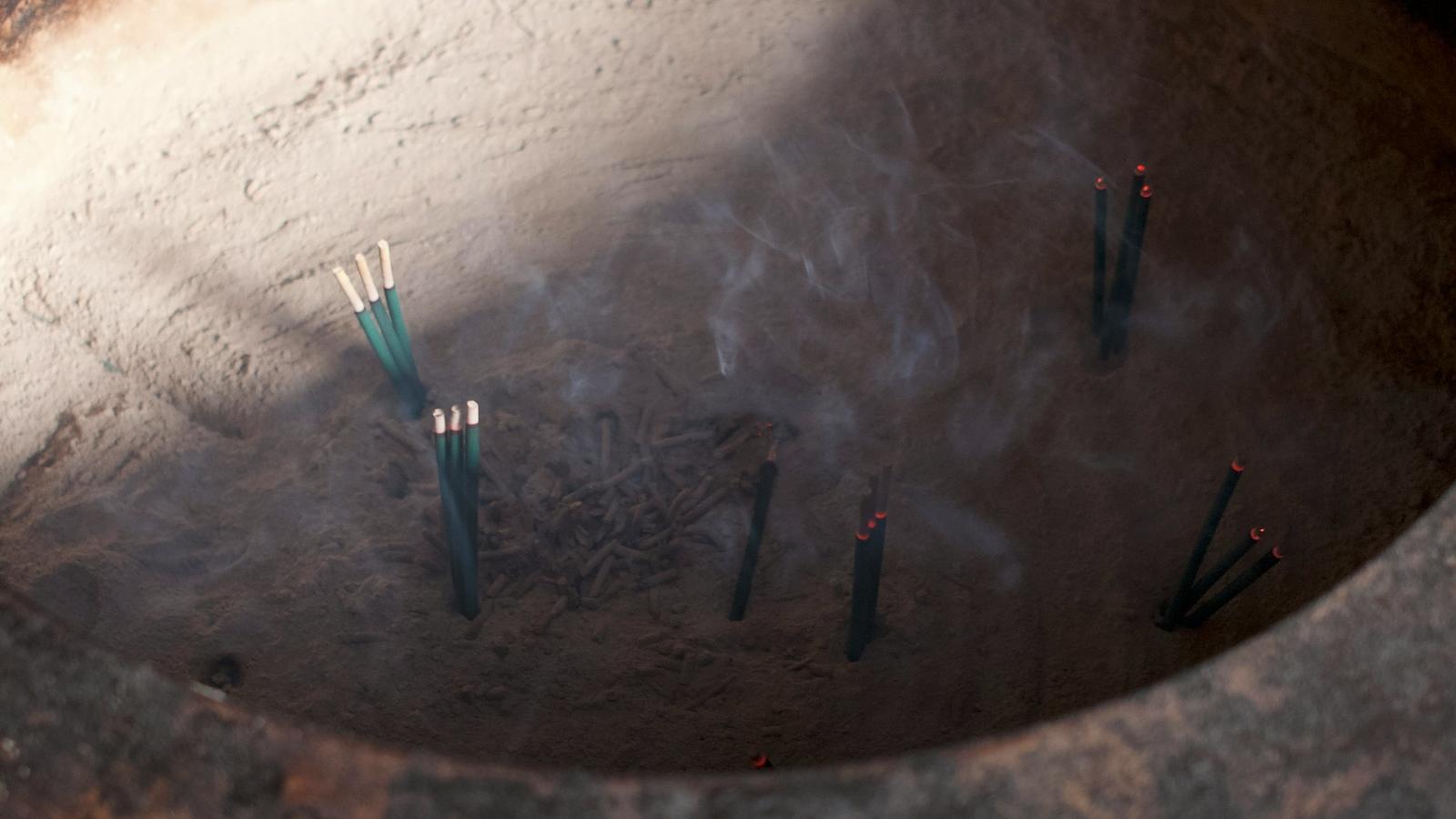
The story of incense in Japan begins on Awaji Island. The Nihon Shoki records that in the fourth month of 595 a piece of fragrant wood drifted ashore there; the islanders, not knowing what it was, put it on the fire with their firewood, and the scent was so remarkable that the wood was presented to the court. Some fourteen centuries later, Awaji still makes most of Japan's incense, and in Kyoto old incense houses still prepare the wood for kodo, the way of incense.
This article is about kodo at its fullest: the two great schools, the incense games called kumiko, the old incense houses of Kyoto, the incense makers of Awaji, and the woods themselves. We read the pages of the incense houses Shoyeido and Yamadamatsu, the Agency for Cultural Affairs, Hyogo Prefecture, the Kobe Shimbun, the National Diet Library and Japanese dictionaries, among others, on November 5, 2026, and contacted none of them; the sources are listed at the end. For the tea room, which grew up beside the incense room in the same century, see A Private Tea Ceremony in Kyoto, Step by Step.
Key points
- Kodo took its form in the Muromachi period around the shogun Ashikaga Yoshimasa. The Oie school traces itself to the courtier Sanjonishi Sanetaka, the Shino school to Shino Soshin.
- In kodo, incense is listened to. Kumiko are set games in which guests tell two or more scents apart, among them Genji-ko, named for The Tale of Genji.
- Shoyeido has made incense in Kyoto since around 1705, and Yamadamatsu has dealt in incense wood since the middle of the Edo period. Both receive guests for listening to incense.
- Hyogo Prefecture puts the Eii district of Awaji Island at about 70 percent of Japan's incense production, a trade begun around 1850 with skills learned from Sakai.
- Kyara is the finest grade of jinko, the resinous wood long said to be worth its weight in gold. A sitting with an incense school can sometimes be arranged; it is the school's decision.
ASK US FOR AN AFTERNOON OF INCENSE →
THE WAY OF INCENSE AND ITS TWO SCHOOLS
The monk Ganjin is said to have brought incense materials with the Buddhist precepts, and the Heian court blended powdered aromatics into kneaded incense to scent rooms and robes. Kodo as a discipline belongs to the Muromachi period. The eighth Ashikaga shogun, Yoshimasa, spent his days at his Higashiyama villa listening to the incense woods he had collected. To sort that collection, the courtier and poet Sanjonishi Sanetaka (1455–1537) and Shino Soshin, who served the shogun, worked out the classification of six countries and five tastes that the incense houses still teach, and the utensils and the manner of listening took their form.
The two men are remembered as the founders of the two great schools. The Oie school traces itself to Sanetaka and was handed down among the court nobility. The Shino school traces itself to Soshin. The Agency for Cultural Affairs describes it as the one school that has kept its line unbroken for more than 500 years; the head family stayed in Kyoto until the fifteenth generation and then moved to Owari, today's Nagoya, under the protection of the Owari Tokugawa. The present head is the twenty-first, who succeeded his father in the spring of 2025. In both schools the manner of the room matters as much as the scent.
LISTENING TO INCENSE: MONKO AND KUMIKO
In kodo the verb for incense is kiku, to listen, and the practice of attending closely to a single wood is called monko. A sliver of wood is warmed over charcoal buried in shaped ash in a small censer, and the censer is passed from guest to guest. Each scent fades as the next arrives, so the room stays quiet and each guest holds the scent in mind before passing the censer on.
Kumiko are the set games of kodo, in which guests listen to two or more woods and tell them apart. The Genroku years, around 1700, were their richest period, when games drawn from the classics were devised, among them Genji-ko, named for The Tale of Genji, as well as games for the Tanabata festival and for horse racing. For a first-time guest, a kumiko is the clearest way into kodo, because the game gives the attention something to do.
KYOTO: SHOYEIDO AND YAMADAMATSU
Shoyeido has made incense in Kyoto since around 1705, when Hata Rokuzaemon Morikichi, a village head from Tamba Sasayama, began the business as Sasaya; the name Shoyeido came with the third generation, and the house is now in its thirteenth. Its main shop stands on Karasuma-dori just north of Nijo, open from 9:00 to 18:00 every day but the New Year. Beside it, Kunjukan opened on July 11, 2018 as a house for incense culture, with an exhibition room, a scent garden and a tour of the incense workroom. Shoyeido also holds gatherings for listening to incense; one is set for November 28, 2026 at Kunjukan.
Yamadamatsu is a specialist in incense wood, founded in the middle of the Edo period, with its main shop in Kyoto and a second in Hanzomon in Tokyo. Its Kyoto shop runs a short course in monko and a Genji-ko session in which guests listen to five woods and tell them apart, for groups of two to six, seated on chairs. The course page is in Japanese only and asks guests to come without perfume. We arrange these sessions by telephone in Japanese, with an interpreter who knows the vocabulary of kodo, so that the names of the woods and the poems behind the games come through.
AWAJI ISLAND, WHERE THE STICKS ARE MADE
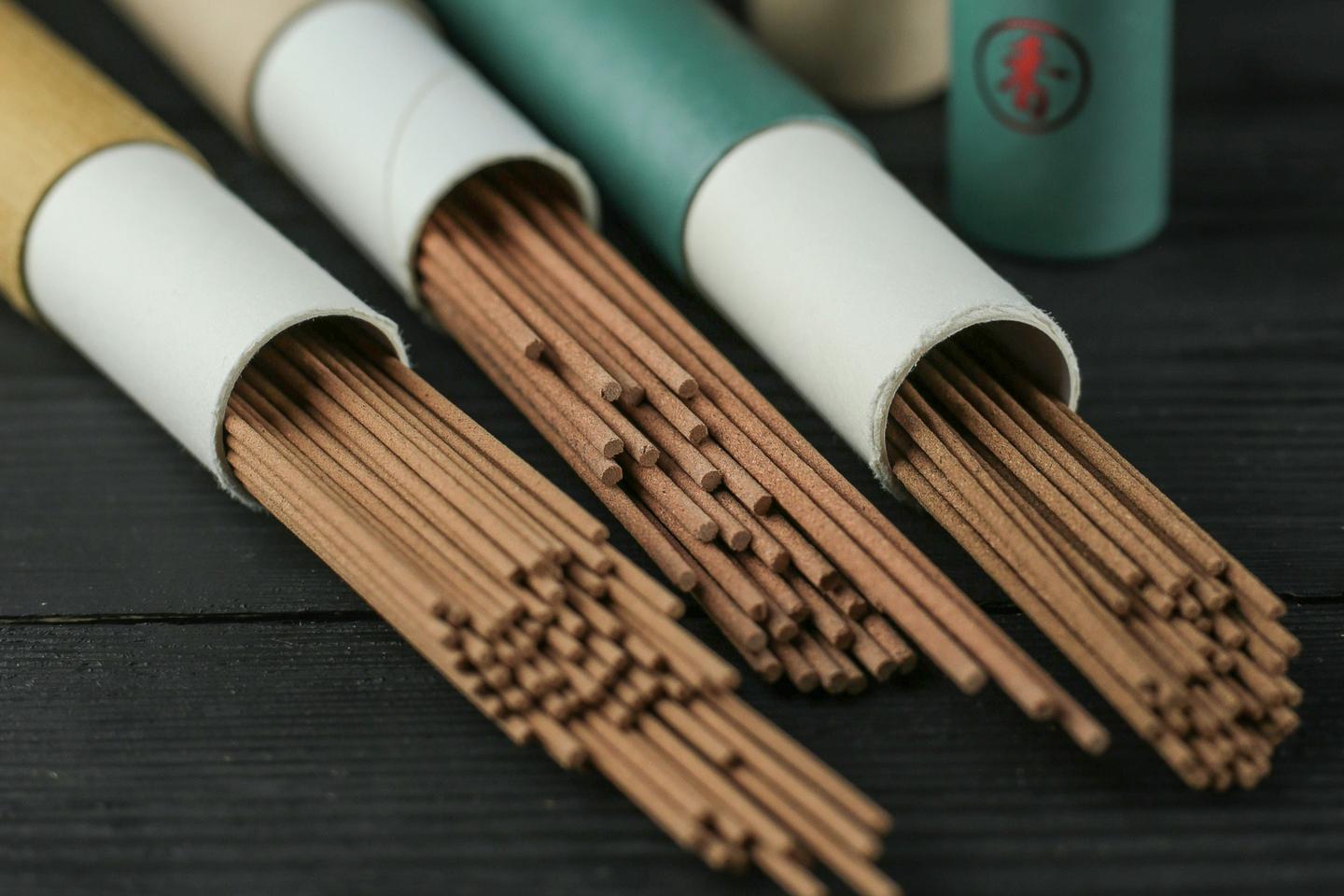
The island where the first incense wood washed ashore now makes most of Japan's incense sticks. Hyogo Prefecture records that the craft took root in Eii, on Awaji's west coast, around 1850, when local people learned it from craftsmen in Sakai. A good harbour for bringing in materials and shipping goods, and the seasonal wind off the Harima Sea that dries the sticks, did the rest. The prefecture puts the Eii district at about 70 percent of the national share, and the Ministry of the Environment has named the scent of its streets one of Japan's 100 fragrant landscapes. The Kobe Shimbun reported fourteen makers in the island's cooperative and about 2,800 tonnes produced in fiscal 2018.
Since fiscal 2005 the Hyogo Incense Cooperative has presented the island's master makers under the name Awaji-shima no Koshi, and it organises workshop visits and hands-on sessions. In the workshops the soft sticks are cut on a board and laid out straight to dry, with the windows opened and closed to control the air. A day on Awaji pairs well with a stay in Kyoto or Kobe, and after an afternoon of kodo the island shows the other end of the craft, a whole town that smells of incense.
KYARA, JINKO AND THE WOOD AT THE SHOSOIN
The wood of kodo is jinko, agarwood, in which resin forms inside the tree over many years. The resinous part is heavy enough to sink in water, which gives jinko its name, and it has little scent at room temperature but opens when warmed. Kyara is the finest jinko. Yamadamatsu notes that it takes so long to form that its scent is deep and layered, and that so little is produced that it has been valued with gold since early times. The six countries of the classification began as names of origins and became categories of scent; the five tastes, sweet, sour, hot, salty and bitter, describe a wood the way a sommelier describes a wine.
The most famous single piece is the jinko known as Ranjatai, kept at the Shosoin in Nara: 11.6 kilograms and 156 centimetres long. Ashikaga Yoshimasa and Oda Nobunaga are among those said to have cut pieces from it. In 2025 the Shosoin Office of the Imperial Household Agency reported that the tree grew between the late eighth and late ninth centuries, and that more than 300 compounds make up its scent. For a day among the treasures of Nara, see A Day in Nara from Kyoto.
ASKING FOR AN INCENSE GATHERING
The fullest form of kodo is a sitting with one of the schools, a koseki, where a teacher prepares the censers, the guests sit in order and a kumiko is played through with fine wood. These are the schools' own occasions. We can sometimes ask a teacher on your behalf for a private sitting or for seats at a gathering; whether a sitting is held, and who attends, is the school's decision, and we say plainly when the answer is no. When it is, a session at Yamadamatsu or a gathering at Shoyeido is a fine evening in its own right.
Within Signature, our planning for journeys of 7 to 21 days, kodo usually takes one afternoon in Kyoto, paired with a tea room or a garden, and a day on Awaji when the route runs west. We arrange the sessions, the interpreter and the car, and settle each in the simplest way available, usually on your hotel bill or on the day. For other doors in Kyoto that open only on request, see Kyoto Again.
SOURCES AND HOW WE CHECKED
We read the pages below on November 5, 2026. We did not contact any incense house, school, agency or other body. Shoyeido gives its founding as around 1705.
- Shoyeido, history (Japanese): founded around 1705 as Sasaya by Hata Rokuzaemon Morikichi of Tamba Sasayama, the name Shoyeido from the third generation, thirteen generations
- Shoyeido, the history of incense (Japanese): the wood burned as firewood on Awaji in 595, Heian kneaded incense, kumiko and incense as a way in the Edo period
- Shoyeido, experiences (Japanese): a gathering for listening to incense at Kunjukan on November 28, 2026
- Kunjukan, about (Japanese): opened July 11, 2018, run by Shoyeido
- Kunjukan, Shoyeido Kyoto main shop (Japanese): Karasuma-dori Nijo, 9:00 to 18:00, closed only at the New Year, a tour of the incense workroom
- Yamadamatsu, the history of incense (Japanese): the Nihon Shoki record of 595, Yoshimasa at Higashiyama, Sanetaka and Soshin as founders of the Oie and Shino schools, kumiko in the Genroku years
- Yamadamatsu, incense wood (Japanese): kyara as the finest jinko valued with gold, jinko sinking in water and opening when warmed, the six countries and five tastes
- Yamadamatsu, monko course in Kyoto (Japanese): monko and Genji-ko with five woods, two to six guests, chairs, no perfume, Japanese-only page
- Agency for Cultural Affairs, interview with the head of the Shino school (Japanese): more than 500 years unbroken, the move to Owari, listening to incense, kumiko
- Tobu Railway, monthly interview (Japanese): the twenty-first head of the Shino school since the spring of 2025, the move to present-day Nagoya
- FASHIONSNAP, a monko sitting with the Shino school (Japanese): in kodo the manner matters as much as the scent
- Kotobank, Oie school (Japanese dictionaries): founded by Sanjonishi Sanetaka, handed down among the court nobility
- National Diet Library, Sanjonishi Sanetaka (Japanese): courtier and poet, 1455–1537
- Hyogo Prefecture, landscapes of Awaji: Eii (Japanese): incense from the Kaei years, about 70 percent of the national share, one of the 100 fragrant landscapes
- Hyogo Prefecture, local industries: Awaji incense (Japanese): around 1850 in Eii, skills from Sakai, the largest producer in Japan, the Awaji-shima no Koshi brand since fiscal 2005
- Hyogo Prefecture, Kenmin Dayori June 2024 (Japanese): the harbour and the wind off the Harima Sea, cutting and drying, workshop visits by the cooperative
- Kobe Shimbun, August 2021 (Japanese): fourteen makers in the cooperative, about 2,800 tonnes in fiscal 2018
- JST Science Portal, September 1, 2025 (Japanese): Ranjatai, 11.6 kg and 156 cm, the dating and more than 300 compounds reported by the Shosoin Office
QUESTIONS TRAVELLERS ASK
What is the difference between the Oie and Shino schools?
Both go back to the Muromachi period. The Oie school traces itself to the courtier Sanjonishi Sanetaka and was handed down among the court nobility; the Shino school traces itself to Shino Soshin and has kept its line for more than 500 years, moving from Kyoto to Owari, today's Nagoya.
Do we need to know anything before an incense sitting?
No. Come without perfume, listen to each wood in turn and pass the censer on. A kumiko such as Genji-ko gives a first-time guest something to listen for.
Can you arrange a sitting with an incense school?
Sometimes. We ask a teacher on your behalf; whether a sitting is held is the school's decision. A session at an incense house in Kyoto is usually simpler to arrange.
Is the session in English?
The Kyoto course pages we read are in Japanese. We arrange an interpreter who knows the vocabulary of kodo.
Where is most Japanese incense made?
On Awaji Island in Hyogo. The prefecture puts the Eii district at about 70 percent of the national share.
ASK US FOR AN AFTERNOON OF INCENSE
Tell us when you are in Kyoto and who is travelling. We will set out the incense houses, the sittings we can ask for and a day on Awaji, with the reasons, so that you can choose.
Begin planning →We reply within 24 hours, in writing
Some of the restaurants and bars we arrange seat guests only by introduction or membership. We ask on your behalf; the table and the evening are the house's decision. We do not publish their names.