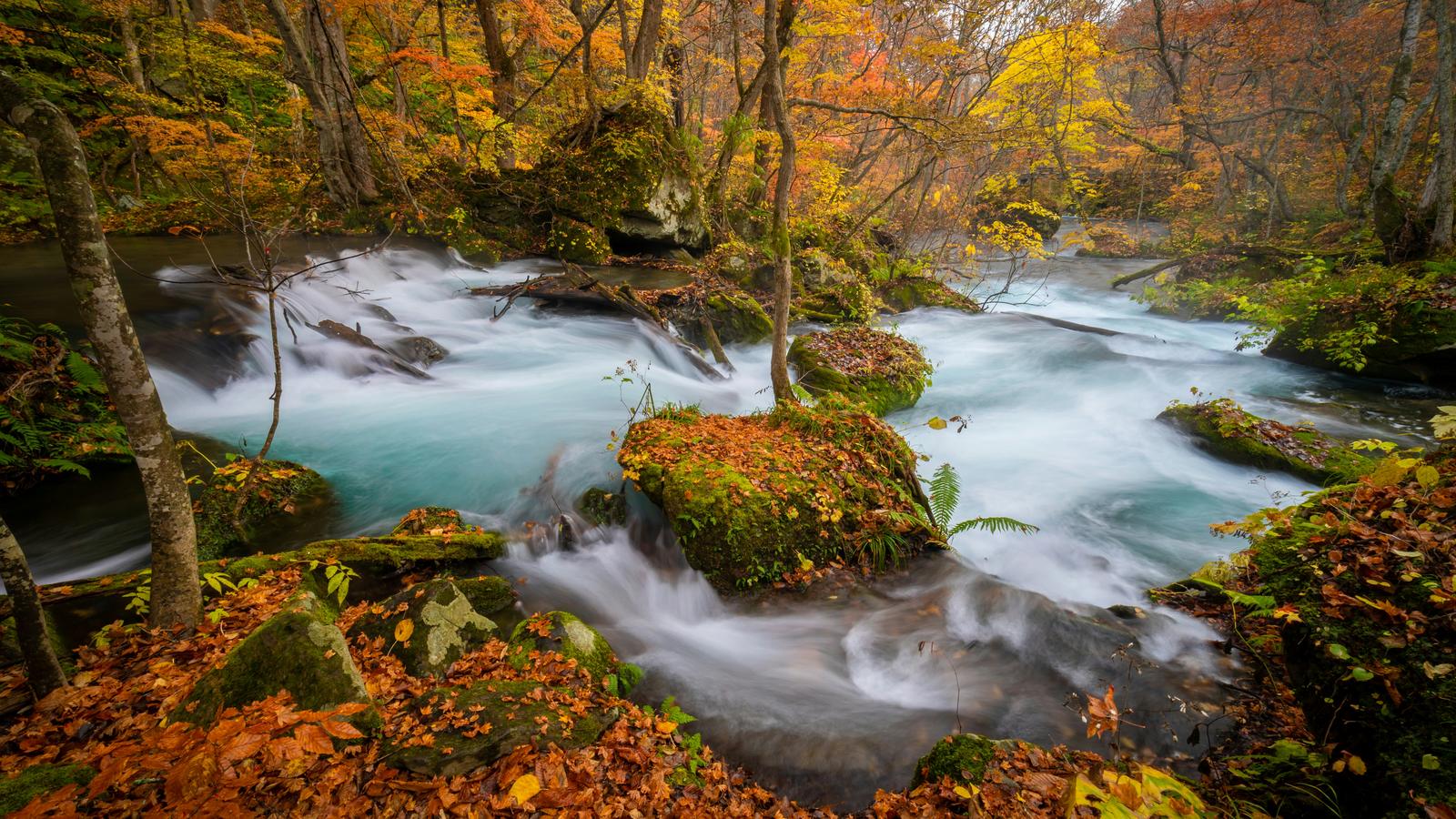
A second journey to Japan usually begins with the places that were left for later. For travellers who already know Kyoto and Tokyo, the far north of Honshu and the southern tip of Hokkaido answer it well. Aomori and Hakodate sit on either side of the Tsugaru Strait, linked by a tunnel under the sea and by a prehistoric culture that lived on both shores, and between them they hold a gorge of moss and water, three museums built for their places, a castle town of brick and apples, and an onsen town with the lights of a harbour city below it.
This article sets out how to shape five or six nights across the strait: what draws travellers with a taste for food, contemporary art and nature, which months to choose and which closures to plan around in 2027, and where to stay. We read Japan's tourism agencies, the pages of the museums, the heritage sites, the inns, the railway and the two regions' official guides, and contacted none of them; the sources are at the end. For the rest of Tohoku, from Ginzan Onsen to Dewa Sanzan, see Tohoku: Japan's Quieter North →.
Key points
- JNTO's market handbook finds that Italian households in the top 20% of income are drawn to food, contemporary art and nature, and show a high level of interest in regions such as Hokkaido and Tohoku.
- The Oirase Gorge runs about 14 km from Lake Towada, with autumn colour at its peak around the end of October and the beginning of November.
- Towada, Aomori and Hirosaki each have a museum of art designed for its site, by Ryue Nishizawa, Jun Aoki and Tsuyoshi Tane. The Aomori Museum of Art closes for renovation from September 27, 2027 to April 14, 2028.
- The Hokkaido Shinkansen connects Aomori and Hakodate in about an hour, and the Jomon sites inscribed by UNESCO in 2021 lie on both sides of the strait.
- In Hakodate, Bourou NOGUCHI Hakodate is closed for works until April 19, 2027 and reopens with check-ins from April 20, 2027.
LET US SHAPE YOUR JOURNEY NORTH →
WHY THE NORTH ON A SECOND JOURNEY
Italy's interest in Japan is rising quickly. JNTO estimates 309,400 visitors from Italy in 2025, 34.6% more than the 229,785 of 2024. Its handbook on the European markets, published in 2024, divides Italian travellers by household income. For the top 20%, with a disposable income of 10.5 million yen a year or more, it lists local food and cooking, museums and contemporary art, scenery, eco-tours and gardens, and notes that their interest in regions such as Hokkaido and Tohoku is high, beyond the cities.
The north answers all three interests at once, and on a scale that suits a second visit. JNTO's Italian site introduces Aomori as a land of primeval forests, apples, rice-field art, sake, seafood and snow, still close to a hidden gem. Our reading is that this is what many of our Italian guests look for after Kyoto: the same refinement, with more space and fewer people around it.
THE OIRASE GORGE AND LAKE TOWADA
The Oirase Gorge flows for about 14 km out of Lake Towada, through thick woods, moss-covered rocks and many waterfalls. It is a national Special Place of Scenic Beauty and a Natural Monument, and Aomori Prefecture's official guide places the peak of its autumn colour around the end of October and the beginning of November. A walking trail follows the gorge, and the walk is best taken slowly, in the morning, with a car waiting at the far end. On Lake Towada itself the colour comes slightly earlier, from the middle to the end of October, and the excursion boats that cross it give a view the shore does not.
Oirase Keiryu Hotel, run by Hoshino Resorts, is the only resort hotel on the bank of the gorge, inside Towada-Hachimantai National Park. Its hot spring rises from the Hakkoda mountains and its open-air bath looks over the stream. The Keiryu Suite measures 120 square metres with its own open-air bath, and four twin rooms of 44 square metres have a semi-open-air bath. Among its restaurants is a French dining room facing the stream. The hotel runs a shuttle from Hachinohe and Aomori stations; we prefer a private car, so that the gorge, the lake and the museum in Towada fit into the same day at your pace. Note that the public JR bus to the gorge is suspended in winter, from mid-November to mid-April.
TOWADA AND AOMORI: ART MADE FOR ITS PLACE
Towada Art Center opened in 2008 on the town's long avenue of government offices, as the heart of a project to bring art back into a street that had emptied. Ryue Nishizawa designed it as separate rooms joined by glass corridors, with windows facing in different directions, so that the works are also shown to the street outside. Nishizawa and Kazuyo Sejima, his partner in SANAA, received the Golden Lion at the 9th Venice Architecture Biennale in 2004 and the Pritzker Prize in 2010. The collection holds 41 works commissioned for the building from 36 artists, among them Yoko Ono, Yayoi Kusama, Choi Jeong Hwa and Ron Mueck. It opens from 9:00 to 17:00 and closes on Mondays.
The Aomori Museum of Art, opened in July 2006 to a design by Jun Aoki, stands beside the Sannai-Maruyama site, and its ground is cut in geometric trenches that recall the excavation next door. Its central Aleko Hall shows Marc Chagall's backdrops for the ballet Aleko, in cooperation with the Philadelphia Museum of Art. Outside stands Yoshitomo Nara's Aomori-ken, a dog 8.5 metres high and 6.7 metres wide; the passage that leads to it closes in winter once the snow settles. The prefecture's guide lists the museum as closed on the second and fourth Monday of each month, and the museum has announced an extended closure for renovation from September 27, 2027 to April 14, 2028. For an autumn journey in 2027, we place it before the end of September or leave it for another year.
HIROSAKI: THE BRICK WAREHOUSE AND THE CASTLE PARK
Hirosaki, west of Aomori, keeps the third museum. The Hirosaki Museum of Contemporary Art occupies a brick warehouse built by the sake brewer Fukushima Tosuke, whose main hall dates from 1923. In 1954 the building became the Hirosaki factory of Asahi Cider, which, with technicians invited from France, began what the museum describes as Japan's first large-scale production of cider from Aomori apples. Yoshitomo Nara, born in Hirosaki, showed here three times from 2002, and the first exhibition drew about 60,000 visitors. Tsuyoshi Tane restored it for its opening on April 11, 2020, and developed a way of laying the brick that he named after the city. It closes on Tuesdays.
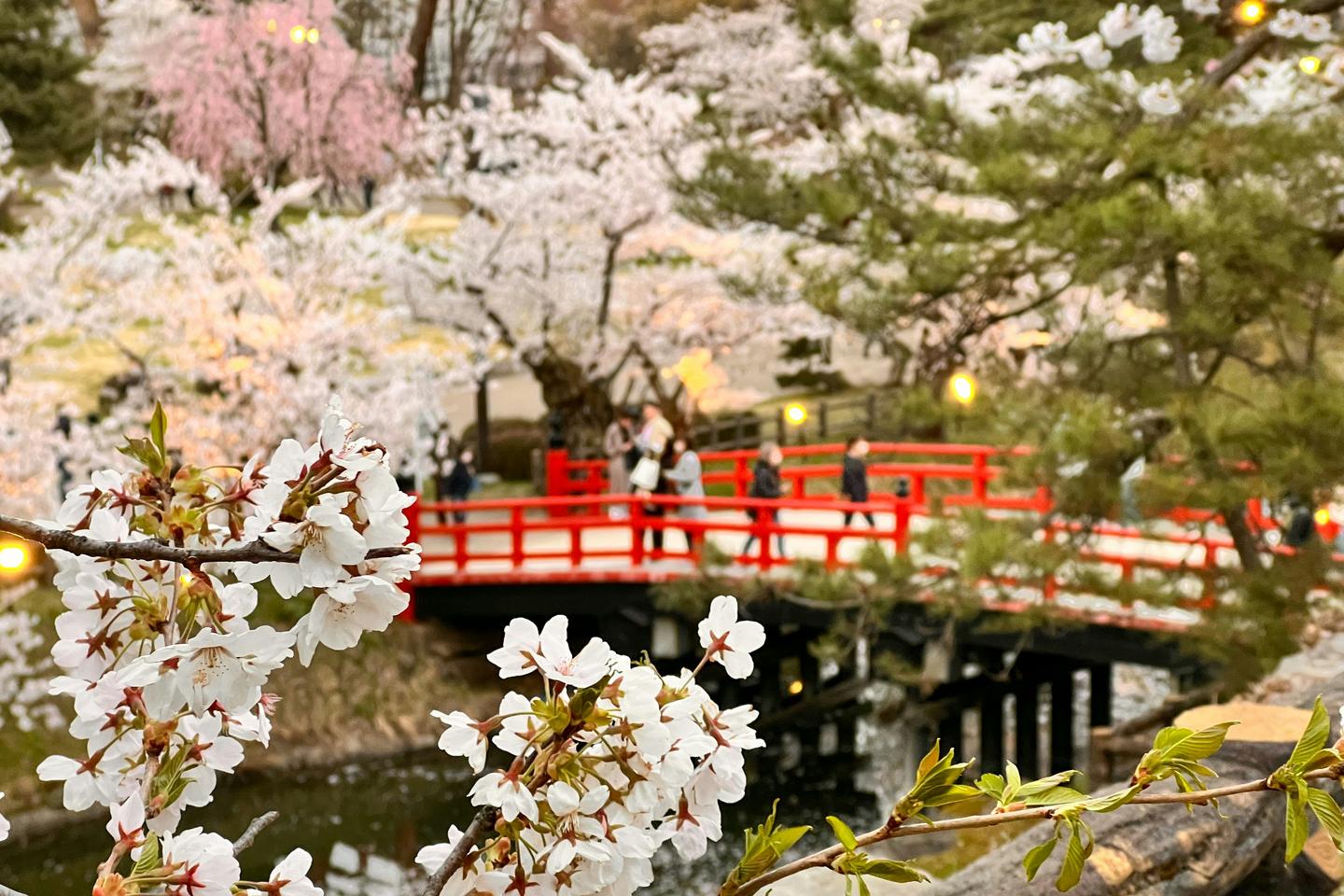
Hirosaki Park, around the castle, holds about 2,000 cherry trees and is among the most celebrated places in Japan for the blossom in spring. In autumn it has its own festival of foliage, and in winter a festival of snow lanterns. One point to plan around: from November 24, 2025, the interior of the castle keep is closed to the public for several years, for the relocation of the keep, preservation repairs and seismic reinforcement. The grounds stay open.
The apples are the other reason to stop. Hirosaki City Apple Park grows about 2,300 trees of some 80 varieties on 5.2 hectares facing Mount Iwaki, with picking from August 1 to mid-November and cider to taste on site. Taken with the museum's history, it shows a region that turned one fruit into a culture. We usually give Hirosaki one night between the gorge and the strait, with the museum in the afternoon and the orchard the following morning.
THE JOMON ON BOTH SHORES OF THE STRAIT
On July 27, 2021, UNESCO inscribed the Jomon Prehistoric Sites in Northern Japan: 17 sites and 2 associated sites, 9 of them in Aomori and 7 in Hokkaido. Sannai-Maruyama, on the edge of Aomori city, is the best known. The official Jomon site dates the special historic site to about 3900 to 2200 BCE; excavation began in 1992, and reconstructed pit dwellings and pillar-supported buildings now stand on the site. It opens from 9:00 to 17:00, until 18:00 from June 1 to September 30, and closes on the fourth Monday of the month. With the Aomori Museum of Art next door, the two fill a morning.
Across the strait, two components lie within Hakodate. Kakinoshima, beside the Hakodate Jomon Culture Center, was settled from about 9,000 to 3,000 years ago and keeps a U-shaped mound 190 metres long and 120 metres wide; Ofune, about ten minutes away by car, shows dwellings more than 10 metres across and more than 2 metres deep. Both are about an hour's drive from Hakodate station. Seen on consecutive days, Sannai-Maruyama and these two sites show one culture that lived on both shores of the strait.
ACROSS TO HAKODATE
The Hokkaido Shinkansen opened on March 26, 2016 between Shin-Aomori and Shin-Hakodate-Hokuto, and the prefecture's guide puts the crossing between Aomori and Hakodate at about an hour, through the Seikan Tunnel. The same line reaches Shin-Hakodate-Hokuto from Tokyo in 3 hours 57 minutes at its fastest, and the city's tourism office gives about 4 hours 30 minutes from Tokyo to Hakodate station with the connecting Hakodate Liner. For the return, a flight from Hakodate to Haneda takes about 1 hour 20 minutes.
The view from Mount Hakodate, over the city and the sea on either side, carries three stars in the Michelin Green Guide Japon, and the ropeway reaches the summit in three minutes. In late October and the first half of November, the Japanese garden of Kosetsuen is lit at night for its autumn leaves.
To stay, we look first at Bourou NOGUCHI Hakodate in Yunokawa Onsen, a hot spring town with some 350 years of history. Its open-air bath on the top floor is the highest in Yunokawa, looking over the city lights, the fishing boats' lamps at sea and the airport. Its SUITE rooms are duplexes, and its creative kaiseki uses the produce of southern Hokkaido, with local place names written into the menu. It does not accept children aged 12 and under. The hotel is closed for maintenance from August 20, 2026 and reopens with check-ins from April 20, 2027. From April 1, 2026, Hokkaido and Hakodate levy an accommodation tax per person per night, 2,500 yen in total for a room rate of 100,000 yen or more, paid at the hotel.
WHEN TO GO AND HOW TO SHAPE THE NIGHTS
October is the month we favour. The Hakkoda mountains colour from the end of September, Lake Towada in the middle and late part of October, the Oirase Gorge at the end of October, and Kosetsuen into mid-November, so a journey that moves from the mountains down to the coast follows the colour. In 2027 that same autumn falls after the Aomori Museum of Art has closed; Towada and Hirosaki remain open. Spring brings the blossom in Hirosaki and the reopening of Bourou NOGUCHI Hakodate, and early August brings the Aomori Nebuta Festival, held every year from August 2 to 7. In winter the gorge belongs to snow, and the bus to it does not run.
JNTO's handbook also notes that Italian travellers prefer to lunch after 13:00 and dine after 20:00. Inns in the north serve dinner at set times, often earlier than that. We ask each inn whether a later sitting is possible, and where it is not, we place the long lunch on the travel day instead. In a Signature journey of 7 to 21 days, Aomori and Hakodate take five or six nights: two at Oirase, one in Hirosaki or Aomori, two or three in Hakodate. We arrange the inns, the cars between stations and the museums around their closing days, so that each morning begins where the previous evening left you.
SOURCES AND HOW WE CHECKED
We read the pages below on November 5, 2026. Travel times are those given by the operators and tourism bodies and are rounded. We did not contact any museum, inn, railway or other body.
- JNTO, Inbound Tourism Handbook 2024, Europe, Italy (Japanese): interests of the top 20% by household income, interest in Hokkaido and Tohoku, lunch after 13:00 and dinner after 20:00
- JNTO, visitor arrivals for December and the year 2025 (Japanese): 309,400 visitors from Italy in 2025 (estimate), 229,785 in 2024, up 34.6%
- JNTO Italy, Aomori (Italian): forests, apples, rice-field art, sake, seafood and snow, "gemme nascoste"
- Amazing AOMORI, official Aomori travel guide, Oirase Gorge: 14 km from Lake Towada, peak colour around the end of October and the beginning of November, designations, JR bus suspended mid-November to mid-April
- Amazing AOMORI, Lake Towada: peak colour from the middle to the end of October, excursion boats suspended in winter
- Amazing AOMORI, Fall Leaves of Hakkoda Mountains: peak from the end of September through October
- Oirase Keiryu Hotel, official site (Japanese): only resort hotel on the gorge, onsen from Hakkoda, Keiryu Suite of 120 square metres, four twin rooms with semi-open-air bath, French restaurant, shuttle from Hachinohe and Aomori stations
- Towada Art Center, about: Arts Towada from 2008, Ryue Nishizawa, Golden Lion in 2004 and Pritzker Prize in 2010, 41 commissioned works by 36 artists
- Towada Art Center, about (Japanese): opening in 2008, chronology
- Towada Art Center, visit: 9:00 to 17:00, closed on Mondays, buses from Hachinohe
- Aomori Museum of Art, about: opening on July 13, 2006, Jun Aoki, the trenches and Sannai-Maruyama, Aleko Hall, Aomori-ken 8.5 metres high
- Aomori Museum of Art, home page: notice of extended closure for renovation from September 27, 2027 to April 14, 2028
- Aomori Museum of Art, visit: 9:30 to 17:00, Aomori-ken passage closed in winter
- Amazing AOMORI, Aomori Museum of Art: closed on the second and fourth Monday, Chagall in cooperation with the Philadelphia Museum of Art
- Hirosaki Museum of Contemporary Art, chronology (Japanese): Fukushima Tosuke, Asahi Cider from 1954, technicians from France
- Hirosaki Museum of Contemporary Art, architecture (Japanese): main hall of 1923, three Nara exhibitions from 2002 with about 60,000 visitors, Tsuyoshi Tane, opening on April 11, 2020
- Hirosaki Museum of Contemporary Art, English site: hours, closed on Tuesdays, exhibitions in 2026 and 2027
- Amazing AOMORI, Hirosaki Park: 2,000 cherry trees, festivals, keep interior closed from November 24, 2025 for several years
- Amazing AOMORI, Hirosaki City Apple Park: 5.2 hectares, 2,300 trees of about 80 varieties, picking from August 1 to mid-November, cider
- Jomon Prehistoric Sites in Northern Japan, official site: inscription on July 27, 2021, 19 sites by prefecture
- Jomon Prehistoric Sites, Sannai-Maruyama: about 3900 to 2200 BCE
- Sannai-Maruyama Special Historic Site, official site (Japanese): hours, longer hours from June 1 to September 30, closed on the fourth Monday
- Amazing AOMORI, Sannai-Maruyama: excavation from 1992, pit dwellings and pillar-supported buildings
- Travel Hakodate, Kakinoshima site: 9,000 to 3,000 years ago, mound of 190 by 120 metres, about 50 minutes by car
- Travel Hakodate, Ofune site: 5,500 to 4,000 years ago, dwellings more than 10 metres across, about 60 minutes by car
- JR Hokkaido, Hokkaido Shinkansen (Japanese): opening on March 26, 2016, Tokyo to Shin-Hakodate-Hokuto in 3 hours 57 minutes at fastest
- Amazing AOMORI, access: Aomori and Hakodate in about an hour by the Hokkaido Shinkansen, Haneda to Aomori in about 1 hour 20 minutes
- Travel Hakodate, access: Tokyo to Hakodate station in about 4 hours 30 minutes, Haneda to Hakodate in about 1 hour 20 minutes
- Travel Hakodate, Mt. Hakodate Observatory: three stars in the Michelin Green Guide Japon, three-minute ropeway, hours
- Travel Hakodate, Miharashi Park (Kosetsuen): lit for the autumn leaves from late October to mid-November
- Bourou NOGUCHI Hakodate, official site (Japanese): about 350 years of Yunokawa Onsen, top-floor open-air bath, suites, creative kaiseki, no children aged 12 and under
- Bourou NOGUCHI Hakodate, closure notice (Japanese): closed from August 20, 2026 to April 19, 2027, check-ins from April 20, 2027
- Bourou NOGUCHI Hakodate, accommodation tax (Japanese): Hokkaido and Hakodate tax from April 1, 2026 by room rate
- Amazing AOMORI, Aomori Nebuta Festival: every year from August 2 to 7
QUESTIONS TRAVELLERS ASK
How many nights do Aomori and Hakodate need?
Five or six: two at the Oirase Gorge, one in Hirosaki or Aomori, and two or three in Hakodate. That leaves time for the gorge in the morning, the three museums on their open days and the Jomon sites on both sides of the strait.
When is the best time to go?
October, for the autumn colour: the Hakkoda mountains from the end of September, Lake Towada in the middle and late part of October, and the Oirase Gorge around the end of October and the beginning of November. In 2027 the Aomori Museum of Art closes for renovation from September 27, so an autumn visit centres on Towada and Hirosaki.
How do you cross from Aomori to Hakodate?
By the Hokkaido Shinkansen, which links Aomori and Hakodate in about an hour through the Seikan Tunnel. From Shin-Hakodate-Hokuto the Hakodate Liner continues into the city, and the flight from Hakodate to Haneda takes about 1 hour 20 minutes.
Can dinner be served late, as at home in Italy?
Inns in the north serve dinner at set times, often before 20:00. We ask each inn whether a later sitting is possible, and where it is not, we make a long lunch the main meal of the day.
On which days are the museums closed?
Towada Art Center closes on Mondays, the Aomori Museum of Art on the second and fourth Monday of the month, the Hirosaki Museum of Contemporary Art on Tuesdays and Sannai-Maruyama on the fourth Monday. We set the route so that each one falls on an open day.
LET US SHAPE YOUR JOURNEY NORTH
Tell us when you would like to travel and what draws you, the art, the forests or the table. We will set out the nights, the inns, the order of the museums and the crossing to Hakodate, side by side with the reasons, so that you can choose.
Begin planning →We reply within 24 hours, in writing
Some of the restaurants and bars we arrange seat guests only by introduction or membership. We ask on your behalf; the table and the evening are the house's decision. We do not publish their names.