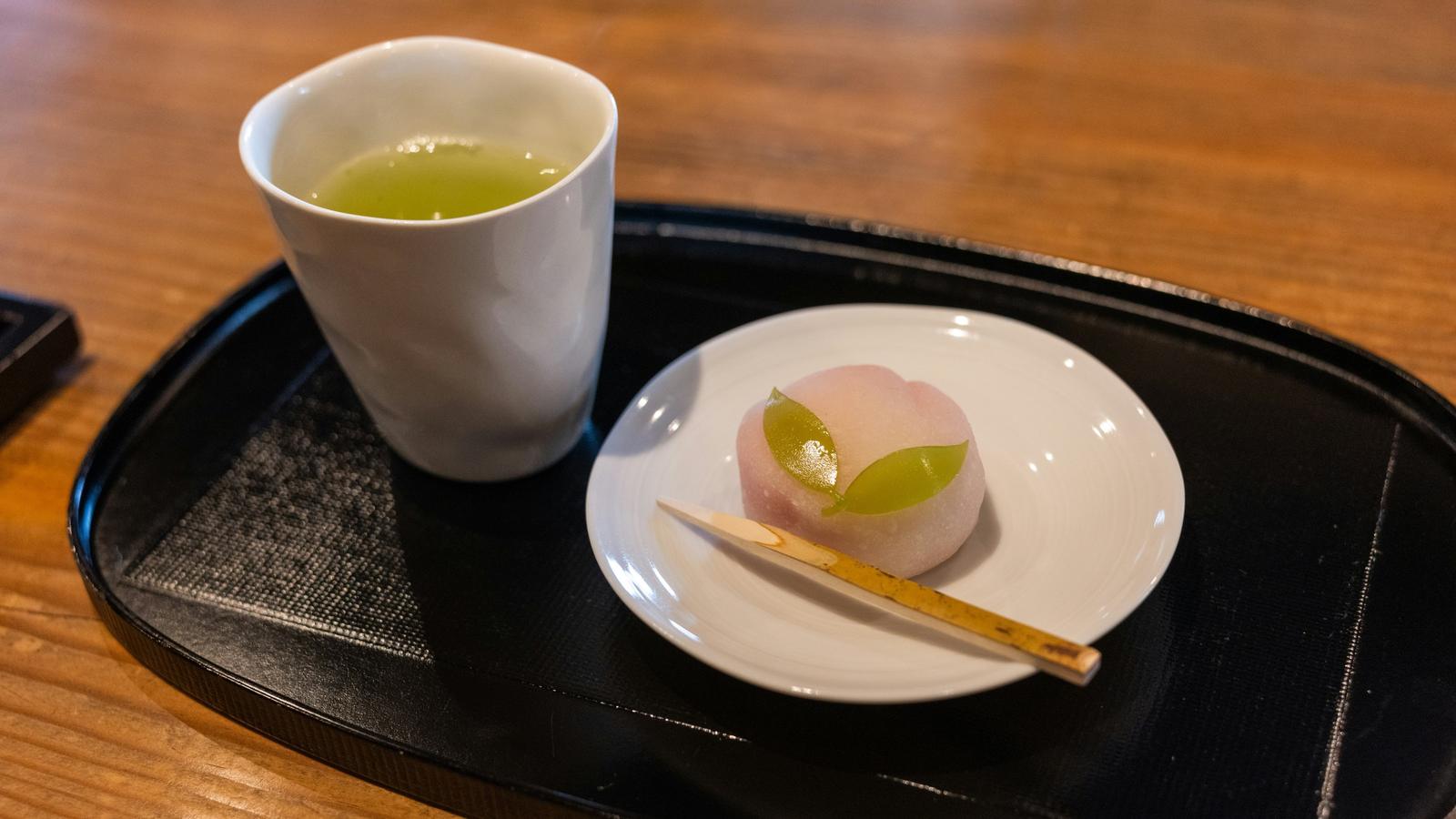
In a Kyoto tea room, the sweet arrives before the tea. It is small, it often carries a name taken from poetry or the season, and it is shaped for that day's gathering. Wagashi, the confectionery of Japan, is at its most refined in the sweets made for tea, and Kyoto is where the old houses that make them still work.
This article explains the two kinds of tea sweet, how a confection follows the calendar, which of Kyoto's houses are worth a visit, and how to have a sweet made for your own table. We read the pages of Toraya, Kagizen Yoshifusa, Suetomi, Kameya Yoshinaga, the Japan Wagashi Association, the National Astronomical Observatory of Japan, the Kyoto City Tourism Association, a Japanese encyclopedia, a university teaching site and a design magazine on November 5, 2026, and contacted none of them; the sources are listed at the end. For the tea itself, see A Private Tea Ceremony in Kyoto and Uji Matcha at the Source.
Key points
- A tea gathering usually prepares two sweets: a moist main sweet, omogashi, and a dry sweet, higashi, which suits thin tea.
- The fine fresh sweets called jo-namagashi follow the twenty-four solar terms, so a house's sweets change with the season.
- Toraya was founded in Kyoto in the late Muromachi period; its oldest surviving pattern book of sweets is dated 1695.
- Kagizen Yoshifusa has made sweets in Gion since the Kyoho era of the early eighteenth century; Suetomi was founded in 1893, Kameya Yoshinaga in 1803.
- Several Kyoto houses make fresh sweets to order. Kameya Yoshinaga asks for seven days' notice for its personal orders.
ASK US TO PLACE THE TEA AND THE SWEETS IN YOUR DAYS →
TWO SWEETS FOR TWO TEAS
The Nipponica encyclopedia notes that a tea gathering today usually prepares two kinds of sweet. The omogashi, the main sweet, is most often moist, and guests cut it with a pick of bamboo or metal, as the Japan Past and Present teaching site of UCLA and Waseda University explains; the higashi is taken by hand and suits thin tea. The Kyoto City Tourism Association describes the moist sweets as made chiefly with sweet bean paste and served with thick tea at formal gatherings, and the dry sweets as shaped in wooden moulds for less formal settings.
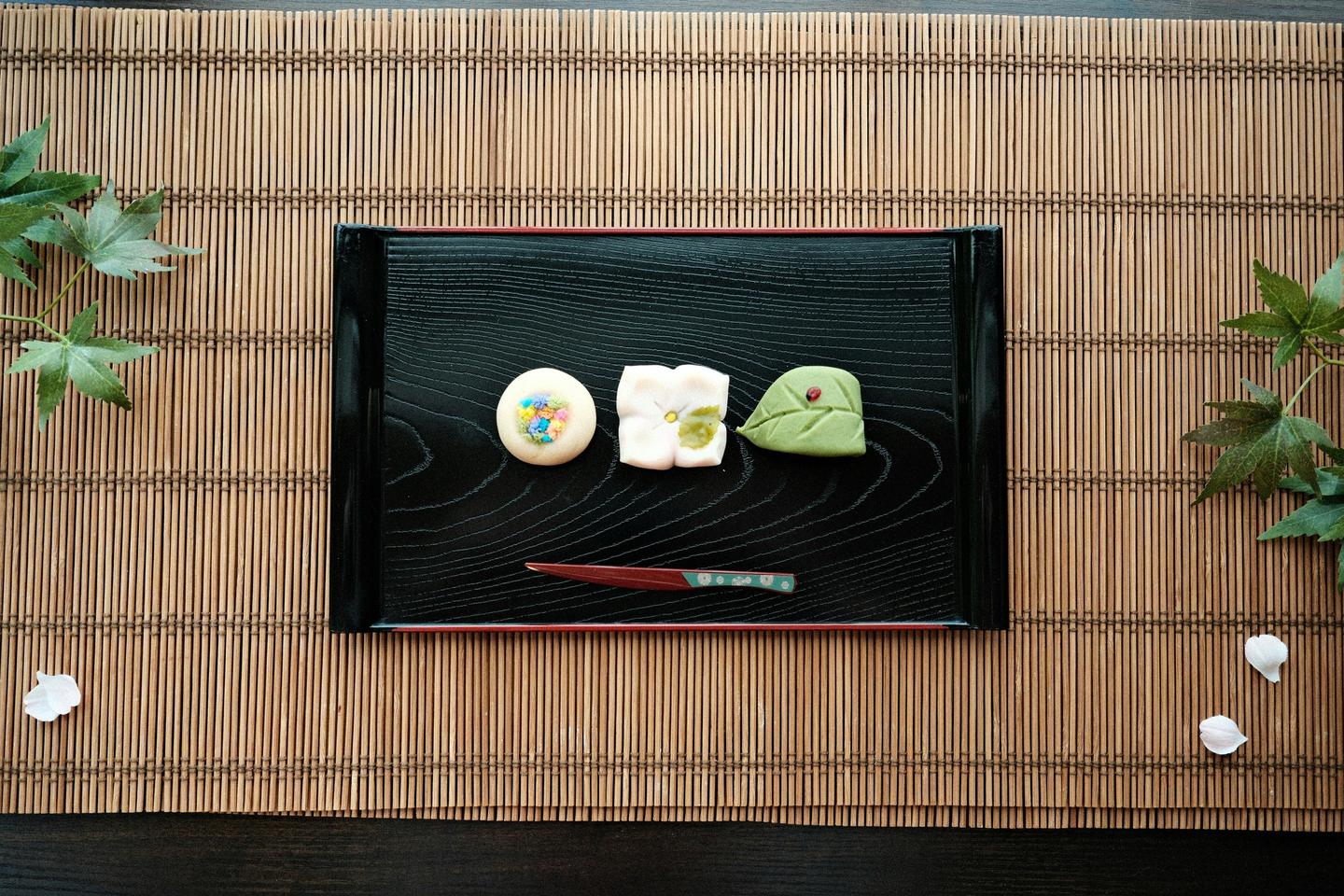
The design magazine Discover Japan puts the same pairing simply: jo-namagashi with thick tea, higashi with thin. The difference matters to a guest because it explains the rhythm of a gathering. The main sweet prepares the palate for the bitter depth of koicha; the dry sweet, a few centimetres of sugar pressed into a flower or a wave, accompanies the lighter bowl that follows.
A CALENDAR YOU CAN EAT
Japan's traditional calendar divides the year by the sun. The National Astronomical Observatory of Japan defines each of the twenty-four solar terms by the sun's longitude, with the spring equinox at zero degrees and a new term every fifteen. Toraya writes that these terms are closely bound to wagashi, which mirror the scenery of each season. Its sweets carry names such as Taoru Sakura, the cherry branch broken off in passing, and Miyama no Yuki, snow in the deep mountains.
The tradition is old. Toraya traces the seasonal designs and names to the refined sweets of the Edo period, the forerunners of today's jo-namagashi, and the Japan Wagashi Association describes Kyoto's confectioners and those of Edo competing in names and designs. Sugar reached Japan around 750 but came into wide use only from the Edo period. For a traveller, this is the reason to eat wagashi where it is made: in November the counter shows the turning leaves; by December it has moved on.
TORAYA AND THE PATTERN BOOKS
Toraya was founded in Kyoto in the late Muromachi period. When the capital moved to Tokyo in 1869, it opened in Tokyo while keeping its Kyoto shop. Its archive holds 43 surviving pattern books in 53 volumes, catalogues of designs from the Edo to the Showa period, the oldest dated 1695. Toraya's Kyoto Ichijo shop has a tea room, Toraya Karyo, where the season's sweets can be taken with tea in quiet.
We suggest Toraya for a guest who wants to understand the long line of the craft before visiting the smaller Kyoto houses, and for its yokan, the dense bean confection it is known for, as a gift that travels.
THE OLD HOUSES OF KYOTO
Kagizen Yoshifusa was founded in the Kyoho era and has made sweets in Gion ever since, for tea masters and monks, and for the patrons of the district's teahouses and restaurants. Its Shijo main shop has a tea room that does not take reservations. Nearby, its small museum ZENBI shows the applied art of the woodworker Kuroda Tatsuaki and others with whom the house has long had ties. It is the natural pause in a Gion afternoon.
Suetomi, founded in 1893 on Matsubara Street, makes main sweets that express the Kyoto year. Its blue wrapping paper began after the war, when the second master asked the painter Ikeda Yoson to design it, and the house compares that work to the way a host and a confectioner build the sweets for a tea gathering together. Kameya Yoshinaga, founded in 1803, also teaches sweet-making. Kameya Matsuhiro, founded in 1804, changes the dry sweets in its box Kyo no Yosuga about fourteen times a year, according to Discover Japan; we choose it for a guest drawn to higashi.
A SWEET MADE FOR YOUR TABLE
The most personal form of wagashi is the sweet made to order. Suetomi states that it accepts made-to-order fresh sweets. Kameya Yoshinaga takes personal orders with seven days' notice, and more for large numbers or in summer. For a private tea gathering, an anniversary or a dinner you host, we ask a house on your behalf to make a sweet for the day: the colour of a season, a flower from your garden at home, a name you would like to give it. Whether and how it can be made is the confectioner's decision.
Within a Signature journey (USD 3,500 for your group, journeys of 7 to 21 days), we place wagashi beside the tea: a morning in Uji, a gathering in a Kyoto tea room, an afternoon in Gion. Sweets are settled at the shop or on your hotel bill, in the simplest way available.
SOURCES AND HOW WE CHECKED
We read the pages below on November 5, 2026. We did not contact any shop, association or institution. Seasonal sweets and shop hours change.
- Kotobank, Nipponica encyclopedia, tea sweets (Japanese): omogashi and higashi prepared at today's tea gatherings
- Japan Past and Present (UCLA and Waseda University), tea gathering terms: omogashi eaten with a pick, higashi by hand with thin tea
- Kyoto City Tourism Association, Kyogashi: namagashi with thick tea, higashi in wooden moulds with thin tea
- Discover Japan, Kameya Matsuhiro (Japanese): jo-namagashi with thick tea and higashi with thin, founded 1804, Kyo no Yosuga changed about 14 times a year
- National Astronomical Observatory of Japan, the 24 solar terms (Japanese): defined by the sun's longitude, spring equinox at 0 degrees, 15-degree steps
- Toraya, the 24 solar terms (Japanese): the terms and wagashi, Taoru Sakura and Miyama no Yuki
- Toraya, about wagashi (Japanese): Edo-period sweets with seasonal designs and names, forerunners of jo-namagashi
- Toraya, history (Japanese): founded in Kyoto in the late Muromachi period, Tokyo in 1869 with the Kyoto shop kept
- Toraya, pattern books (Japanese): 43 items in 53 volumes, the oldest dated 1695
- Toraya, shops (Japanese): Kyoto Ichijo with Toraya Karyo tea room
- Japan Wagashi Association, history (Japanese): Kyoto and Edo sweets in competition, sugar around 750 and widely from the Edo period
- Kagizen Yoshifusa (Japanese): founded in the Kyoho era in Gion, sweets for tea people, monks and teahouses
- Kagizen Yoshifusa, Shijo main shop (Japanese): the tea room does not take reservations
- ZENBI, Kagizen Art Museum (Japanese): Kuroda Tatsuaki and the applied arts
- Suetomi (Japanese): main sweets of the Kyoto calendar, made-to-order fresh sweets
- Suetomi, about (Japanese): founded 1893, the blue paper by Ikeda Yoson
- Kameya Yoshinaga, personal orders (Japanese): founded 1803, seven days' notice
QUESTIONS TRAVELLERS ASK
What is the difference between omogashi and higashi?
Omogashi is the moist main sweet, usually served with thick tea and eaten with a pick. Higashi is the dry sweet, pressed in a mould and taken by hand with thin tea.
Can fresh wagashi be taken home?
Fresh sweets do not keep long. For gifts that travel, we would choose dry sweets or yokan.
Can we have a sweet made for a special occasion?
Several Kyoto houses make sweets to order, and some ask for a week's notice. We ask on your behalf; the design and the date are the confectioner's decision.
Can we sit down to eat wagashi in Kyoto?
Yes. Kagizen Yoshifusa in Gion and Toraya's Kyoto Ichijo shop both have tea rooms. Kagizen's tea room does not take reservations, so we plan the visit around quieter hours.
ASK US TO PLACE THE TEA AND THE SWEETS IN YOUR DAYS
Tell us when you are coming and what you would like to taste. We will set out the tea rooms, the houses and the gatherings, with the reasons, so that you can choose.
Begin planning →We reply within 24 hours, in writing
Some of the restaurants and bars we arrange seat guests only by introduction or membership. We ask on your behalf; the table and the evening are the house's decision. We do not publish their names.