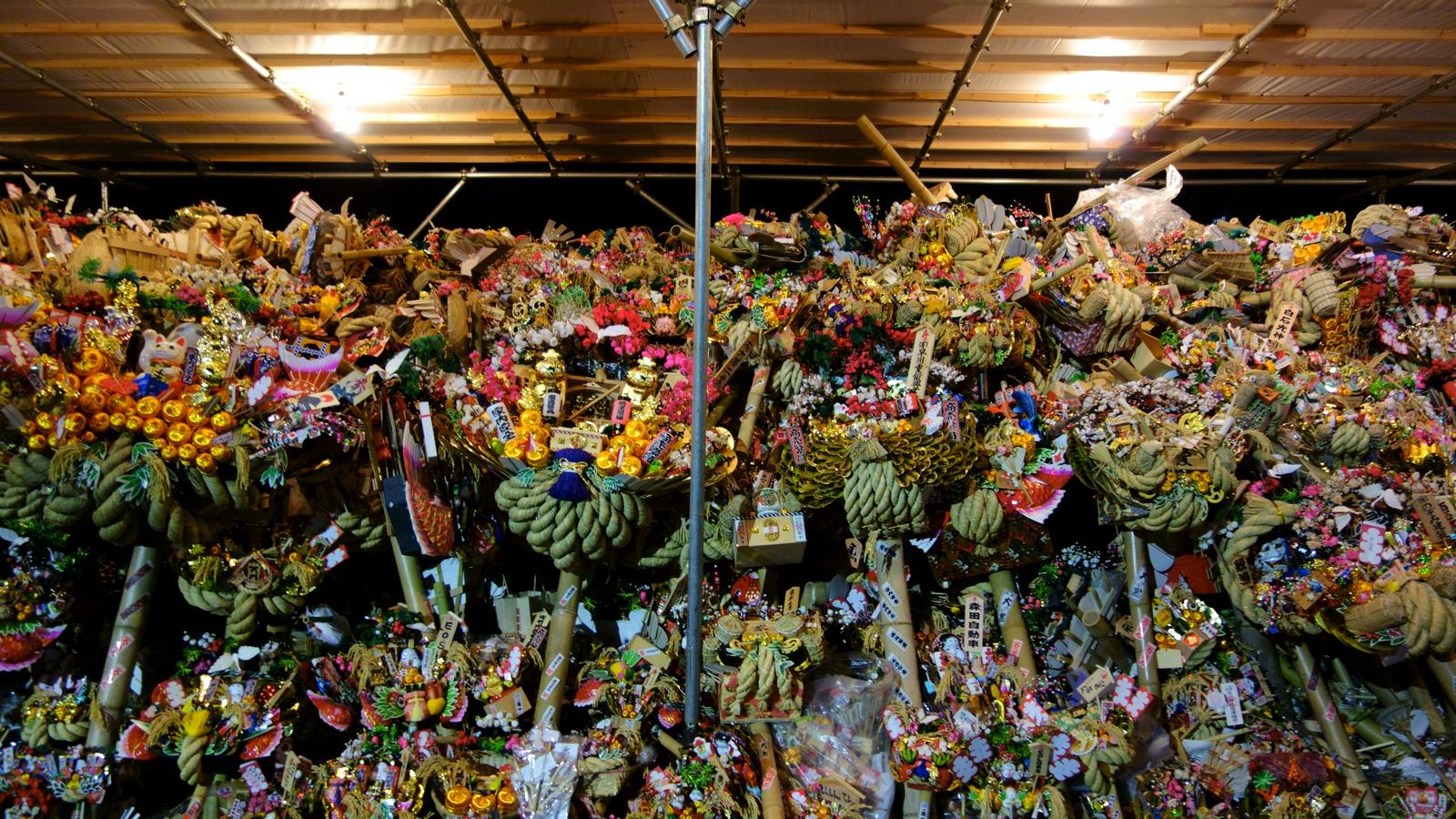
Tori no Ichi is a November fair held at Ōtori shrines on the days of the rooster, one of the twelve signs used to count days in the old calendar, and its emblem is the kumade, a decorated bamboo rake said to rake in good fortune. In 2026 the rooster days fall on Saturday, November 7 (the first, called ichi no tori) and Thursday, November 19 (the second, ni no tori), and there is no third. Otori Shrine in Asakusa, where the fair is said to have begun, holds it from midnight to midnight on both days. Hanazono Shrine in Shinjuku and Ōkunitama Shrine in Fuchū list the same two dates, and Hanazono adds an eve-of-festival fair on November 6 and 18.
Below are the 2026 dates and hours as each shrine publishes them, what the kumade stands for, how a rake is bought by the old custom, and how to choose an hour that suits you. We read each shrine's own pages, the National Diet Library and Meguro City's history page on October 22, 2026, and did not contact any shrine; the sources are listed at the end. The 2027 dates had not been published by any of these shrines on that day. For the other charms Japanese homes keep through the year, see Japanese Lucky Charms: Maneki Neko, Kadomatsu and Wind Chimes →.
Key points
- Tori no Ichi is held on the rooster days of November. A year has two or three of them; 2026 has two, Saturday, November 7 and Thursday, November 19.
- Otori Shrine in Asakusa holds the fair from midnight to midnight on both days, opening with a drum at 0:00. Its eve rite begins at 11:15 pm on November 6 and 18.
- Hanazono Shrine in Shinjuku opens its stalls from about 3 pm on November 6 and 18 and from about noon on November 7 and 19, until midnight, and may limit entry when it is crowded after 6 pm.
- Otori Shrine says rakes start at about ¥1,000 and run to hundreds of thousands of yen, with most sold at around ¥20,000 to ¥50,000.
- By the old custom, a buyer who talks the price down leaves the difference with the stall as a gift, and the sale is closed with a round of rhythmic hand clapping called tejime.
WHAT TORI NO ICHI IS
In the old calendar each day carries one of twelve animal signs, so a rooster day comes round every twelve days. The National Diet Library explains that the first rooster day of November is called ichi no tori, the one twelve days later ni no tori, and, when the calendar allows a third, san no tori. Otori Shrine in Asakusa writes that the festival runs to the second rooster day when November has two and to the third when it has three, and that it makes no difference which of them you come on. The shrine counts more than ten Tori no Ichi fairs in Tokyo today.
Otori Shrine, known locally as Otori-sama, traces the festival to the legendary prince Yamato Takeru. Its history page says that he hung a rake on a pine in front of the shrine to celebrate a victory, and that the day of his visit of thanks was a rooster day in November, which became the shrine's festival day. The shrine also notes that the proper name was Tori no Machi, the rooster festival, and that the word for market came to be written in its place as stalls gathered around it. The shrine quotes an Edo almanac, the Tōto Saijiki, which dated the crowds to some sixty years before 1832, and the haiku poets Kikaku, Shiki and Kyoshi all wrote of the fair; in Japanese poetry it is a word for winter.
The shrine's own count puts the Asakusa fair at about 150 rake stalls and some 750 other stalls, with 700,000 to 800,000 visitors a year. Other shrines tell their own beginnings. Meguro City's history page says the fair at Ōtori Shrine in Meguro, the oldest shrine in the ward, began in November 1835, when a sake brewer in Shimo-Meguro sent to Asakusa for rakes, and that it started as a market where nearby farmers sold vegetables and tools. At Ōkunitama Shrine in Fuchū, the fair belongs to the Ōtori shrine in its grounds.
THE 2026 DATES AT FOUR TOKYO SHRINES
The table gives the 2026 dates as each shrine or city had published them on October 22, 2026. Where a shrine gives no hours, we have left the hours out.
| Shrine | First rooster day | Second rooster day | Hours as published |
|---|---|---|---|
| Otori Shrine, Asakusa (Taitō) | Sat, Nov 7 | Thu, Nov 19 | Midnight to midnight on each day; eve rite 11:15 pm on Nov 6 and 18 |
| Hanazono Shrine, Shinjuku | Sat, Nov 7 (eve fair Fri, Nov 6) | Thu, Nov 19 (eve fair Wed, Nov 18) | Eve: stalls from about 3 pm to midnight. Main day: from about noon to midnight |
| Ōkunitama Shrine, Fuchū | Nov 7 | Nov 19 | Not given |
| Ōtori Shrine, Meguro | In November on the rooster days; no 2026 dates found on an official page | Not given | |
Hanazono Shrine says about 260 stalls take part, that its lanterns go out at about midnight on every night of the fair, and that it may restrict entry to the grounds when crowds build after 6 pm. Otori Shrine says it has no parking on fair days and asks visitors to come by public transport. Its nearest station is Iriya on the Hibiya Line, about seven minutes on foot, or Asakusa on the Tsukuba Express, about eight. Ōkunitama Shrine is about five minutes from Fuchū Station on the Keiō Line.
For 2027, none of these shrines had published dates on October 22, 2026. Hanazono posted its 2026 notice on October 7, so autumn is when to look. For the rest of the year's festivals, see Japanese Festival Calendar: Holidays and Customs by Month →.
WHAT THE KUMADE MEANS
A kumade is a rake, the tool for gathering fallen leaves. Meguro City's page explains how the rake and the yatsugashira taro sold beside it became charms: the taro came to stand for rising to the head of others, and the rake for raking treasure into the house. Its page on Ōtori Shrine also records an older story, that the rake recalls the three-pronged metal rake with which Yamato Takeru beat back a fire.
Otori Shrine writes that rakes were once mainly for people in trade, and that today they are also bought for love, for the safety of a family, for health and for luck in competition. Its history page traces the decoration over time. From the mid Edo period to the early 1830s, a rake was a long-handled working tool with an Okame mask and paper streamers tied to it. Since then it has gathered treasure ships, folding fans, carriages and many other ornaments, and each year brings designs that follow the fashion. Okame, the round, smiling face also called Otafuku, has decorated the fair's rakes since the Edo period, the shrine says, as a figure who brings good fortune.
Two kinds of rake are sold. Otori Shrine itself offers a small rake charm called kakkome, given only during Tori no Ichi; it starts with the midnight drum, and the first person to receive one is given a gold coin charm by the shrine. The large decorated rakes are made and sold by the rake stalls around the grounds. At Hanazono, a flower rake called hana-kumade is offered only on the main festival days and in limited numbers.
HOW A KUMADE IS BOUGHT
Otori Shrine sets out the buying in a few steps. First settle on a design and a budget. Then walk the whole grounds once before choosing, because every stall has its own style, and two rakes of the same size can differ in price by the number and kind of ornaments. The shrine says rakes start at about ¥1,000 (about US$6) and go to hundreds of thousands of yen, and that the ones most often sold are about ¥20,000 to ¥50,000 (about US$130 to US$320).
Then the bargaining begins. The shrine describes it as a contest of nerve between the stall keeper and the buyer. In the old days, it says, the stylish way to buy was to leave the amount you had talked off with the stall as a gift, goshūgi. The buyer pays the asking price after all, enjoys a moment of feeling like a lord, and the stall keeper enjoys feeling he has done better than expected. The deal is then closed with tejime, the rhythmic hand clapping that marks the end of a bargain, with wishes for the household or company. Otori Shrine calls this exchange the way rakes have been bought since the Edo period.
The shrine adds one more custom: start with a small rake and buy a larger one as the business or household grows. A rake from the fair is a craft object in its own right, and you can also simply come to look at the stalls and the lanterns without buying.
WHAT ELSE IS SOLD AT THE FAIR
Otori Shrine lists the other traditional foods of the fair. Yatsugashira, a large taro that sends up many shoots from one root, is sold as a charm for rising in the world and for children; the shrine says only one stall in the grounds still sells it, the second on the right inside the torii. Kiri-zanshō, a sweet rice cake flavoured with sanshō pepper and cut into strips, is sold at the first stall on the right, and at a few more outside the grounds.
CHOOSING THE HOUR
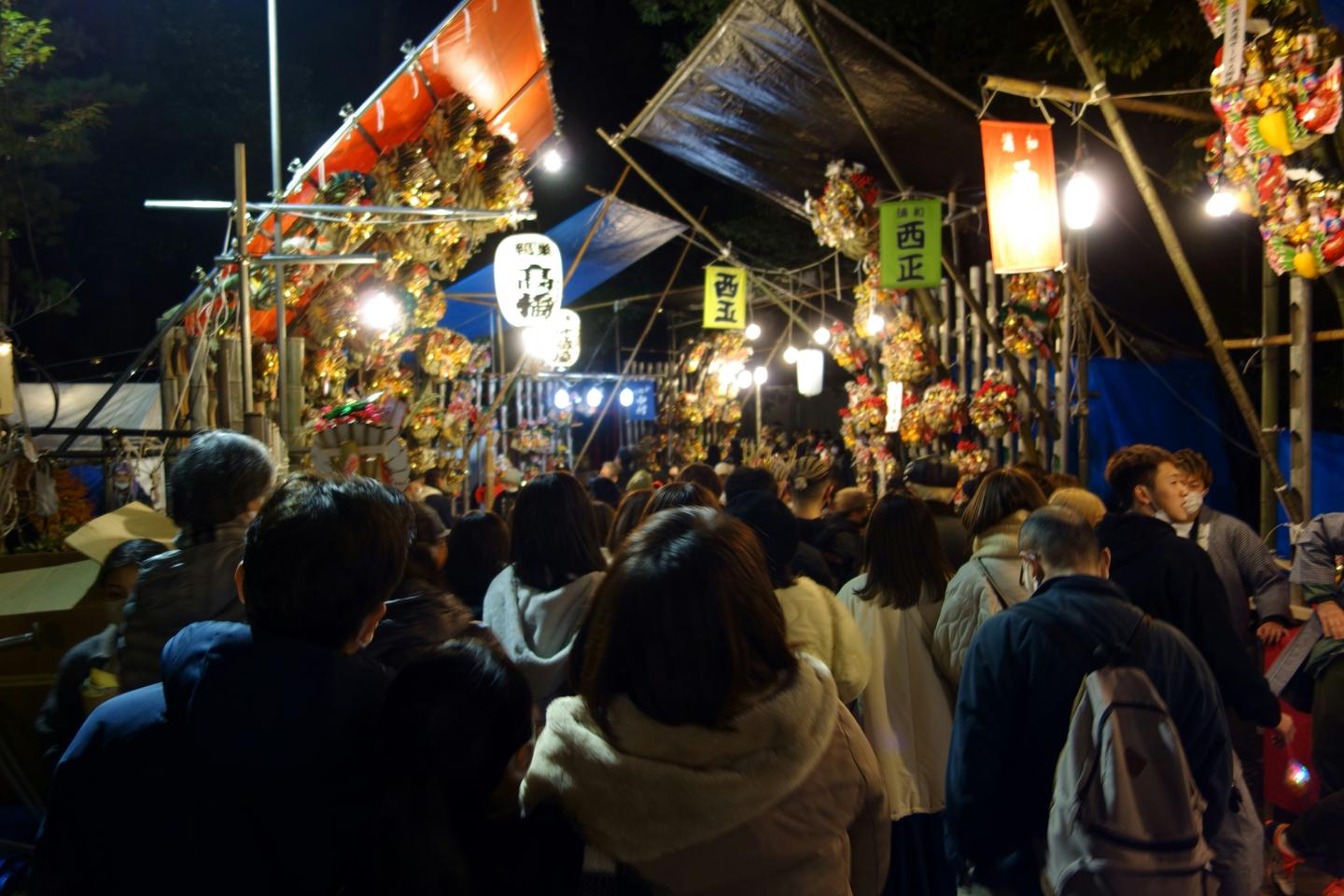
At Otori Shrine the fair opens at midnight with the first drum, and the shrine holds it through the whole day. Hanazono's stalls open from mid afternoon on the eve and from about noon on the main day. Both close at about midnight. The evening, when the lanterns are lit, is when Hanazono warns that it may restrict entry.
For a first visit, the daylight hours give a clearer view of the rakes and more room to talk with the stall keepers, and in 2026 the second rooster day falls on a Thursday. The lit evening is the fair at its most crowded and most photographed. A guide who knows the grounds can walk you to the stalls worth seeing and explain the ornaments and the bargaining as it happens.
For those who want to take part in a rite, Otori Shrine holds its eve rite at 11:15 pm on November 6 and 18 and a special rite at 1 pm on November 7 and 19, and attending either needs booking in advance. These are religious ceremonies, and the fair can be enjoyed fully without them.
KEEPING A KUMADE AT HOME
Otori Shrine's page on keeping charms says a new rake is usually put up on December 28, and that if you are replacing an old one you may hang the new one at once. It suggests a high place facing south or east, avoiding north. A rake kept for a year is returned to the shrine or temple where it was bought, with an offering for the ceremonial burning. Taken home abroad, a rake is simply a decoration.
A large rake is bulky and its ornaments are fragile, so think about how it will travel. Small rakes from about ¥1,000 are sold as well, and the shrine notes that rakes made to stand on a shelf have joined the hanging kind as homes have changed.
WHERE STAYGO COMES IN
STAYGO plans private trips across Japan from Tokyo. If your dates include November 7 or 19, tell us, and we will ask what can be arranged: a guide to walk the Asakusa or Shinjuku fair with you at a quieter hour, or time with the people who make the rakes. We will tell you plainly what was possible and what was not. We arrange everything in your names, and you pay the guides, hosts and stalls directly at their own prices, with no commission or markup from us. Trips are planned on the Signature plan, for 7 to 14 days, or as Bespoke for longer or more complex journeys.
SOURCES AND HOW WE CHECKED
We read the official pages listed below on October 22, 2026. We did not contact the shrines, the library or the city, and we did not use figures from guidebooks, booking sites or press coverage. Dates and hours are those published for 2026 and can change; check the shrine's own page before you go. Dollar amounts are a guide only, at ¥158 to US$1 (October 2026); stalls charge in yen.
- National Diet Library, Tori no Ichi: first, second and third rooster days, twelve days apart
- Otori Shrine, Asakusa, this year's Tori no Ichi: 2026 dates, hours, rites and the first kakkome
- Otori Shrine, history: Yamato Takeru, Tori no Machi, the almanac and the rake's ornaments
- Otori Shrine, notes on Tori no Ichi: number of stalls and visitors, prices, bargaining, goshūgi, tejime, foods of the fair
- Otori Shrine, keeping rakes and charms: when and where to put a rake up, returning an old one
- Otori Shrine, access and parking: stations and no parking on fair days
- Hanazono Shrine, 2026 Ōtori festival and yearly events: dates, stall hours, number of stalls, entry limits and hana-kumade
- Ōkunitama Shrine, Ōtori Shrine festival: dates, the three rooster days and the history of the fair
- Meguro City, Ōtori Shrine: the fair's beginning in 1835 and the meaning of the rake and the taro
QUESTIONS TRAVELLERS ASK
When is Tori no Ichi in 2026?
On the two rooster days of November 2026, Saturday, November 7 and Thursday, November 19. Otori Shrine in Asakusa, Hanazono Shrine in Shinjuku and Ōkunitama Shrine in Fuchū all list these dates, and there is no third rooster day this year.
When is Tori no Ichi in 2027?
The shrines had not published 2027 dates on October 22, 2026. The fair is always on the rooster days of November, and Hanazono Shrine posted its 2026 notice in early October, so look at the shrines' own pages in the autumn.
What does a kumade mean?
A kumade is a rake, and as a charm it is said to rake treasure and good fortune into the house. Otori Shrine says rakes were once bought mainly by people in trade and are now bought for family, health and other wishes too.
How much does a kumade cost?
Otori Shrine says the rakes at its fair start at about ¥1,000 and reach hundreds of thousands of yen, and that the most popular are about ¥20,000 to ¥50,000. The price depends on the size and on the number and kind of ornaments.
Do I need to be religious to visit Tori no Ichi?
No. The fair is a shrine festival with a large market around it, and you can come to see the stalls and the rakes. The rites are separate and need booking, and you can visit the fair without taking part in them.
ASK US ABOUT TORI NO ICHI
Send us your November dates. We will ask about a guided walk through the fair at a quieter hour and about meeting the rake makers, and come back with what we were able to confirm.
Begin planning →