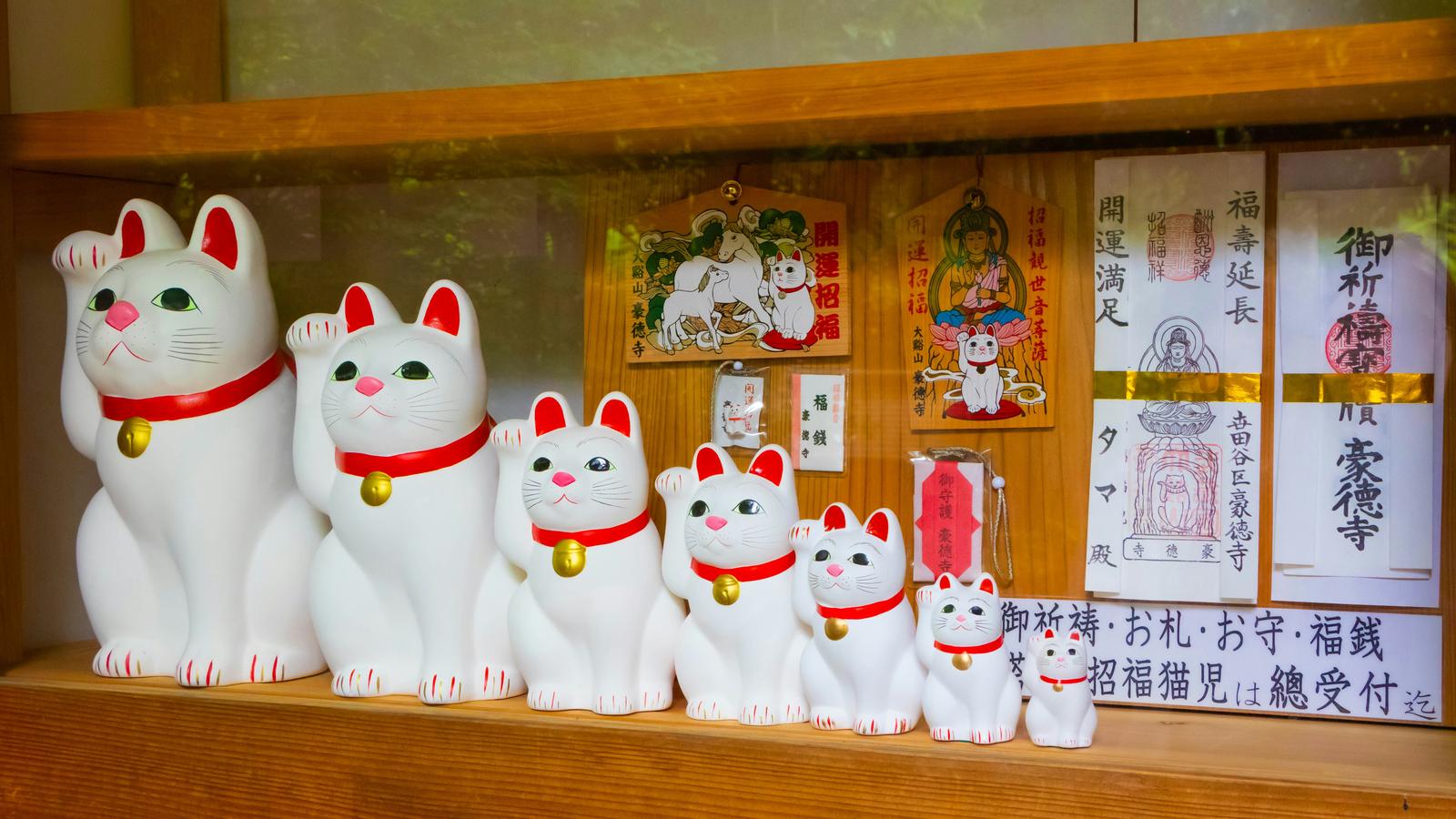
Japanese homes and shops keep a set of lucky objects, called engimono, and most of them belong to a season. The beckoning cat, maneki neko, stays all year: a raised left paw is said to beckon people and a raised right paw fortune, and Gotokuji temple in Tokyo, which tells the story of a cat that waved in a feudal lord, offers its own right-pawed cats for ¥500 to ¥10,000. Pine kadomatsu, straw shimekazari and the stacked rice cakes of kagami mochi go up in late December and come down in the first half of January, on dates that vary by region. The hamaya arrow is a New Year charm, the bamboo kumade rake belongs to the Tori-no-Ichi fairs of November, and the glass furin wind chime belongs to summer.
Below are seven of these objects: what each one is said to bring, when it appears, where it is made or sold, and what travels home well. We present them as crafts and seasonal customs, which anyone can enjoy or take home, whatever their beliefs. We checked each fact on October 22, 2026, on the official pages of temples, shrines, city offices, Japan's Ministry of Agriculture, Forestry and Fisheries and the Japan Tourism Agency; the sources are listed at the end. This is one of five STAYGO articles on Japanese customs, alongside Daruma Dolls: What the Eyes Mean and Where to Buy One →, Omamori: Japanese Shrine Charms and What Each One Is For →, Tori no Ichi: Tokyo's Kumade Rake Fair and Its Dates → and Japanese Festival Calendar: Holidays and Customs by Month →.
Key points
- A maneki neko with its left paw raised is said to beckon people, and one with its right paw raised fortune and wealth, according to the Japan Tourism Agency's entry on Tokoname, a leading producer of the ceramic cats.
- Gotokuji in Setagaya, Tokyo, offers right-pawed cats without a gold coin from ¥500 to ¥10,000 at its office, open 8:00 to 15:00; some sizes can be out of stock.
- Kadomatsu, shimekazari and kagami mochi are New Year decorations; the Ministry of Agriculture gives January 11 for kagami biraki, when the rice cakes are struck open with wood and eaten.
- Kawasaki Daishi's wind chime market ran from July 17 to 21 in 2026, with about 800 kinds of furin from across Japan.
MANEKI NEKO THE BECKONING CAT
The maneki neko is a seated cat with one paw raised, copying the Japanese gesture for calling someone over: the hand up, palm down, fingers moving. The Japan Tourism Agency's multilingual guide, in its entry on Tokoname in Aichi Prefecture, describes the usual cat as a calico with white, black and orange markings, holding a gold coin in the other paw. It says a cat with the left paw raised is said to beckon people, which is why shops like it, and one with the right paw raised is meant to bring good fortune and wealth. The same entry says the origin of the figure is unclear.
Two places in Tokyo tell their own beginnings. Gotokuji, a temple in Setagaya, says a cat at its gate beckoned Ii Naotaka, lord of the Hikone domain, as he rode back from a hawking trip; he stopped, a thunderstorm broke, and he spent the rain talking with the priest. The temple says it was rebuilt with his support in 1633, and it calls its cats shofuku neko, beckoning good fortune. Its cats raise the right paw and hold no coin. The temple explains why: the cat brings people and connections, and what comes of them depends on the person, so fortune arrives for those who are grateful. Rows of offered cats stand at the temple's offering place; the temple says there is no rule about offering one, though many people bring a cat back after a wish has come true. The grounds are open 6:00 to 17:00. The temple asks visitors not to write on the cats.
Imado Shrine, about 15 minutes on foot from Asakusa Station, stands where Imado ware was fired from the 16th century. Taito City's tourism site says cat figures were sold here, so the shrine is also counted as a birthplace of the maneki neko, and it is known for matchmaking, with paired cats on its ema plaques. Its office is open 9:00 to 16:00. Taito City's cultural heritage pages add that Imado ware was made and sold around Imado in the Edo and Meiji periods, and that one Imado ware craftsman still works in the ward, making about 80 kinds of dolls and lucky figures with his mother. Imado dolls, the maneki neko among them, are pressed from clay in molds, fired and painted.
For the craft side, Tokoname is the place to see. The Japan Tourism Agency says local makers turned to the cats in the late 1930s and that by 1950 the city was the country's main producer. Maneki Neko-dori, a street near the station, is lined with 39 modern cats by artists with ties to the town, and Tokonyan, a giant cat face with a raised left paw, looks over a wall nearby: 3.8 meters high and 6.3 meters wide.
HAMAYA AND KUMADE AT THE TURN OF THE YEAR
Two charms are bought at shrines around the change of year and then kept at home. The hamaya is a charm in the shape of an arrow. The Japan Tourism Agency describes arrow-shaped hamaya as believed to ward off misfortune and bring good luck, and popular with visitors to shrines on New Year's Day. Its entry on a National Treasure set of bow and arrows at Tsurugaoka Hachimangu in Kamakura says those arrows are said to be the origin of the custom. Hamaya are offered at many shrines over the New Year; the design and the offering differ from shrine to shrine.
The kumade is a bamboo rake for raking in good fortune, sold at the Tori-no-Ichi fairs held on the days of the rooster in November. Otori Shrine in Asakusa says its fair has been held two or three times every November since the Edo period, and that stalls in its grounds sell rakes decorated with symbols of good fortune. In 2026 the days are Saturday, November 7 and Thursday, November 19, each from midnight to midnight. The shrine itself offers a small rake charm called kakkome, apart from the stalls. More on the fair is in Tori no Ichi: Tokyo's Kumade Rake Fair and Its Dates →.
KADOMATSU SHIMEKAZARI AND KAGAMI MOCHI
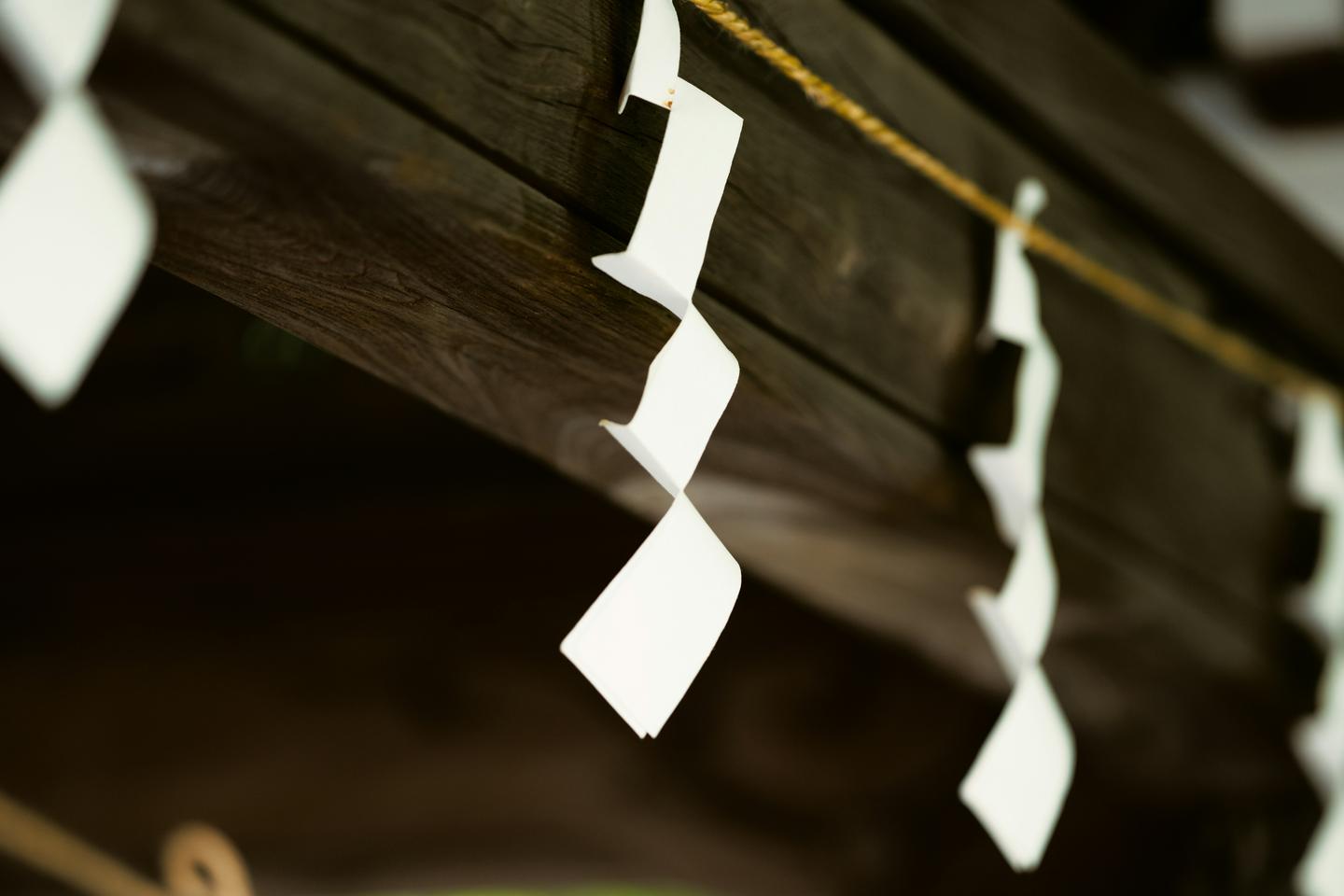
Three decorations mark the New Year in a Japanese home, and all three are tied to the toshigami, the deity of the new year. A Yokohama City Library answer in the National Diet Library's reference database cites a dictionary of Japanese culture describing the kadomatsu, the pine and bamboo arrangement placed at a gate or entrance, as the place where the toshigami comes to rest. The shimekazari is a straw rope decoration hung over the door; Iida City in Nagano describes the straw rope as marking a sacred area. Kagami mochi is an offering to the toshigami. The Ministry of Agriculture, Forestry and Fisheries says the custom is said to date from the Muromachi period, and reads each part: the two rounds of rice cake stand for the sun and the moon, the bitter orange on top for a family that prospers through the generations, and the urajiro fern for long life.
The dates differ by region and by household, and two city records show how much. Iida City's account of local New Year customs has families fetching pine and bamboo in late December, burning the decorations in a bonfire on January 7, opening the rice cakes on January 11, and pulling the last kadomatsu stakes on February 1. Katsushika City's history of annual events in the ward, in Tokyo, records the kadomatsu being taken out once the first three days of the year had passed. The Ministry of Agriculture gives January 11 for kagami biraki, when the rice cakes are taken down and eaten with a wish for good health. A knife is thought unlucky for an offering, so the cakes are struck with wood, and the word "open" is used in place of "break."
For travelers, this is a season to see more than to buy. Katsushika's history records families buying the pine for their kadomatsu at year-end markets and street stalls. If you are in Japan over the New Year, look for the straw ropes over doors in the first week of January.
| Object | When | Where we checked it |
|---|---|---|
| Maneki neko | All year | Gotokuji, Taito City, Japan Tourism Agency |
| Hamaya | New Year | Japan Tourism Agency (Tsurugaoka Hachimangu) |
| Kadomatsu and shimekazari | Late December to early January, by region | Iida City, Katsushika City |
| Kagami mochi | New Year; opened January 11 | Ministry of Agriculture, Forestry and Fisheries |
| Kumade | November, Tori-no-Ichi days | Otori Shrine, Asakusa (2026: Nov 7 and 19) |
| Furin | Summer | Kawasaki Daishi (2026: Jul 17–21), Edogawa City |
FURIN THE SUMMER WIND CHIME
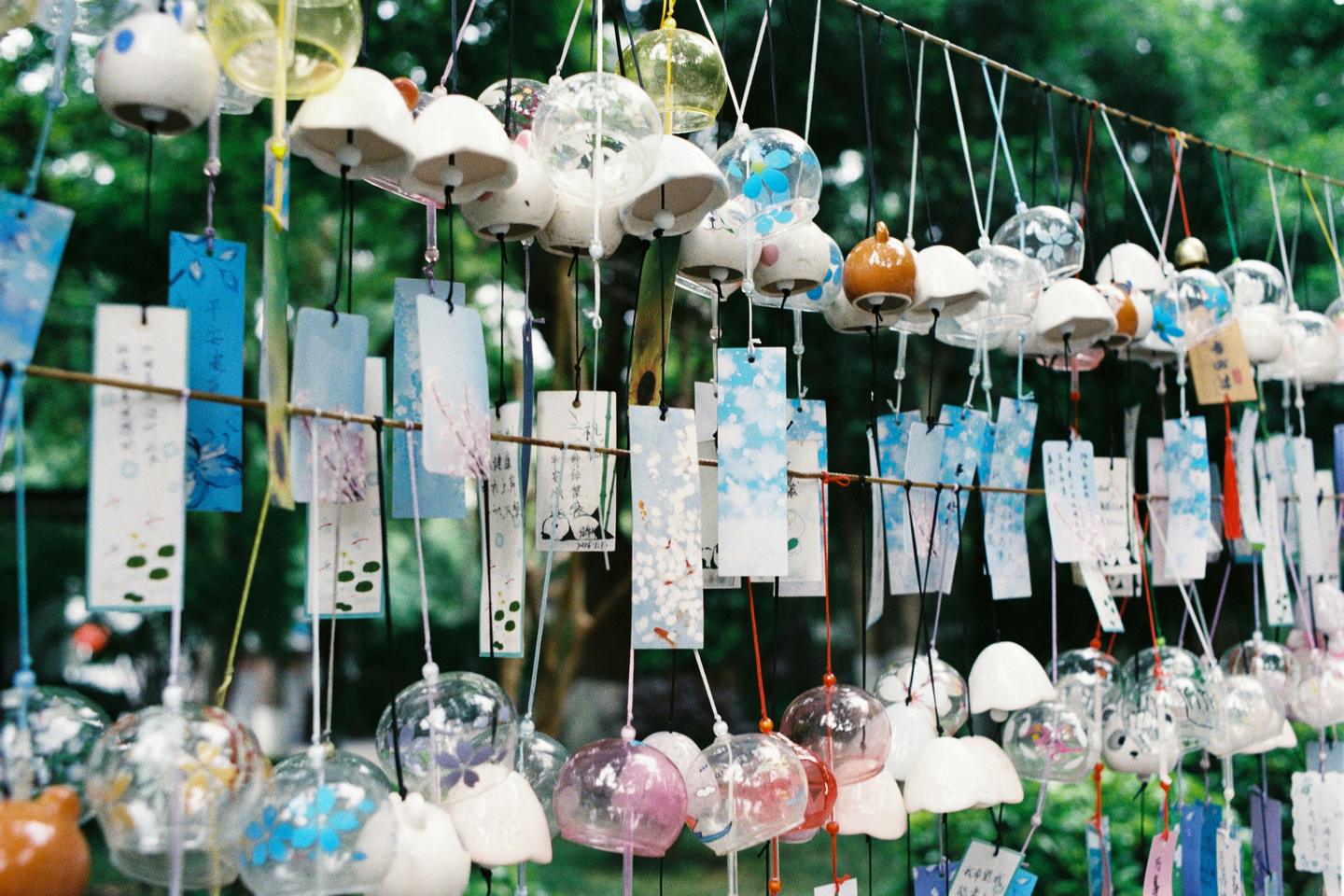
The furin is a small bell hung to ring in the breeze, and the Japan Tourism Agency calls its sound refreshing in the summer heat. Two kinds of maker and one market show its range.
Edo furin are glass chimes from Tokyo. Edogawa City lists Shinohara Furin Honpo, founded in November 1915, as a traditional craft workshop skilled in free-blown glass, open for workshop visits and retail sales. The Tokyo Metropolitan Government's gift catalogue adds that each chime is blown in the air without a mold, entirely by hand, and that the rim where the clapper strikes is left jagged on purpose for the sound, so no two chimes look or ring quite alike. The catalogue lists a small round chime at ¥2,090.
Nanbu ironware from Iwate makes chimes in cast iron. The Japan Tourism Agency notes that workshops there still make kettles and pots by hand, along with wind chimes.
For the whole range in one place, Kawasaki Daishi, the temple between Tokyo and Yokohama, hosts a wind chime market each July. In 2026 it ran from July 17 to 21, from 10:00 to 17:00 (to 19:00 on the 20th), in a space set up in the temple grounds, with chimes gathered from across Japan; Kanagawa's tourism association counts about 800 kinds. The temple also offers its own daruma-shaped chime.
DARUMA AND THE SEVEN LUCKY GODS
The red daruma, the round figure whose eyes are painted in when a wish is made and when it comes true, is the lucky object visitors ask about most. It has its own article: Daruma Dolls: What the Eyes Mean and Where to Buy One →.
The Seven Lucky Gods, shichifukujin, are a common subject for lucky figures and pictures. The Japan Tourism Agency lists them as Ebisu for prosperity and commerce, Daikokuten for agriculture, Bishamonten for protection against evil, Benzaiten for beauty and the arts, Fukurokuju for wisdom and long life, Jurojin for health and long life, and Hotei for happiness, and says they were first named as a group in the Muromachi period. It adds that they are a common motif for the ema paintings offered at shrines. In Asakusa, Imado Shrine is one of the Asakusa Meisho Shichifukujin, the seven sites of the Seven Lucky Gods of Asakusa; Taito City says it enshrines Fukurokuju.
BRINGING ONE HOME
Most of these objects travel well if they are packed with care. A few points we can state from the makers and temples:
- Ceramic and clay cats from Gotokuji, Imado or Tokoname are fired clay and need wrapping. The smallest Gotokuji cat comes in a case for ¥1,000. Gotokuji notes that some sizes may be out of stock.
- Glass furin are blown by hand, one by one, so pack them as you would any glass.
- Kagami mochi is food. The Ministry of Agriculture says rice cake left out grows mold in about a week, so it is a decoration to enjoy where you are, along with the kadomatsu and shimekazari.
- Kumade belong to the fair days in November; our Tori no Ichi: Tokyo's Kumade Rake Fair and Its Dates → covers the fair.
Gotokuji states that it has no partner tours with travel companies or guides, and asks anyone planning guided tours, photography or other commercial activity in its grounds to consult the temple first. For shopping across Tokyo and Kyoto more widely, see our shopping guide, and for manners at temples and shrines, Japanese etiquette for travelers.
WHERE STAYGO COMES IN
STAYGO plans private trips across Japan from Tokyo. If these objects interest you, tell us which ones and when you travel, and we will ask what can be arranged: time with a craftsman at a workshop that receives visitors, or a walk through a market or temple grounds at a calmer hour. We make no promise until the workshop or host has said yes, and we follow each temple's own rules on visits and guiding. We arrange everything in your names, and you pay the workshops, hotels and hosts directly at their own rates, with no commission or markup from us. Trips are planned on the Signature plan or, for longer and more complex journeys, as Bespoke.
SOURCES AND HOW WE CHECKED
We read the official pages listed below on October 22, 2026. We did not contact any temple, shrine, workshop or office, and we did not use figures from blogs, guidebooks, booking sites or press coverage. Dates and prices are those shown on October 22, 2026, and can change; dates given for 2026 apply to that year only.
- Gotokuji, the beckoning cat, history and items offered: the story, the right paw and no coin, the offering of cats, prices, office hours and opening hours
- Gotokuji, notice on commercially guided tours and on writing on the cats: the temple's rules
- Taito City tourism, Imado Shrine: Imado ware, the maneki neko, Fukurokuju, hours and access
- Taito City, Imado ware: history, the workshops and today's craftsman
- Japan Tourism Agency, multilingual guide: Tokoname maneki neko (left and right paw, Maneki Neko-dori, Tokonyan), Tokoname ware (production history), Tsurugaoka Hachimangu bow and arrows (hamaya), Nanbu ironware (wind chimes), Magariya House (the sound of furin in summer) and Itsukushima Shrine, the Seven Lucky Gods
- Otori Shrine, Asakusa, this year's Tori-no-Ichi and English page: 2026 dates, hours, the kakkome charm and the rake stalls
- Ministry of Agriculture, Forestry and Fisheries, kagami mochi: origin, the meaning of each part, kagami biraki on January 11 and keeping rice cake
- Iida City, New Year customs: kadomatsu, shimekazari, kagami mochi and their dates in Iida
- Katsushika City history, annual events: when the kadomatsu came down
- National Diet Library reference database, Yokohama City Library answer on New Year decorations: the kadomatsu and kagami mochi as described in published references
- Kawasaki Daishi, July events and Kanagawa Tourism Association, wind chime market: 2026 dates, hours, venue and number of kinds
- Edogawa City, Shinohara Furin Honpo and Tokyo Metropolitan Government, Edo furin: founding, free-blown glass, visits, the rim and price
QUESTIONS VISITORS ASK
What is the difference between a left paw and a right paw maneki neko?
The Japan Tourism Agency says a cat with the left paw raised is said to beckon people, which is why shops favor it, and one with the right paw raised is meant to bring good fortune and wealth. Gotokuji in Tokyo explains its own right-pawed cats as bringing connections with people, with fortune following for those who are grateful.
Where can I buy a maneki neko in Tokyo?
Gotokuji in Setagaya offers its cats at the temple office from ¥500 to ¥10,000, open 8:00 to 15:00, though some sizes can be out of stock. Imado Shrine near Asakusa is also counted as a birthplace of the cat, and a craftsman in Taito City still makes Imado clay figures, the maneki neko among them.
When are kadomatsu and kagami mochi put up and taken down?
They go up in late December and come down in the first half of January, on dates that vary by region and household. The Ministry of Agriculture gives January 11 for kagami biraki, when the rice cakes are struck open with wood and eaten.
When is the Kawasaki Daishi wind chime market?
It is held each July in the temple grounds. In 2026 it ran from July 17 to 21, from 10:00 to 17:00 and to 19:00 on the 20th, with about 800 kinds of wind chimes from across Japan.
Do I need to be religious to buy a lucky charm in Japan?
No. Many of these objects, such as Edo wind chimes and Tokoname cats, are crafts sold by their makers and in shops. At temples and shrines, follow each one's own requests, such as Gotokuji's request not to write on its cats.
TELL US WHICH CRAFT OR SEASON DRAWS YOU
Tell us which of these objects interests you and when you travel. We will ask the workshops and hosts what can be arranged, such as time with a craftsman or a calm hour at a market, and come back with what they say.
Begin planning →