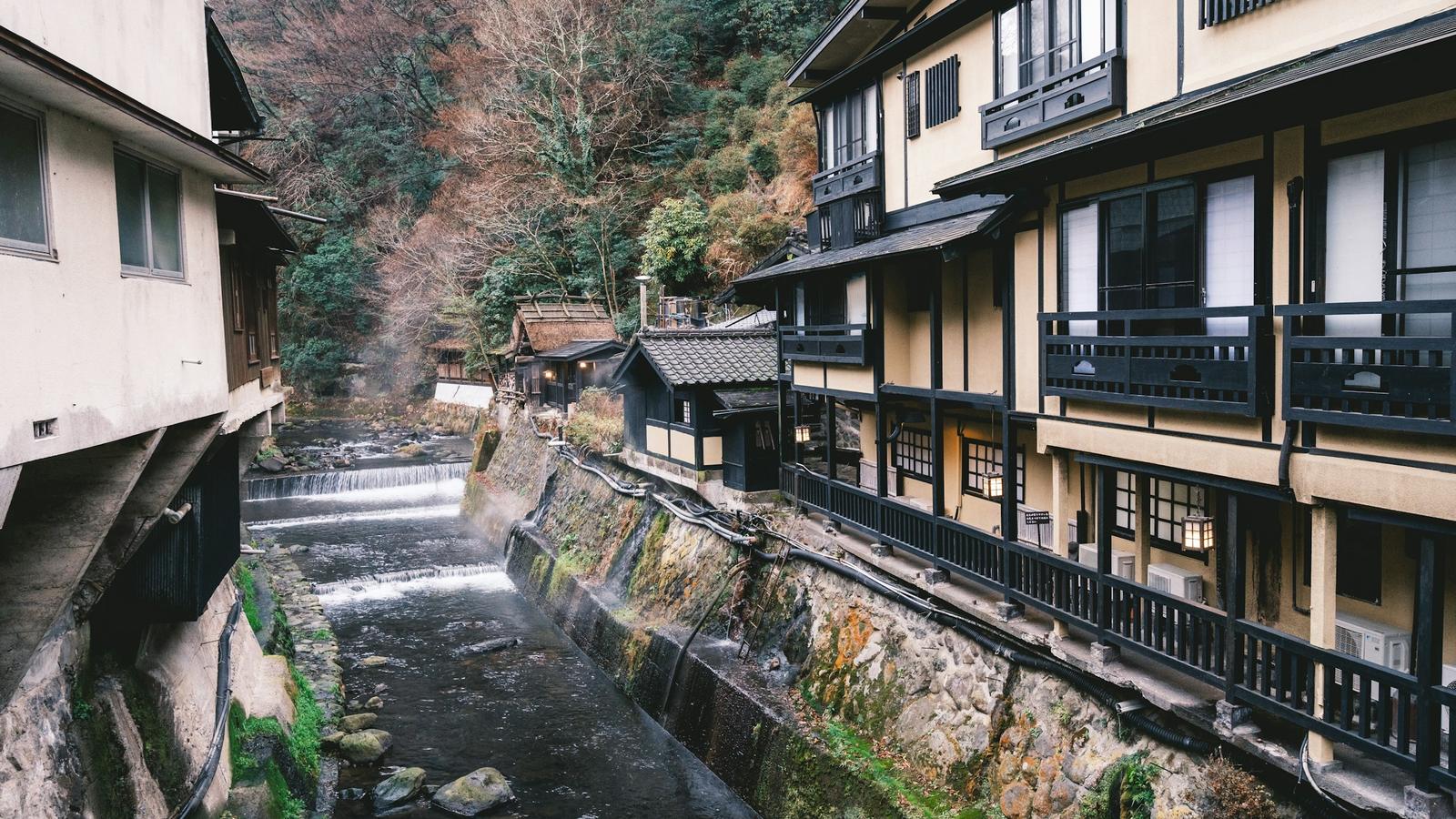
Toji is the old Japanese custom of staying at a hot spring town for several nights or longer, bathing a few times a day and resting in between. The word joins the characters for hot water and for healing. Japan's Tourism Agency describes farmers in the north of Honshu who came to the springs with their families in the off season and stayed for weeks, and how the custom faded as lifestyles changed from the Meiji era on. Since 2017 the Ministry of the Environment has promoted a modern form, which it calls shin-toji: a stay that adds the nature, history and food of the town to the bathing.
Below is what the ministry says about therapeutic springs and how to bathe in them, and four places where toji is still lived: Tamagawa in Akita, Misasa in Tottori, Kannawa in Beppu and Itamuro in Tochigi. We read the ministry's, the Tourism Agency's and the Tokyo Metropolitan Government's pages, the springs' and inns' own sites, a prefectural page, a magazine feature, a booking service and a research column on October 31, 2026, and did not contact any inn. Where a health effect is mentioned, it is given as the source states it. For bathing etiquette in general, see Japan's Onsen Culture: What to Know →.
Key points
- Toji means staying several nights at a hot spring town to bathe and rest. The Ministry of the Environment has promoted a modern form, shin-toji, since 2017.
- Springs that meet the standard of a therapeutic spring are sorted into ten types, and the ministry sets the conditions each type is suited to. These are indications, and some conditions rule bathing out.
- The ministry advises a glass or two of water before bathing and leaving the bath before you feel light-headed. It writes that a single bath costs about 800 mL of fluid on average.
- Tamagawa in Akita has a spring of pH 1.2, Misasa in Tottori is known for radon, Kannawa in Beppu has a steam bath first opened in 1276, and Itamuro in Tochigi keeps its water at about 40°C for long, gentle soaks.
WHAT TOJI MEANS TODAY
The old toji guest cooked for themselves, bathed several times a day and stayed until the work of the farm called them home. Some inns still keep self-catering rooms for this, and some keep a kitchen where guests cook over the spring's own steam. Alongside them, a newer kind of inn has grown up for guests who want the long stay without the cooking: rooms with a view of the river, meals brought to the room, baths open at any hour and nothing on the schedule.
The ministry's shin-toji was proposed in July 2017 by an expert panel on reviving hot spring towns. The ministry describes it as a way of spending time at a hot spring town that suits modern life, in which people enjoy the nature, history, culture and food around the spring and rest body and mind by staying there. Walks, local meals and conversation with the people of the town are part of it, as much as the water.
WHAT THE MINISTRY SAYS ABOUT SPRINGS AND HEALTH
In Japan the word onsen covers many springs, but only those with enough of certain components are classed as ryōyōsen, therapeutic springs. The Ministry of the Environment sorts them into ten types and decides which conditions each type is suited to. It lists general indications shared by all therapeutic springs, such as chronic muscle and joint pain and stiffness, poor circulation, reduced digestive function and recovery from fatigue, and others for each type. For simple springs, the commonest kind, it lists autonomic imbalance, insomnia and low mood.
These are indications, and they come with limits. The national guidance that Tokyo's health bureau publishes also lists contraindications, conditions in which bathing should be avoided, such as an active illness with fever, serious heart or lung disease, or bleeding, and for acid springs, very sensitive skin. A senior fellow at the Research Institute of Economy, Trade and Industry wrote in 2020 that many questions about the effects of hot springs have not yet been settled scientifically. We give the ministry's lists as it publishes them and make no claim of our own.
The ministry's practical advice is simple. Drink a glass or two of water before bathing; one bath costs about 800 mL of fluid on average. Leave before you feel light-headed, which the ministry calls a form of heatstroke. After a strong acid or sulphur spring, rinse with plain water. Tokyo's guidance adds that for the first few days you bathe once or twice a day, rising to two or three times, and stay in for three to ten minutes at first, later up to fifteen or twenty. It warns that between about the third day and the end of the first week of a cure some people feel unwell, sleep badly or get a skin reaction, called yuatari, and that bathing should then be reduced or paused. Finally, put the phone away: the ministry writes that research has reported hormone levels and blood pressure settling after a stay of several days or more, and that even one night helps if it is spent resting rather than sightseeing.
TAMAGAWA AND THE ACID SPRING OF AKITA
Tamagawa Onsen stands in the beech forest of Towada-Hachimantai National Park in Akita, and calls itself the home of toji. The inn describes its water as a strongly acidic spring of pH 1.2 whose main component is hydrochloric acid, rare in the world, and says its flow is the largest in Japan. The main bath, built of Aomori hiba cypress because the wood stands up to acid, has eleven baths, from pure spring water to half-strength, a box steam bath and a standing bath. The inn keeps the pure spring bath cooler than the others because it is so strong, and asks that the drinking water be diluted 38 times. The main bath is open from 3:00 to midnight.
The inn has two sections, a ryokan with meals and a self-catering section with the room only. Meals are a daily changing buffet. Many guests come for the natural bedrock bathing on the warm ground of the national park; staying guests can also use an indoor bedrock room. In 2026 the inn has asked guests on the nature trail to carry the bear bells it lends, to walk in company and to avoid going out at night or early morning. The first snow fell on October 28, 2026, and the bus timetable changes from mid November, so a winter stay needs a car and a driver who knows the mountain road.
MISASA AND THE THREE MORNINGS
Misasa, in the hills of central Tottori, is one of the radon springs of Japan, and its tourist association calls it one of the leading radioactive springs in the world. The name is written with the characters for three mornings, and the association says that after three mornings here you feel well again. The town's legend holds that a white wolf showed the spring to a pilgrim more than 850 years ago.
In 2015 Misasa and Mount Mitoku were recognised together as Japan Heritage. Tottori Prefecture's summary of the story explains that pilgrims climb the cliffs of Mount Mitoku to Sanbutsu-ji to cleanse the six roots of perception, and then rest the six senses by bathing at Misasa. The ministry lists gout, rheumatoid arthritis and ankylosing spondylitis among the indications for radioactive springs. The town's own literature adds that the water is drunk and breathed as well as bathed in, with drinking fountains, a radon steam room and mineral mud packs.
KANNAWA AND THE STEAM OF BEPPU
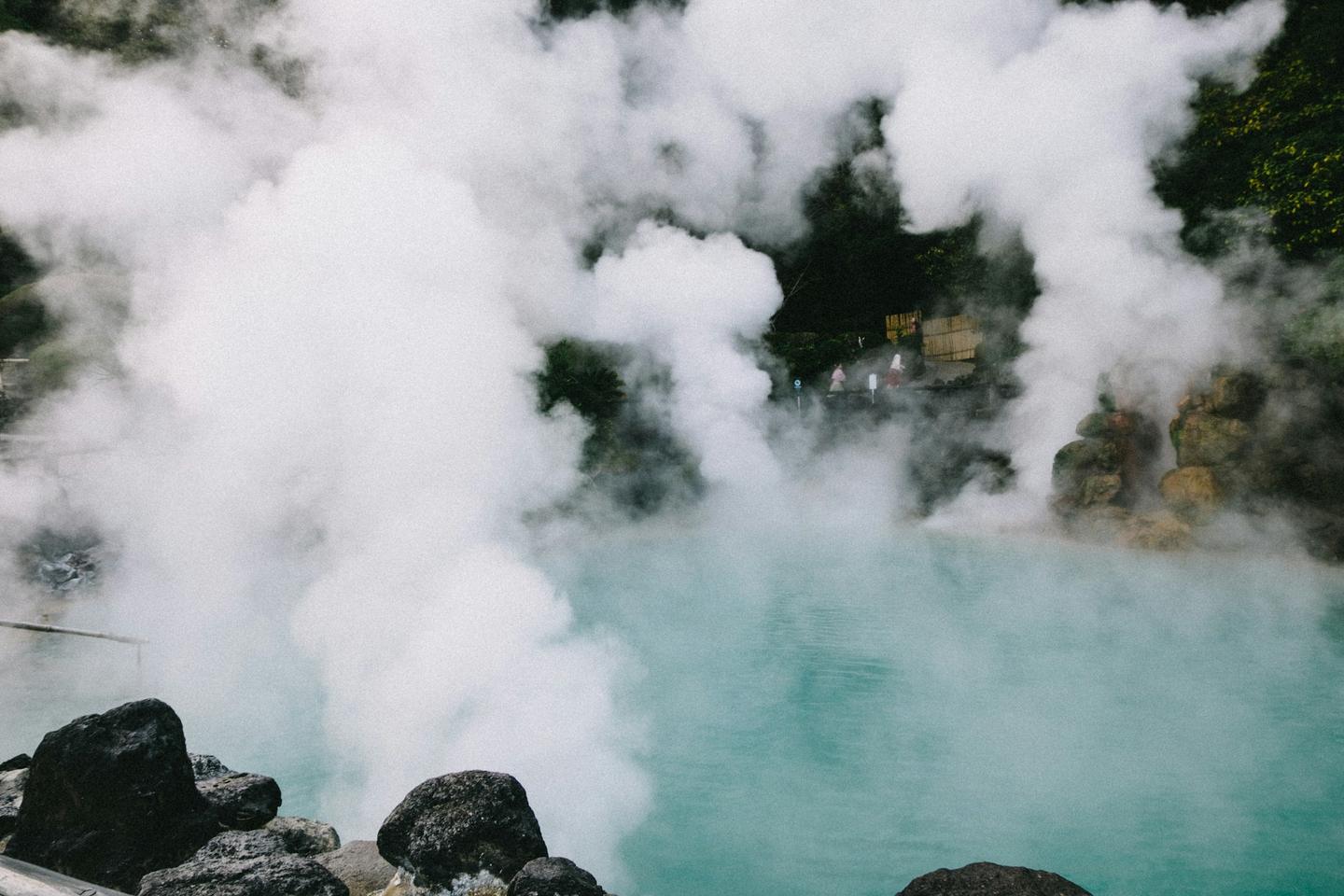
In Kannawa, the steam town of Beppu in Oita, plumes rise from the streets and many inns cook with them. The city's own steam bath, Kannawa Mushiyu, was opened in 1276 by the travelling monk Ippen, whose wooden statue stands by the entrance. Through a door one metre square is a stone room of about eight tatami mats, its floor heated by the spring and covered with sekishō, a sweet flag that grows only beside clear streams, on which you lie down. The poet Noguchi Ujō wrote that its scent stays on the skin on the way home. From October 1, 2026 to January 31, 2027 it opens from 7:30 to 19:30, with last entry at 19:00, and takes four men and four women at a time.
Kannawa still has toji inns where guests cook their own meals over the steam. The magazine Discover Japan, in its February 2024 issue on restorative onsen stays, described one of them, Tōji Yanagiya, as an inn from the Meiji era with a steam kitchen at its centre, rooms ranging from simple toji rooms to a study suite, and a spring of about 99.6°C.
A QUIETER TOJI AT ITAMURO
Itamuro, at the foot of the Nasu mountains in Tochigi, has been known since old times as the healing water of Shimotsuke province. Daikokuya, founded in 1551, calls itself an inn of rest and art. Its water is an alkaline simple spring at about 40°C, poured straight from the source, and the inn writes that it keeps the water lukewarm because it wants guests to stay in it for a long time. The baths face the Naka River, and a listing on the booking service Ikyu notes that the baths can be used through the night, with one of the three always open while the others are cleaned in the morning. Works by the artist Kishio Suga stand in the garden and in a warehouse gallery, and exhibitions change through the year.
Ikyu gives the journey as about two hours from Tokyo, with a 30-minute taxi ride from Nasushiobara Station on the Tōhoku Shinkansen. For guests who want the rhythm of toji without the long road north, Itamuro is the nearest of the four.
HOW A WEEK OF TOJI CAN LOOK
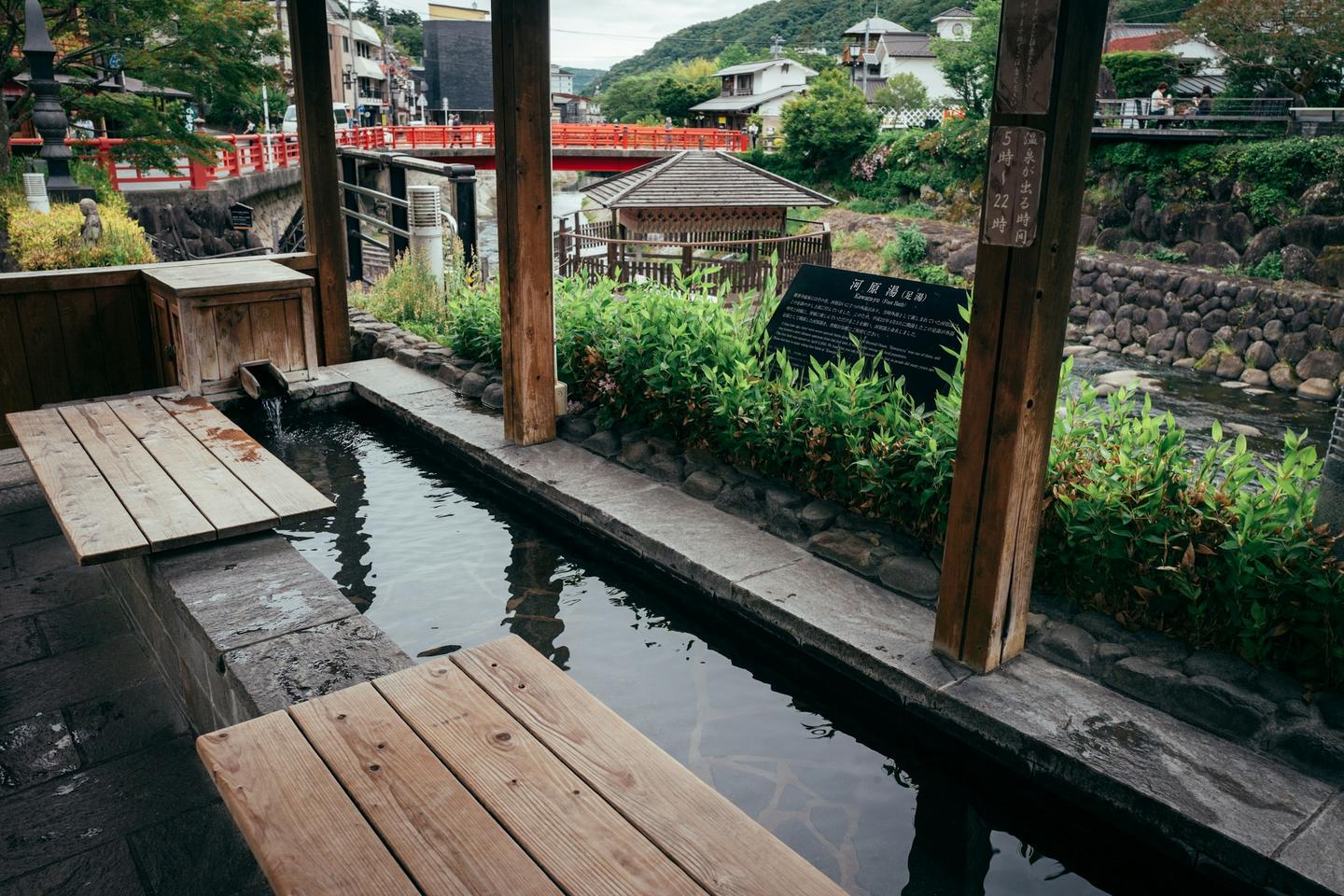
A day begins with an early bath, before breakfast, while the steam still lies on the river. Then a walk: in Misasa to the riverside bath and the old lanes, in Kannawa past the steam vents, at Itamuro along the river to the gallery. Lunch is light. In the afternoon, a nap, a book, a second bath. Dinner comes to the room. The last bath is late and short.
Over a week the days settle into this pattern. Many travellers pair two places, three or four nights in each, with a car between them so that nothing has to be carried. In the cold months a mountain spring such as Tamagawa asks for a driver who knows the road; Misasa and Kannawa are easier to reach by train and car in any season.
WHERE STAYGO COMES IN
For a toji stay we arrange the inns, the rooms with the right bath and the right meals for several nights, the car and the driver between places, and quiet days in the town around you: a walk with a local guide, a visit to Mount Mitoku, a gallery at Itamuro. When you arrive, the room is ready for a long stay, the bath times are known, and dinner is the one you asked for. If you mention a health condition, we will ask you to speak with your doctor first, and we will ask the inn what it can do. We arrange everything in your names, and you pay the inns, drivers and guides directly at their own prices, with no commission or markup from us. Trips are planned on the Signature plan, for 7 to 14 days, or as Bespoke for longer or more complex journeys.
SOURCES AND HOW WE CHECKED
We read the pages below on October 31, 2026: the Ministry of the Environment and the Tourism Agency for the definition, history and health guidance; the Tokyo Metropolitan Government for the national bathing guidance; the springs', inns' and city's own pages for hours, baths and rules; a prefectural page for the Japan Heritage story; a magazine, a booking service and a research column for background. We did not contact any inn.
- Ministry of the Environment, shin-toji (Japanese): the 2017 proposal and what shin-toji means
- Ministry of the Environment, Ecojin, shin-toji feature (Japanese): ten types of therapeutic spring, indications, water before bathing, 800 mL, staying several days
- Tokyo Metropolitan Government, using hot springs (Japanese): indications by spring type, contraindications, how often and how long to bathe, yuatari
- Japan Tourism Agency, The History of Hot-Spring Therapy (Toji): long stays by farming families and the decline from the Meiji era
- Research Institute of Economy, Trade and Industry, Health Tourism in Japan (2020): open scientific questions on hot spring effects
- Tamagawa Onsen (Japanese) and its baths: pH 1.2, flow, eleven baths, hours, drinking dilution, two sections, bear precautions, first snow
- Tottori Prefecture, Japan Heritage (Japanese): the Mount Mitoku and Misasa story, recognised in 2015
- Misasa Onsen tourist association (Japanese): radon, the three mornings, the white wolf, drinking and radon steam
- Beppu City, Kannawa Mushiyu (Japanese): 1276, Ippen, the stone room, sekishō, 2026 to 2027 hours
- Discover Japan, Tōji Yanagiya in Kannawa (Japanese, 2024): the steam kitchen, rooms and spring temperature
- Itamuro Onsen Daikokuya (Japanese): founded 1551, the spring, the lukewarm water, the three baths, art
- Ikyu, Itamuro Onsen Daikokuya (Japanese): baths open through the night, journey time and access
QUESTIONS TRAVELLERS ASK
What is toji?
Toji is the Japanese custom of staying at a hot spring town for several nights or longer to rest and bathe. Japan's Tourism Agency describes farmers in Tohoku who once came to the springs with their families for long stays in the off season. Today the Ministry of the Environment promotes a modern form called shin-toji, which adds the town's nature, history and food to the bathing.
Do hot springs in Japan have official health indications?
Yes, for springs that meet the standard of a ryōyōsen, a therapeutic spring. The Ministry of the Environment sorts these into ten types and sets the conditions each type is suited to. These are indications, and the official guidance also lists conditions in which bathing should be avoided, so anyone with a health condition should ask their doctor before a toji stay.
How many nights does a toji stay need?
There is no fixed length. The Ministry of the Environment writes that research has reported changes after staying several days or more at a hot spring town, and also that even one night can rest you if you spend it resting rather than sightseeing. Many people now stay three to seven nights.
Is toji suitable for travellers who do not speak Japanese?
Yes, with some preparation. The places in this article publish their baths, hours and rules in Japanese, and some in English. The bathing manners are the same as at any onsen, and the inn's staff will show you the order of the baths.
Can toji be combined with a ryokan stay of a high standard?
Yes. Self-catering rooms still exist at places such as Tamagawa, while an inn such as Daikokuya in Itamuro offers art, a river view and baths that can be used through the night. We choose the inn by how you want to spend the days.
ASK US ABOUT A TOJI STAY
Tell us how many nights you have and how you like to rest. We will ask the inns about rooms, baths and meals for a longer stay, and come back with what they were able to confirm.
Begin planning →We reply within 24 hours, in writing
Some of the restaurants, bars and private places we arrange take guests only by introduction or membership. We do not publish their names.