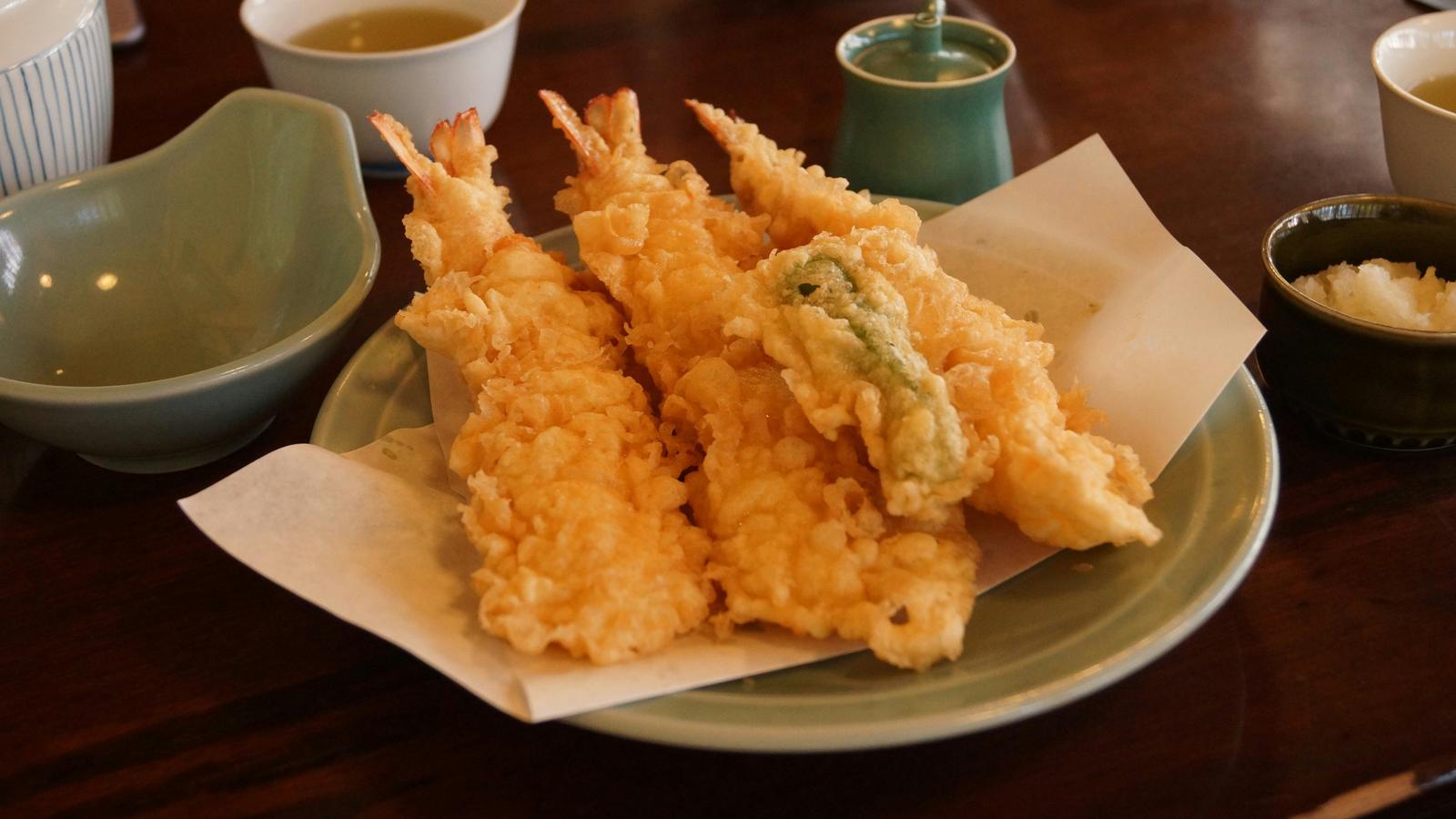
Tempura is at its finest at a counter, a piece at a time, passed from the oil to your plate while the batter still crackles. In Tokyo and Kyoto the great tempura houses seat their guests around the pot, and the chef fries the course in front of you, one prawn, one sillago, one slice of sweet potato, adjusting the heat as he goes.
This article is about the tempura counter: where Edo-style tempura came from, what the oil and the batter do, the seasons in the pot, salt and dipping sauce, the counters the Michelin Guide lists, and how Tokyo and Kyoto differ. We read the pages of the Michelin Guide, the restaurants and a reservation service, a food culture foundation, the National Diet Library, and Japanese magazines and news sites on November 5, 2026, and contacted none of them; the sources are listed at the end. For how the most sought-after tables in the city are filled, see How Tokyo's Most Sought-After Tables Actually Work; for the order of a kaiseki dinner, see Kaiseki Etiquette.
Key points
- Frying in batter reached Japan with the Portuguese in the 16th century. Tempura appeared on the streets of Edo in the latter half of the 18th century, sold on skewers from outdoor stalls.
- The Michelin Guide lists 46 tempura restaurants in Japan: 21 in Tokyo, 16 in Osaka, 8 in Kyoto and 1 in Nara. In Tokyo, Tempura Kondo in Ginza and Tempura Motoyoshi in Ebisu hold two stars.
- The old Tokyo style fries in sesame oil at high heat and serves the pieces with dipping sauce and grated daikon. The old Kansai style fries in plain vegetable oil at a lower heat, without egg in the batter, and serves the pieces with salt. Today each chef chooses.
- Every counter chooses its own oil: cold-pressed sesame at Kyobashi Tempura Fukamachi, sesame and rice oil at Tempura Miyashiro, canola at Tenjaku in Kyoto, safflower at Tempura Mizuki in Kyoto.
- The batter is made with wheat flour, and at a counter such as Ginza Tenichi everything goes into one oil, so allergies to shellfish, sesame, egg or wheat should be raised before the evening is arranged.
ASK US FOR A SEAT AT THE TEMPURA COUNTER →
FROM THE STALLS OF EDO TO THE COUNTER
The Michelin Guide's own history of the dish begins with Portuguese missionaries and traders, who brought the technique of frying in a flour batter in the 16th century. Nagasaki tempura, from the late 16th century, used a thick batter sweetened with sugar and mixed with sake, fried in lard and eaten without sauce. In Kyoto and Osaka the method became tsukeage, and with vegetables close at hand and Buddhist custom strong, it was fried in plant oils and called shojin-age.
Edo met tempura in the latter half of the 18th century, as a third street food after soba and eel. It was sold from stalls, partly because frying indoors in a city of wooden houses was a fire risk; the Ajinomoto Foundation for Dietary Culture notes that vendors who used oil were allowed to cook only outdoors, and that eating standing at the stalls became common. Fresh small fish were close at hand, sesame oil masked any smell, and the batter of flour and water, the Michelin Guide writes, was born in Edo. Pieces were skewered so hands stayed clean and eaten with dipping sauce and grated daikon. A print by Utagawa Hiroshige of the crowds waiting for the 26th-night moon at Takanawa, shown at the Ota Memorial Museum of Art in January 2025, has crowds eating tempura, soba and sweet bean soup at the stalls. Forbes Japan counts tempura with nigiri sushi, eel and soba as the four Edo dishes that began on the street.
From the stall the dish moved indoors and upwards. Ginza Tenichi, founded in 1930, was early to bring vegetables into a menu built on seafood. A 1961 book held by the National Diet Library, Yonetaro Tsuyuki's Tempura Monogatari, opens with a long chronicle of Tokyo's tempura houses. The counter you sit at today is the descendant of the stall: the cook still stands at the pot, and the food still goes from the oil to you at once.
OIL, BATTER AND HEAT
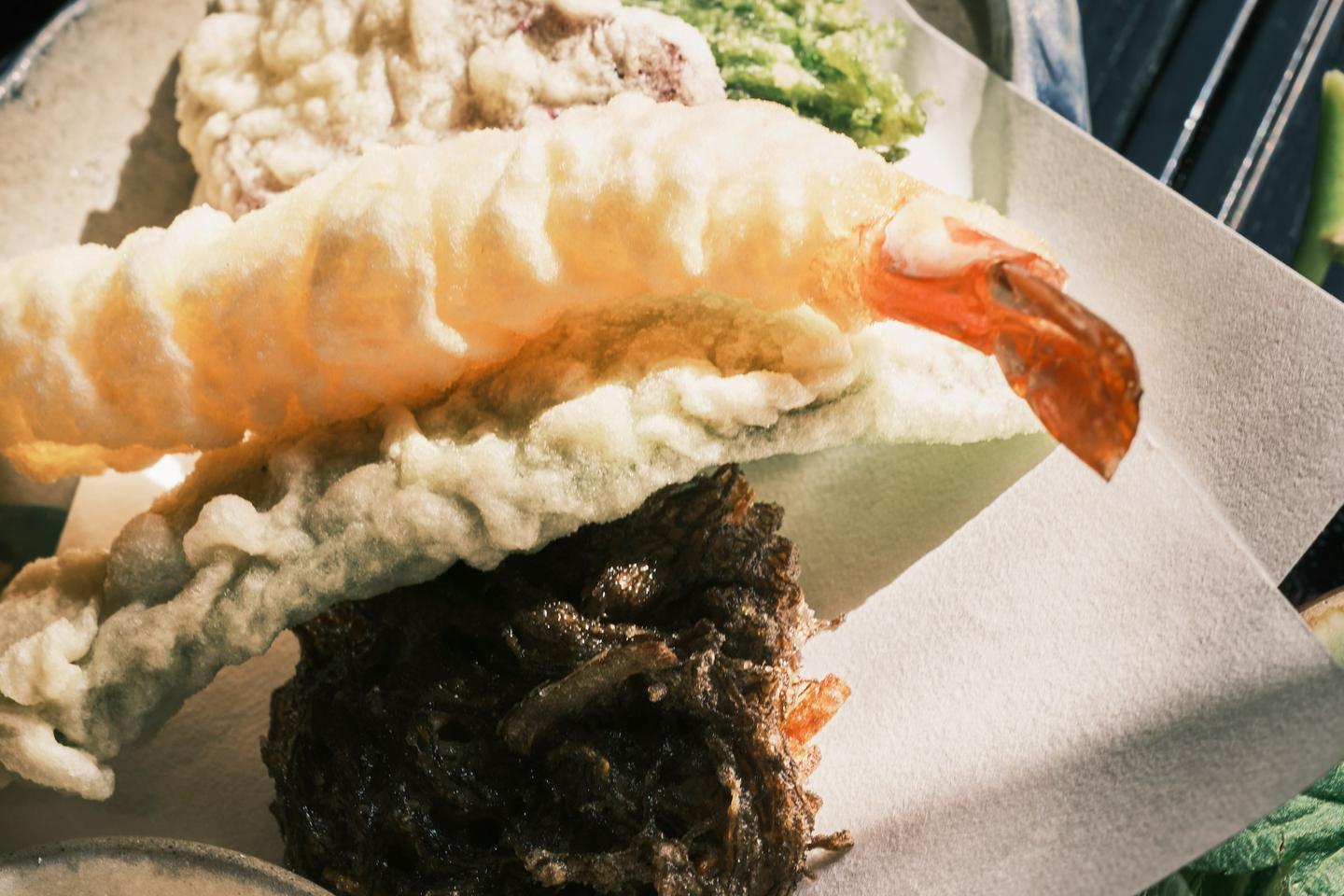
At the counter, the choice of oil is the chef's signature. Kyobashi Tempura Fukamachi, run by a father and his two sons, uses cold-pressed sesame oil and two fryers held at different temperatures, sometimes frying a piece twice, first in medium oil and then hot. Tempura Miyashiro in Meguro blends sesame oil with rice oil for lightness. Ginza Tenichi bases its oil on sesame with corn oil added. Tempura Ginya in Shirokanedai fries on high heat and, as the Michelin inspectors put it, listens to the sound of the oil.
The batter is the other half. Fumio Kondo of Tempura Kondo, who has stood at the pot for more than half a century, describes tempura as a form of steaming as much as frying: once the piece leaves the oil, the ingredient goes on cooking in its own moisture inside the batter. He works backward from the frying time, preparing each ingredient just before it goes in. At Tempura Motoyoshi in Ebisu the batter is made with two kinds of water and liquid nitrogen. Much of what makes it good is gone within a minute of the oil.
THE SEASON IN THE POT
A tempura course follows the market. Sillago, conger eel and prawn are the familiar pieces of the Tokyo counter, and the vegetables change with the season; at Tempura Miyashiro in Meguro, bamboo shoots are boiled first and then fried. Ten Yokota in Moto-Azabu builds its course around prawn, frying the first piece rare to bring out the sweetness. Ginza Tenichi buys its seasonal fish and vegetables at Tsukiji.
Kondo made vegetables the centre of the meal. In a 2012 interview with nippon.com he described frying rings of sweet potato more than 10 centimetres across for about 30 minutes, until the moisture and sweetness are sealed in, and asking a grower to leave three pumpkins on a vine instead of five so that each would taste fuller. His shredded carrot, fried all at once in a loose nest, is his own creation. If you sit at Kondo, the sweet potato and the carrot are the reasons.
SALT OR TENTSUYU
The old rule, as the Michelin Guide sets it out, was dipping sauce with grated daikon in Tokyo and salt in Kansai. The sauce, with grated daikon to cut the oil, suits the darker, sesame-fried Edo style. Salt lets a thin, pale batter and a delicate vegetable speak for themselves. At Kyoboshi in Gion the salt is crushed by hand. At Tenjaku in Kyoto the dipping sauce comes warm, and some pieces are dressed with chopped onion and mustard, a house style inherited from the chef's grandfather.
Most counters now set out both, and the chef will often tell you which to use for each piece. The prawn heads, the conger eel and the kakiage usually want the sauce; the vegetables, the sillago and anything fried rare usually want a pinch of salt and nothing else.
TOKYO AND KYOTO
Tokyo is the home of the Edo counter, and the Michelin Guide's Japan list is weighted towards it. The two-star counters, Kondo in Ginza and Motoyoshi in Ebisu, sit beside one-star houses across the city, from Fukamachi in Kyobashi to Nihombashi Sonoji, Edomae Shinsaku and Tempura Yaguchi in Ningyocho. If you want the classic sesame-fried tempura with sauce and daikon, or Kondo's vegetables, Tokyo is where to eat it.
Kyoto is quieter and lighter. At Kyoboshi the batter is so thin it is almost transparent, and the pieces are small, a consideration, the inspectors note, for the appetites of geisha and maiko; the meal ends with tempura over rice in a green tea broth. Tenjaku serves tempura as a kaiseki inherited from the chef's grandfather. Tempura Mizuki, at The Ritz-Carlton, Kyoto, sets the ingredients out before frying: vegetables from Takagamine and Shugakuin, seafood from Awaji and Shizuoka. Between kaiseki dinners, a Kyoto tempura counter makes a lighter evening.
THE COUNTERS WE ASK FOR
We ask on your behalf, matching the counter to your evening: Kondo for the vegetables, Motoyoshi for invention, Fukamachi or Ginya for the classic Edo hand, Kyoboshi or Tenjaku in Kyoto. The seat and the evening are the house's decision. Ginza Tenichi's page on Ikyu notes that everything is fried in the same oil and that it cannot seat guests with allergies to egg, wheat, soy or sesame, so we raise any allergy before we ask; see Food Allergies and Gluten-Free Dining in Japan.
Within Signature, our planning for journeys of 7 to 21 days, we place a tempura counter early in the trip, so that the rest of the week's tables can be read against it. Each meal is settled in the simplest way available, usually on your hotel bill or on the day.
SOURCES AND HOW WE CHECKED
We read the pages below on November 5, 2026. We did not contact any restaurant, guide, foundation or other body. Michelin distinctions are those shown on each restaurant's page for 2026.
- MICHELIN Guide, Tempura restaurants in Japan: 46 restaurants, 21 in Tokyo, 16 in Osaka, 8 in Kyoto, 1 in Nara
- MICHELIN Guide, restaurant pages: Tempura Kondo and Tempura Motoyoshi two stars; Fukamachi, Miyashiro, Ten Yokota, Ginya, Nihombashi Sonoji, Edomae Shinsaku, Tempura Yaguchi, Kyoboshi, Tenjaku one star; Tempura Mizuki listed; oils, batter and service as described
- MICHELIN Guide, Tempura (Japanese, June 22, 2021): Portuguese origin, Nagasaki tempura, shojin-age, Edo stalls in the latter half of the 18th century, flour and water batter, Tokyo and Kansai styles
- MICHELIN Guide, Mentor Chef Award, Fumio Kondo (Japanese, December 15, 2023): the award in the Michelin Guide Tokyo 2024, more than half a century at the stove
- nippon.com, interview with Fumio Kondo (Japanese, February 15, 2012): tempura as steaming, sweet potato over 10 cm fried about 30 minutes, three pumpkins instead of five, shredded carrot
- Ajinomoto Foundation for Dietary Culture, Edo Fast Food: Tempura (Google Arts & Culture): oil vendors cooked only outdoors, skewered pieces with dipping sauce, standing at the stalls
- Bijutsu Techo, report on Edo Meshi at the Ota Memorial Museum of Art (Japanese): Hiroshige's Takanawa print with tempura and soba stalls, exhibition January 5 to 26, 2025
- Forbes Japan (Japanese, June 25, 2023): nigiri sushi, tempura, eel and soba began as street stalls
- Ginza Tenichi (Japanese): founded 1930, early to add vegetables, sesame oil with corn oil
- Ikyu Restaurant, Ginza Tenichi main shop (Japanese): counter seating, one frying oil, guests with egg, wheat, soy or sesame allergies cannot be seated
- National Diet Library, Tempura Monogatari by Yonetaro Tsuyuki (1961): the book and its chronicle of Tokyo tempura houses
QUESTIONS TRAVELLERS ASK
Should we sit at the counter or at a table?
At the counter. Tempura is at its finest in the first minute after it leaves the oil, and at the counter each piece is passed straight to you.
Should we use salt or the dipping sauce?
Both are usually set out, and the chef will often say which suits each piece. As a rule, salt for vegetables and delicate fish, sauce with grated daikon for prawn, conger eel and kakiage.
Can you arrange a seat at Tempura Kondo or another two-star counter?
We ask on your behalf, with your dates and party. The seat and the evening are the house's decision.
Is tempura possible with a food allergy?
Often not for shellfish, sesame, egg or wheat. The batter is made with wheat flour, and at a counter such as Ginza Tenichi everything is fried in the same oil. Tell us early, and we raise it with the restaurant before we ask for a seat.
Is tempura better in Tokyo or in Kyoto?
Tokyo has more of the Michelin-listed counters and the Edo style of sesame oil, sauce and daikon. Kyoto's counters tend to be lighter, with thin batter, small pieces and salt.
ASK US FOR A SEAT AT THE TEMPURA COUNTER
Tell us when you are coming, who is travelling and what you like to eat. We will set out the counters in Tokyo and Kyoto that suit your evenings, with the reasons, so that you can choose.
Begin planning →We reply within 24 hours, in writing
Some of the restaurants and bars we arrange seat guests only by introduction or membership. We ask on your behalf; the table and the evening are the house's decision. We do not publish their names.