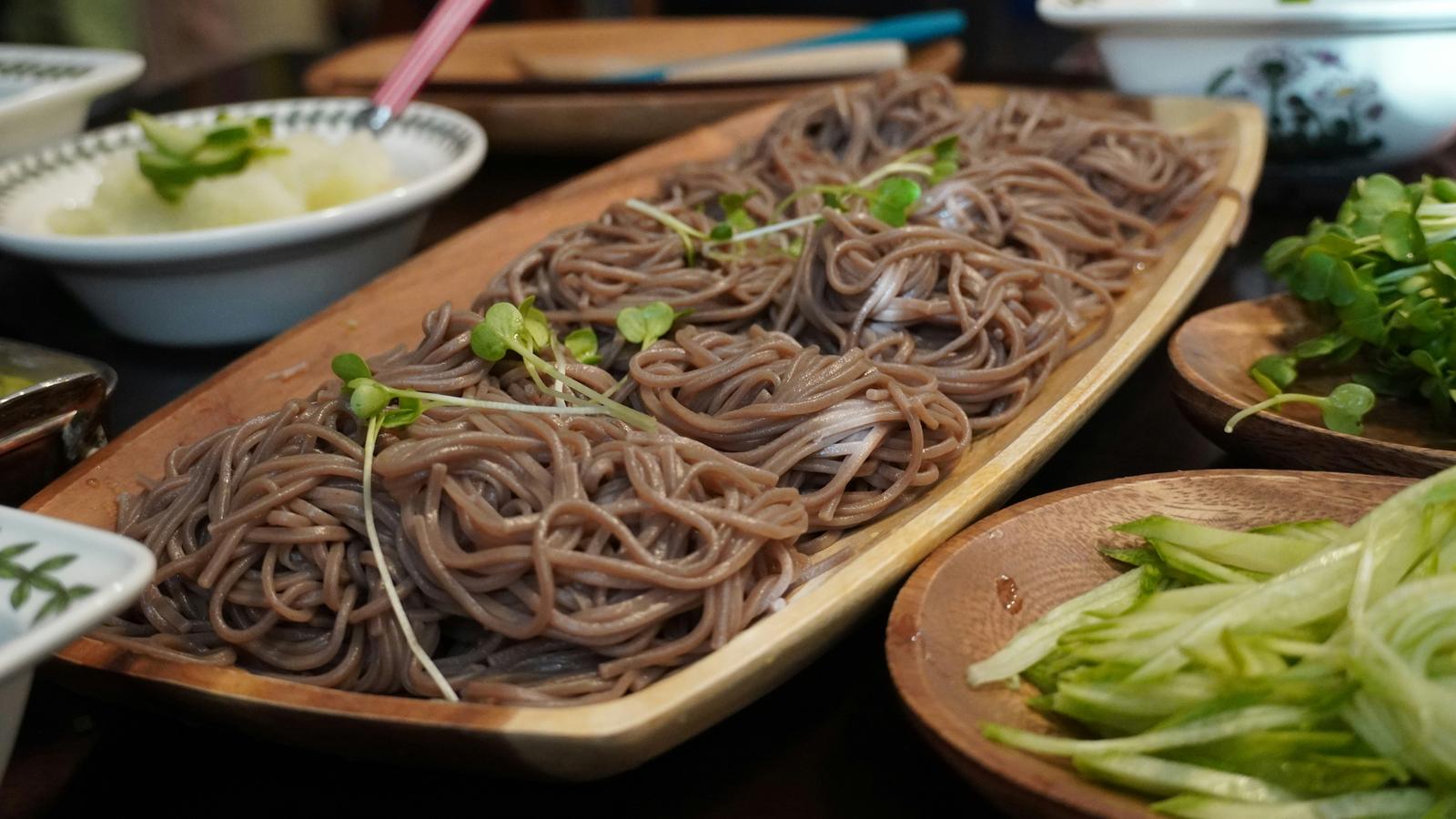
Japan's food allergy labelling law applies to packaged food, so a menu at a kaiseki restaurant or a ryokan dinner carries no legal allergen declaration. Wheat is in most Japanese soy sauce, fish is in most dashi, and both reach dishes that look free of them. Travellers with food allergies, coeliac disease or a gluten-free diet eat well in Japan when each kitchen is told the exact restriction in Japanese, in writing, weeks before the meal, and when they accept that some kitchens will decline.
This guide covers what the law does and does not require, where wheat, fish, shellfish, sesame and buckwheat hide in Japanese cooking, what fine restaurants and ryokan publish about allergies, how to bring adrenaline auto-injectors and other medicines into Japan, and what to do in an emergency. We read every rule and policy quoted here on the official site of the government agency, hotel or ryokan on October 14, 2026. If you are looking for how the reservations themselves work, that is in how to get a reservation at Japan's best restaurants. Nothing here is medical advice; please speak to your own doctor about your diagnosis and what you should carry.
Key points
- Since April 1, 2026, Japan requires allergen labelling of nine items on packaged processed food: shrimp, cashew nuts, crab, walnuts, wheat, buckwheat, egg, milk and peanuts. Twenty more, including sesame, soybeans, salmon, mackerel and pistachio, are recommended only.
- The Consumer Affairs Agency describes restaurants as places where the labelling standard does not apply. It asks them to provide allergen information voluntarily.
- Japan's wheat labelling covers wheat only. The Agency's handbook states that barley and rye fall outside it, which matters for coeliac guests.
- Koikuchi soy sauce, the everyday kind, is brewed from soybeans and roughly equal wheat under the Japanese Agricultural Standard. Tamari uses soybeans with a little wheat or none.
- Policies differ by kitchen. Gora Kadan in Hakone asks for its allergy form three days before arrival and can cook vegetarian and gluten-free; the sushi counter at Hoshinoya Tokyo states it cannot accommodate allergies or dietary restrictions.
- Prescription medicines up to one month's supply, including self-injection kits, can enter Japan for personal use without an import certificate. Dial 119 for an ambulance.
WHAT THE LABELLING LAW COVERS
Japan's allergen labelling sits under the Food Labelling Act and the Food Labelling Standard, and it is run by the Consumer Affairs Agency. The Agency's own summary says the obligation applies to processed food in containers and packaging. It sorts allergens into two tiers.
The nine mandatory items
Tokutei genzairyo, the specified ingredients. These must be declared on packaged processed food. As of April 2026 there are nine: shrimp (ebi), cashew nuts, crab (kani), walnuts (kurumi), wheat (komugi), buckwheat (soba), egg, milk and peanuts (rakkasei). Walnuts were added in March 2023. Cashew nuts were added on April 1, 2026, and the Agency's notice of that date gives manufacturers a two-year transition period, while asking them to label as soon as they can. A packet bought in the next year or two may therefore contain cashew without saying so.
The twenty recommended items
Items equivalent to the specified ingredients. These are recommended for labelling and are not required: almond, abalone, squid, salmon roe (ikura), orange, kiwi fruit, beef, sesame, salmon, mackerel, soybean, chicken, banana, pistachio, pork, macadamia nut, peach, yam (yamaimo), apple and gelatine. Pistachio joined the list on April 1, 2026, because of its cross-reactivity with cashew. Macadamia was added and matsutake mushroom removed in March 2024. A manufacturer may leave any of these twenty off the label entirely.
What the law does not reach
The Agency's 2026 handbook for food businesses refers to restaurants as places where food is served under conditions in which the labelling standard does not apply, and asks them to show allergen information on menus or websites and to train staff. That is a request. A restaurant in Japan has no legal duty to list allergens on its menu, and the person taking your order may not know what is in the stock or the sauce. The same handbook includes a reported case of a child who reacted to a restaurant curry after staff said it contained no milk; the curry roux contained skimmed milk powder.
Two further details from the handbook are worth knowing. Labelling is triggered when an allergen's protein is present at a few micrograms per gram or more, and vague "may contain" wording is prohibited; a factory may instead state that it also produces products containing a named allergen. And the scope of each item is fixed: the handbook states that barley and rye are not covered by "wheat", and that only true shrimp and crab count, so mantis shrimp and krill fall outside the shrimp item.
WHERE WHEAT HIDES
For a coeliac guest or a guest with a wheat allergy, the main dishes are rarely the problem. The seasonings are. Wheat is used across Japanese brewing, and the Consumer Affairs Agency notes that it is usually impossible to tell from a finished dish whether wheat was used.
Soy sauce and its relatives
Koikuchi soy sauce. The Japanese Agricultural Standard for soy sauce defines koikuchi, the dark everyday type, as brewed with roughly equal parts soybeans and wheat. Usukuchi, the lighter Kansai style used in Kyoto broths, is defined the same way. The Agency's handbook states plainly that soy sauce is generally made from soybeans and wheat.
Tamari. The standard defines tamari as soybeans alone, or soybeans with a little wheat. A tamari can therefore still contain wheat, and the bottle in a restaurant kitchen is usually not the one a guest sees. When we write to a kitchen we ask which tamari it holds and whether it is wheat-free.
Shiro shoyu. White soy sauce is defined as a little soybean with wheat, so it is mostly wheat. It is used in clear soups and pale simmered dishes precisely because it does not colour them.
Miso mirin and the rest
Miso. The Japanese Agricultural Standard for miso recognises rice miso, barley miso (mugi miso, made with a koji of barley or naked barley) and soybean miso. Barley is outside Japan's wheat labelling, so a coeliac guest needs the kitchen to name the miso it uses.
Mirin. The National Tax Agency describes hon mirin as brewed from glutinous rice, rice koji and shochu or alcohol. Kitchens also use mirin-style seasonings and mirin-type fermented seasonings, and the Consumer Affairs Agency's handbook tells manufacturers to check fermented seasonings for wheat. We ask which one is in the kitchen.
Ponzu, tsuyu and tare. Ponzu is citrus juice with soy sauce. The Agency's labelling example for concentrated noodle broth (tsuyu) lists soy sauce, bonito, mackerel flakes, dried sardines, kelp and a fermented seasoning containing soybeans and wheat. Grilling glazes for eel, yakitori and teriyaki are soy-based.
Batter, starch and gluten. Tempura batter and the coating on karaage are wheat flour. The handbook warns that food starch may be wheat starch, and the soy sauce standard permits wheat gluten in some grades. Fu, the wheat gluten cakes that float in clear soups, are wheat by definition.
A gluten-free kaiseki is possible where the kitchen agrees to it, because rice, fish, vegetables, tofu, kelp and salt are naturally free of wheat. It means the chef rebuilding every sauce, which is why the request has to arrive well before the day.
DASHI FISH AND SHELLFISH
Dashi is the stock under almost every Japanese course: soups, simmered dishes, savoury custard (chawanmushi), dipping sauces and many vegetable dishes. The usual base is kelp with dried bonito, and some kitchens add dried sardines or mackerel flakes. The Japanese Agricultural Standard for miso lists bonito flakes, dried sardines and kelp among the flavourings that may be added to miso itself, so a dashi-flavoured miso carries fish too.
For a guest allergic to fish this is the central issue, and it is one the label system says little about. Only salmon, mackerel and salmon roe appear on the recommended list; tuna, bonito, sardine, sea bream and most other fish appear on neither list. Among shellfish, only shrimp and crab are mandatory, with abalone and squid recommended. Clams, scallops, oysters and sea urchin are on neither list. A kombu-only dashi, made from kelp alone, is the standard substitute, and a kitchen that agrees to cook it should make it separately for you.
Shrimp and crab also reach dishes in less obvious ways: dried shrimp in seasonings, shrimp in tempura oil shared with other items, and crab in savoury custards and rice dishes in winter.
SESAME BUCKWHEAT AND NUTS
Sesame. Sesame is on the recommended list only, so packaged dressings and sauces may not declare it. In restaurants it appears as sesame tofu (goma dofu), sesame dressings on greens (goma ae), sesame oil in tempura frying and as a garnish on rice.
Buckwheat. Soba is mandatory because reactions to it can be severe, and the handbook adds that buckwheat can be present in seasonings. In a kitchen that also cooks noodles, the questions are whether soba and other noodles share boiling water, utensils or work surfaces, and whether buckwheat flour is used for dusting. For a severe buckwheat allergy we ask whether the kitchen cooks soba at all, since some kaiseki menus end with a soba course.
Nuts. Walnuts and cashew nuts are now mandatory on packaged food; almond, macadamia and pistachio are recommended. The handbook notes that pecans can cross-react with walnut and encourages a warning on products containing them. In Japanese cooking walnut can appear in sweet dressings (kurumi ae) and confectionery. Ginkgo nuts, a common autumn ingredient, are on neither list.
WHAT FINE RESTAURANTS AND RYOKAN CAN ADAPT
A kaiseki dinner or an omakase counter is designed by one chef around the season and the morning's market. Some adapt fully, some adapt within limits and some decline. Here is what three well-known properties publish.
Gora Kadan in Hakone
The ryokan's FAQ asks guests with dietary restrictions or allergies to complete an allergy information form, linked from the booking confirmation email, by three days before arrival, and to resubmit it by the same deadline if anything changes. It states that vegetarian and gluten-free meals are possible, that all dishes are prepared in a shared kitchen so contamination cannot be ruled out entirely, that halal and certified ingredients are not offered, and that requests on the day cannot be accommodated.
Hoshino Resorts properties
The group's allergy page asks guests to declare food allergies at the time of booking, and states that it will try to remove allergens and that it cannot guarantee their removal. It may decline to serve a meal where a guarantee is required, and in that case accepts guests bringing their own food if told in advance. On the day we checked, the page still listed eight labelled items, which shows how long policy pages can trail a change in the law. At Hoshinoya Tokyo, the sushi counter Otemon states that it cannot accommodate specific allergies or dietary restrictions; both dinners there must be booked by 20:00 the day before. At Hoshinoya Kyoto, the à la carte menu states that individual allergy requests cannot be met.
What this means in practice
- Removing an ingredient you can see on the plate is the simplest request. Changing the stock, the soy sauce or the frying oil for a single guest is a far larger one, and that is where kitchens differ.
- A sushi counter is a hard place for a fish or shellfish allergy and often for coeliac guests, because the soy sauce, the glaze on eel and the sweet omelette are all prepared in advance.
- Tempura is fried in shared oil unless a kitchen tells you otherwise, so we ask.
- A ryokan with a written form and a deadline, such as Gora Kadan's three days, gives a clear record of what was agreed.
- Some kitchens refuse requests made on the day. Gora Kadan states this in its FAQ.
A refusal is useful information. It is better to hear it weeks ahead and book somewhere that can cook for you. Where a kitchen is right for you, the general guidance on behaviour at the table is in Japan etiquette for luxury travellers, and how to choose the right inn is in how to choose a ryokan.
WHY THE REQUEST GOES IN WRITING IN JAPANESE
A kaiseki chef often orders produce days in advance and plans the menu around it, and a ryokan kitchen sets the evening's courses for every room at once. A request that arrives a few weeks ahead can be planned into the menu. One that arrives at the table usually cannot.
Writing in Japanese matters because the precise words differ from English habits. "Gluten-free" means little to many kitchens; "no wheat, barley or rye, including soy sauce, miso, fu, tempura batter and wheat starch, and no shared frying oil" is a request a chef can act on. "Fish allergy" can be read as raw fish only, unless it says "including dashi made with bonito or sardines". A written request also travels intact from the reservations desk to the kitchen.
When we arrange a trip we secure each table in your name, then write to every restaurant and ryokan in Japanese with your exact restriction, the severity, whether trace amounts matter, and the specific seasonings to avoid. We ask them to confirm in writing what they can and cannot do, and we tell you before you travel. A short card like the one below, in your wallet, is still worth having for meals you choose on the day.
| English | Japanese |
|---|---|
| I have coeliac disease. | 私はセリアック病です。 |
| I cannot eat wheat, barley or rye, even in trace amounts. | 小麦・大麦・ライ麦は、少量でも食べられません。 |
| This includes soy sauce, miso, fu, tempura batter and wheat starch. | 醤油、味噌、麩、天ぷらの衣、小麦でん粉も含みます。 |
| Please tell me if a dish is not suitable. | 食べられない料理があれば教えてください。 |
For other allergies the second and third lines change. A fish allergy card should mention dashi (出汁), bonito (かつお節) and dried sardines (煮干し); a sesame card should mention sesame oil (ごま油).
HIDDEN SOURCES BY DISH
This is the list we work through with a kitchen. It is a checklist of questions to ask; the answer depends on each kitchen's recipe.
| Dish | What to ask about | Relevant to |
|---|---|---|
| Clear soup (suimono) | Bonito dashi, white or light soy sauce, fu | Fish, wheat |
| Miso soup | Barley miso, dashi in the miso, clams or shrimp | Barley, fish, shellfish |
| Savoury custard (chawanmushi) | Egg, dashi, shrimp, ginkgo, soy sauce | Egg, fish, shrimp, wheat |
| Sashimi and sushi | Soy sauce, glaze on eel, sweet omelette, rice vinegar blends | Wheat, egg, fish |
| Tempura | Wheat batter, egg in batter, shared oil, sesame oil | Wheat, egg, shrimp, sesame |
| Simmered dishes (nimono) | Dashi, soy sauce, mirin-type seasoning | Fish, wheat |
| Grilled fish and yakitori | Soy-based glaze (tare), saikyo miso marinade | Wheat, soy, barley |
| Dressed greens (goma ae, shira ae) | Sesame paste, tofu, soy sauce, walnut | Sesame, soy, wheat, nuts |
| Shabu-shabu and sukiyaki | Ponzu, sesame sauce, sukiyaki sauce, raw egg dip | Wheat, sesame, egg |
| Noodles | Soba flour, shared boiling water, tsuyu with mackerel flakes | Buckwheat, wheat, fish |
| Rice dishes (takikomi gohan) | Dashi, soy sauce, crab or shellfish in season | Fish, wheat, shellfish |
| Wagashi and dessert | Wheat flour, egg, walnut, sesame, kinako (soybean flour) | Wheat, egg, nuts, sesame, soy |
| Pickles and condiments | Soy sauce pickling, sesame, dried fish | Wheat, sesame, fish |
MEDICATION AND EMERGENCIES
Bringing medicines into Japan
The Ministry of Health, Labour and Welfare allows travellers to bring prescription medicines for personal use up to one month's supply without any special procedure. Injectables are allowed up to one month's supply when they are pre-filled syringes or self-injection kits. The Ministry's Q&A states that medicines brought together with their syringes, such as insulin, for less than one month's supply do not need an import certificate. Over-the-counter medicines are allowed up to two months' supply.
Above those amounts you need a Certificate for Import Confirmation before you travel. The Ministry's online system for it has run since February 1, 2023; the certificate arrives by email and is shown at customs. The application needs a prescription or doctor's note naming the patient, the medicine and the doctor, and a document showing your arrival date, airport, flight number and name. Narcotics and stimulant raw materials follow a separate permission process, and some medicines legal elsewhere are prohibited in Japan. Please check each medicine against the Ministry's pages and ask your doctor what to carry and in what quantity.
If something happens
Dial 119 for an ambulance from any mobile or landline. The Fire and Disaster Management Agency's English guide says to tell the operator first that it is a medical emergency, and to have your passport, a means of payment and your current medication ready. JNTO's guide for visitors notes that you cannot choose the hospital you are taken to, and suggests showing a nearby person the sentence 救急車を呼んでください, which asks them to summon an ambulance, if you cannot speak Japanese. The Japan Visitor Hotline, 050-3816-2787, runs 24 hours a day in English, Chinese and Korean for emergencies and illness.
Two practical points we add to every trip with a serious allergy. We note the nearest hospital to each ryokan, since many are in the mountains or on the coast. And we make sure each kitchen has the written request with the severity stated, so the people serving you know before the first course arrives. The cost of a trip planned this way is set out in what a bespoke Japan trip costs.
SOURCES AND HOW WE CHECKED
We read each source below on October 14, 2026, on the official site of the agency, hotel or ryokan. We did not contact the restaurants or ryokan. Policies and menus change, and we confirm each kitchen's answer in writing when we arrange each table.
- Consumer Affairs Agency, food allergy labelling: dates walnut, cashew and macadamia were added and matsutake removed
- Consumer Affairs Agency, what allergen labelling is (April 2026): the nine mandatory and twenty recommended items, packaged food scope, no "may contain" wording
- Consumer Affairs Agency, notice of April 1, 2026: cashew made mandatory with a two-year transition, pistachio added
- Consumer Affairs Agency, allergen labelling handbook (April 2026): restaurants outside the standard, thresholds, scope of wheat and shrimp, soy sauce and fermented seasonings, the restaurant curry case
- Ministry of Agriculture, Forestry and Fisheries, Japanese Agricultural Standard for soy sauce: definitions of koikuchi, usukuchi, tamari and shiro
- Ministry of Agriculture, Forestry and Fisheries, Japanese Agricultural Standard for miso: barley koji, types of miso, fish flavourings
- National Tax Agency, the history of hon mirin: ingredients of mirin and mirin-style seasonings
- Gora Kadan, FAQ: allergy form deadline, vegetarian and gluten-free, shared kitchen, no same-day requests
- Hoshino Resorts, food allergy policy: declare at booking, no guarantee, bringing your own food
- Hoshinoya Tokyo, dining: Otemon allergy policy and booking deadline
- Hoshinoya Kyoto, dining: à la carte allergy policy
- Ministry of Health, Labour and Welfare, bringing medicines into Japan: quantity limits
- Ministry of Health, Labour and Welfare, Q&A on importing medicines: self-injection with syringes, application documents
- Ministry of Health, Labour and Welfare, Application for Import Confirmation: online system since February 1, 2023
- Fire and Disaster Management Agency, ambulance guide in English: dialling 119 and what to have ready
- JNTO, guide for when you are feeling ill: hospital choice, the sentence to show
- JNTO, Japan Visitor Hotline: number, hours and languages
QUESTIONS GUESTS ASK
Do restaurants in Japan have to list allergens on the menu?
No. Japan's allergen labelling is required on packaged processed food, and the Consumer Affairs Agency describes restaurants as outside the labelling standard. The Agency asks restaurants to provide allergen information voluntarily, so practice varies from kitchen to kitchen.
Is soy sauce in Japan gluten-free?
Usually not. Under the Japanese Agricultural Standard, koikuchi and usukuchi soy sauce are brewed from soybeans and roughly equal wheat, and white soy sauce is mostly wheat. Tamari is soybeans alone or with a little wheat, so a kitchen needs to confirm that its tamari is wheat-free.
Can a ryokan cook gluten-free kaiseki?
Some can. Gora Kadan in Hakone states that it can prepare vegetarian and gluten-free meals if its allergy form is completed three days before arrival, while noting that its kitchen is shared. Other properties decline specific requests, so each one has to be asked in advance.
Can I bring an adrenaline auto-injector into Japan?
The Ministry of Health, Labour and Welfare allows self-injection kits and pre-filled syringes for personal use up to one month's supply without an import certificate. Larger quantities need a Certificate for Import Confirmation, applied for online before you travel. Please confirm the details with your doctor and on the Ministry's pages.
What number do I dial for an ambulance in Japan?
Dial 119 for an ambulance or fire. Tell the operator first that it is a medical emergency, and have your passport, a means of payment and your medication ready. The Japan Visitor Hotline, 050-3816-2787, offers support in English 24 hours a day.
DINE WELL WITH A RESTRICTION
Send us your travel dates and your dietary needs as precisely as you can, including whether trace amounts matter. We will come back with the restaurants and ryokan that can cook for you, write to each kitchen in Japanese, and secure every table in your name.
Begin planning →