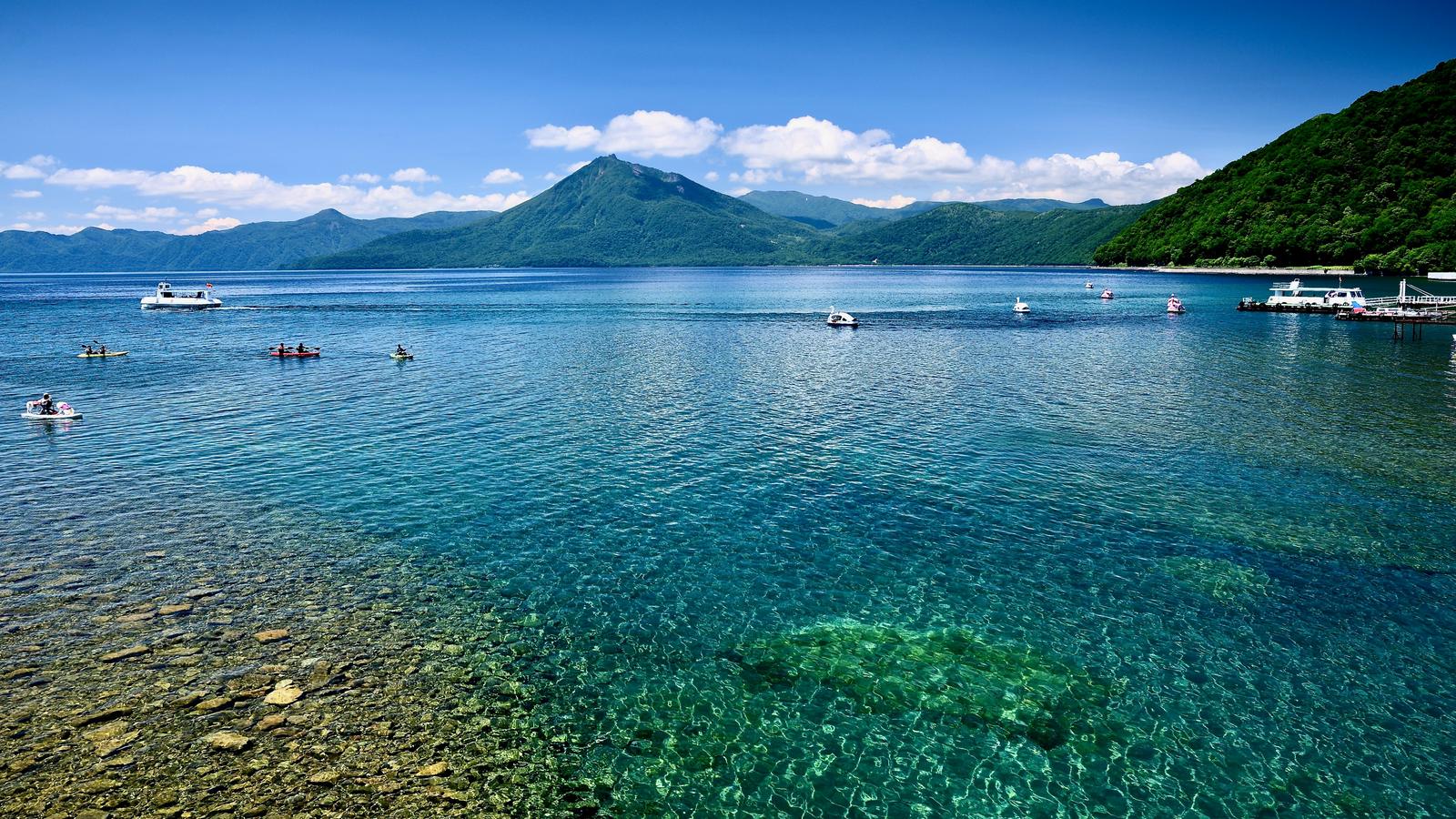
Spanish families travel in August, and more of them now travel to Japan. In August 2026, 36,500 visitors came from Spain, the most in any single month so far; the Japan National Tourism Organization put it down to the school holidays, the summer break and added flights between Madrid and Narita, and across 2025 the total reached 245,600, about a third more than the year before. Hosteltur reported that Iberia would add a weekly frequency on its Madrid to Tokyo route between August and October. Many have already seen Tokyo and Kyoto, and they know the heat of a Honshu summer. For a second journey we often suggest the southwest of Hokkaido, where caldera lakes, a living volcano, Ainu culture and the port of Hakodate sit within a few hours of each other by road.
This article sets August's official averages for Sapporo and Hakodate beside Tokyo, Madrid and Sevilla, then follows a week from Lake Shikotsu to Hakodate with the places that hold children's attention and the hotels that suit a family. We read the weather agencies' tables, the tourism statistics, the hotels', museum's and operators' own pages and Hokkaido's tax notice, and contacted none of them; the sources are listed at the end. For Furano, Shiretoko and the winter, see Hokkaido Honeymoon: Summer or Winter, and Where to Stay (2027) →.
Key points
- Sapporo's August averages 26.4°C by day and 19.1°C by night, against 31.3°C and 23.5°C in Tokyo (Japan Meteorological Agency, 1991 to 2020).
- Madrid's August afternoons average the same 31.3°C as Tokyo's, in much drier air, and Sevilla's reach 35.5°C (AEMET, 1981 to 2010).
- Lake Shikotsu, Upopoy, Noboribetsu and Lake Toya all lie within about an hour and a half of New Chitose Airport by road.
- Upopoy shows Ainu dance, crafts and reconstructed houses; in 2026 it opened from 9:00 to 18:00 between April and October, closed on most Mondays.
- Hakodate ends the week with its morning market, the star fort of Goryokaku and the view from Mount Hakodate, and flies to Haneda in about 1 hour 20 minutes.
PLAN A HOKKAIDO SUMMER WITH US →
HOW AUGUST COMPARES WITH TOKYO AND SPAIN
The Japan Meteorological Agency's normals for 1991 to 2020 give Sapporo an average August high of 26.4°C and an average low of 19.1°C. Hakodate, on the southern tip, is a little cooler at 25.9°C and 18.9°C. Tokyo averages 31.3°C by day and 23.5°C at night. Spain's state agency AEMET publishes normals for 1981 to 2010, a different period, so read the comparison as a guide: Madrid Retiro averages 31.3°C in the afternoon and 18.8°C at night in August, and Sevilla Airport 35.5°C and 20.4°C.
Madrid's line is the telling one. On paper its August afternoons match Tokyo's to the decimal, yet the two feel very different. Madrid's relative humidity averages 41% in August, Tokyo's 74%, and Tokyo's nights stay above 23°C, which is why a family from Madrid finds Tokyo in August so tiring. Sapporo is about as humid as Tokyo, at 75%, but its day peaks five degrees lower and its night falls to 19°C, close to a night in Madrid.
August is not dry in the north. Sapporo averages 126.8 mm of rain in the month and Hakodate 156.5 mm, about the same as Tokyo's 154.7 mm, so every day in our plans has an indoor alternative ready.
LAKE SHIKOTSU FOR THE FIRST NIGHTS
After a long flight, the first base should be close. Lake Shikotsu is about 35 to 40 minutes by car from New Chitose Airport, and the Japan National Parks site lists kayaking across its wide, clear water. A morning on the lake sets the pace for the week.
On its shore, Shikotsu Tsuruga Bessou Ao no Za has 25 suites, each with its own hot spring bath, and its FAQ states that there is no age restriction. The Executive Suite Villas, 210 and 270 m² over two floors, take five guests, and the Suite Villas can be joined into a connecting pair for up to seven, which suits grandparents travelling too. Check-in is at 14:00, an hour earlier than many hotels, which helps on the day of arrival.
UPOPOY AND THE AINU
Upopoy, the National Ainu Museum and Park in Shiraoi, is about 40 minutes by expressway from New Chitose Airport to the Shiraoi interchange and ten minutes more by car. It is the national centre for the revival of Ainu culture, the culture of Hokkaido's Indigenous people, and its name means singing together in a large group. Signs throughout the park are written first in the Ainu language.
For children it is a place to watch and to make. Traditional Ainu dance, recognised by UNESCO as intangible cultural heritage, is performed in the Cultural Exchange Hall; the Crafts Studio holds woodcarving and embroidery workshops; and in the Kotan, a group of reconstructed houses, staff talk about daily life inside them. Strollers are lent free of charge. In 2026 Upopoy opened from 9:00 to 18:00 between April and October and closed on Mondays, though it opened on August 10 and 24; the 2027 calendar is not yet published, and hands-on workshops are charged separately from admission.
NOBORIBETSU AND THE VOLCANO AT TOYA
From Shiraoi the road continues west to Noboribetsu Onsen, about 6 km from the Noboribetsu-Higashi interchange, where a walk through the steaming fumaroles of Jigokudani, Hell Valley, shows children how much heat lies under the ground they stand on. It fits in a morning between Upopoy and Lake Toya.
At Lake Toya the volcano is close enough to touch. The Mount Usu Ropeway climbs in about six minutes to decks over Lake Toya and over the crater basin. Nearby Showa-Shinzan is a mountain formed in the eruption of 1943 to 1945. On the Nishiyama route of the Toya-Usu Geopark, a boardwalk passes the craters of the 2000 eruption that cut National Route 230: a pond in the middle of the road, asphalt broken into steps, machinery left where it stood. In 2026 the route was open from late April to October 30. The lake's nightly summer fireworks are described in our Hokkaido honeymoon guide.
THE WINDSOR HOTEL TOYA AS THE FAMILY BASE
For three nights at Toya we look first at The Windsor Hotel Toya, about an hour and a half from New Chitose by expressway. It hosted the 2008 Hokkaido Toyako Summit, and its rooms run from 33 m² to suites of 174 m²; the Japanese-style suites of 120 m² give a family space to spread out on tatami. Guests have the use of the hotel's hot spring baths, open only to those staying, and of the Crystal Blue Club pool.
What makes it a family base is the programme. The hotel lists a Kids' Room for children from six months to preschool age, open daily from 9:00 to 22:00; a Canadian canoe with rates for school-age and preschool children; horse trekking for children of school age who are at least 140 cm tall; glassblowing from school age; park golf for all ages; and stargazing on summer nights. Parents can have an afternoon to themselves while the younger ones are looked after.
HAKODATE TO FINISH
Hakodate, at the southern tip, makes the last two nights. By road, Ao no Za puts Lake Shikotsu at about four hours from Hakodate, and Toya is closer; by rail, the limited express between Sapporo and Hakodate takes about three and a half hours and stops at Toya. Either way we keep the day light, with lunch on the way.
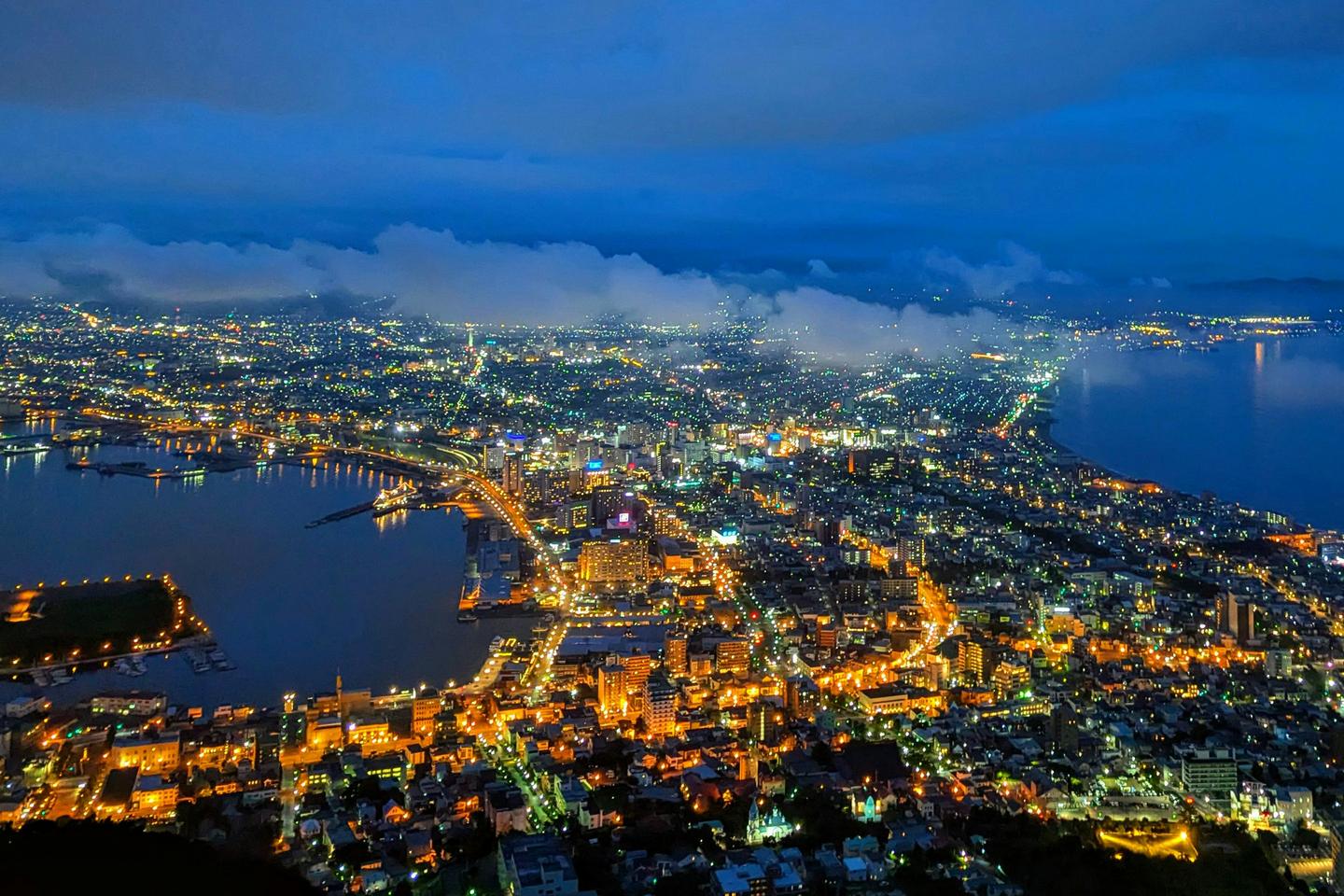
Children remember the morning market. Its roughly 250 stalls stand a minute's walk from JR Hakodate Station and open from 5:00, and at one of them they can catch a live squid from a tank, which a cook then slices as sashimi; the squid tends to spray water as it comes out. Goryokaku, a star-shaped Western-style fort completed in 1864, saw the end in 1869 of the Hakodate War, the last battle of the Boshin War, and its tower lets families see the star from an observation floor 90 m up. In the evening the Mount Hakodate Ropeway rises in about three minutes, with the last car down at 22:00 in summer. Hakodate's tourism site notes that private cars are restricted on the summit road at night in some seasons, so we plan the evening around the ropeway.
For a family we like La Vista Hakodate Bay, in the bay area: its baths on the top floor look out over the night view, its Japanese-Western rooms sleep up to four, and its breakfast includes Hakodate's squid and a seafood bowl that each guest tops as they like. From Hakodate it is about 1 hour 20 minutes by air to Haneda, or about four and a half hours by the Hokkaido Shinkansen from Shin-Hakodate-Hokuto to Tokyo.
SHAPING THE WEEK
A week in the southwest might run two nights at Lake Shikotsu, three at Lake Toya with Upopoy and Noboribetsu on the way, and two in Hakodate. One car and driver for the whole week keeps the luggage in one place and lets the day bend around the children; our guide to private drivers sets out how that is arranged. Since April 1, 2026 Hokkaido has charged an accommodation tax per person per night: ¥100 on a room charge under ¥20,000, ¥200 from ¥20,000 and ¥500 from ¥50,000. Its exemptions cover school trips only, so children on a family holiday pay it too, and several towns, Toyako among them, add their own.
Within Signature, our planning for journeys of 7 to 21 days, we draw the lakes, the volcano and Hakodate around the ages of your children, then the drives between them. The hotels, the car and the workshops are arranged by us and settled with each of them in the simplest way available, usually on your hotel bill or on the day.
SOURCES AND HOW WE CHECKED
We read the pages below on November 5, 2026. Travel times are rounded and are those the sources give. We did not contact any hotel, museum, operator or other body. Opening days and hours are those published for 2026 and may change in 2027.
- Japan Meteorological Agency, Sapporo normals 1991 to 2020 (Japanese): August average 22.3°C, high 26.4°C, low 19.1°C, humidity 75%, rain 126.8 mm
- Japan Meteorological Agency, Hakodate normals 1991 to 2020 (Japanese): August high 25.9°C, low 18.9°C, rain 156.5 mm
- Japan Meteorological Agency, Tokyo normals 1991 to 2020 (Japanese): August high 31.3°C, low 23.5°C, humidity 74%, rain 154.7 mm
- AEMET, Madrid Retiro normals 1981 to 2010 (Spanish): August high 31.3°C, low 18.8°C, humidity 41%
- AEMET, Sevilla Airport normals 1981 to 2010 (Spanish): August high 35.5°C, low 20.4°C
- Japan National Tourism Organization, visitor arrivals for August 2026 (Japanese): 36,500 visitors from Spain, a monthly record, and the reasons given
- Japan National Tourism Organization, visitor arrivals for 2025 (Japanese): 245,600 visitors from Spain in 2025, up 34.7%
- Hosteltur, Iberia adds a weekly Madrid to Tokyo flight (Spanish): the extra frequency between August and October
- Upopoy, visitor information: 2026 hours, Monday closures and the August opening days
- Upopoy, access: 40 minutes from New Chitose Airport to Shiraoi by expressway, 10 minutes more by car
- Upopoy, visitor leaflet (PDF): name, dance, crafts studio, Kotan, free strollers
- Shikotsu Tsuruga Bessou Ao no Za, FAQ: no age restriction, check-in 14:00
- Ao no Za, rooms: 25 suites with hot spring baths, villas for five, connecting rooms for seven
- Ao no Za, access: 35 to 40 minutes from New Chitose Airport, about 4 hours from Hakodate
- Japan National Parks, Shikotsu-Toya: things to see and do: kayaking on Lake Shikotsu, the fumaroles of Jigokudani
- Noboribetsu Onsen tourism association, access: 6 km from Noboribetsu-Higashi interchange, bus times from New Chitose
- Mount Usu Ropeway: six minutes each way, observation decks, Showa-Shinzan 1943 to 1945
- Toya-Usu UNESCO Global Geopark, Nishiyama route (Japanese): 2000 eruption craters on Route 230, open late April to October 30
- The Windsor Hotel Toya, rooms: room sizes, Japanese-style suites, hot spring baths and pool
- The Windsor Hotel Toya, activities: Kids' Room, canoe, horse trekking, glassblowing, park golf, stargazing
- The Windsor Hotel Toya, access: about 1.5 hours from New Chitose Airport by expressway
- The Windsor Hotel Toya, facilities: venue of the 2008 Hokkaido Toyako Summit
- Hakodate City official tourism site, morning market (Japanese): about 250 stalls, hours, live squid fishing
- Hakodate City official tourism site, Goryokaku (Japanese): completed 1864, the Hakodate War of 1869, tower observation at 90 m
- Mount Hakodate Ropeway, hours and fares: summer hours and the three-minute ride
- Hakodate City official tourism site, Mount Hakodate (Japanese): night restrictions on private cars
- Hakodate City official tourism site, access (Japanese): flights to Haneda, Shinkansen and limited express times
- La Vista Hakodate Bay (Japanese): top-floor baths, rooms for four, breakfast, access
- Hokkaido Government, accommodation tax (Japanese): start on April 1, 2026 and the exemptions
- Hokkaido Government, rates by town (Japanese): Hokkaido's three rates and the towns with their own tax
QUESTIONS TRAVELLERS ASK
Is Hokkaido really cooler than Tokyo in August?
Yes. The Japan Meteorological Agency's averages give Sapporo 26.4°C by day and 19.1°C at night in August, against 31.3°C and 23.5°C in Tokyo. It is still humid and it does rain, so we keep indoor plans ready.
How does Hokkaido in August compare with Madrid or Sevilla?
Madrid's August afternoons average 31.3°C and Sevilla's 35.5°C on AEMET's normals, against 26.4°C in Sapporo. The nights are similar to Madrid's, around 19°C, but the air in Hokkaido is much more humid.
Is Upopoy suitable for young children?
Yes. Children can watch Ainu dance, try woodcarving or embroidery workshops and walk into reconstructed houses, and strollers are lent free. In 2026 it was closed on most Mondays, so we check the calendar for your dates.
How far is Lake Toya from New Chitose Airport?
The Windsor Hotel Toya gives about an hour and a half by expressway. Lake Shikotsu is closer, about 35 to 40 minutes, which is why we often spend the first nights there.
Do children pay Hokkaido's accommodation tax?
Yes, on a family holiday. Hokkaido's exemptions cover school trips only. The tax is ¥100, ¥200 or ¥500 per person per night depending on the room charge, and some towns, including Toyako, add their own.
PLAN A HOKKAIDO SUMMER WITH US
Send us your August dates and the ages of your children. We will draw the lakes, the volcano and Hakodate around them, with the drives and the reasons, so that you can choose the pace.
Begin planning →We reply within 24 hours, in writing
Some of the restaurants and bars we arrange seat guests only by introduction or membership. We ask on your behalf; the table and the evening are the house's decision. We do not publish their names.