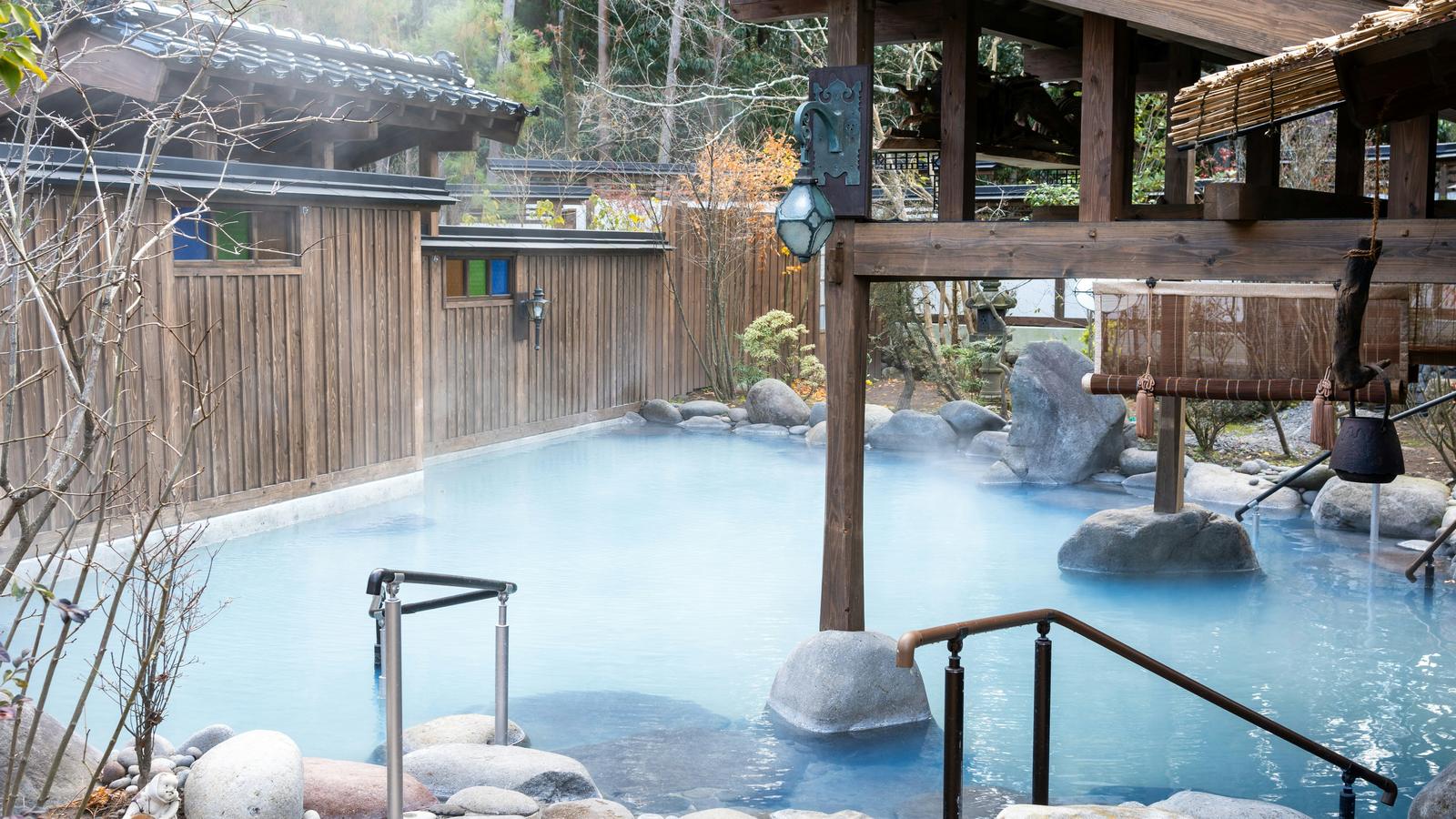
Most Americans who come to Japan for the first time spend their days in Tokyo and Kyoto. With an average stay of more than ten nights, there is room for a few days that slow the journey down: hot water, food grown close by, and a walk among old trees. Japan's national tourism organisation now presents the country to American travellers through exactly those three things, onsen, food and nature, under the heading of wellness. This article builds that part of the journey in one place we can document closely, Kirishima in Kagoshima, at the southern end of Kyushu.
On November 5, 2026 we read the pages of the ryokan, the vinegar maker, the national park, the Ministry of the Environment, the weather agency, the airport, Japan's national tourism organisation and the press, and contacted none of them; the sources are listed at the end. For forest bathing, temple stays and the idea of ma, see Japan's Wellness Circuit: Forest, Onsen, Silence →, and for a first wellness week built around Tokyo, Hakone and Kyoto, A Wellness Week in Japan: 7-Day Tokyo, Hakone and Kyoto Itinerary →.
Key points
- JNTO's marketing strategy for the United States presents Japan's food, onsen and nature through wellness, and names households with USD 200,000 a year or more among its targets.
- Under the Hot Springs Act of 1948, water, steam or gas from the ground counts as onsen if it is 25°C or warmer at the source, or if it carries one of 19 listed substances in a set amount.
- Gajoen, opened in 1970 in Myoken Onsen, describes its Type D room as the original guest room with its own open-air bath, and its private bath draws on a spring that flows up on its own.
- Tenku, the second house of the same founder, has five villas, each with its own onsen, on 60 hectares of hillside.
- Black vinegar brewed in jars in Fukuyama, made there since about 1800, was registered under Japan's Geographical Indication system in 2015 as Kagoshima tsubozukuri kurozu.
ASK US ABOUT A WELLNESS LEG IN KIRISHIMA →
WHY KIRISHIMA AFTER TOKYO AND KYOTO
JNTO's strategy for the American market says it will present Japan's regional food, onsen and nature with wellness as the way in, and it treats households with a disposable income of USD 200,000 a year or more, the top tenth, as a target of their own. Its handbook for the market notes that Americans see Japanese food as healthy and that the wealthiest travellers lean towards the outdoors. The Japan Tourism Agency's survey for 2025 shows how most Americans travel now: 69.6 percent were on their first visit, they stayed an average of 10.7 nights, 92 percent went to Tokyo and 51 percent to Kyoto. Only 0.56 percent reached Kagoshima.
That gap is the reason to go. Kirishima is a short flight from either city. The ryokan we describe give the flight from Osaka Itami to Kagoshima Airport as about 1 hour 10 minutes and from Haneda as about 1 hour 45 minutes, with the inns about 15 minutes by car from the airport. Kagoshima Airport also receives business and private jets, between 7:00 and 22:00. For the rest of Kyushu, from Fukuoka to Beppu, see Kyushu: Where to Go After Tokyo and Kyoto →.
WHAT JAPANESE LAW CALLS AN ONSEN
The word has a legal meaning. Article 2 of the Hot Springs Act, Act No. 125 of 1948, defines onsen as hot water, mineral water, steam or other gas that wells up from the ground, excluding natural gas made mostly of hydrocarbons, which has either the temperature or one of the substances in its appended table. The temperature is 25°C or more when the water is drawn from the source. The table then lists 19 substances, any one of which is enough at the stated amount per kilogram: for example 1,000 milligrams of dissolved solids, or 250 milligrams of free carbon dioxide. A spring can be cool at the source and still be an onsen by law.
The Ministry of the Environment goes a step further with its national health resort hot springs, which the Minister designates under the same Act. Its criteria ask for a spring of therapeutic grade, an abundant flow of about 0.5 litres a minute or more for each bather, surroundings suited to rest, and doctors or trained staff who can advise on bathing. Kirishima City's tourism association lists Myoken Onsen, a row of inns along the Amori River, as one of these, and states that every inn there draws on its own source. For the older tradition of staying at a spring to rest, see Toji in Japan: Staying at a Hot Spring Town to Rest →.
GAJOEN ON ITS OWN SPRINGS
Gajoen stands apart from the main group of inns at Myoken, beside the Amori River. Its founder, Tateo Tajima, was born in 1945 at a toji inn in Myoken and opened Gajoen in 1970 as a hamlet of thatched country houses brought together on the riverbank. The inn describes its Type D room as the first guest room in Japan with its own open-air bath: a half-open wooden terrace with the bath and a bed, joined to two tatami rooms. The two Japanese-style suites face the river with large tatami rooms, windows that open fully and a semi-open bath inside.
The public bath, Tateyu, was carved over half a year from a single rock of about 20 tonnes, and outside the day-visitor hours of 12:00 to 15:00 it can be reserved for private use at no charge. The private bath is fed by a spring that has flowed up on its own since long ago; the inn notes the carbon dioxide in it and the softness of the water. Rooms are taken up to six months ahead, which for spring or autumn is the window to use.
The kitchen of the house works from its own farm and garden. Free-range chickens raised by the inn, and vegetables picked that day, go into the dishes of Satsuma: on a sample evening, home-made plum wine, wild sweetfish grilled with salt, black pork stewed slowly, chicken sashimi from the inn's own birds, soup with dumplings made from sweet potato starch, and tempura of wild greens such as mugwort and plantain. At breakfast the fish and eggs are cooked to order.
TENKU FIVE VILLAS ON A HILL
In 1994 Tajima began clearing a bamboo-covered hill, and in 2004 he opened Tenku there, a resort of villas looking out over the Kirishima mountains. Its own English page gives 60 hectares of grounds and only five villas, each with its own onsen and set far enough from the others that no neighbour can be seen. The largest, also called Tenku, sits near the hilltop with a bedroom and a living room in separate buildings and an outdoor onsen on a deck facing the view. Two of the five are kept for day use.
The food follows the same idea as Gajoen, at a larger scale. More than thirty kinds of vegetables grow on Tenku's terraced fields without agricultural chemicals, and the house serves young shoots as soon as they appear. Meals are served in the Pavilion restaurant, or in the villa at an extra charge. Tenku is a member of Relais & Châteaux, as the travel trade paper Travel Voice reported Gajoen to be in 2018. For a couple who want the bath and the view entirely to themselves, Tenku is the top form of this journey; Gajoen is the warmer, older house, closer to village life.
BLACK VINEGAR AT ITS SOURCE
On the shore of Kinko Bay, about 30 minutes by car from Kagoshima Airport, the town of Fukuyama has made rice vinegar in ceramic jars set out in fields since about 1800. Sakamoto Jozo, the family brewery that carried the method through the war years, records that some 24 breweries worked here before the Pacific War, and that most closed when rice ran short and cheap synthetic vinegar took over. The family gave the jar-brewed vinegar the name kurozu, black vinegar, in 1975, for the colour it takes on as it ages.
Its history page lists the recognition that followed: registration in 2015 under Japan's Geographical Indication system, among the first group of products, as Kagoshima tsubozukuri kurozu, and selection by the Agency for Cultural Affairs as one of its 100-year foods in 2022. The company explains why Fukuyama: mild winters, ground water from the wall of the Aira caldera formed about 29,000 years ago, rice gathered at the old port, and jars from the kilns of Satsuma ware close at hand.
Kurozu Garden Tsubobatake, the brewery's shop and restaurant, looks over the fields of jars to the bay and Sakurajima. Panels and films explain the method, and the restaurant cooks with the vinegar, including its sweet and sour pork. The shop opens from 9:00 to 17:00 and the restaurant from 10:00 to 17:00, with last orders at 16:00. A late lunch here makes a natural day between two nights at the ryokan.
A GUIDED WALK IN THE NATIONAL PARK
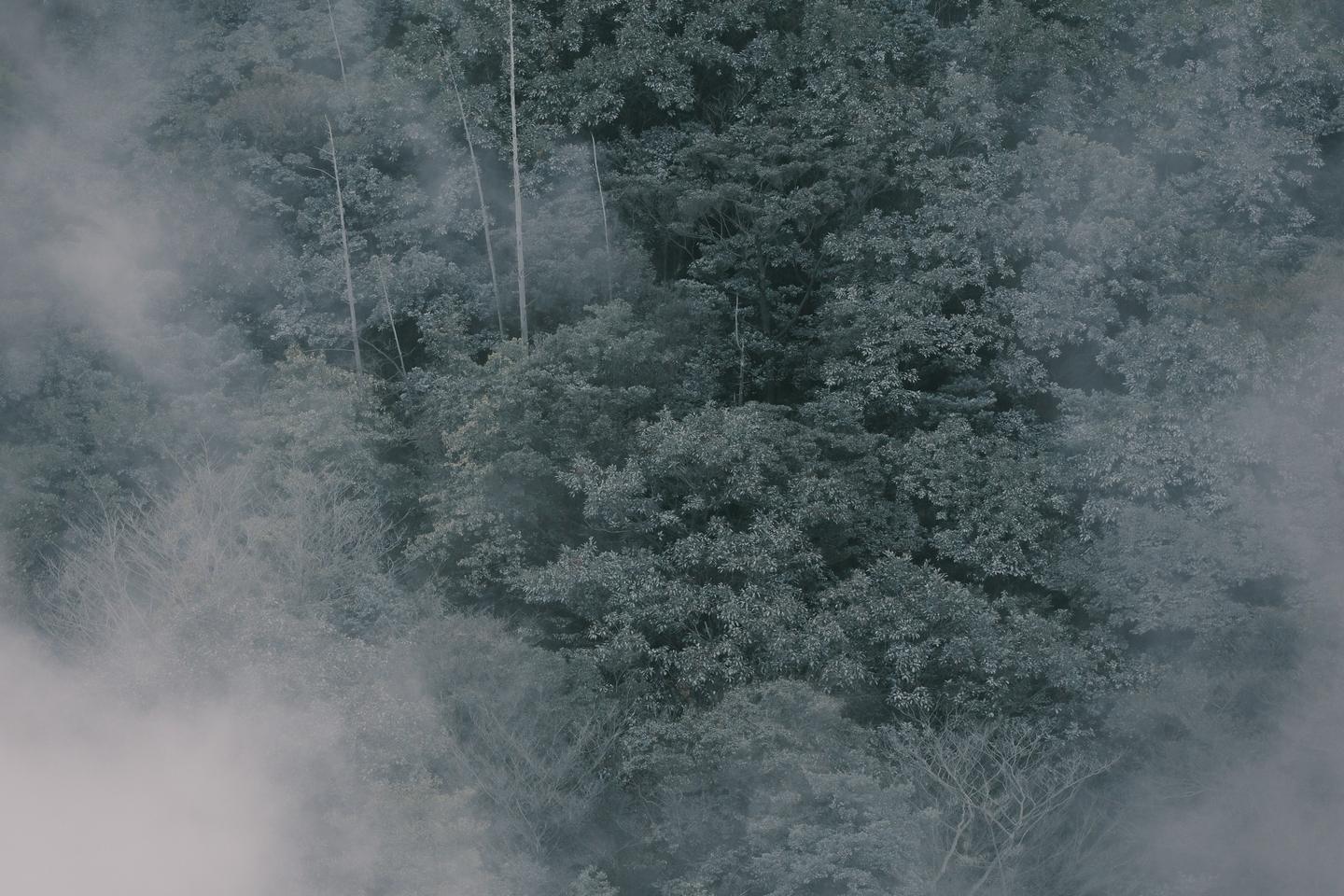
Kirishima was designated a national park on March 16, 1934, and since 2012 it has formed Kirishima-Kinkowan National Park, which the Ministry of the Environment measures at 36,605 hectares of land. Kirishima City's tourism association calls it the first national park designated in Japan. The walk we choose is the Maruo nature trail, a stone-paved path of about 2.3 kilometres inside the park, between about 560 and 700 metres above sea level, through a mixed forest of fir, hemlock and evergreen broadleaf trees, some more than 200 years old. Near it, hot spring water runs into the Maruo waterfall, and on the trail stands what the association calls the oldest rock bath in Kirishima.
The trail is one of three in Kirishima's certified forest therapy base, and the Kirishima Forest Therapy Guide Club walks all three with up to five guests for each guide, asking for requests at least a week ahead. For the higher mountains, the Kirishima Nature Guide Club has many registered geo guides as well as specialists in plants and geology. The volcanoes set the limits on any given day. On October 30, 2026 the Japan Meteorological Agency kept Shinmoedake at alert level 2, with caution inside about 2 kilometres of the crater, while Iozan at Ebino Kogen was at level 1. We read the bulletins again in the days before a walk and choose the route with the guide. For forest walks closer to Tokyo, see Forest Bathing Near Tokyo: Guides, Fees and Routes →.
WHERE STAYGO COMES IN
We usually give Kirishima three or four nights after Kyoto: a morning flight from Itami, two nights at Gajoen or Tenku, a day for the vinegar fields and the bay, a morning on the forest trail with a guide, and a final night before flying to Haneda for the journey home. Couples who want both houses can spend the first nights at Gajoen and the last at Tenku. Private baths also settle a question many American guests ask about tattoos, covered in Tattoo Friendly Onsen in Japan: Where You Can Bathe →.
Within Signature, our planning for journeys of 7 to 21 days, we set out the flights and the stays around the alert levels and the seasons, and arrange the ryokan, the villa, the guide and the cars. We ask each house about dietary needs when we arrange the stay. Rooms, meals and guides are settled with each provider in the simplest way available, usually on your bill or on the day.
SOURCES AND HOW WE CHECKED
We read the pages below on November 5, 2026. Travel times are approximate and as given by each source. We did not contact any ryokan, maker, guide, agency or other body.
- JNTO, US market marketing strategy (Japanese): food, onsen and nature presented through wellness; top 10 percent of households at USD 200,000 a year or more as a target
- JNTO, Visit Japan handbook 2023, United States section (Japanese): Japanese food seen as healthy, outdoor leaning of the wealthiest travellers, tattoos at onsen
- Japan Tourism Agency, Consumption Trend Survey for Foreigners Visiting Japan 2025, tables (Japanese): first visits 69.6 percent, 10.7 nights, Tokyo 92 percent, Kyoto 51 percent, Kagoshima 0.56 percent
- e-Gov, Hot Springs Act, Act No. 125 of 1948 (Japanese): Article 2 and the appended table: 25°C, 19 substances, dissolved solids and free carbon dioxide
- Ministry of the Environment, national health resort hot springs (Japanese): designation under the Act and its criteria
- Ministry of the Environment, Kirishima-Kinkowan National Park overview (Japanese): designated March 16, 1934, renamed in 2012, 36,605 hectares
- JNTO, National Parks of Japan, Kirishima-Kinkowan: visitor centres and the park's volcanic landscape
- Japan Meteorological Agency, Kirishimayama (Shinmoedake) (Japanese): alert level 2 and the 2 kilometre zone, bulletin of October 30, 2026
- Japan Meteorological Agency, Kirishimayama (Ebino Kogen, Iozan) (Japanese): alert level 1
- Gajoen, rooms (Japanese): Type D open-air room, suites on the river, check-in 14:00, rooms taken six months ahead
- Gajoen, onsen (Japanese): Tateyu carved from a rock of about 20 tonnes, private use, the self-flowing carbonated spring
- Gajoen, cuisine (Japanese): own farm and garden, sample breakfast and dinner
- Gajoen, about the founder and access (Japanese): Tateo Tajima, 1945, 1970, Tenku in 2004, flight times, 15 minutes from the airport
- Tenku, official site: 60 hectares, five villas with onsen, terraced fields, the Pavilion, Relais & Châteaux
- Sakamoto Kurozu, company history and origin (Japanese): about 1800, 24 breweries, the name in 1975, GI 2015, 100-year food 2022, the Aira caldera
- Sakamoto Kurozu, Kurozu Garden Tsubobatake (Japanese): view, hours, distance from the airport
- Kirishima City Tourism Association, travel cards (Japanese): Myoken Onsen and its own sources, the Maruo trail, the two guide clubs
- Kagoshima Airport, business jets (Japanese): private and business jets, 7:00 to 22:00
- Travel Voice, July 10, 2018 (Japanese): Gajoen and Tenku as members of Relais & Châteaux in 2018
QUESTIONS TRAVELLERS ASK
What makes a hot spring an onsen in Japan?
The Hot Springs Act of 1948. Water, steam or gas from the ground is an onsen if it is 25°C or warmer at the source, or if it carries one of 19 listed substances in a set amount, such as 1,000 milligrams of dissolved solids or 250 milligrams of free carbon dioxide per kilogram.
How do we reach Kirishima from Kyoto or Tokyo?
Fly to Kagoshima Airport: about 1 hour 10 minutes from Osaka Itami or about 1 hour 45 minutes from Haneda, as the ryokan give it. Gajoen and Tenku are about 15 minutes by car from the airport, which also receives private jets between 7:00 and 22:00.
Can we have a private open-air bath in our room?
Yes. Gajoen has a room with its own open-air bath on a wooden terrace and suites with semi-open baths, and each of Tenku's five villas has its own onsen. Gajoen also lets guests reserve its rock bath privately outside day-visitor hours.
Is it safe to walk in Kirishima with active volcanoes?
The Japan Meteorological Agency sets alert levels for each crater. On October 30, 2026 Shinmoedake was at level 2, with caution inside about 2 kilometres, and Iozan at level 1. We read the bulletins again before the day and choose the route with a local guide, who knows which paths are open.
How many nights should a Kirishima wellness leg have?
Three or four nights works well after Tokyo and Kyoto: two at the ryokan or villa, a day for the black vinegar fields in Fukuyama, a guided morning in the forest and a final night before flying home.
ASK US ABOUT A WELLNESS LEG IN KIRISHIMA
Send us your dates in Tokyo and Kyoto and how you like to spend a quiet day. We will add the flights, the ryokan or villa, the vinegar fields and a guided walk, timed to the season and the mountain.
Begin planning →We reply within 24 hours, in writing
Some of the restaurants and bars we arrange seat guests only by introduction or membership. We ask on your behalf; the table and the evening are the house's decision. We do not publish their names.