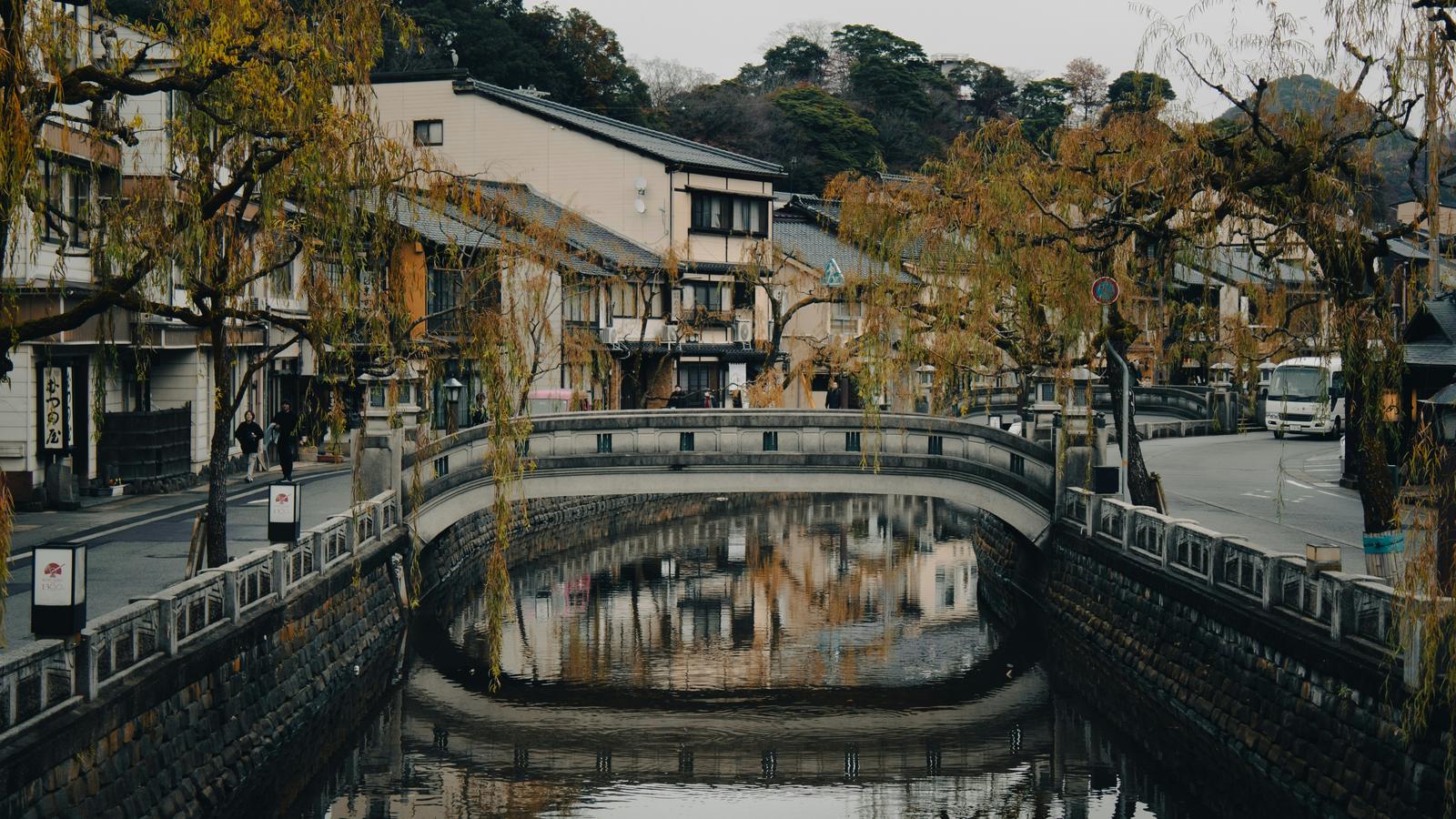
Yes, you can bathe in a Japanese onsen with tattoos, and on a well planned trip you will rarely be turned away. There are three routes: a room with its own hot spring bath, a private bath reserved for your party, or a shared bath whose operator says in writing that it accepts tattoos, sometimes on condition that they are covered. Kinosaki Onsen's seven public bathhouses accept tattoos of any size without covering, Hakone Yuryo lifted its tattoo restriction on April 1, 2025, and Hoshino Resorts writes that it does not restrict its facilities on the basis of tattoos, while keeping the right to refuse the shared bath if other guests may be uncomfortable.
This guide sets out those three routes, the published rules of named properties and onsen towns, and the questions to settle before a ryokan is booked. We read every policy below on the operator's own website, or on a government page, on October 14, 2026, and the sources are listed at the end. The etiquette of the bath itself is covered in our guide to onsen culture, and how to choose the ryokan in how to choose a ryokan in Japan; this article deals only with tattoos.
Key points
- The simplest route is a room with its own hot spring bath. At Kinnotake Sengokuhara in Hakone and Beniya Mukayu in Ishikawa, every room has its own open-air bath, so the shared bath never comes into it.
- Kinosaki Onsen's official visitor site says all seven public bathhouses accept tattoos of all sizes with no covering. It also says the baths inside each inn may have different rules.
- Hoshino Resorts, which runs Hoshinoya and KAI, does not restrict its facilities on account of tattoos, but may refuse the shared bath if staff believe other guests could be uncomfortable. At its facilities open to non-staying guests, tattoos must be fully covered by eight cover stickers of 8 cm by 10 cm.
- Hakone Yuryo, a day spa beside Hakone-Yumoto, lifted its tattoo restriction on April 1, 2025, and has 19 private open-air bath rooms from ¥10,400 for two hours on weekdays.
- Rules for the onsen, the spa, the gym and the pool are often different inside one hotel. The Ritz-Carlton, Nikko welcomes tattoos in its onsen; The Ritz-Carlton, Osaka asks guests with tattoos, even small ones, not to use its spa area.
WHAT THE RULES ACTUALLY SAY
Many shared baths in Japan have long refused bathers with tattoos, because tattoos were associated with organised crime. That history is the reason for the signs, and it is also why the rules now vary so much from one door to the next.
The government position
In March 2016 the Japan Tourism Agency wrote to the national hotel, ryokan and hot spring associations about foreign travellers with tattoos. The notice states that refusing a bather only because they have a tattoo is not appropriate, and it notes that people have tattoos for religious, cultural and fashion reasons, and that a tattoo raises no hygiene concern. It then gives operators three ways to avoid friction: ask for the tattoo to be covered with a sticker or similar, or ask for nothing if it is about palm sized and not intimidating; suggest bathing at hours when fewer families are in the bath; or offer a private bath, or a room with its own bath. The Ministry of Health, Labour and Welfare passed the notice to prefectures and cities two days later.
The notice is guidance, and each bath still sets its own rule. The agency's own ryokan question and answer page says plainly that the response to tattoos differs greatly from ryokan to ryokan: some impose no restriction at all, some decide case by case and accept a single small design, and some offer private baths or rooms with their own bath. It ends by advising guests to ask the ryokan.
Those three ideas are the three routes below.
ROUTE ONE A ROOM WITH ITS OWN HOT SPRING BATH
For a guest with tattoos this is usually the simplest answer, and it is also how many people choose to stay at a fine ryokan anyway. If the room has its own hot spring bath, on a terrace or in a bathroom of its own, you can bathe at any hour without anyone else's rule applying to you.
Kinnotake Sengokuhara in Hakone
Kinnotake Sengokuhara states on its English rooms page that an open-air onsen bath is a feature of every room, and that the ryokan is for guests aged 12 and over. It does not publish a tattoo policy, and with a private open-air bath in every room it does not need one for your stay. Its rates, and the room we would ask for, are in our luxury Japan honeymoon itinerary; for the area itself, see our Hakone guide.
Beniya Mukayu in Yamashiro Onsen
Beniya Mukayu has 16 rooms and suites, and its rooms page states that every one has a private open-air hot spring bath overlooking the garden. It also has gender separated communal baths, indoor and outdoor, with a sauna. The website does not state a tattoo policy for those communal baths, so we treat them as a question to settle before arranging the stay; the bath in your room is yours whatever the answer.
What to ask about a room bath
The words "private bath" cover very different things. Before a room is arranged we confirm that the bath is filled with hot spring water and not ordinary tap water, whether it is open-air or indoors, how many people it seats, and whether every room in the category has one or only some.
ROUTE TWO A PRIVATE BATH RESERVED FOR YOUR PARTY
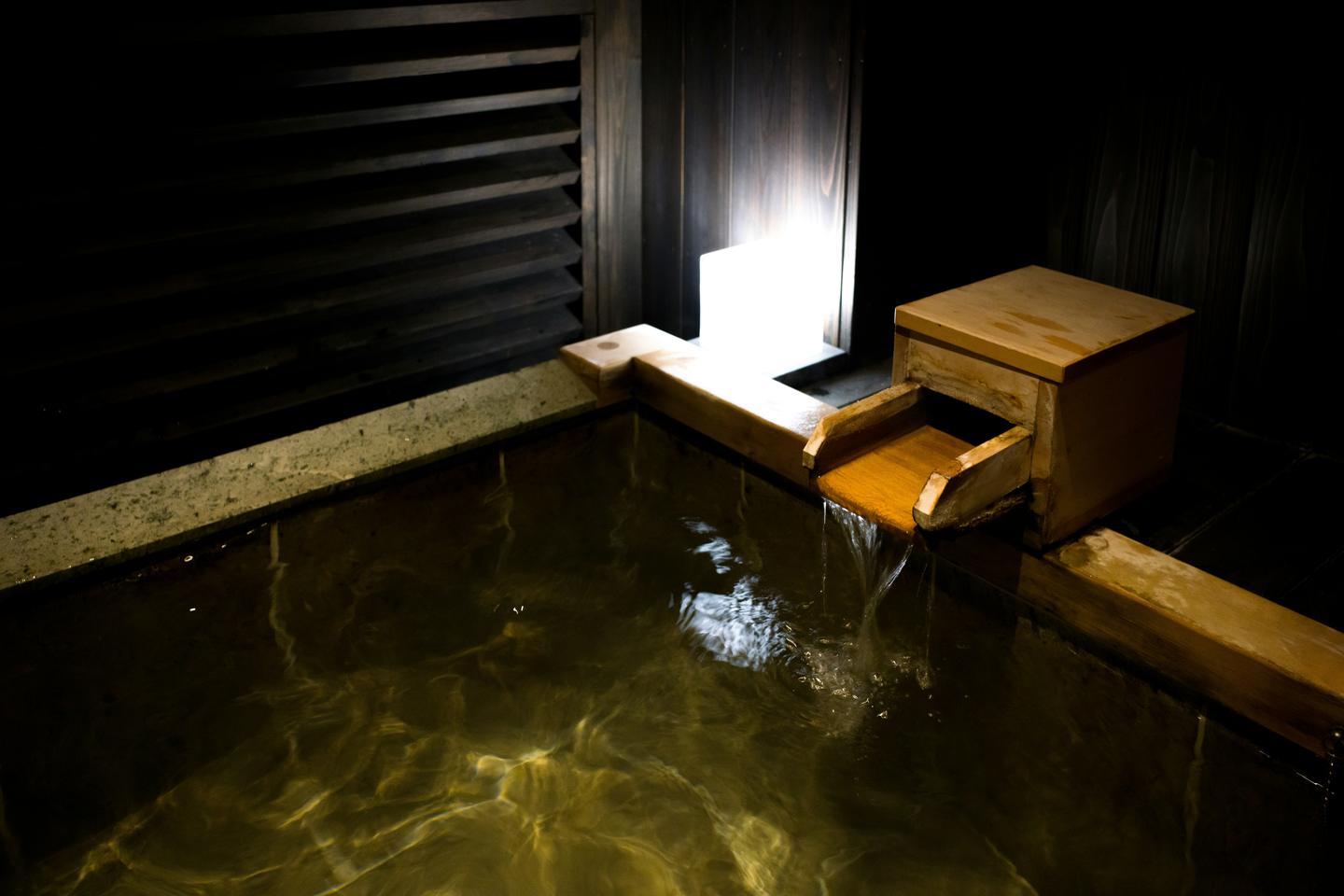
The second route is the kashikiri bath, a hot spring bath that one party reserves for a set time and locks from the inside. Many ryokan have one or two alongside their shared baths, and some day spas are built around them. For a couple or a family where one person has tattoos, this lets everyone bathe together.
Hakone Yuryo
Hakone Yuryo, run by Odakyu Resorts in Tonosawa, three minutes by free shuttle bus from Hakone-Yumoto station, is a day spa with both. Its English site states that it lifted its tattoo restriction on bathing from April 1, 2025, so both the shared baths and the private rooms are open to you. The 19 private open-air bath rooms, named Hanare Yuya Kaden, are reserved for two hours. The rooms for two, about 18 m², cost ¥10,400 on weekdays and ¥11,400 at weekends and holidays; the largest, about 32 m² for up to four, ¥14,400 and ¥15,400. Reservations open one month ahead and close at 15:00 the day before. The site does not state whether those prices include tax. The shared baths cost ¥1,700 to ¥1,800 for adults on weekdays and ¥2,000 to ¥2,200 at weekends and holidays, and children aged five and under are not admitted to them.
The house rules still exclude anyone connected with organised crime, and swimwear is not worn in the baths, as at any onsen.
Kashikiri baths inside a ryokan
At a ryokan, the private bath is usually booked at check-in or on the day, by time slot, and the number of slots is limited. If the room has no bath of its own, we ask the ryokan before arranging the stay how many private baths there are, how long each slot lasts, whether slots can be reserved ahead, and whether the inn applies any tattoo rule to them at all.
ROUTE THREE SHARED BATHS THAT ACCEPT TATTOOS
The third route is the shared bath, with its view and its scale. Where an operator publishes a written policy, the useful part is usually a condition.
Kinosaki Onsen
Kinosaki Onsen, two and a half hours by train from Kyoto and Osaka, is the clearest case in Japan. Its official visitor site, operated by Toyooka Tourism Innovation for Toyooka City, states that all seven public bathhouses accept tattoos of all sizes, with no need to cover them. The bathhouses are Kono-yu, Mandara-yu, Goshono-yu, Ichino-yu, Yanagi-yu, Jizo-yu and Satono-yu, each closed one day a week. When we checked, the site listed Kono-yu as closed for renovation from May 11 to October 30, 2026, and Satono-yu as closed for renovation from April 1, 2024, so we check which bathhouses are open for your dates. Day visitors can buy a pass for all the bathhouses for ¥1,500, and guests at Kinosaki inns are usually given a pass at check-in. The same page adds one important line: the baths inside each inn may have different rules. So in Kinosaki you can bathe across the town, while the ryokan's own bath is a separate question.
Hoshino Resorts with Hoshinoya and KAI
Hoshino Resorts publishes its policy in two places. Its hotel information page says it does not restrict the use of its facilities on the basis of tattoos, but may refuse access to the shared bath if it believes tattoos could cause discomfort or concern to other guests. Its hotel regulations, last amended on March 25, 2026 and effective from April 1, 2026, apply to its properties in Japan whose baths are for staying guests only, and use similar words: tattoos are welcome, but access may be limited if a tattoo could be perceived as intimidating. Neither page lists exceptions by brand, other than a separate pool page for Hoshino Resorts Tomamu.
Two further rules are worth knowing. At pools, staff may ask a guest with tattoos to wear a rash guard, which you need to bring because none are provided. At facilities open to visitors who are not staying, tattoos are accepted only if they can be fully covered by eight cover stickers of 8 cm by 10 cm.
The Tenzan bathhouse in Hakone
Tenzan Tohji-kyo, a day bathhouse near Hakone-Yumoto, has an unusual rule that catches couples out. Its rules page says tattoos alone are no reason to refuse a guest. The condition is that only one tattooed guest, of either gender, may be inside at a time. If two guests with tattoos arrive, even separately, they are asked to leave once they are together in the building. Tattooed guests are asked to wear a layer over their tattoos while moving around the building. The bathhouse has no private bath, and its separate bath for guests of its rest rooms is closed to guests with tattoos. Admission is ¥1,450 for adults, tax included, in cash only, and it takes no reservations.
Where the policy was not clear
Some names appear on every list of tattoo friendly onsen. We include a place here only if its own site states the policy today. Dogo Onsen in Matsuyama is a good example: an English answer saying tattoos are not restricted exists in the code of its official question page, but it is hidden from visitors, so we could not confirm the current rule and have left it out of the table.
OFFICIAL POLICIES SIDE BY SIDE
| Property or place | What the official page says | What it means for you |
|---|---|---|
| Kinosaki Onsen, seven public bathhouses | All seven accept tattoos of all sizes, no covering needed. Inn baths may differ. | Bathe across the town freely. Confirm the ryokan's own bath separately, or book a room with its own bath. |
| Hakone Yuryo | Tattoo restriction on bathing lifted from April 1, 2025. | Shared baths and the 19 private bath rooms are open to you; private rooms from ¥10,400 for two hours on weekdays. |
| Hoshino Resorts, including Hoshinoya and KAI | No restriction on account of tattoos, but the shared bath may be refused if other guests could be uncomfortable or a tattoo could seem intimidating. | Usually fine, but not guaranteed. A room with its own bath or a covered tattoo removes the doubt. |
| Hoshino Resorts, facilities open to non-staying visitors | Tattoos must be fully covered by eight stickers of 8 cm by 10 cm. | Larger pieces cannot be covered within the limit, so plan to bathe where you stay. |
| Hoshino Resorts, pools | A rash guard may be requested; none are provided. | Pack a rash guard if you plan to swim. |
| Tenzan Tohji-kyo, Hakone | Tattoos accepted for one guest at a time; cover up inside the building. | Works for one person. Two people with tattoos cannot go together. |
| The Ritz-Carlton, Nikko | Tattoos are welcomed in the onsen; the onsen is for staying guests and day spa guests. | Use the onsen freely during your stay. |
| The Ritz-Carlton, Osaka | Guests with tattoos, including small ones, asked not to use the spa area; tattoos covered in the gym and pool. | Plan for no spa area use. Cover with the hotel's tape or a rash guard for the gym and pool. |
| Kinnotake Sengokuhara, Hakone | An open-air onsen bath in every room; guests 12 and over. | No shared bath needed, so no policy applies to your bathing. |
| Beniya Mukayu, Yamashiro Onsen | A private open-air hot spring bath in every room; no tattoo policy published for the communal baths. | Bathe in your room; ask before using the communal baths. |
HOTELS WITH A SPA A GYM OR A POOL
International hotels in Japan often set one rule for the onsen and another for the spa, the gym and the pool, and the stricter rule is not always where you expect it. The two Ritz-Carlton hotels we checked show how far apart one brand can be.
The Ritz-Carlton, Nikko states under its onsen policies that tattoos are welcomed, and that use by those affiliated with criminal groups is not. The onsen opens from 5:30 to 23:00 with a two-hour cleaning break between 12:00 and 14:00, and is for staying guests, or day guests who have booked a spa treatment.
The Ritz-Carlton, Osaka asks guests with tattoos, including small fashion tattoos, not to use its spa area. In the fitness centre and the pool, all tattoos must be covered, with taping provided by the hotel, a rash guard or rental clothing, and the hotel notes that rash guards and rental clothing are limited in number.
So before a city hotel is arranged for someone who swims or trains every morning, we read the pool and gym rules as closely as the bath rules. If a pool asks for cover, a rash guard from home is the easiest answer. For the cost side of these hotels, see what a luxury Japan trip costs.
WHAT TO CONFIRM BEFORE BOOKING
These are the questions we settle with each property in writing before a room is held for a guest with tattoos.
- Does the room category have its own bath, and is it hot spring water, open-air or indoor?
- Is there a private bath that can be reserved, how many are there, how long is a slot, and can it be booked before arrival?
- Does the property have a written tattoo policy for its shared baths, and does it differ between the indoor bath, the open-air bath and any sauna?
- If cover is required, what is the largest area a sticker or set of stickers may cover, and does the property provide them or must you bring your own? Hoshino Resorts, for example, sets eight stickers of 8 cm by 10 cm for visitors who are not staying.
- Do the spa, gym and pool follow the same rule as the onsen, and is a rash guard accepted?
- Does the rule apply per person or per group? Tenzan Tohji-kyo admits only one tattooed guest at a time.
- In an onsen town such as Kinosaki, do the inn's own baths follow the town's public bath policy, or a stricter one?
It helps us to know roughly where your tattoos are. A forearm that one sticker covers and a full back piece can get different answers at the same property.
HOW STAYGO ARRANGES IT
When a guest tells us about tattoos, we start from the bath and work back to the property. For most guests that means a room with its own hot spring bath for the ryokan nights, a town such as Kinosaki where the public baths are open to everyone, and hotels whose pool and gym rules suit how the guest likes to spend the morning. We confirm each property's policy in writing before anything is held, and we arrange everything in your names; you pay the hotels and ryokan directly at their own rates, with no markup or commission from us. Our Signature planning fee is USD 3,500 for the group, for trips of 7 to 14 days, and longer or more complex trips are quoted as Bespoke. How we plan hot spring stays more broadly is on onsen and ryokan in Japan, planned from Tokyo.
SOURCES AND HOW WE CHECKED
We read each policy on the operator's own website, or on a government page, on October 14, 2026. Where a page gave no tattoo policy, we say so in the text and do not assume one. Prices are as published on the official site on that date. Policies change, so we confirm them again with each property before arranging anything.
- Japan Tourism Agency notice of March 2016, as circulated by the Ministry of Health, Labour and Welfare: the government position and the three suggested approaches
- Japan Tourism Agency, ryokan questions and answers: how ryokan policies vary
- Visit Kinosaki, tattoo friendly onsen: the seven public bathhouses and inn baths
- Visit Kinosaki, the seven onsen: bathhouse names, closures and the day pass
- Hoshino Resorts, hotel information: shared bath, pool and sticker rules
- Hoshino Resorts, hotel regulations: bath and pool rules effective April 1, 2026
- Hoshino Resorts, tattoos in the pool area: rash guards and the Tomamu exception
- Hakone Yuryo: tattoo restriction lifted and house rules
- Hakone Yuryo, hot springs: private bath rooms, fees and reservations
- Tenzan Tohji-kyo, English guide: tattoo rule
- Tenzan Tohji-kyo, rules of use: one tattooed guest at a time and group size
- Tenzan Tohji-kyo, questions and answers: no private bath and the rest room bath
- Tenzan Tohji-kyo, Tenzan: admission and hours
- The Ritz-Carlton, Nikko, spa and onsen: onsen tattoo policy and hours
- The Ritz-Carlton, Osaka, experiences: spa, gym and pool tattoo rules
- Kinnotake Sengokuhara, rooms: open-air bath in every room and age limit
- Beniya Mukayu, rooms: private open-air bath in every room and communal baths
QUESTIONS ANSWERED
Can you go to an onsen in Japan with tattoos?
Yes. A room with its own hot spring bath or a reserved private bath avoids the question entirely, and some shared baths publish a policy accepting tattoos. Kinosaki Onsen's seven public bathhouses accept tattoos of all sizes without covering, and Hakone Yuryo lifted its tattoo restriction on April 1, 2025.
Do Hoshino Resorts and KAI accept guests with tattoos?
Hoshino Resorts states that it does not restrict its facilities on the basis of tattoos, but may refuse access to the shared bath if it believes other guests could be uncomfortable. At its facilities open to visitors who are not staying, tattoos must be fully covered by eight cover stickers of 8 cm by 10 cm, and at pools a rash guard may be requested.
Are the ryokan baths in Kinosaki also tattoo friendly?
Not necessarily. Kinosaki's official visitor site says the seven public bathhouses accept tattoos of all sizes, but that the baths inside each inn may have different rules. We confirm the inn's own policy before arranging the stay, or choose a room with its own bath.
Will a cover sticker be enough?
Only where the property accepts covering and your tattoo fits within its limit. The Japan Tourism Agency's 2016 notice lists covering with a sticker as one approach, and Hoshino Resorts sets a limit of eight stickers of 8 cm by 10 cm for visitors who are not staying. Some places allow only one tattooed guest at a time whatever the covering, as Tenzan Tohji-kyo in Hakone does.
Do hotel pools and gyms in Japan allow tattoos?
It depends on the hotel and the facility. The Ritz-Carlton, Osaka asks for all tattoos to be covered in its gym and pool and asks guests with tattoos not to use its spa area, while The Ritz-Carlton, Nikko welcomes tattoos in its onsen. A rash guard from home is the simplest cover where one is asked for.
BATHE WHEREVER YOUR TRIP TAKES YOU
Tell us your dates, the kind of bath you would like and, roughly, where your tattoos are. We will come back with rooms that have their own hot spring bath, the shared baths that will welcome you, and the published rules for each.
Begin planning →