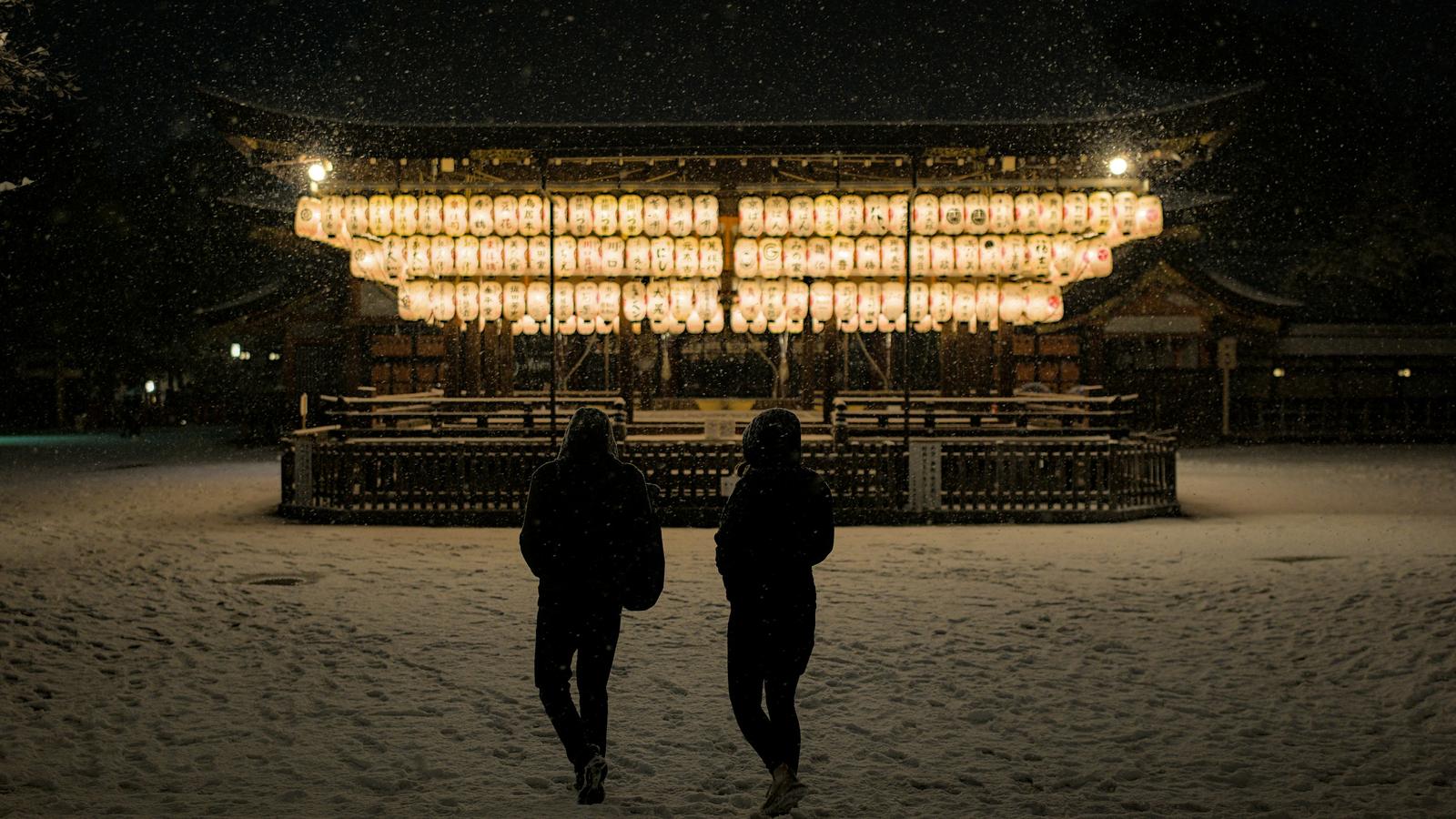
Setsubun, the eve of spring on the old calendar, falls on Wednesday, February 3, 2027, and Kyoto marks it over two days, February 2 and 3, at dozens of shrines and temples. At Yasaka Shrine in Gion, the geiko and maiko of four of the city's five geisha districts dance on the open stage in the shrine grounds and then throw lucky beans to the crowd, one district at a time across the two afternoons. At Kitano Tenmangu, on February 3, the fifth district, Kamishichiken, dances after a comic play that drives out the demons. At Yoshida Shrine, a figure in a four-eyed golden mask chases three demons around the shrine on the evening of February 2, and on the night of February 3 a great fire burns the old charms of the year. At Rozan-ji, red, blue and black demons dance and are driven from the temple. All of it is free to watch, and there are no tickets or seats.
Below are the date, the main events and their times, how to plan two days around them, and what to wear in early February. The times are those the shrines, the temples and the Kyoto City Tourism Association published for 2026, which follow a pattern that repeats each year; the 2027 list had not yet appeared when we read the pages again on November 2, 2026. We read the shrines' and temples' own pages, the tourism association, the National Astronomical Observatory of Japan, the Japan Meteorological Agency, nippon.com, a Japanese dictionary and a lifestyle magazine, and did not contact any of them; the sources are listed at the end. For the year's other customs, see Japanese Festival Calendar: Holidays and Customs by Month →.
Key points
- Setsubun is on Wednesday, February 3, 2027, the day before Risshun, the start of spring, on February 4, as the National Astronomical Observatory of Japan sets out.
- At Yasaka Shrine, geiko and maiko dance and throw beans on February 2 (Pontocho at 1 pm, Miyagawacho at 3 pm) and February 3 (Gion Kobu at 1 pm, Gion Higashi at 3 pm).
- Kamishichiken's geiko and maiko dance at Kitano Tenmangu on February 3, after the demon play that began at 1 pm in 2026.
- Yoshida Shrine's festival runs from February 2 to 4, with the demon chase at 6 pm on the 2nd and the fire at 11 pm on the 3rd, and about 800 stalls.
- The events are free and there are no seats. The 2027 times will be confirmed by each shrine and temple; the 2026 ones below are a guide.
ASK US ABOUT SETSUBUN IN KYOTO →
WHAT SETSUBUN IS
Setsubun means the division between seasons. The National Astronomical Observatory of Japan, which publishes the official calendar, puts Risshun, the start of spring, at 10:46 am on February 4, 2027, and Setsubun on February 3. On the old calendar spring began the year, so Setsubun was in effect a New Year's Eve, and the night to drive out what the old year had brought. The Japanese dictionary Nihon Kokugo Daijiten records the court rite of tsuina, chasing out the demons of disease, first held in Japan in 706 on the last night of the year, and spreading over time to shrines, temples and homes, where it became the throwing of beans at Setsubun.
At home, families throw roasted soybeans out of the door with the call oni wa soto, fuku wa uchi, demons out, luck in, and eat one bean for each year of their age. nippon.com, writing on Kyoto's Setsubun, notes a medieval story of demons on Mount Kurama, north of the city, being driven off with beans. Another custom is to eat a whole rolled sushi, ehomaki, facing the year's lucky direction; the lifestyle site All About gives the rule by which the direction changes, and for years ending in 7, 2027 among them, the direction is north-northwest.
For a visitor, what makes Kyoto's Setsubun worth a journey is that the city's shrines and temples each keep their own form of it. Some reenact the court rite of the Heian period, some stage demons that dance, and at two shrines the geisha districts come out in public, by daylight, on an open stage.
THE GEISHA DISTRICTS AT YASAKA AND KITANO
Yasaka Shrine's own page sets out the two days. On the dance stage in the shrine grounds, each of four geisha districts offers a dance, and its geiko and maiko then throw beans. Between them come court music and an imayo song, and at 4 pm each day the shopping street of the approach throws beans of its own. The shrine gives out lucky beans for an offering of ¥300 a bag, each with a ticket for a prize draw in which, it says, there are no blanks.
| Day | Time | Offering |
|---|---|---|
| February 2 | 1 pm | Dance by Pontocho, then beans |
| February 2 | 2 pm | Court music by the Yasaka Gagaku society, then beans |
| February 2 | 3 pm | Dance by Miyagawacho, then beans |
| February 3 | 11 am | Imayo song, then beans |
| February 3 | 1 pm | Dance by Gion Kobu, then beans |
| February 3 | 3 pm | Dance by Gion Higashi, then beans |
nippon.com describes the scene: the geiko and maiko in kimono on the stage, the dance, and then the crowd reaching up for the beans. The stage stands in the open, and the shrine grounds fill around it, so the earlier you arrive, the closer you stand.
The fifth district dances in the northwest of the city. At Kitano Tenmangu, the shrine's page explains, Setsubun opens with the festival in the main hall, followed in the kagura hall by the Kitano tsuina kyogen, a comic play performed by the Shigeyama Sengoro company of kyogen actors, and then a dance by the geiko and maiko of Kamishichiken before the beans are thrown. In 2026 the tourism association gave the play at 1 pm. Over February 2 and 3, then, all five of Kyoto's geisha districts can be seen in public, which is rare at any other time of year. Gion Kobu's dance at Yasaka and Kamishichiken's at Kitano both fall on the afternoon of February 3, at shrines on different sides of the city, so on that day you choose one.
DEMONS AND FIRE AT YOSHIDA AND ROZAN-JI
Yoshida Shrine, on Kagura-oka hill in Sakyo Ward, holds the city's best known Setsubun. Its own page calls it a great Kyoto event kept since the Muromachi period, with about 500,000 visitors in a normal year and about 800 stalls on the 2nd and 3rd. On the evening of February 2, nippon.com writes, the tsuina rite begins at 6 pm: Hososhi, a figure in a golden mask with four eyes, carrying a halberd and a shield, leads a band of children with torches against red, blue and yellow demons, and courtiers finally drive them off with arrows of reed from bows of peach wood. The shrine describes the rite as handed down from the palace of the early Heian period. On February 3, from 11 pm, the karo-sai fire burns the old charms that worshippers have brought back to the shrine in a hearth set up before the third gate. The shrine accepts only old charms and amulets for the fire.
Rozan-ji, a temple in Kamigyo Ward, holds its demon dance on the afternoon of February 3, from 3 pm. The tourism association describes three demons, red, blue and black, standing for three of the passions in Buddhist teaching, who dance into the hall and try to disturb the fire rite inside, and are driven out by the rite, the archer's arrows and beans. nippon.com describes them as carrying a torch and a sword, a great axe and a great mallet. Beans and rice cakes are thrown from 4 pm, and on that day the temple shows treasures linked to its founder, the priest Ganzan Daishi. The tourism association notes that the temple's garden is closed to visitors from February 1 to 4 for the festival.
THE OTHER RITES OF FEBRUARY 2 AND 3
The tourism association's 2026 list ran to more than twenty shrines and temples. A few stand out for a visitor.
At Mibu-dera, in the southwest of the old city, Setsubun is said to have been begun at the wish of Emperor Shirakawa more than 900 years ago, and the temple's page describes three days of rites. On February 2 and 3 its kyogen hall stages the Mibu kyogen play called Setsubun, free, four times an evening on the hour from 5 pm in 2026. Visitors buy unglazed clay plates on the approach, write their names, ages and wishes on them, and offer them to the temple; the plates are smashed in the opening piece of the play, and the temple says those who offered them are spared the year's misfortunes. Roads around the temple are closed during the festival.
At Heian Jingu on February 3, the tourism association listed a kyogen performance at noon, a reenactment of the Heian court's demon rite at 2 pm, the demons' dance and beans at 3 pm, and from about 3:30 pm a great fire of about 40,000 prayer sticks. At Shogo-in, a temple once headed by imperial princes, the state hall that is normally closed opens free on February 2 and 3, and at 1 pm on the 3rd its mountain ascetics bring the demons to repent; a great fire rite follows at 3 pm. At Senbon Shakado, the Okame Setsubun on February 3, from about 3 pm, honours the wife of the hall's master carpenter, and maiko join the bean throwing.
PLANNING TWO DAYS
The 2026 times make a natural shape. On February 2, in 2027 a Tuesday, Yasaka's dances at 1 pm and 3 pm, then Mibu-dera's kyogen in the early evening and Yoshida's demon chase at 6 pm. On February 3, a Wednesday, a choice between Gion Kobu at Yasaka and Kamishichiken at Kitano in the early afternoon, Rozan-ji's demons at 3 pm or Heian Jingu's fire at about 3:30 pm, dinner, and, for those who stay up, Yoshida's fire at 11 pm.
Each site is busy in its own way. Yoshida has no parking during the festival, Mibu-dera's streets are closed, and Yoshida asks visitors to come by public transport, so a car brings you near and the last part is on foot. Early February is cold in Kyoto: the Japan Meteorological Agency's averages for 1991 to 2020 give a February high of 10.0°C and a low of 1.6°C, and the evening rites are spent standing outdoors. A warm coat, gloves and shoes for gravel paths are what the two days ask of you.
The dances at Yasaka are the one moment of the year when the four districts appear together in daylight, free of charge. A private evening with geiko and maiko is something else, arranged at a teahouse by introduction; we write about how that works in Maiko Dinner in Kyoto: Introductions, Dances and Gion Rules →.
WHERE STAYGO COMES IN
STAYGO plans private trips across Japan. If your dates include February 2 and 3, tell us, and we will build the two days around the rites you most want to see, with the times confirmed once the shrines and the tourism association publish the 2027 list in the new year: a driver to take you as close as cars may go and to wait between sites, a guide to explain what each rite is, a room in Kyoto within easy reach of Gion, and a quiet dinner between the afternoon and the fire at Yoshida. There are no seats at any of these rites and nobody can hold a place, so we plan arrival times instead. We arrange everything in your names, and you pay the hotels, restaurants, guides and drivers directly at their own prices, with no commission or markup from us. Trips are planned on the Signature plan, for 7 to 14 days, or as Bespoke for longer or more complex journeys.
SOURCES AND HOW WE CHECKED
We read the pages below on November 2, 2026: the shrines' and temples' own pages for their rites and times; the Kyoto City Tourism Association's list of Setsubun events for 2026; the National Astronomical Observatory of Japan for the date; the Japan Meteorological Agency for the weather; nippon.com for descriptions of Yoshida, Rozan-ji and Yasaka; a Japanese dictionary for the history of tsuina; and a lifestyle magazine for the lucky direction. We did not contact any shrine, temple or other body. The times are those of 2026, and each shrine and temple can change them.
- Kyoto City Tourism Association, Setsubun festivals 2026 (Japanese): dates and times at Yasaka, Yoshida, Mibu-dera, Heian Jingu, Shogo-in, Kitano Tenmangu, Rozan-ji, Senbon Shakado and others
- Yasaka Shrine, Setsubun (Japanese): the dances of the four districts and their times, the beans at ¥300 and the prize draw
- Yoshida Shrine, Setsubun festival (Japanese): the three days, about 500,000 visitors, about 800 stalls, the tsuina rite and the fire
- Mibu-dera, Setsubun-e (Japanese): more than 900 years, the Setsubun play, the clay plates
- Kitano Tenmangu, annual events (Japanese): the Kitano tsuina kyogen and the Kamishichiken dance
- Shogo-in, news (Japanese): Setsubun-e on February 2 and 3, 2026
- National Astronomical Observatory of Japan, calendar for 2027 (Japanese): Risshun at 10:46 am on February 4 and Setsubun on February 3, 2027
- Japan Meteorological Agency, Kyoto averages 1991 to 2020 (Japanese): February high and low
- nippon.com, Setsubun in Kyoto (Japanese): the Yoshida tsuina at 6 pm and fire at 11 pm, Rozan-ji's demons, the dances at Yasaka, the Kurama story
- Kotobank, tsuina, from Nihon Kokugo Daijiten (Japanese): the court rite from 706 and its spread to Setsubun
- All About, the lucky direction (Japanese): how the direction is set and north-northwest for years ending in 7
QUESTIONS TRAVELLERS ASK
When is Setsubun in 2027?
On Wednesday, February 3, 2027, the day before Risshun on February 4, according to the National Astronomical Observatory of Japan. Most of Kyoto's rites are held on February 2 and 3, and Yoshida Shrine's festival runs to February 4.
Where can I see geiko and maiko at Setsubun?
At Yasaka Shrine, where four districts dance and throw beans: Pontocho at 1 pm and Miyagawacho at 3 pm on February 2, Gion Kobu at 1 pm and Gion Higashi at 3 pm on February 3. Kamishichiken dances at Kitano Tenmangu on February 3.
Do I need tickets?
No. The rites are free and there are no seats. Some shrines offer lucky beans or charms for a small offering, such as ¥300 a bag at Yasaka.
When is the fire at Yoshida Shrine?
The karo-sai fire, which burns the old charms brought back to the shrine, begins at 11 pm on February 3. The demon chase, the tsuina rite, is at 6 pm on February 2.
Are the 2027 times confirmed?
Not yet. The times here are those published for 2026, which follow a yearly pattern. Each shrine and temple confirms its own times, and the tourism association publishes its list around the start of the year.
ASK US ABOUT SETSUBUN IN KYOTO
Send us your dates in early February and where you will be staying. We will suggest which rites to see on each day, ask about a driver, a guide, a room near Gion and a table between the afternoon and the fire, and come back with what we were able to confirm.
Begin planning →We reply within 24 hours, in writing
Some of the restaurants, bars and private places we arrange take guests only by introduction or membership. We do not publish their names.