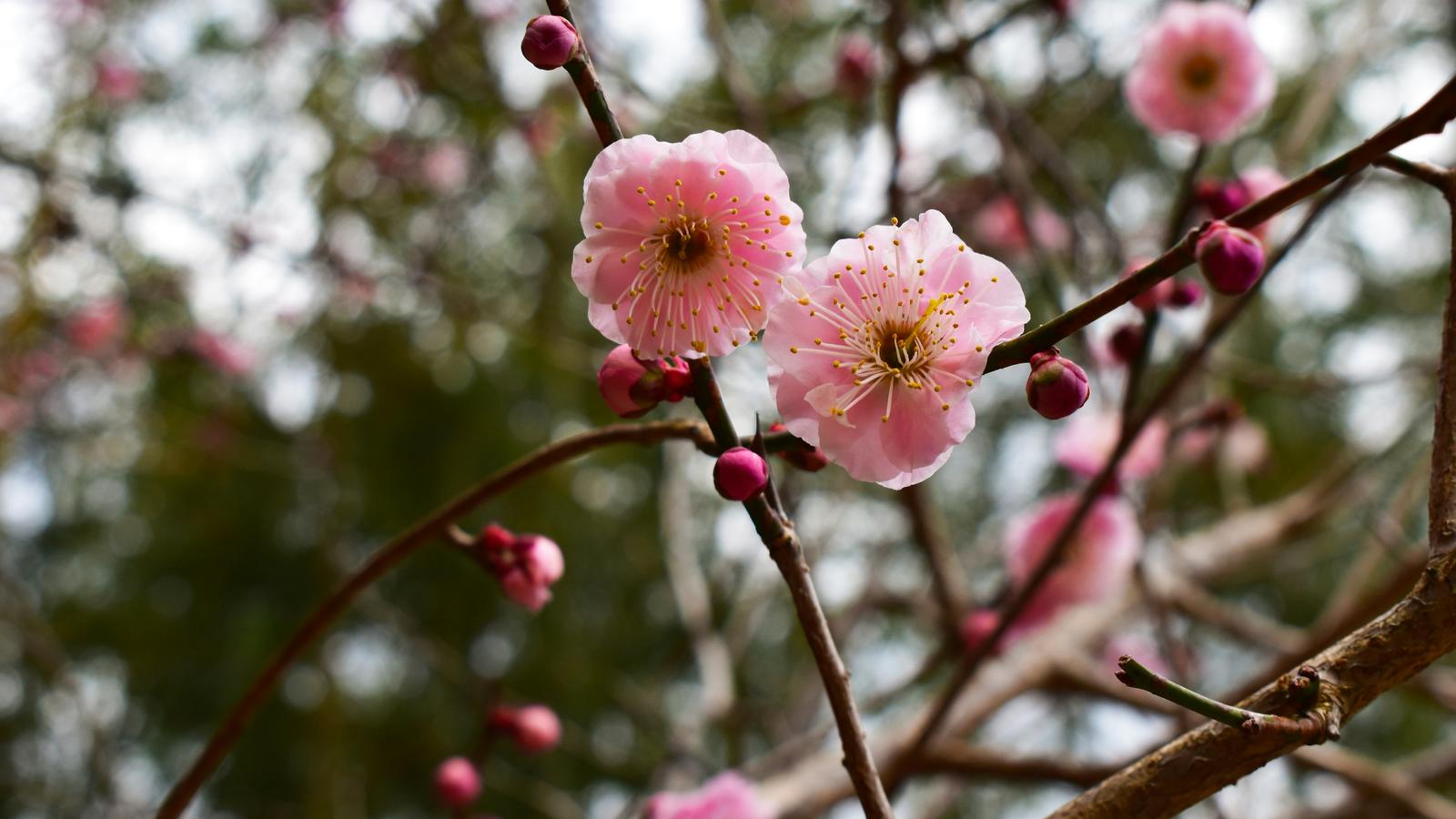
Japan's plum season runs from the first flowers of January to the last weeping plums of late March, and its heart is the shrines of Tenjin, the scholar Sugawara no Michizane, who loved the tree and is worshipped as a god of learning. For 2027, three dates are already set. Atami Baien holds its plum festival from Saturday, January 9 to Sunday, March 7. Jonangu in Kyoto opens its weeping plum season, with a plum-branch kagura dance twice a day, from Thursday, February 18 to Monday, March 22. Kitano Tenmangu in Kyoto keeps its Baikasai, with an open-air tea ceremony served by the geiko and maiko of Kamishichiken, on February 25, the day Michizane died, which in 2027 is a Thursday. The Mito Plum Festival at Kairakuen, the plum festival at Yushima Tenmangu in Tokyo and Dazaifu Tenmangu's poetry banquet had not published 2027 dates on October 31, 2026.
Below are the six places we would choose, the 2027 dates where they exist and the 2026 dates as a guide where they do not, how wide the flowering can swing from year to year, the tea served under the trees, and how to shape an early morning around the crowds. We read each shrine's, garden's, city's and tourist association's own pages on October 31, 2026, together with the Japan Meteorological Agency's flowering records, an encyclopedia entry, Nippon.com and the Rurubu travel guide, and did not contact any shrine, garden or city; the sources are listed at the end. For the rest of the year's festivals, see Japanese Festival Calendar: Holidays and Customs by Month →.
Key points
- Plum flowers open over about three months. Atami's first flower comes in November, Tokyo's reference tree flowers in late January in an average year, and Kyoto's in late February.
- Published for 2027: Atami Baien, January 9 to March 7; Jonangu's weeping plums and plum kagura, February 18 to March 22; Kitano Tenmangu's Baikasai and tea ceremony, February 25.
- Not yet published on October 31, 2026: the Mito Plum Festival (February 11 to March 22 in 2026), Yushima's plum festival (February 8 to March 8 in 2026) and Dazaifu's Kyokusui no Utage, held on the first Sunday of March.
- Kairakuen opens at 6 am from mid February, and its entry fee during the festival rises to ¥500 for adults, by a notice the park posted on October 28, 2026.
- At Jonangu's peak, the shrine says its car park is full from about 8 am with waits of 60 to 90 minutes, so arriving by car with a driver who drops you at the gate saves the queue.
ASK US ABOUT THE PLUM SEASON →
PLUM AND THE GOD OF LEARNING
The plum came to Japan early. Nippon.com writes that the tree is said to have come from China by way of the Korean Peninsula, and that the eighth-century poetry collection Man'yōshū holds more than 100 poems about it. Jonangu adds that flowering plums are grown for their scent, trunk and branches as well as the flowers.
The plum's closest companion in Japan is Sugawara no Michizane. Kitano Tenmangu records that he was born on June 25, 845, and died on February 25, 903, in Dazaifu in Kyushu, where he had been sent in disgrace on a false charge. Before he left the capital he spoke to the plum tree in his garden in a poem, asking it to send its scent on the east wind and not to forget the spring because its master was gone. Dazaifu Tenmangu tells what came next: the tree, missing its master, flew to Dazaifu in a single night. That tree, the Tobiume or flying plum, still stands to the right of the main hall. The shrine names its variety as Iro-tamagaki, a very early plum that flowers before every other tree in the grounds. Kitano Tenmangu keeps a record from 907 of the plum flying from Michizane's house to his grave.
Michizane is worshipped as Tenjin, and the plum is his flower. Dazaifu Tenmangu notes that the first poem he wrote, at five, was about a red plum, and that the plum crest appears all over its grounds. Both Kitano and Dazaifu hold a Baikasai, a plum festival, on February 25, the anniversary of his death. The encyclopedia Nipponica explains that Kitano's rite was once called Natane no Gokū, an offering decorated with rapeseed flowers, and that plum blossom took their place when the rapeseed was not yet in flower.
The weeping plum came later. Jonangu traces it to the gardening fashion of the Edo period and quotes a 1710 book describing a plum whose branches hang like a willow.
WHEN THE PLUMS FLOWER
A plum garden flowers in stages, from early to middle to late varieties, which is why the season is long. Kitano Tenmangu says its earliest plums open after New Year and flowering continues into late March, fullest from late February to mid March. Kairakuen's plant guide lists varieties flowering from mid January to mid March. Atami's tourist association says the first flower in its plum garden opens every November.
The Japan Meteorological Agency records the day a reference plum tree in each city first flowers. Its figures show how much a season can move. In 2025, a cold winter, the first flowers came three weeks late in Mito and more than two weeks late in Kyoto. In 2026 Tokyo and Fukuoka were early and Mito and Kyoto were exactly on their average dates.
| City | Average date | 2025 | 2026 |
|---|---|---|---|
| Fukuoka | January 31 | February 4 | January 18 |
| Tokyo | January 22 | January 29 | January 14 |
| Mito | February 3 | February 26 | February 3 |
| Kyoto | February 22 | March 11 | February 22 |
First flowering is only the start. Jonangu has kept its own record of the weeping plums since 2011. Full bloom began as early as February 15 in 2020 and as late as March 11 in 2025, the latest in its records, and lasted about ten days in each of 2025 and 2026. A trip planned around one fixed day can miss the peak, so we look at a window of a week or more and at more than one garden.
Both Jonangu and Mito describe three ways of enjoying the plum: tanbai, searching out the first flowers in the cold; kanbai, viewing the trees in full flower; and sekibai, regretting the falling petals. Jonangu says the early days are quieter, and that a few days after full bloom the moss is covered with petals. Michizane's poem is about the scent, and Nippon.com notes that wild plums are especially fragrant.
THE 2027 DATES SO FAR
The table gives the dates as each organiser had published them on October 31, 2026. Where 2027 is not yet announced, the 2026 dates are given as a guide, from the same organiser.
| Place | 2027 | 2026, as a guide | Entry |
|---|---|---|---|
| Atami Baien, Atami | Sat, Jan 9 to Sun, Mar 7 | Jan 10 to Mar 8 | ¥300 from 8:30 am to 4 pm in the 2026 festival; free at other hours |
| Jonangu, Kyoto (weeping plums and camellias) | Thu, Feb 18 to Mon, Mar 22 | Feb 18 to Mar 22 | Garden ¥1,000, 9 am to 4:30 pm, last entry 4 pm |
| Kitano Tenmangu, Kyoto (Baikasai and tea ceremony) | Thu, Feb 25 | Wed, Feb 25 | Shrine grounds open 7 am to 5 pm |
| Kitano Tenmangu, Kyoto (plum garden) | Not yet published | Feb 1 to May 24, with an art installation | 2026: ¥3,000 on the day, 9 am to 8:30 pm, lit every evening |
| Mito Plum Festival, Kairakuen and Kōdōkan, Mito | Not yet published | Feb 11 to Mar 22 | ¥500 during the festival; park opens 6 am from mid February |
| Bunkyō Plum Festival, Yushima Tenmangu, Tokyo | Not yet published | Feb 8 to Mar 8 | Grounds free, open 6 am to 8 pm |
| Dazaifu Tenmangu, Fukuoka (Kyokusui no Utage) | Not yet published; held on the first Sunday of March | Sun, Mar 1 | From about 1 pm in 2026; the procession can be watched by anyone |
Kitano and Dazaifu both hold their Baikasai on February 25 every year, since it is the anniversary of Michizane's death; what Kitano has not yet published is the 2027 opening of its plum garden. By the first-Sunday rule, Dazaifu's banquet would fall on March 7, 2027, but the shrine had not confirmed it. Kairakuen says its festival runs every year from mid February to late March, and Bunkyō City says Yushima's runs from early February to early March.
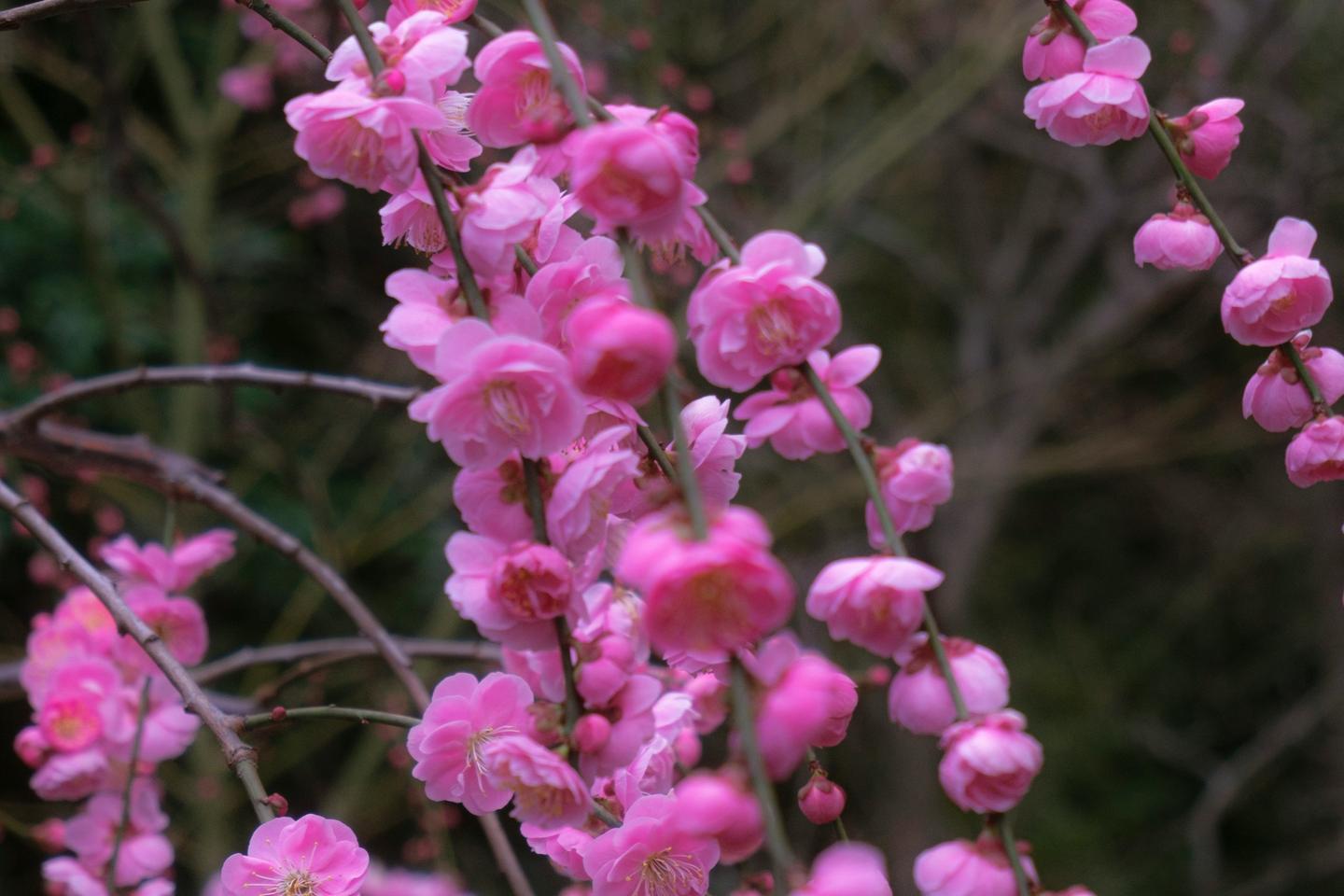
KYOTO: KITANO TENMANGU AND JONANGU
Kitano Tenmangu, founded in 947, has about 1,500 plum trees of 50 varieties across grounds of some 20,000 tsubo, about 6.6 hectares. Its plum garden, Hana no Niwa, is opened when the trees allow, usually in early February. The shrine describes paths winding between white and red, single and double flowers, a new viewing platform that looks across the whole garden, and a tea house serving plum tea and sweets. In 2026 the garden stayed open from February 1 to May 24 as the setting for an installation by the artist Mika Ninagawa, lit every evening until 8:30 pm, at ¥3,000 on the day (about US$19). The shrine says the dates change each year and had not published 2027's.
On February 25 the shrine holds its Baikasai. Kitano says the rite is about 900 years old. Paper bundles of brown rice called kōdate are set with sprigs of white and red plum and offered to Michizane, and the rice is afterwards given out as a charm against misfortune. The same day, the tea ceremony described below is held in the grounds.
Jonangu, in the south of the city, is a different picture. On the slope its garden calls the Spring Mountain, 150 weeping plums open in pale pink, red and white, and around them 400 camellias of 150 varieties flower from autumn to the end of March. The scene the shrine is proudest of is the weeping plums above red camellias fallen on green moss. In 2027 the season runs from February 18 to March 22. During those weeks a shrine maiden dances the Umegae Kagura on the kagura stage at 10 am and 3 pm, wearing plum flowers in her crown and holding a plum branch, and the stage is free to watch. The garden asks visitors not to use tripods or selfie sticks, and only the northern part of the garden is open in the season.
A camellia rice cake, tsubaki-mochi, made in limited numbers each day, is sold on the approach at ¥850 for two.
MITO, ATAMI AND TOKYO
Kairakuen in Mito is one of the three great gardens of Japan and the main ground of the Mito Plum Festival. It was laid out by Tokugawa Nariaki, the ninth lord of Mito, who also founded the Kōdōkan school. Mito's tourism association says that when Nariaki first came to his domain in 1833 he found few plum trees, so he gathered plum stones in Edo and sent them to Mito year after year. Today Kairakuen has about 3,000 trees of about 100 varieties and the Kōdōkan about 800 of 60, and in 2024 Mito's plums were recognised as a National Collection by the Japan Association of Botanic Gardens. The 2026 festival, the 130th, ran from February 11 to March 22 and drew 320,000 visitors.
The villa in the garden, Kōbuntei, takes its name from another word for plum. The park explains it through a Chinese story in which the plums flowered only while the emperor kept to his studies. Kōbuntei burned in an air raid in August 1945 and was rebuilt from 1955. During the festival Mito holds an evening plum event, a festival of plum liqueurs from across Japan and a tea gathering under the trees.
Atami Baien opened in 1886 and has 469 plum trees of 60 varieties, some more than 100 years old. The city's tourist association calls its first flowers the earliest in Japan. The 2027 festival runs from January 9 to March 7. In 2026 the garden charged ¥300 only between 8:30 am and 4 pm during the festival, from February 25 made entry free, opened a foot bath and stalls, and had Atami's geiko perform on some days. The association asks visitors to come by train, since the car parks fill every day; Kinomiya Station is about ten minutes' walk.
In Tokyo, Yushima Tenmangu has been known for its plums since the Edo period, the shrine says. Bunkyō City, which runs the festival with the shrine, counts about 300 trees, mostly white plums, and the 69th festival in 2026 ran from February 8 to March 8. Rurubu adds that the evening plums were lit from 5 to 7 pm. The shrine is two minutes from Yushima Station on the Chiyoda Line, and its gates open at 6 am. For the gardens of Tokyo through the year, see Japanese Gardens in Tokyo →.
DAZAIFU AND THE FLYING PLUM
Dazaifu Tenmangu calls itself the head shrine of all the Tenmangu shrines in Japan. Its grounds hold about 6,000 plum trees of about 200 varieties, and the shrine explains that every one was planted as an offering by worshippers. The Tobiume flowers first, and the others follow in turn.
On February 25 the priests wear plum flowers in their caps for the Baikasai, and shrine maidens dance the Tobiume no Mai. On the first Sunday of March the shrine holds the Kyokusui no Utage, a banquet first held in 958. Poets in Heian court dress, including the twelve-layered robes of court ladies, sit beside a winding stream in the plum garden and must write a poem before a cup of sake floating down to them passes by. In 2026 it was held on March 1 from about 1 pm, Rurubu reports, and the procession along the approach can be watched by anyone.
TEA UNDER THE PLUMS
The most celebrated plum tea in Japan is Kitano Tenmangu's Baikasai Nodate Ōchanoyu, the open-air tea ceremony of February 25. It is held in the garden called Funade no Niwa and recalls the great tea gathering Toyotomi Hideyoshi held at the shrine; the shrine began the present ceremony in 1952, for the 1,050th anniversary of Michizane's death. The tea is served by the geiko and maiko of Kamishichiken, the teahouse district on the shrine's eastern approach. Kamishichiken's own history says it began as seven teahouses built at the east gate, that Hideyoshi used them as his resting place at the gathering, and that this is said to be the origin of the ochaya in Japan.
The shrine's page does not say how seats are given out for 2027, so this is something we ask the shrine about in advance for each guest. On other days in the season, the tea house in Kitano's plum garden serves plum tea and sweets. In Mito, the festival programme includes a tea gathering beneath the trees. For a tea ceremony of your own in Kyoto, away from the festival crowds, see A Private Tea Ceremony in Kyoto, Step by Step →.
SHAPING THE MORNING
Plum gardens are at their quietest early, and the gardens themselves show when the doors open. Kairakuen opens at 6 am from mid February. Yushima Tenmangu opens its gates at 6 am and Kitano Tenmangu at 7 am, though Kitano's plum garden kept 9 am hours in 2026. Jonangu's garden opens at 9 am, and the shrine warns that once the weeping plums reach their peak its car park is full from about 8 am on weekdays and weekends alike, with waits of 60 to 90 minutes. Atami charged only from 8:30 am in 2026, so an early walk there cost nothing.
The weekday matters too. In 2027 February 25 falls on a Thursday. The Mito festival drew 320,000 visitors over 40 days in 2026, so a weekday early in the morning is the gentlest way in. A car with a driver helps at each of these gardens: it drops you at Jonangu's gate when the car park is full, and in Atami the tourist association itself asks visitors to leave the car parks alone. For what a driver costs, see Private Driver in Japan Cost →. As for where to stay, a hotel or ryokan in central Kyoto puts both Kitano and Jonangu within an easy morning; on weekdays a bus called R'EX also runs from the Hachijō exit of Kyoto Station to Jonangu. A night in Atami lets you walk into the garden before the paid hours begin, and Dazaifu can be visited from a stay in Fukuoka. For Kyoto's neighbourhoods, see Where to Stay in Kyoto →.
WHERE STAYGO COMES IN
STAYGO plans private trips across Japan. If your dates fall between January and March, tell us, and we will look at which gardens are likely to be in flower that week and build the mornings around them: an early hour at Kairakuen or Yushima, a driver for Jonangu, a night in Atami or Kyoto close to the trees. For Kitano's tea ceremony on February 25 and for tea in the gardens, we ask the shrine and the hosts what can be arranged and tell you plainly what was possible and what was not. We arrange everything in your names, and you pay the shrines, hosts, drivers and hotels directly at their own prices, with no commission or markup from us. Trips are planned on the Signature plan, for 7 to 14 days, or as Bespoke for longer or more complex journeys.
SOURCES AND HOW WE CHECKED
We read the pages below on October 31, 2026: the shrines', gardens', cities' and tourist associations' own pages for dates, hours, prices and history, the Japan Meteorological Agency for flowering dates, and an encyclopedia, Nippon.com and the Rurubu travel guide for background. We did not contact any shrine, garden, city or association. Figures taken from Rurubu are marked as such in the text. Dates, hours and prices are those published for 2026 or 2027 and can change; check the organiser's page before you go. Dollar amounts are a guide only, at ¥158 to US$1 (October 2026).
- Kitano Tenmangu, the plum garden Hana no Niwa (Japanese): 50 varieties and 1,500 trees, flowering season, the 2026 garden dates, hours and fees, the poem and the 907 record of the flying plum
- Kitano Tenmangu, yearly events (Japanese): the Baikasai and its offerings, the Nodate Ōchanoyu since 1952, Michizane's birth and death, the founding in 947
- Kamishichiken (Japanese): the seven teahouses at the east gate and Hideyoshi's tea gathering
- Jonangu, weeping plums and camellias (Japanese): 150 weeping plums, the camellias, the 2027 kagura dates, fees and hours, parking at the peak, and full-bloom dates since 2011
- Kyoto City Official Travel Guide, Jonangu weeping plum and camellia festival (Japanese): 2026 dates and the carpet of petals
- Kairakuen, plum guide (Japanese), visitor information, festival fee notice of October 28, 2026 and Kōbuntei: trees and varieties, opening hours, the ¥500 festival fee, the name Kōbuntei and its rebuilding
- Mito Tourism and Convention Association, Mito Plum Festival (Japanese), its history, how to enjoy the plums and 2026 visitor numbers: events, Nariaki and the plums, tanbai, kanbai and sekibai, the 2026 dates and 320,000 visitors
- Atami City Tourist Association, Atami Baien Plum Festival (Japanese) and Atami Baien: the 2027 dates, trees and varieties, first flowers in November, fees and hours, access
- Bunkyō City, Bunkyō Plum Festival (Japanese): about 300 trees, the 2026 dates and access
- Yushima Tenmangu (Japanese): plums since the Edo period and gate hours
- Dazaifu Tenmangu, Tenjin and the plum (Japanese) and Kyokusui no Utage: the Tobiume and its variety, 6,000 trees, the Baikasai, the banquet since 958 on the first Sunday of March
- Japan Meteorological Agency, plum first-flowering dates 2025 and 2026 (Japanese): dates and differences from the average for Fukuoka, Tokyo, Mito and Kyoto
- Nipponica encyclopedia via Kotobank, Baikasai (Japanese): Natane no Gokū and the offerings at Kitano
- Nippon.com, Heralding the Spring: A Japanese Plum Blossom Guide (2025) and Japan's Top Events in Spring 2026: the plum's arrival, the Man'yōshū, fragrance, and Kairakuen
- Rurubu, Yushima Tenjin Plum Festival (Japanese), Kyokusui no Utage and Jonangu: Yushima's evening lighting, Dazaifu's 2026 date and hour, Jonangu's season
QUESTIONS TRAVELLERS ASK
When is plum blossom season in Japan?
From January to March. The Japan Meteorological Agency's reference trees first flower on average in late January in Tokyo and Fukuoka, early February in Mito and late February in Kyoto, and gardens with many varieties keep flowering for a month or more after that. The dates can move by two or three weeks from year to year.
When is the Baikasai at Kitano Tenmangu in 2027?
On February 25, the anniversary of Sugawara no Michizane's death, which in 2027 is a Thursday. The shrine holds the rite and the open-air tea ceremony served by the geiko and maiko of Kamishichiken on that day each year. The 2027 dates of its plum garden had not been published on October 31, 2026.
When is the Mito Plum Festival in 2027?
The 2027 dates had not been published on October 31, 2026. Kairakuen says the festival runs each year from mid February to late March, and in 2026 it ran from February 11 to March 22.
Where do the plum blossoms open first?
Atami Baien, where the city's tourist association says the first flower opens in November, and whose 2027 festival runs from January 9 to March 7. Among the cities in this guide, Tokyo and Fukuoka usually see first flowers before Mito and Kyoto.
Do I need a ticket for the plum gardens?
Some charge in the season and some do not. Jonangu's garden costs ¥1,000, Kairakuen ¥500 during the festival, and Atami charged ¥300 in its paid hours in 2026, while the grounds of Yushima and Kitano are free; Kitano's plum garden has its own fee, ¥3,000 on the day in 2026.
ASK US ABOUT THE PLUM SEASON
Send us your dates between January and March. We will look at which gardens should be in flower, ask about tea under the plums and an early hour at each, and come back with what we were able to confirm.
Begin planning →We reply within 24 hours, in writing
Some of the restaurants, bars and private places we arrange take guests only by introduction or membership. We do not publish their names.