Mid May 2027 brings three of Japan's great festivals within a few days of each other. In Kyoto, the Aoi Matsuri sends a procession of more than 500 people in Heian court dress, with horses and an ox-drawn carriage, from the Imperial Palace to the Shimogamo and Kamigamo shrines on Saturday, May 15, 2027, as it does on May 15 every year. In Tokyo, the Kanda Matsuri of Kanda Myojin is held once every two years, and 2027 is a main festival year, with a day-long procession through Kanda, Nihonbashi, Otemachi, Marunouchi and Akihabara. In Asakusa, the Sanja Matsuri is held over the Friday, Saturday and Sunday around the third Saturday of May, which in 2027 means May 14 to 16, and ends with the three great portable shrines carried out of Asakusa Shrine at dawn on the Sunday. The Aoi Matsuri has paid seats, sold by the Kyoto City Tourism Association; the two Tokyo festivals are watched from the street.
Below are the dates, what happens on each day, how the Aoi Matsuri seats are sold and what they cost, and how to fit Kyoto and Tokyo into one trip. We read the Kyoto City Tourism Association's pages, the shrines' own pages, the Japan Meteorological Agency, Time Out Tokyo, the travel magazine Nippon Tabi Magazine and the Shogakukan magazine HugKum again on November 2, 2026, and did not contact any of them; the sources are listed at the end. On that day, the 2027 schedules of the Kanda and Sanja festivals and the 2027 Aoi Matsuri seat sale had not yet been published, so details marked 2025 or 2026 are those years', as a guide. For the holiday weeks just before, see Japan's Holiday Blackouts: When to Travel →.
Key points
- The Aoi Matsuri procession is on May 15 every year, a Saturday in 2027. In rain it moves to the next day, decided at about 6 pm the evening before.
- In 2026 the Aoi Matsuri seats in the Kyoto Imperial Park went on sale on April 1, with Royal Seats at ¥20,000 in the front row, commentary in Japanese and English, and ordinary seats from ¥5,000.
- Kanda Myojin holds its main festival every two years; 2026 was the off year, so 2027 is a main year. In 2025 the procession was on Saturday, May 10.
- By Asakusa Shrine's rule, the Sanja Matsuri runs from Friday, May 14 to Sunday, May 16, 2027, with the three main portable shrines out on the Sunday.
- Kyoto averages a high of 25.1°C in May. The festivals fall after Golden Week, which ends on May 5.
ASK US ABOUT THE MAY FESTIVALS →
THE THREE FESTIVALS AT A GLANCE
The table puts the three side by side. The Aoi Matsuri date is fixed. The Sanja dates follow the shrine's own rule. The Kanda dates for 2027 had not been announced on November 2, 2026, so the table gives the 2025 main festival as the most recent guide.
| Festival | Where | 2027 | The day to see |
|---|---|---|---|
| Aoi Matsuri | Kyoto Imperial Palace to Shimogamo and Kamigamo shrines | Saturday, May 15 | The procession, from 10:30 am |
| Kanda Matsuri | Kanda Myojin and the districts around it | Not yet announced (2025: May 8 to 15) | The Shinko-sai procession (2025: Saturday, May 10) |
| Sanja Matsuri | Asakusa Shrine, Asakusa | Friday, May 14 to Sunday, May 16 | Sunday, the three main portable shrines |
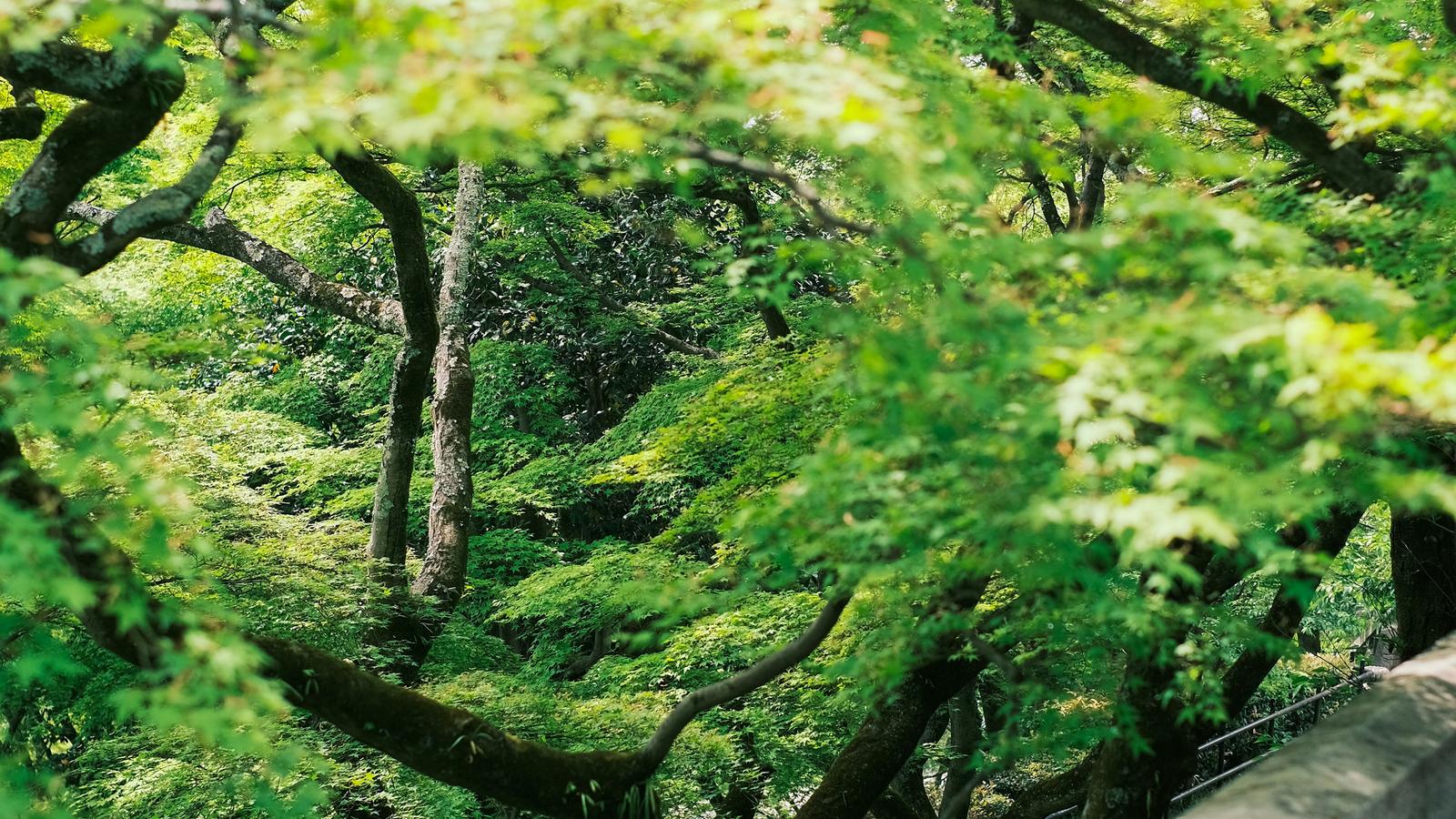
All three come after Golden Week, the run of national holidays that ends on May 5. The Japan Meteorological Agency's averages for 1991 to 2020 give Kyoto a May high of 25.1°C and a low of 14.5°C, the season of new green leaves.
THE AOI MATSURI ON MAY 15
The Aoi Matsuri is the annual festival of Kyoto's two Kamo shrines, Shimogamo, formally Kamo-mioya Jinja, and Kamigamo, Kamo-wakeikazuchi Jinja. The Kyoto City Tourism Association traces its origin, after the shrines' own record, to the reign of Emperor Kinmei about 1,500 years ago, when storms ruined the harvests and a horse race was run to calm the gods. In 819 it became a rite of state, and in the Heian period a festival meant this one: it appears in The Pillow Book and in The Tale of Genji, where two noblewomen's carriages clash over a place to watch the procession. It has been interrupted three times, for about 200 years after the Onin War, from 1871 to 1883, and from 1943 to 1952. The name comes from the leaves of futaba-aoi, a wild ginger with paired heart-shaped leaves and the crest of both shrines, which are woven with katsura twigs and hung on the carriage, the costumes and even the oxen.
The procession of May 15, the Roto no Gi, is what most visitors come for. The tourism association gives it as more than 500 people, 36 horses, four oxen, two ox carriages and one palanquin, covering about eight kilometres. The second half is the Saiodai's procession: since 1956, a young woman of Kyoto chosen each year has taken the place of the imperial princesses who once served the shrines, and she is carried in a palanquin in the layered robes of the court. The times below are those the association publishes for the head of the procession.
| Place | Time |
|---|---|
| Kyoto Imperial Palace, departs | 10:30 am |
| Shimogamo Shrine, arrives | 11:40 am |
| Shimogamo Shrine, departs | 2:20 pm |
| Kitaoji Bridge | 2:55 pm |
| Kamigamo Shrine, arrives | 3:30 pm |
In the first days of May the two shrines hold the rites that lead up to it, which the association lists: on May 1 the trial run of the Kamo horse race at Kamigamo; on May 3 yabusame, archery from galloping horses, at Shimogamo; on May 4 the Saiodai's purification, held at the two shrines in alternate years; and on May 5 the Kamo horse race itself at Kamigamo, run since 1093. The yabusame and the horse race fall inside Golden Week, and the procession ten days later.
SEATS FOR THE PROCESSION
The procession can be watched free from the street. The tourism association also sells numbered seats in two places, inside the Kyoto Imperial Park, where the procession sets out, and on the approach to Shimogamo Shrine. Its 2026 sale is the latest guide. Seats went on general sale at 10 am on April 1, 2026, after a first round for groups of ten or more in December 2025. Every seat came with the official guidebook, an audio guide and a commemorative card painted by a court painter.
| Place | Seat | Front row | Second row and behind |
|---|---|---|---|
| Kyoto Imperial Park | Royal Seat, with commentary in Japanese and English | ¥20,000 | ¥18,000 |
| Kyoto Imperial Park | General seat | ¥6,500 | ¥5,000 |
| Shimogamo Shrine approach | Manabi seat, with commentary in Japanese | ¥10,500 | ¥8,500 |
| Shimogamo Shrine approach | General seat | ¥6,500 | ¥5,000 |
The Royal Seats also came with a commemorative fan and a sprig of aoi and katsura. The commentary is heard through the guest's own phone and earphones, in a web browser, so a charged phone matters. The association passes on the procession's times at the seats: the head reaches the Imperial Park seats at about 10:30 am and the Shimogamo seats at about 11:40 am. If rain moves the procession to May 16, the seats are valid on that day, and they cannot be refunded.
THE KANDA MATSURI IN A MAIN YEAR
Kanda Myojin, the shrine in Sotokanda in Chiyoda Ward, calls the Kanda Matsuri one of the three great festivals of Edo and of Japan, held once every two years. Its festival site said plainly that 2026 was the off year, with no procession, which makes 2027 the next main year. The 2027 dates had not been published on November 2, 2026.
The main festival of 2025 shows its shape. On the evening of Thursday, May 8, the gods were moved into the festival's palanquins. On Saturday, May 10, the Shinko-sai procession went out for the whole day through Kanda, Nihonbashi, Otemachi and Marunouchi, and Akihabara, with the tsuke-matsuri parade joining from about 3 pm. On Sunday, May 11, the neighbourhoods carried their own portable shrines into the shrine grounds all day. On May 14, the grand master of the Omotesenke school of tea made a tea offering at 11 am, and that evening the Kongo school of Noh performed by firelight; the main rite of the year followed on May 15.
For a visitor, the Saturday procession through the business districts and the Sunday arrivals at the shrine are the two days to plan around, and the firelit Noh is the quiet counterpoint. Each will be confirmed when the shrine publishes the 2027 schedule.
THE SANJA MATSURI IN ASAKUSA
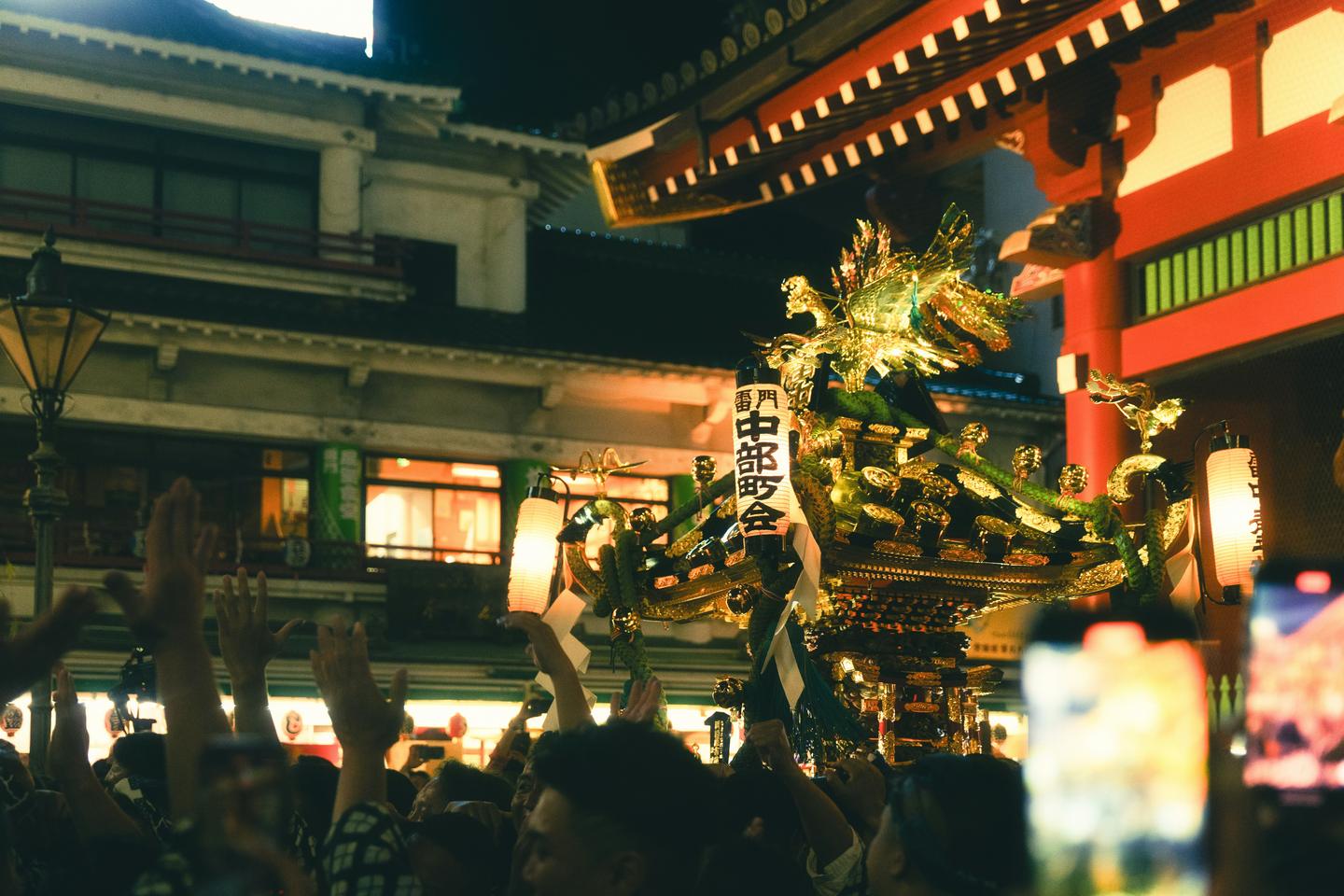
Asakusa Shrine stands beside Senso-ji, and its festival, the Sanja Matsuri, is held over the Friday, Saturday and Sunday around the third Saturday of May. The shrine describes about 1.8 million people coming over the three days. On the Friday, a grand procession of festival music floats, firemen's chants and geisha in festival dress announces the start, and the binzasara-mai, a rice-planting dance designated an intangible cultural property of Tokyo, is offered at the shrine; in 2026 the procession set out at 1 pm. On the Saturday, about 100 portable shrines of the shrine's 44 neighbourhoods gather behind the main hall of Senso-ji and set off one by one after being blessed. On the Sunday, the three main portable shrines, Ichinomiya, Ninomiya and Sannomiya, are carried out of the shrine early in the morning, travel through the neighbourhoods in three directions during the day, and come back after dark.
The shrine explains why they are shaken so hard: the bearers rock the shrines up and down and side to side to stir the spirit of the god inside, which is believed to bring good harvests and drive away disease. The present shrines were given by the parishioners in 1950 and 1953, after the old ones were lost in the air raids of the war. In 2026, Time Out Tokyo gave the Sunday departure as 7 am and the return as about 7 to 8 pm; Nippon Tabi Magazine gave the departure from 6 am. The whole of Asakusa is part of the festival for those three days, with stalls along the approach to Senso-ji.
PUTTING THE TWO CITIES TOGETHER
In 2027 the calendar is close to ideal for one trip. The Aoi Matsuri falls on Saturday, May 15, and the Sanja Matsuri's main day on Sunday, May 16, so a morning on the Aoi Matsuri seats in Kyoto can be followed by the bullet train to Tokyo that evening and the portable shrines of Asakusa the next day. The Kanda procession was held on the second Saturday of May in 2025; where it falls in 2027 will be clear when the shrine publishes its schedule, and the order of the two cities can follow it.
Kyoto in mid May is green, after the cherry and before the rainy season, and May is also the month of the Kamogawa Odori, the spring dances of Pontocho, which we cover in Maiko Dinner in Kyoto: Introductions, Dances and Gion Rules →. In Tokyo, the evenings of the festival weekends are loud and joyful in the festival streets, and a few streets away the city is calm.
WHERE STAYGO COMES IN
STAYGO plans private trips across Japan. If your dates include mid May, tell us, and we will build the days around the festivals you want to see. For the Aoi Matsuri, we watch for the 2027 seat sale and arrange the seats you choose in your names as soon as it opens, with a driver to bring you to the Imperial Park and on to lunch, and a guide if you would like the procession explained. In Tokyo, we plan a room within reach of Asakusa or Kanda for the weekend, a car for the early start, and a quiet dinner away from the crowds after the shrines come home. We arrange everything in your names, and you pay the seats, hotels, restaurants, guides and drivers directly at their own prices, with no commission or markup from us. Trips are planned on the Signature plan, for 7 to 14 days, or as Bespoke for longer or more complex journeys.
SOURCES AND HOW WE CHECKED
We read the pages below on November 2, 2026: the Kyoto City Tourism Association for the Aoi Matsuri, its history, route, rites and seats; Kanda Myojin and its festival site for the Kanda Matsuri; Asakusa Shrine for the Sanja Matsuri; the Japan Meteorological Agency for the weather; and Time Out Tokyo, Nippon Tabi Magazine and HugKum for the Sanja Matsuri's times in 2026. We did not contact any of them. The 2027 schedules of the Kanda and Sanja festivals and the 2027 Aoi Matsuri seat sale had not been published; details from earlier years are marked as such.
- Kyoto City Tourism Association, Aoi Matsuri overview (Japanese): May 15, the rain rule, the procession, the Saiodai since 1956, the aoi leaves, the rites before
- Kyoto City Tourism Association, Aoi Matsuri paid seats 2026 (Japanese): places, prices, the sale dates, the commentary, postponement and refunds
- Kyoto City Tourism Association, route and people of the procession (Japanese): the times at each point, 500 people, 36 horses, four oxen, about eight kilometres
- Kyoto City Tourism Association, history and related rites (Japanese): the origin, 819, the interruptions, the rites of May 1 to 5
- Kanda Myojin, official site (Japanese): one of the three great festivals of Edo and of Japan, held once every two years
- Kanda Matsuri, official festival site (Japanese): 2026 as the off year, the 2025 schedule
- Asakusa Shrine, about the Sanja Matsuri (Japanese): the third Saturday rule, 1.8 million people, the three days, the portable shrines and their history
- Time Out Tokyo, Sanja Matsuri 2026 (Japanese): the 2026 dates, 7 am departure and the return at about 7 to 8 pm
- Nippon Tabi Magazine, Sanja Matsuri (Japanese): the Friday procession at 1 pm, the Saturday gathering, the Sunday departure from 6 am
- HugKum, Shogakukan, Sanja Matsuri 2026 (Japanese): the 2026 schedule and the three-day pattern
- Japan Meteorological Agency, Kyoto averages 1991 to 2020 (Japanese): May high and low
QUESTIONS TRAVELLERS ASK
When is the Aoi Matsuri in 2027?
On Saturday, May 15, 2027. The procession leaves the Kyoto Imperial Palace at 10:30 am and reaches Kamigamo Shrine at about 3:30 pm. In rain it moves to May 16, decided at about 6 pm the evening before.
Can I get a seat for the Aoi Matsuri?
Yes. The Kyoto City Tourism Association sells numbered seats in the Kyoto Imperial Park and on the Shimogamo Shrine approach. In 2026 they went on general sale on April 1, from ¥5,000, with Royal Seats at ¥18,000 to ¥20,000. The 2027 sale had not been announced on November 2, 2026.
Is 2027 a main year for the Kanda Matsuri?
Yes. Kanda Myojin holds its main festival every two years, and its site said 2026 was the off year without a procession. The 2027 dates had not been published on November 2, 2026.
When is the Sanja Matsuri in 2027?
Asakusa Shrine holds it on the Friday, Saturday and Sunday around the third Saturday of May, which gives May 14 to 16, 2027. The three main portable shrines come out early on the Sunday morning.
Can I see the Aoi Matsuri and the Sanja Matsuri on one trip?
In 2027, yes. The Aoi Matsuri is on Saturday, May 15, and the main day of the Sanja Matsuri is Sunday, May 16, so Kyoto and Tokyo can be seen on consecutive days.
ASK US ABOUT THE MAY FESTIVALS
Send us your May dates and the festivals that interest you. We will watch for the 2027 seat sale and the shrines' schedules, ask about seats, a driver, a guide and rooms in Kyoto and Tokyo, and come back with what we were able to confirm.
Begin planning →We reply within 24 hours, in writing
Some of the restaurants, bars and private places we arrange take guests only by introduction or membership. We do not publish their names.