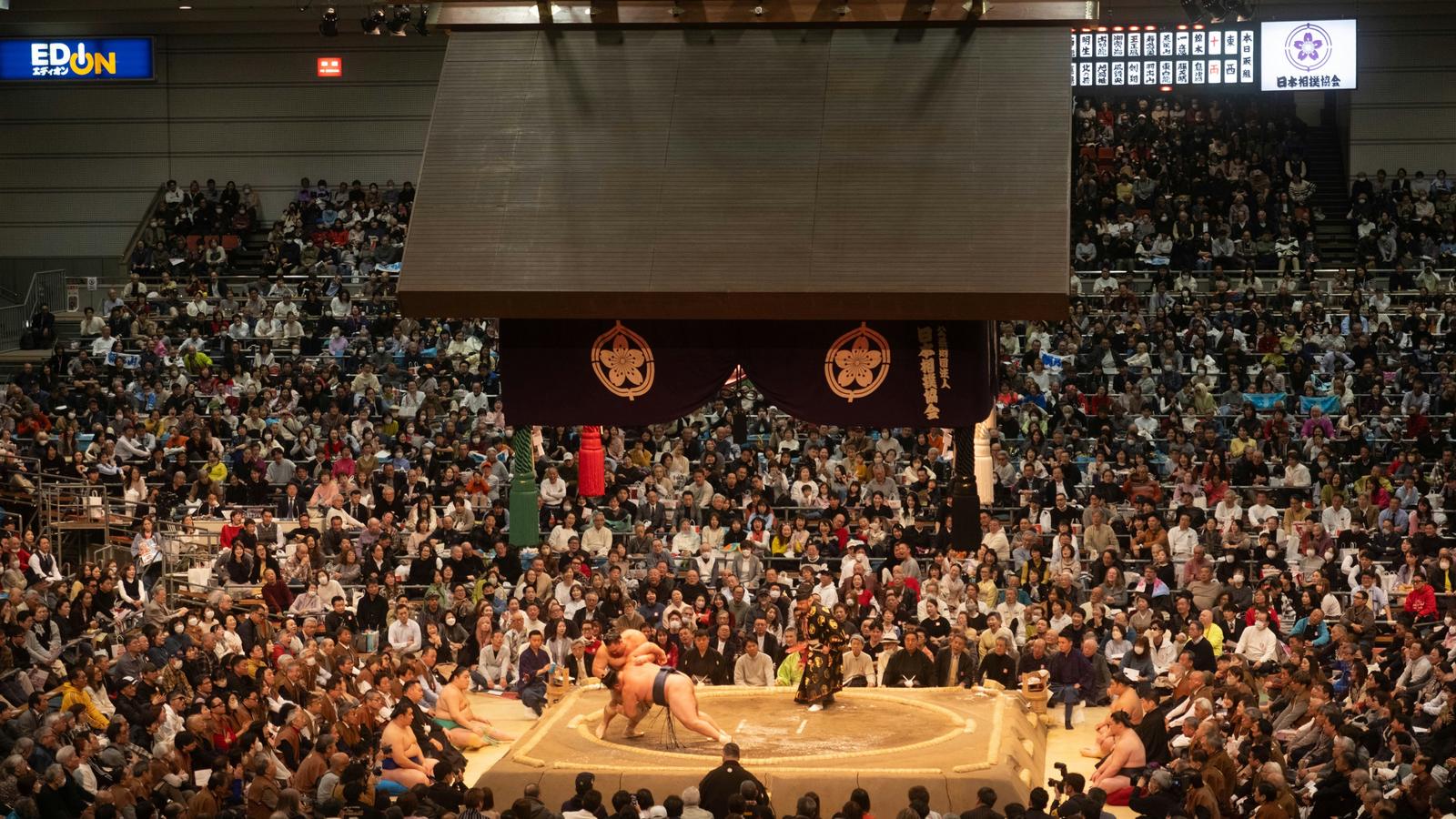
Between November 2026 and May 2027 there are four grand sumo tournaments a traveller can see. The November tournament runs from November 8 to 22, 2026 at the Fukuoka Kokusai Center in Fukuoka. In 2027 the January tournament runs from January 10 to 24 at the Ryōgoku Kokugikan in Tokyo, the March tournament from March 14 to 28 at EDION Arena Osaka, and the May tournament from May 9 to 23, again at the Kokugikan. Each lasts fifteen days, and the Japan Sumo Association, which runs professional sumo, puts tickets on general sale on December 5, 2026 for January, February 6, 2027 for March and April 10, 2027 for May. The November 2026 tournament is already sold out.
Below are the four tournaments with their dates and sale days, how the seats are sold, the seat types and what they cost, including the new Tokyo prices that start in January 2027, how a day in the hall unfolds, the manners asked of spectators, and what is known about watching morning practice at a sumo stable. We read the Japan Sumo Association's own pages and its official ticket site, Ticket Oosumo, on October 31, 2026, together with a stable's own practice page, the Tokyo tourism bureau, a travel guide, a Japanese encyclopedia and a press report, and did not contact the association, the stables or any venue; the sources are listed at the end. For the rest of the year's customs and festivals, see Japanese Festival Calendar: Holidays and Customs by Month →.
Key points
- Fukuoka, November 8 to 22, 2026: on sale since September 19 and sold out for every day, with no tickets sold on the day.
- Tokyo, January 10 to 24, 2027: general sale from December 5, 2026. Osaka, March 14 to 28: general sale from February 6, 2027. Tokyo, May 9 to 23: general sale from April 10, 2027.
- Fan club and website lotteries come before each general sale, and some seat types can sell out in them.
- From January 2027, Tokyo prices rise. A ringside tamari seat costs ¥25,000 a person on weekdays, ¥27,500 at weekends and on holidays and ¥30,000 on the last two days.
- The day runs from the morning to about 6 pm. The ring-entering ceremonies and the top division fill the late afternoon.
- Some stables let visitors watch morning practice, on their own terms. Each stable decides.
ASK US ABOUT A DAY AT THE SUMO →
THE FOUR TOURNAMENTS AT A GLANCE
Professional sumo holds six tournaments, or basho, a year: three in Tokyo, one each in Osaka, Nagoya and Fukuoka. The association's introduction to sumo explains that each lasts fifteen days and that the wrestlers in the top two divisions fight once every day. The ranking list, the banzuke, is published before each tournament. The table gives the four tournaments in the travel season from November 2026 to May 2027, as the association's annual schedule showed them on October 31, 2026.
| Tournament | Venue | Days | General sale | Banzuke |
|---|---|---|---|---|
| November 2026 | Fukuoka Kokusai Center, Fukuoka | Sun, Nov 8 to Sun, Nov 22 | Sat, Sep 19, 2026 (sold out) | Oct 26, 2026 |
| January 2027 | Ryōgoku Kokugikan, Tokyo | Sun, Jan 10 to Sun, Jan 24 | Sat, Dec 5, 2026 | Dec 21, 2026 |
| March 2027 | EDION Arena Osaka (Osaka Prefectural Gymnasium) | Sun, Mar 14 to Sun, Mar 28 | Sat, Feb 6, 2027 | Mar 1, 2027 |
| May 2027 | Ryōgoku Kokugikan, Tokyo | Sun, May 9 to Sun, May 23 | Sat, Apr 10, 2027 | Apr 26, 2027 |
Each tournament begins and ends on a Sunday. The association's calendar marks the public holidays that fall inside them: Coming of Age Day on Monday, January 11, the Vernal Equinox on Sunday, March 21 and its substitute holiday on Monday, March 22. Weekends and holidays are priced higher, and japan-guide.com notes that weekend seats are the hardest to get.
The three venues are easy to reach. The association says the Kokugikan is two minutes on foot from the west exit of JR Ryōgoku Station and five from Ryōgoku on the Ōedo subway line, and that it has no parking. EDION Arena Osaka is two minutes on foot from Namba Station. The Fukuoka Kokusai Center is reached by city bus from Hakata Station or Tenjin.
HOW THE SEATS GO ON SALE
The association's page for the November 2026 tournament shows the order in which seats are sold, and the same order is used for each tournament. Two rounds of lotteries for members of the official fan club came first, from August 14 and August 21, then a lottery on Ticket Oosumo, the association's ticket site, from August 28, then a lottery on Ticket Pia from September 4. General sale opened at 10 am on Saturday, September 19, online, by phone and at Seven-Eleven shops, and at the venue's own window from the next day. The association warns that some seat types may sell out during the lotteries, in which case they are not offered at general sale.
On October 31, 2026, the pages for January, March and May 2027 gave the general sale days and asked visitors to wait for the seat details. The 2027 lottery dates had not been published (October 31, 2026). In the November pattern, the lotteries ran from about five weeks to two weeks before the general sale.
Demand is high. Ticket Oosumo's English page said the November 2026 tournament was sold out on every day and that there would be no tickets on the day. The Japan Times reported in September 2026 that the Tokyo tournament that month sold out almost as soon as tickets became available, and that long-time fans were going home empty-handed from the lotteries.
The association's spectator terms forbid reselling tickets as a business without its permission, and allow a ticket to pass, without profit, to family, friends or business associates. Ticket Oosumo adds that anyone who obtains tickets for prohibited resale, including to make up tours or packages without the organiser's permission, may be refused entry. Buyers on Ticket Oosumo must confirm a phone number. Its English pages say payment is by credit card only, tickets are printed at a Seven-Eleven in Japan, a lost ticket means no entry, and a ticket cannot be changed or refunded. For a buyer who can no longer go, Ticket Oosumo runs a resale at face value until the day before each day of sumo. The association also lists official hotels, among them The Gate Hotel Ryōgoku, Dai-ichi Hotel Ryōgoku and the Asakusa Yokozuna Hotel, set in a former stable building, in Tokyo, and Conrad Osaka, Hotel Nikko Osaka and Hotel Granvia Osaka in Osaka.
THE SEATS AND WHAT THEY COST
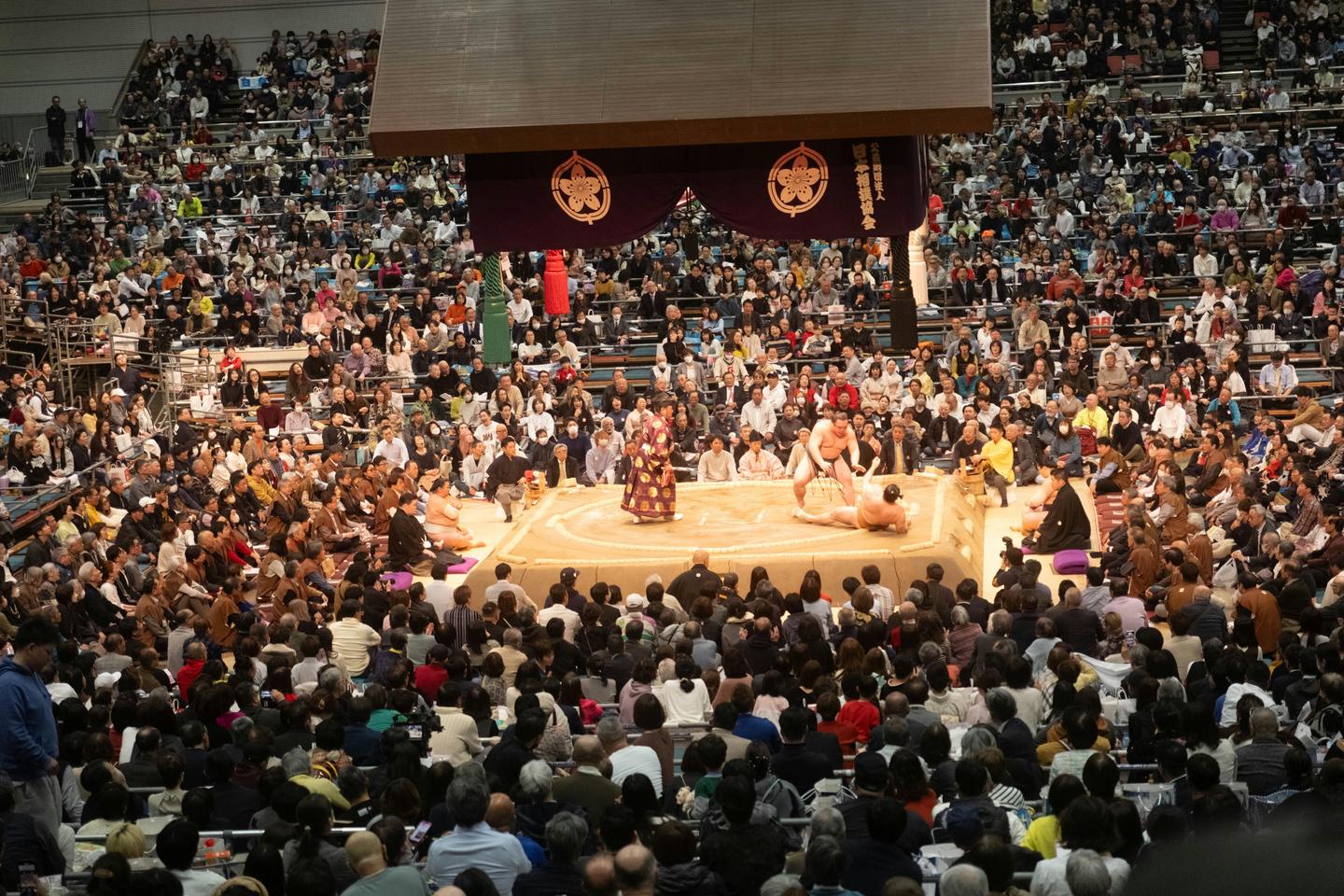
There are three kinds of seat. Tamari seats are single cushions on the floor around the ring, known as sunakaburi, the sand-covered seats. Britannica's Japanese encyclopedia notes that sand can reach them during a bout and that the word came to mean the seasoned fans who sit there. Masu seats are boxes on the floor behind them. The association describes each box as about 1.3 metres square, framed in metal and laid with cushions, for two to four people, and sells it whole, with shoes kept in a space behind the box. Chair seats rise behind and above. On the association's seat guide, the front side faces the ring as television shows it, and the opposite side looks at the referee's back.
On July 30, 2026 the association announced new prices for the Tokyo and Osaka tournaments from January 2027, and updated the table on October 1. Fukuoka and Nagoya stay as they are. At the Kokugikan the first two rows of boxes become a new Masu SS, rows three and four become Masu S, and the 14th and final days get their own, higher price. The table gives a selection, per person, including tax.
| Seat | Tokyo, Jan and May 2027 (weekday / weekend and holiday / days 14 and 15) | Osaka, Mar 2027 (weekday / weekend and holiday) | Fukuoka, Nov 2026 (weekday / weekend and holiday) |
|---|---|---|---|
| Tamari, ringside | ¥25,000 / ¥27,500 / ¥30,000 | ¥20,000 | ¥20,000 |
| Masu SS (Tokyo, rows 1 to 2) | ¥22,500 / ¥24,000 / ¥25,000 | None | None |
| Masu S | ¥18,000 / ¥20,000 / ¥22,000 | ¥17,000 | ¥13,000 / ¥14,000 |
| Masu C | ¥9,500 / ¥10,500 / ¥11,500 | ¥9,500 / ¥10,500 | ¥8,000 / ¥8,500 |
| Chair S | ¥11,000 / ¥12,000 / ¥13,000 | ¥10,000 / ¥11,000 | ¥5,500 / ¥6,000 |
| Chair C | ¥5,000 / ¥6,000 / ¥7,000 | ¥5,000 / ¥5,500 | ¥2,000 / ¥2,500 |
A four-person box at Masu S in Tokyo on a weekday comes to ¥72,000 (about US$456). Ticket Oosumo's English pages add a service fee of ¥2,000 a ticket. Children need a ticket from the age of four.
The tamari seats carry rules of their own. The association's seat guide says they are for people aged 16 and over, warns that a wrestler may fall from the ring into them, and forbids eating, drinking, photography and the use of phones there, as well as legless chairs or kneeling stools. In a masu box a low legless chair may be used only if it does not block the view of those behind.
A DAY AT THE TOURNAMENT
Ticket Oosumo's 2026 pages say the doors open at 8:45 am, at 10:30 am on the 13th and 14th days and at 10 am on the final day, that the bouts start in the morning and end at about 6 pm, and that one ticket covers the whole day. In Tokyo a spectator may leave and come back once and must be back by 5 pm; in Fukuoka re-entry is allowed as often as needed, also by 5 pm.
The morning belongs to the lower divisions, and the hall fills as the day goes on. Ticket Oosumo says the bouts of the top wrestlers begin at about 2 pm. Japan-guide.com, a long-running travel guide, gives the second division, juryo, from about 3 pm and the top division, makuuchi, from about 4 pm, with the highest-ranked wrestlers fighting just before 6. On the final day the schedule moves about half an hour earlier to leave time for the prize-giving.
The ceremonies set the rhythm of the afternoon. The association's introduction to sumo describes them. Just before the top division, the makuuchi wrestlers enter the ring, east and west in turn, in embroidered silk aprons that cost upwards of about one million yen; earlier in the afternoon the juryo wrestlers perform a similar ceremony before their own bouts. Then each yokozuna, the grand champion, performs his own ring entry with a referee and two attendants, one carrying a sword, wearing a braided hemp rope of 11 to 15 kilograms. He claps, opens his arms with the palms up to show he hides no weapon, and raises each leg high before stamping it down to drive evil from the ring. The day closes with the bow-twirling ceremony, the yumitori-shiki, after the last bout.
For most visitors, arriving in the middle of the afternoon gives the ring-entering ceremonies and the top division without a long day on the floor of a box. Japan-guide.com suggests being in the hall at least from 3:30 to 6 pm.
MANNERS IN THE HALL
The association's spectator terms set out what is not allowed. Bottles and cans may not be brought in. Flash and other lights that disturb the bouts are forbidden, as are leaning out beyond your seat, throwing anything towards the ring and entering the ring area. Cheering with trumpets, drums or whistles, banners that block other people's view, and organised group cheering all need the association's permission.
The rest is the ordinary courtesy of a full hall. In a masu box shoes come off and go in the space behind; legs are folded or crossed on the cushion, and the box is shared at close quarters, so a light coat and a small bag are easier than luggage. The association's introduction explains that the salt thrown before a bout purifies the ring and is a prayer for safety. Japan-guide.com notes that the atmosphere builds as the hall fills towards the evening.
For lunch and the long afternoon, the Kokugikan sells food inside. Its gourmet page, written for the September 2026 tournament, puts chanko, the stew that is the staple of a sumo stable, in the hall on the basement floor at ¥500 a bowl from 11 am to 4:30 pm, made in the hall every day, in September to the recipe of the Dewanoumi stable, and sold at more than 2,000 bowls a day. The hall's own yakitori costs ¥850 for five skewers; the page explains that a bird stands on two legs and never puts its hands down, which in sumo means defeat, so chicken is a lucky food. Food and drink are not allowed on the tamari seats.
MORNING PRACTICE AT A STABLE
A stable, or heya, is where wrestlers live and train under their master. The Tokyo Convention and Visitors Bureau's guide to Ryōgoku says that some stables allow visitors to watch morning practice, that strict conditions apply and that research is needed beforehand. Japan-guide.com puts it more plainly: stables are neither public places nor sights, only a few accept visitors, and some insist that visitors come with someone fluent in Japanese and familiar with the customs of sumo. It adds that visitors should expect to sit silently on the floor for two to three hours.
One stable that publishes its terms is Arashio, in Nihonbashi-Hamachō, Tokyo. Its page says practice can be watched free of charge, without a reservation, from 7:30 to about 9 am, from the street through its large windows, since visitors are not admitted inside. Practice can be cancelled without notice, so the stable keeps an online calendar and does not answer questions by phone or email. It asks for silence, no flash, no eating or drinking, and that visitors do not sit on the neighbours' steps; it adds that men and women are equally welcome to watch. On October 31 its calendar said the stable had left for Fukuoka and there would be no practice in Tokyo until December.
That last line matters for planning. Stables travel to the Osaka and Fukuoka tournaments; Arashio, for one, lodges at Ōtori Taisha in Sakai during the Osaka tournament. Practice in Tokyo is therefore a matter of the weeks between tournaments and of the Tokyo tournaments themselves. Each stable sets its own rules, and a request to watch is just that, a request.
EATING BEFORE AND AFTER
Ryōgoku has long been the home of sumo, and the Tokyo bureau's guide notes the many chanko restaurants around the station, some run by former wrestlers, with eel and monjayaki among the other local dishes. A table for chanko after the final bout, or a lunch nearby before the afternoon session, fits the day well. In Osaka the arena is two minutes from Namba Station, and in Fukuoka the hall is a bus ride from Hakata and Tenjin, so dinner after the sumo can be in the centre of either city.
The hours matter. The top-division bouts end close to 6 pm, and the crowd leaves at once, so a dinner at 7 pm or a little later, close to the venue or a short drive away, leaves time to move without hurry.
WHERE STAYGO COMES IN
STAYGO plans private trips across Japan from Tokyo. If your dates include one of these tournaments, tell us early. We will work through the association's own sales on the days they open, in your names and within its rules on resale and on how many seats each buyer may take, and we will tell you plainly which seats and days we were able to secure and which we were not. Seats at the sumo are scarce, and we will not promise them before the sale. We arrange a car to and from the hall, which has no parking of its own, a table for lunch before the afternoon session or dinner after the last bout, and a guide who knows the ceremonies if you would like one. We will also ask a stable whether you may watch a morning practice; whether to accept is always the stable's decision. You pay the association, the restaurants and the guides directly at their own prices, with no commission or markup from us. Trips are planned on the Signature plan, for 7 to 14 days, or as Bespoke for longer or more complex journeys.
SOURCES AND HOW WE CHECKED
We read the pages below on October 31, 2026: the Japan Sumo Association's own pages and price lists and its ticket site, Ticket Oosumo, for dates, sale days, prices, seats, hours and rules, a stable's own page for practice viewing, and the Tokyo tourism bureau, a travel guide, a Japanese encyclopedia and a press report for background. We did not contact the association, any stable, venue or restaurant. Prices and hours can change; the association updates its pages before each tournament. Dollar amounts are a guide only, at ¥158 to US$1 (October 2026); the association charges in yen.
- Japan Sumo Association, tournament schedule (Japanese) and English schedule: venues, days, general sale and banzuke dates for 2026 and 2027
- Japan Sumo Association, January 2027 ticket page (Japanese), March 2027 and May 2027: days, holidays and the general sale dates, with seat details still to come
- Japan Sumo Association, ticket prices from January 2027 (PDF, Japanese): the Tokyo and Osaka prices, Masu SS and the 14th and final day prices
- Japan Sumo Association, November 2026 prices (Japanese), how to buy and seats: Fukuoka prices, the lottery and sale order, the tamari rules and the masu boxes
- Japan Sumo Association, spectator terms (Japanese): resale, items not allowed, prohibited conduct and cheering
- Japan Sumo Association, Kokugikan food (Japanese): chanko and yakitori in the hall
- Japan Sumo Association, access to the Kokugikan (Japanese), Osaka and Fukuoka: stations, buses and no parking
- Japan Sumo Association, official hotels (Japanese): the hotels in Tokyo and Osaka
- Japan Sumo Association, introduction to sumo (PDF): the six tournaments, the ring-entering ceremonies, the yokozuna, the salt and the bow ceremony
- Ticket Oosumo English, with its November, January and May pages: sold out in November, door times, re-entry, fees, pickup, refunds and the note on tours and packages
- Ticket Oosumo (Japanese): the 2027 sale dates and the face-value resale
- Arashio stable, watching morning practice and Japanese page: hours, house rules and the calendar
- GO TOKYO, Ryōgoku: stables, practice viewing and chanko restaurants
- japan-guide.com, sumo: the afternoon timetable and visiting a stable
- Britannica Japan, sunakaburi, via Kotobank (Japanese): the ringside seats and the name
- The Japan Times, September 9, 2026: the September tournament selling out
QUESTIONS TRAVELLERS ASK
When are the sumo tournaments in 2027?
The Japan Sumo Association lists six: January 10 to 24 in Tokyo, March 14 to 28 in Osaka, May 9 to 23 in Tokyo, July 11 to 25 in Nagoya, September 12 to 26 in Tokyo and November 14 to 28 in Fukuoka.
When do tickets go on sale for the January 2027 tournament?
General sale opens on Saturday, December 5, 2026. Fan club and website lotteries come before it; their dates had not been published on October 31, 2026. Tickets for March go on sale on February 6, 2027 and for May on April 10, 2027.
How much are sumo tickets in Tokyo in 2027?
From January 2027 a chair seat at the Kokugikan costs from ¥3,000 a person in Chair D to ¥13,000 in Chair S on the last two days. A masu box is sold whole, from ¥9,500 to ¥25,000 a person, and a ringside tamari seat costs ¥25,000 to ¥30,000.
Can I still get tickets for the November 2026 tournament in Fukuoka?
Ticket Oosumo said on October 31, 2026 that every day was sold out and that no tickets would be sold on the day. Its resale at face value stays open until the day before each day of sumo, so seats can appear there.
Can visitors watch morning practice at a sumo stable?
Some stables allow it, each on its own terms, and practice can be cancelled without notice. Stables travel to the Osaka and Fukuoka tournaments, so in Tokyo it is a matter of the weeks between tournaments and of the Tokyo tournaments.
ASK US ABOUT A DAY AT THE SUMO
Send us your dates. We will work through the official sale for seats, ask a stable about morning practice and set the car and the table around the afternoon, and come back with what we were able to confirm.
Begin planning →We reply within 24 hours, in writing
Some of the restaurants, bars and private places we arrange take guests only by introduction or membership. We do not publish their names.