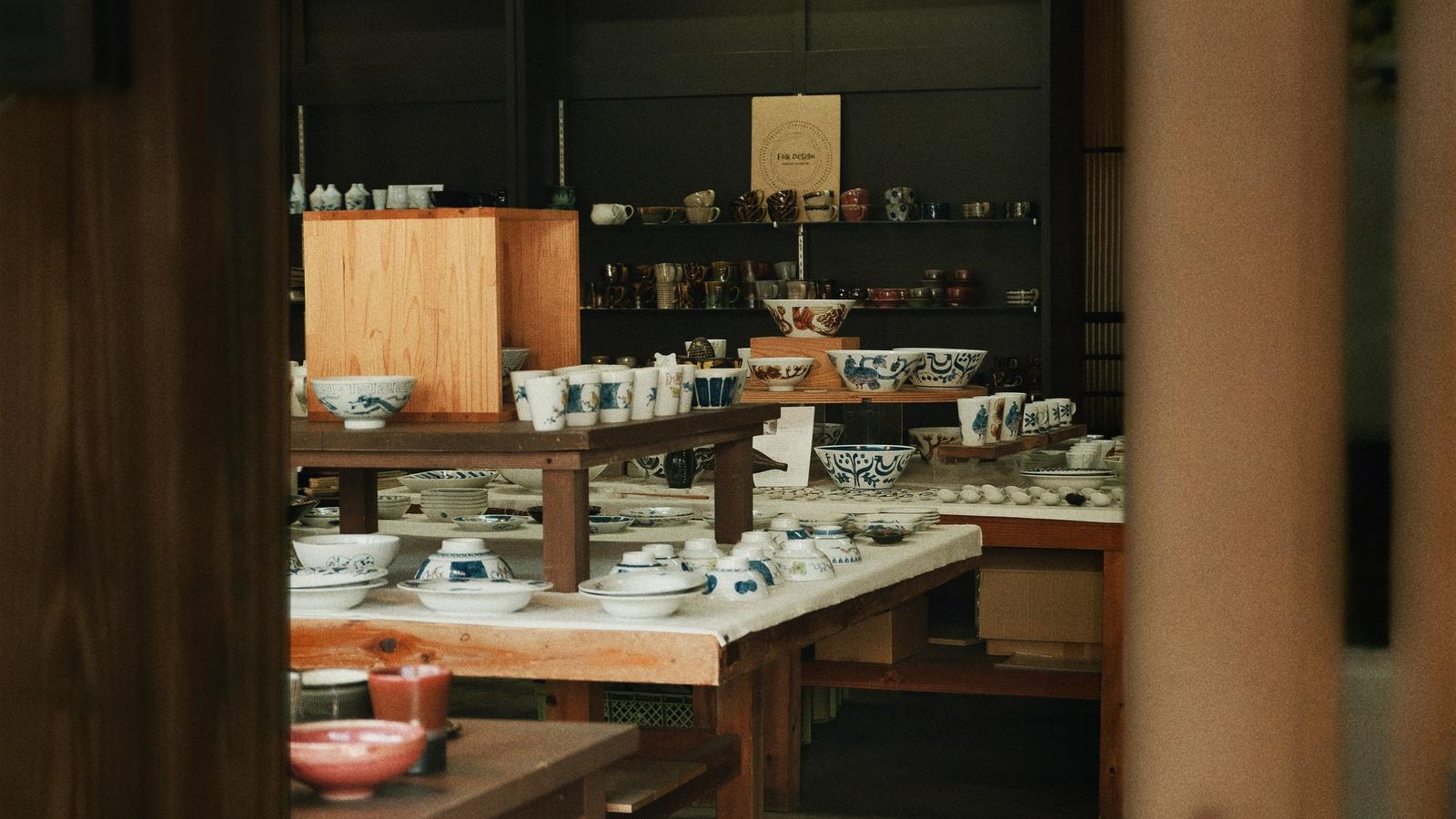
Japan's pottery is made in towns that grew around their kilns: hillside streets with workshops below the kilns, brick chimneys between the houses and walls set with shards and old kiln tools. Six of these towns have fired pottery since the Middle Ages, and two more, Hagi and Arita, shaped the tea bowl and the porcelain plate. An afternoon in one of them changes how every dish on the table looks for the rest of the trip.
This article covers the Six Ancient Kilns, Hagi, and Arita and Imari, with the fairs whose dates we could confirm. We read the pages of the Agency for Cultural Affairs, the Six Ancient Kilns council, five prefectures and their tourism sites, the city of Fukui, the town of Arita, two museums, the Arita fair, JETRO and three publications on November 5, 2026, and contacted none of them; the sources are listed at the end. Kutani porcelain is in Kanazawa and Kaga: Gold Leaf, Lacquer and Kutani.
Key points
- Seto, Tokoname, Echizen, Shigaraki, Tamba and Bizen were named the Six Ancient Kilns around 1948 and recognised together as Japan Heritage in 2017.
- Of the six, only Seto glazed its wares in the medieval period; the others are fired bare, and their colour comes from the clay, the flame and the ash.
- Hagi ware grew from the kiln of the Mori family, and tea people rank its bowls second only to Raku.
- Porcelain in Japan began in Arita in the early seventeenth century, after porcelain stone was found at Izumiyama; tradition gives the year as 1616.
- The great fairs fall in late April and early May in Arita and Hagi, and in October in Tamba and Bizen.
ASK US ABOUT A DAY AMONG THE KILNS →
THE SIX ANCIENT KILNS
The name Nihon Rokkoyo, the Six Ancient Kilns of Japan, was given around 1948 by the ceramics scholar Koyama Fujio to six kilns that have worked since the Kamakura and Muromachi periods. In 2017 the six towns were recognised together as Japan Heritage, described as hillside towns of old kiln sites and narrow slopes winding like a maze towards the workshops.
Seto, in Aichi, began glazing in the second half of the tenth century and was the only one of the six to glaze in the medieval period; its name became the everyday word for pottery, setomono. Tokoname, on Ise Bay, was the largest of the medieval kilns, known for big jars and an iron-rich clay that fires red; its Pottery Footpath runs 1.6 kilometres past a preserved climbing kiln. Shigaraki, in Shiga, has worked since the late Kamakura period, and its Ceramic Cultural Park has hosted potters from around the world in its studio since 1992.
BIZEN, TAMBA AND ECHIZEN
These three are for a guest who likes plain, fired stoneware. Bizen ware comes from Imbe in Okayama, where galleries stand among the chimneys of the climbing kilns and a national historic site holds kiln remains more than 50 metres long; see also Beyond Tokyo and Kyoto: Private Experiences in Regional Japan.
Tamba ware is made in Tachikui, in Hyogo, where about 60 kilns work today. Its potters turn a kick wheel anticlockwise, and the Tachikui climbing kiln is held to be the oldest surviving in Japan; Tamba Tachikui ware has been a national traditional craft since 1978. Echizen ware, on the Sea of Japan coast of Fukui, is about 850 years old and fired bare to a hard body with a rustic surface of ash. Potters keep studios around the Echizen Ceramic Village, beside the Fukui Prefectural Ceramics Hall, and it sits well with a night near Eiheiji, as in Fukui by Shinkansen.
HAGI AND THE TEA BOWL
Hagi ware began as the kiln of the Mori family, who moved to Hagi in the early Edo period. Mori Terumoto brought potters from the Korean peninsula skilled in Korean tea bowls, and Yi Chakkwang is honoured as the founder. The tradition divided between Hagi and Fukawa in Nagato, and both lines served the domain for about 400 years.
Tea people rank the bowls they prize as Raku first, Hagi second, Karatsu third. Hagi has little painting and relies on the clay and the glaze. Over years of use, tea seeps into the fine crackle and the bowl slowly changes colour, which tea people call the seven transformations of Hagi. A Hagi bowl rewards the guest who uses it every day. For the bowl in use, see A Private Tea Ceremony in Kyoto, Step by Step.
ARITA AND IMARI
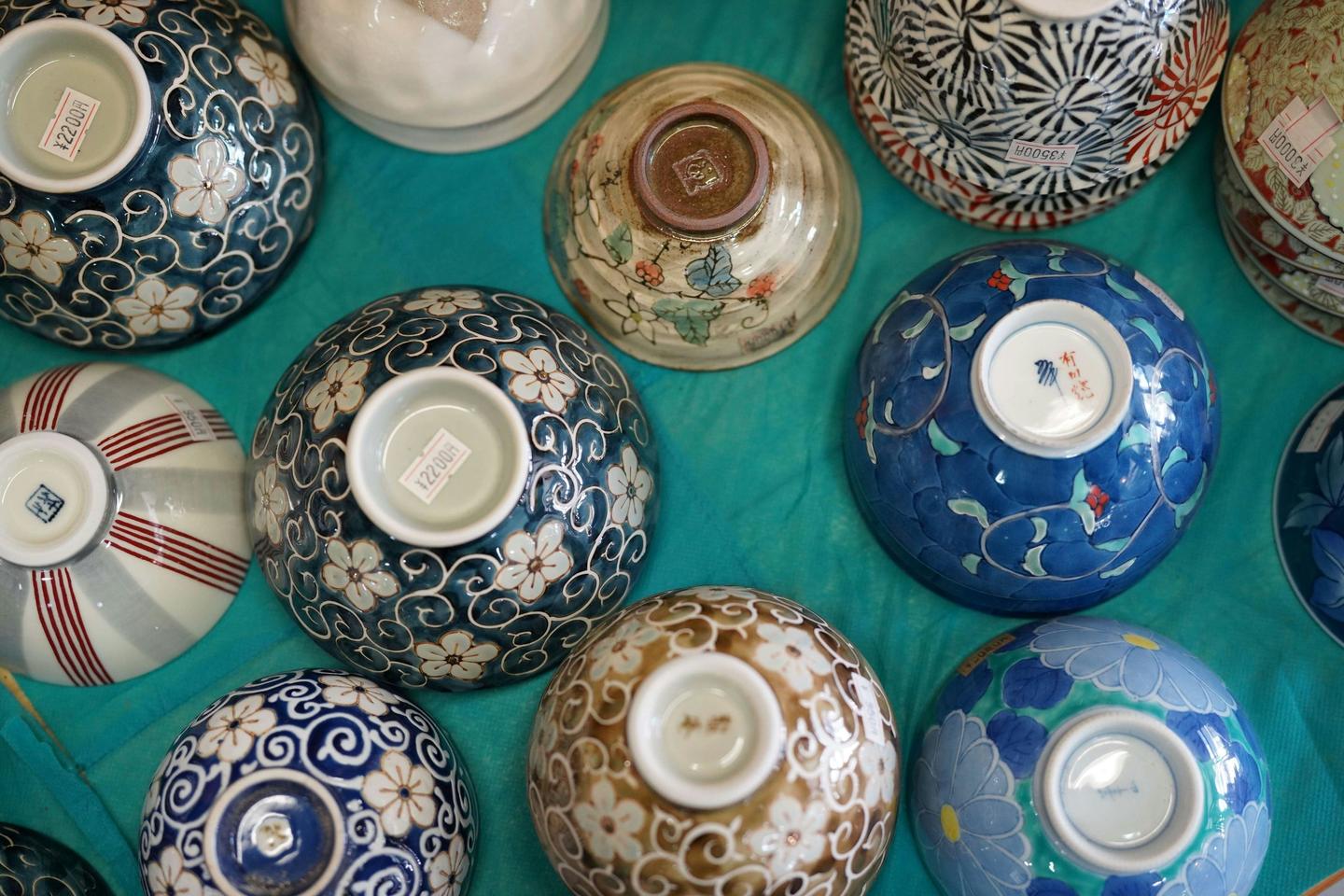
Porcelain in Japan began in Arita. In the early seventeenth century, the Korean potter Yi Sam-pyeong, known in Japan as Kanegae Sanbei, and his group found porcelain stone at Izumiyama and became the first in Japan to make porcelain in quantity. The usual date, 1616, is a tradition that the town's own history column traces to a book of 1936. The quarry, about 400 by 250 metres, is a national historic site. The Sakaida Kakiemon family succeeded with red overglaze enamels around 1643, and the Kakiemon style was exported widely in the late seventeenth century.
The Kyushu Ceramic Museum in Arita, run by Saga Prefecture, is the place to begin: its free permanent galleries trace the birth of Japanese porcelain and hold the Shibata Collection of Edo-period Arita ware. In the neighbouring city of Imari, Okawachiyama was the site of the Nabeshima domain kiln, whose porcelain was made as gifts for the shogun's household and the great lords; about 30 kilns work in the valley today. Both fit a week in Kyushu.
VISITING A POTTER AND CHOOSING A PIECE
The finest way to see these towns is with one potter: the workshop, the kiln and the pieces the potter chooses to show. We ask a potter whose work suits you to receive you on your behalf; whether a visit is possible, and when, is the potter's decision. Where a potter accepts commissions, a set of plates or bowls can be made for your table, and we arrange the packing and the shipping home.
When choosing, hold the piece. Feel its weight against its size, turn it over to see the foot, where the bare clay shows how it was thrown and fired, and set it on a table to see how it sits. In Bizen, Tamba and Echizen the marks of ash and flame differ on every piece, so see several side by side. Within Signature, our planning for journeys of 7 to 21 days at USD 3,500 for your group, a pottery day is set around the potter's calendar and the fairs below.
THE FAIRS AND WHEN TO GO
The fairs bring the fullest choice of work. The 122nd Arita Pottery Fair ran for seven days to May 5, 2026, and the Hagi-yaki Matsuri from May 1 to 5, 2026. In autumn, the 49th Tamba Pottery Festival ran from October 9 to 18, 2026, and the Bizen-yaki Festival is held on the third Sunday of October and the Saturday before, drawing about 100,000 visitors. The 2027 dates had not been published when we read the pages.
For time at the kilns, we would suggest the weeks outside the fairs, when the studios are calmer and the potters have more time to talk. The spring fairs fall in Golden Week, when trains and inns are at their fullest; see Japan's Holiday Blackouts.
SOURCES AND HOW WE CHECKED
We read the pages below on November 5, 2026. We did not contact any potter, museum, fair, agency or other body. Fair dates for 2026 are past; we give them as a guide to the season, not as the dates for 2027.
- Agency for Cultural Affairs, Japan Heritage story 050 (Japanese): the six towns, Seto glazing from the late tenth century, Shigaraki from the late Kamakura period, Bizen kiln sites over 50 m, the Tachikui kiln
- Six Ancient Kilns, official site (Japanese): named around 1948, Japan Heritage in 2017, about 60 kilns in Tachikui
- Aichi Prefecture, Aichi Now (Japanese): setomono, Tokoname's clay, the Pottery Footpath of 1.6 km
- Hyogo Prefecture, Tamba Tachikui ware (Japanese): the anticlockwise kick wheel, traditional craft since 1978
- Hyogo Prefecture, Museum of Ceramic Art press release (Japanese): the 49th Tamba Pottery Festival, October 9 to 18, 2026
- Okayama Prefecture tourism, Bizen-yaki Festival (Japanese): third Sunday of October and the Saturday before, about 100,000 visitors
- Fukui City tourism, Echizen ware (Japanese): about 850 years, fired bare, the Echizen Ceramic Village
- Shigaraki Ceramic Cultural Park, artist in residence (Japanese): potters hosted since 1992
- nippon.com, Shigaraki Ceramic Cultural Park (Japanese): the park and its studio in Shigaraki
- Yamaguchi Prefecture tourism, Hagi ware (Japanese): Mori Terumoto, Yi Chakkwang, Raku first and Hagi second, the Hagi and Nagato lines
- Yamaguchi Prefecture tourism, Hagi-yaki Matsuri (Japanese): May 1 to 5, 2026
- Serai, Shogakukan (Japanese): little painting, the seven transformations of Hagi
- Arita Tourism Association, Izumiyama quarry (Japanese): early seventeenth century, Yi Sam-pyeong, the quarry of 400 by 250 m
- Town of Arita, History and Folklore Museum column (Japanese): the 1616 date as a tradition first set out in 1936
- Waraku, Shogakukan (Japanese): Kakiemon red enamel around 1643 and its export
- Kyushu Ceramic Museum, Saga Prefecture (Japanese): free permanent galleries, the Shibata Collection
- JETRO, a kiln in Imari (Japanese): the Nabeshima domain kiln, about 30 kilns today
- Arita Pottery Fair, official site (Japanese): the 122nd fair, seven days ending May 5, 2026
QUESTIONS TRAVELLERS ASK
What are the Six Ancient Kilns of Japan?
Seto, Tokoname, Echizen, Shigaraki, Tamba and Bizen, the six kilns that have worked since the medieval period. They were named around 1948 and recognised together as Japan Heritage in 2017.
Can we visit a potter's studio?
We ask a potter whose work suits you to receive you on your behalf. Whether a visit is possible, and when, is the potter's decision.
When is the Arita pottery fair?
In 2026 the 122nd fair ran for seven days to May 5, at the end of April and the start of May. The 2027 dates had not been published when we read the official site.
Can a set of tableware be made to order?
Some potters accept commissions. Where one does, we arrange the details with the studio and the packing and shipping home; the timing depends on the potter and the kiln.
Which town suits a first visit?
For porcelain, Arita, with the Kyushu Ceramic Museum. For bare, fired stoneware, Bizen or Tamba. For tea bowls, Hagi. We would suggest choosing by the pieces you would use at home.
ASK US ABOUT A DAY AMONG THE KILNS
Tell us when you are coming, who is travelling and what you like on your table. We will set out the towns, the potters and the fairs, with the reasons, so that you can choose.
Begin planning →We reply within 24 hours, in writing
Some of the restaurants and bars we arrange seat guests only by introduction or membership. We ask on your behalf; the table and the evening are the house's decision. We do not publish their names.