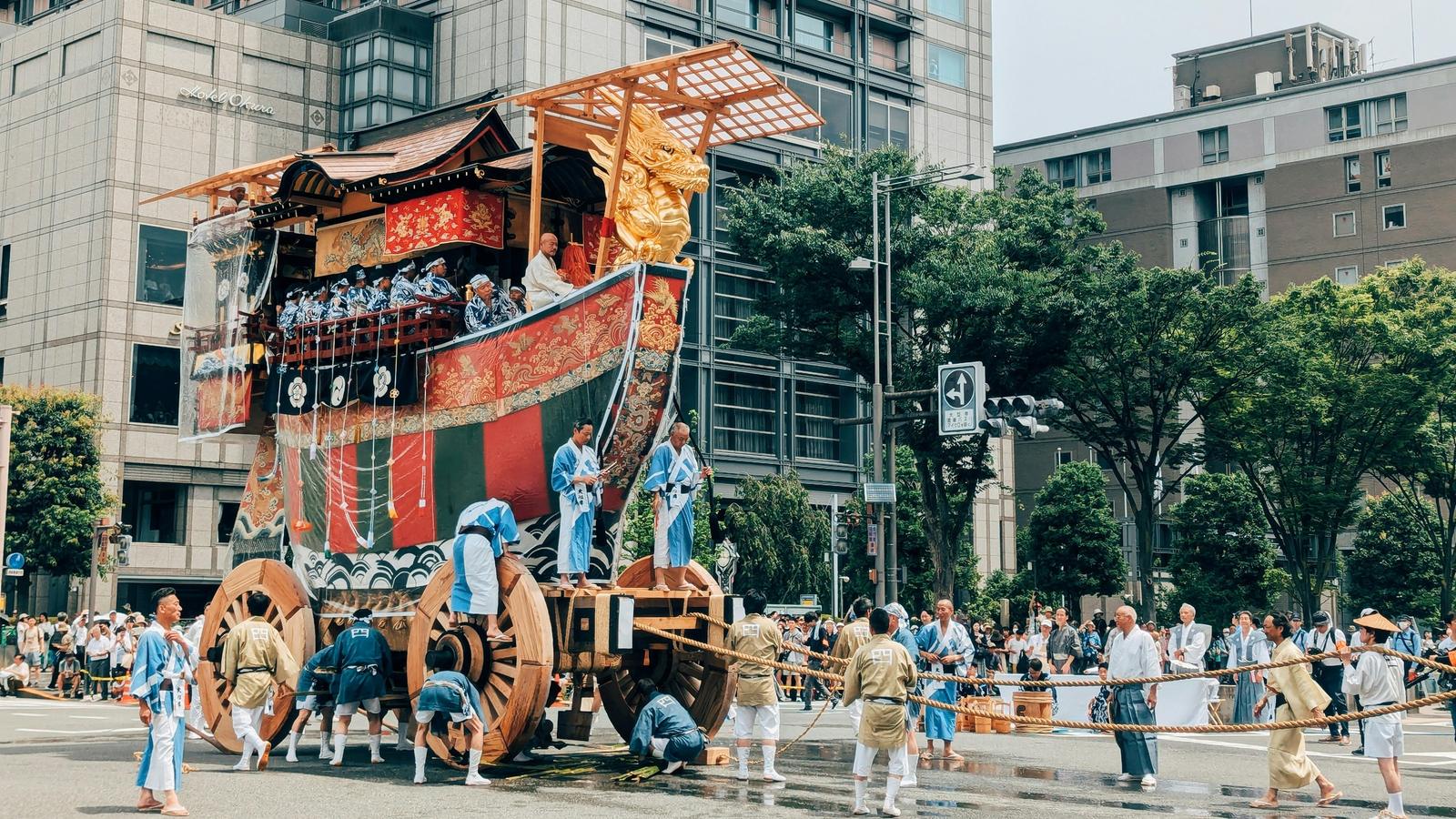
For the whole of July, Kyoto belongs to Yasaka Shrine. The Gion Matsuri opens on July 1 and closes on July 31, and at its centre stand 34 floats, the yama and hoko, raised by hand in the streets of central Kyoto, lit with lanterns on the evenings called yoiyama, and drawn through the city in two processions. In 2027 those processions fall on Saturday, July 17 and Saturday, July 24, the dates first set in 1888.
This article is about seeing the festival well: the evenings among the lit floats, the private houses that open their folding screens, the two processions and the seats along Oike-dori, and how to live with Kyoto's July heat. We read the pages of Yasaka Shrine, the Gion Matsuri Yamahoko Association, the Kyoto City Tourism Association, the Japan Meteorological Agency, the Sugimoto House, three hotels, Kyodo News and two magazines on November 5, 2026, and contacted none of them; the sources are listed at the end. The festival's place in the Japanese year is in Japanese Festival Calendar, and Kyoto's spring festival, the Aoi Matsuri, is in May Festivals in Japan 2027.
Key points
- The Gion Matsuri runs from July 1 to 31. In 2027 the first procession, the Saki Matsuri, is on Saturday, July 17, and the second, the Ato Matsuri, on Saturday, July 24.
- The yoiyama evenings, when the floats stand lit in their streets, are July 14 to 16 and July 21 to 23.
- The Yamahoko Association lists 34 floats. In 2026, 23 went out on July 17 and 11 on July 24. The largest weigh up to 12 tonnes.
- The float rites were inscribed by UNESCO in 2009, and since 2016 they are part of the Yama, Hoko, Yatai float festivals, 33 festivals in 18 prefectures.
- In 2026 the tourism association's seats on Oike-dori went on sale on June 1, from ¥6,000 to ¥155,000 a seat. The 2027 sale had not been announced when we checked.
ASK US TO SHAPE YOUR JULY IN KYOTO →
A FESTIVAL THAT FILLS THE MONTH
Yasaka Shrine dates the festival to 869, when an epidemic spread through the capital and 66 halberds, one for each province of the time, were raised to calm it. The Onin War stopped it in 1467; it returned in 1500, after 33 years, with 36 floats. When Japan adopted the solar calendar the dates moved, and in 1888 the processions were set on July 17 and 24. The national government designated the float rites an Important Intangible Folk Cultural Property in 1979.
The procession days are only part of it. On July 1 the float neighbourhoods begin their rites. At about 20:00 on July 10 a portable shrine is purified on the Shijo bridge over the Kamo River. From July 9 to 14 the floats of the first procession are raised in the streets, and on July 12 and 13 they are pulled for the first time, the hikizome. On July 31 the month ends at the small Ekijinja inside the Yasaka grounds, where charms of chigaya grass are given out. For a guest who arrives early in the month, watching a hoko rise beside an office building is one of the quieter pleasures of Kyoto.
THE YOIYAMA EVENINGS AND THE FOLDING SCREENS
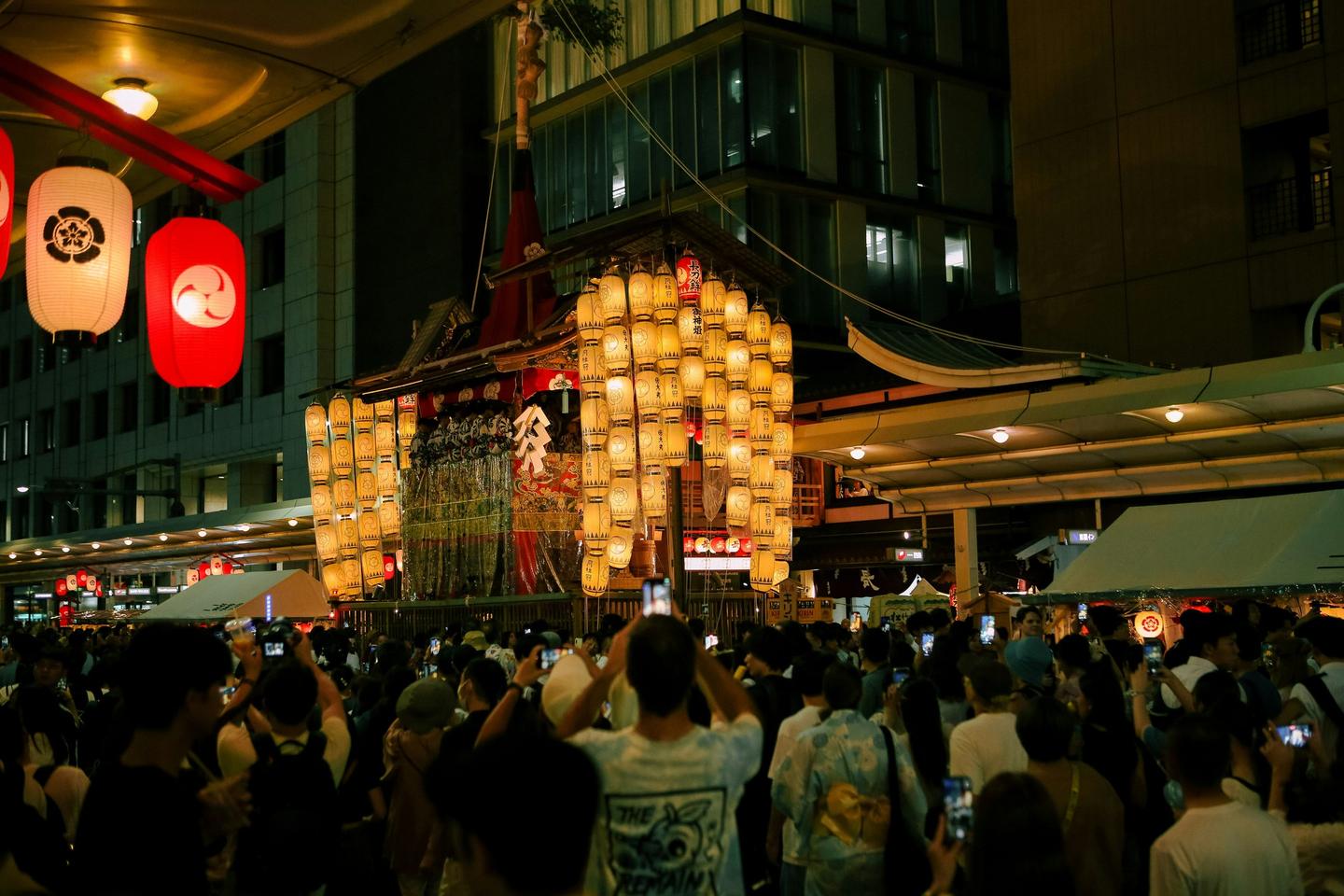
On the three evenings before each procession, July 14 to 16 and July 21 to 23 in 2027, the floats stand lit in their streets, the komagata lanterns glow and Gion bayashi, the festival music, plays from the hoko. Each float neighbourhood sells chimaki, bundles of bamboo leaves that are a charm against misfortune and cannot be eaten; Kyoto families hang them over the door for the year. Some floats let you climb aboard when you buy a charm. The tourism association suggests the evening of the 14th, when the crowds are lighter, and coming before dusk to see the great hoko of Shijo-dori.
This is also when one of the great merchant houses opens. The Sugimoto House, a machiya of about 156 years and an Important Cultural Property, opens its rooms for the festival under the name Gion-e Byobu Matsuri, the festival of screens, and sets out the folding screens of its collection. In 2026 it opened on July 3 to 5, 10 and 11, 14 to 16 and 21 to 23, with advance requests given priority on the yoiyama days. The house also serves as the place where the decorations of Hakugayama, one of the floats, are displayed. We would suggest an early evening at the Sugimoto House, then a walk through the lit streets once the light goes.
THE PROCESSIONS OF JULY 17 AND 24
On the morning of the Saki Matsuri, the floats set out from Shijo-Karasuma at 9:00. In 2026 the tourism association gave the lead at Kawaramachi-Shijo at about 9:35, Kawaramachi-Oike at 10:20 and Shinmachi-Oike at 11:20. At each corner the great hoko are turned through 90 degrees in the tsuji-mawashi: crews lay bamboo under the wheels, wet it, and pull the ropes until the float slides round. Naginata-boko leads every year, carrying a boy as the sacred child; in 2026, Kyodo News reported, he cut the sacred rope across Shijo-dori with one stroke of a sword as the crowd cheered.
The Ato Matsuri of July 24 is smaller and calmer, with 11 floats running the route in reverse, from Karasuma-Oike at 9:30. It was merged into the 17th in 1966 and revived in 2014, the year the boat-shaped Ofune-boko was rebuilt and rejoined the procession. The same day brings the Hanagasa procession of nearly 1,000 people, with maiko and geiko among them. In the evenings of the 17th and 24th the shrine's three portable shrines travel between Yasaka and the Shijo-Teramachi otabisho. For a first visit we would suggest the 17th for its scale; for guests who have seen it, the 24th is easier to watch at leisure.
SEATS ON OIKE-DORI
The Kyoto City Tourism Association sets out numbered seats along Oike-dori, where they have stood since 1956. For 2026 the sale opened on June 1 at 10:00 through Ticket Pia, with general seats at ¥8,000 in the front row and ¥6,000 behind. The special manabi seats in front of Kyoto City Hall add commentary in Japanese and English through your own phone and earphones, at ¥14,500 in front and ¥12,500 behind.
For the first procession there are also premium seats, at ¥125,000 in the front row and ¥155,000 in the second and third rows, which have cushions, tables and parasols for shade. In 2025, when they cost ¥120,000 and ¥150,000, they stood on the southwest corner of the Kawaramachi-Oike crossing, where the floats turn, with a banquet room of Hotel Okura Kyoto open from 9:00 for drinks, a buffet lunch from noon to 14:00, a guide in Japanese with an English interpreter, and yukata dressing for those who wished. The procession goes ahead in rain, and umbrellas and parasols are not allowed in the seats because they block the view. We would suggest the premium seats for a family with older guests, for the shade, the room behind them and the corner where the floats turn.
JULY HEAT AND WHERE TO STAY
July in Kyoto is hot and humid. On the Japan Meteorological Agency's 1991 to 2020 averages, the mean daily high is 32.0°C, the low 23.6°C, and the month brings 223.6 mm of rain, as the rainy season ends. The lead float of the first procession reaches the end of its route at about 11:20, so we plan the morning outdoors, a long lunch and rest in the cool of the afternoon, and the yoiyama after sunset. Light linen, a hat and a cold towel do more than any schedule.
For the festival, a room close to the streets matters more than a view. Hotel Okura Kyoto, with 320 rooms, stands on the Kawaramachi-Oike corner itself, connected underground to Kyoto Shiyakusho-mae Station. Hiiragiya, a ryokan of more than two hundred years on Fuyacho in Nakagyo Ward, has a Michelin Key for 2026. Hotel The Mitsui Kyoto, with 160 rooms on the site of the Mitsui family's main residence near Nijo Castle, has hot spring water from beneath its own grounds, welcome after a hot evening. For ryokan with their own baths, see Kyoto Ryokan with Private Onsen.
Within Signature, our planning for journeys of 7 to 21 days, we arrange the room near the quarter, the seats when the sale opens, subject to what remains, a car to the corner on the morning of the procession, and a guide for the yoiyama. Each is settled in the simplest way available, usually on your hotel bill or on the day.
SOURCES AND HOW WE CHECKED
We read the pages below on November 5, 2026. We did not contact the shrine, the association, any hotel or any other body. The 2027 schedule and seat sale had not been published; times and prices are those of 2026, or of 2025 where marked, as a guide.
- Yasaka Shrine, the Gion Matsuri (Japanese): the origin in 869 with 66 halberds, the shrine's rites from July 1 to 31
- Gion Matsuri Yamahoko Association, history (Japanese): 1467 and 1500, the dates fixed in 1888, 1956 seats, 1966 merger, 1979 designation, UNESCO 2009 and 2016, 2014 and 2022
- Gion Matsuri Yamahoko Association, schedule (Japanese): float building, hikizome, yoiyama, procession times, mikoshi, July 31
- Gion Matsuri Yamahoko Association, the floats (Japanese): the 34 floats, up to 12 tonnes, some 180 people for the largest
- Kyoto City Tourism Association, paid seats 2026 (Japanese): sale from June 1, prices, commentary, the rules on rain and parasols
- Kyoto City Tourism Association, premium seats 2025 (PDF, Japanese): Kawaramachi-Oike corner, Hotel Okura Kyoto banquet room, buffet, guide, yukata
- Kyoto City Tourism Association, how to see the Gion Matsuri (Japanese): routes, passing times, 23 and 11 floats, yoiyama advice, charms and boarding
- Kyodo News via Kumamoto Nichinichi Shimbun, July 17, 2026 (Japanese): 23 floats, the 9:00 start, the sacred child and the rope, the tsuji-mawashi
- Kyodo News via Kumamoto Nichinichi Shimbun, July 24, 2026 (Japanese): 11 floats led by Hashibenkei-yama, about 9:30, 1966 and 2014
- HugKum, Shogakukan (Japanese): chimaki, the yoiyama, the heat, the Hanagasa procession of nearly 1,000 people
- Nippon Tabi Magazine, the 33 Yama, Hoko, Yatai festivals (Japanese): 33 festivals in 18 prefectures, the Gion inscription of 2009
- Japan Meteorological Agency, Kyoto normals 1991 to 2020 (Japanese): July high, low and rainfall
- Sugimoto House (Japanese): a machiya of 156 years, Important Cultural Property, the byobu matsuri dates of 2026
- Kyoto City Tourism Association, Sugimoto House byobu matsuri 2025 (Japanese): the house as the display place of Hakugayama, evening hours
- Hotel Okura Kyoto (Japanese): Kawaramachi-Oike, 320 rooms, linked to Kyoto Shiyakusho-mae Station
- Hiiragiya (Japanese): more than two hundred years, Fuyacho in Nakagyo, Michelin Key 2026
- Hotel The Mitsui Kyoto (Japanese): 160 rooms, the Mitsui residence, hot spring water from its own grounds
QUESTIONS TRAVELLERS ASK
When is the Gion Matsuri in 2027?
The festival runs from July 1 to 31. The processions are on Saturday, July 17 and Saturday, July 24, 2027, and the yoiyama evenings on July 14 to 16 and July 21 to 23.
Which procession should we see?
For a first visit we would suggest July 17, with 23 floats and the great hoko. The 11 floats of July 24 are calmer and easier to watch at leisure, and the Hanagasa procession comes the same day.
How do we get seats for the procession?
The Kyoto City Tourism Association sells numbered seats on Oike-dori. In 2026 the sale opened on June 1 at 10:00. When the 2027 sale opens, we request the seats you choose, subject to what remains.
How hot is Kyoto in July?
The Japan Meteorological Agency's average daily high for July is 32.0°C, with humid air. Umbrellas and parasols are not allowed in the seats, so a hat, light clothes and water matter.
Can we see inside the old houses during the festival?
The Sugimoto House, an Important Cultural Property, opens during the festival and shows its folding screens. In 2026 it opened from July 3 to 23 on set days.
ASK US TO SHAPE YOUR JULY IN KYOTO
Tell us when you are coming, who is travelling and how you like to spend a hot day. We will set out the evenings, the seats and the rooms near the floats, with the reasons, so that you can choose.
Begin planning →We reply within 24 hours, in writing
Some of the restaurants and bars we arrange seat guests only by introduction or membership. We ask on your behalf; the table and the evening are the house's decision. We do not publish their names.