Urushi lacquer is a natural coating refined from the sap of the urushi tree, and under Japan's household goods labelling rules, tableware may be called 漆器 (shikki, lacquerware) only if every coated surface uses natural urushi alone; pieces finished with urethane, cashew or other resins must say so. Care is simple: wash by hand in warm or plain water, wipe dry with a soft cloth, and keep urushi out of the dishwasher, the microwave and direct sunlight.
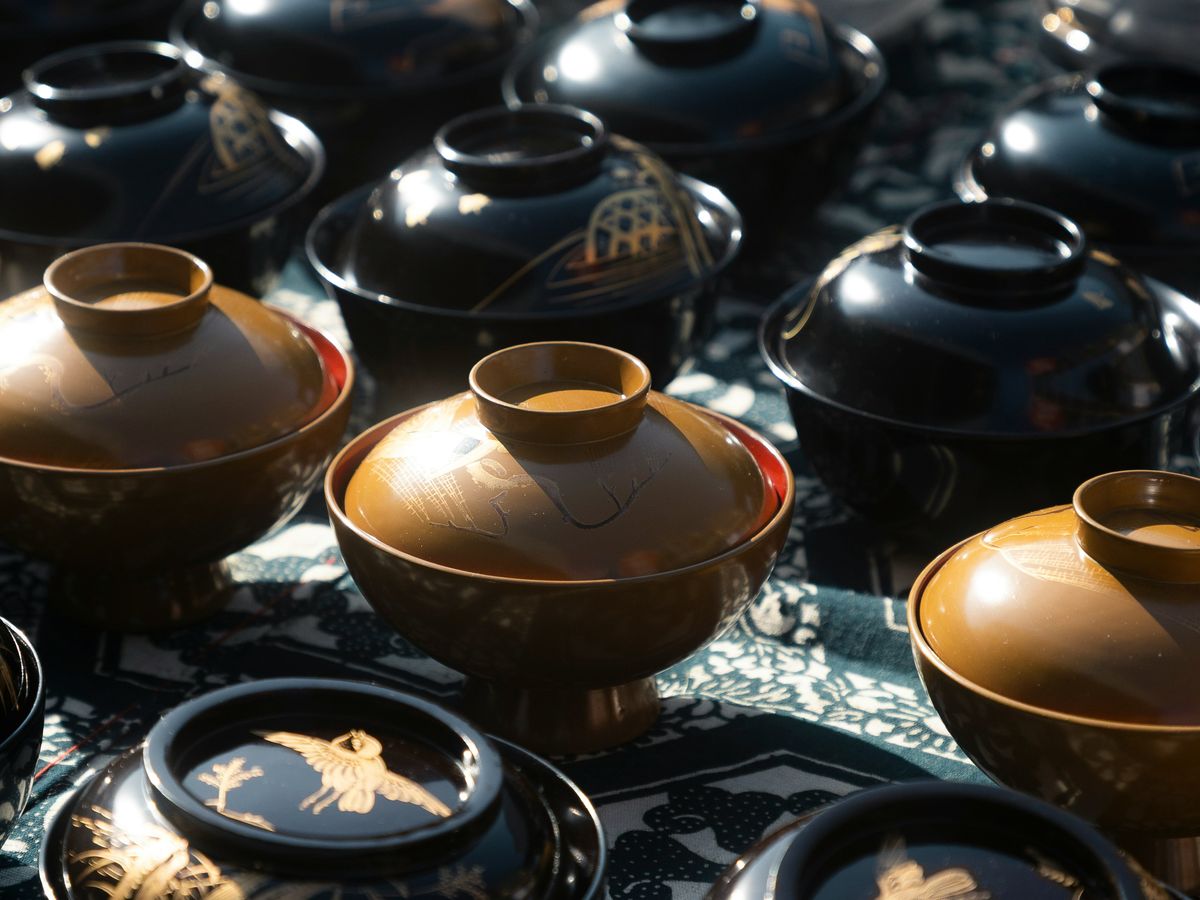
What urushi is
Japan's Forestry Agency describes urushi as a refined mixture of sap and resin collected from the urushi tree, used for centuries to coat tableware, crafts and buildings and as an adhesive.
Most urushi used in Japan today is not produced in Japan. In its annual report on forests and forestry for fiscal 2024, the Agency records domestic consumption of 29.8 tonnes in 2023 and domestic production of 1.7 tonnes, equal to 5.5% of consumption. Production has risen since 2015, after the Agency for Cultural Affairs decided in fiscal 2014 to use domestic urushi in principle for repairing National Treasure and Important Cultural Property buildings. If the origin of the lacquer matters to you, ask the maker directly; where a piece was made and where its urushi came from can differ.
Reading the label
For wooden and plastic tableware and kitchen items coated with urushi or cashew resin, the Consumer Affairs Agency's guidance under the Household Goods Quality Labeling Act sets out what the label must show. The product name 漆器 (shikki) may be used only when every coated surface uses natural urushi alone. Items coated with cashew or synthetic resin use a name such as 合成漆器 (gosei shikki, synthetic lacquerware), and an item that mixes urushi with synthetic coatings cannot be called 漆器.
The label also states the surface coating and the base material. These are the terms to look for:
- 漆塗装 (urushi toso): urushi coating
- ウレタン塗装 (uretan toso): urethane resin coating
- カシュー塗装 (kashu toso): cashew resin coating
- メラミンアルキド塗装 and ユリアアルキド塗装: melamine alkyd and urea alkyd resin coatings
- 天然木 (tennen-moku): natural wood base, sometimes with the species in brackets
- 木粉 (mokufun): wood flour mixed with resin, with its percentage by weight
Furniture and larger pieces
Where more than one coating is used, the guidance requires each coated part to be named, and an undercoat may be shown in brackets as 下地塗装 (shitaji toso). Very small items, under 200 square centimetres seen from above in normal use, may show only the coating and the base material.
The labelling rule covers tableware and kitchen items. A lacquered dining table, a tray stand or a chest of drawers falls outside it, so ask the maker or shop in writing which coating is on each surface, whether there is a synthetic undercoat, what the base wood is, and whether they can repair or recoat the piece later. Keep the answer with the receipt.
Choosing urushi for a home you visit a few times a year
Synthetic coatings have their place. A urethane-coated tray can be a sensible choice for a busy kitchen, as long as you know what you are buying. Check that the label, the price and what the shop tells you all agree.
For pieces that will live in a Tokyo apartment you leave closed for weeks at a time, a few questions at the counter save trouble later.
- Is the name on the label 漆器 or 合成漆器, and what coating and base does it list
- Is the base solid wood, and which species
- Which care steps does the maker recommend, and are they printed on the tag
- Can the maker or shop repair or recoat it, and how do you contact them from abroad
- Can the shop pack and ship it to your Tokyo address
Using and washing urushi every day
Urushi is made to be used. The care points below follow the examples the Consumer Affairs Agency gives for lacquerware labels.
In practice, wipe each piece dry soon after washing, and avoid stacking lacquer with ceramics or metal, which can scratch the surface.
- Wash in warm or plain water after use and wipe with a soft cloth
- Do not scrub with scouring pads or polishing powder
- Do not leave strongly acidic foods such as vinegar or lemon in the piece; the surface can change and lose its gloss
- Do not put it in a microwave
- Do not wash it in a dishwasher
Light, storage and the apartment you leave empty
The Agency's guidance also lists keeping lacquerware out of direct sunlight, which can cause discoloration or deformation. In a Tokyo apartment this means no lacquer on a sunny windowsill or a shelf that catches afternoon light, and none in front of an air conditioner outlet or heater.
Before you leave for a long stretch, make sure every piece is completely dry, wrap it in soft cloth or paper, and store it in a closed cupboard away from the windows. On your next visit, unwrap the pieces, check them in daylight and use them. If the apartment tends to be damp while it is closed, look after the humidity of the room as a whole; our article on humidity in an empty apartment covers the steps.
Chips, wear and repair
Urushi can be repaired and recoated by a lacquer craftsperson. A worn rim, a chip or a dull patch is usually a question for the maker or the shop that sold the piece; production areas such as Wajima in Ishikawa have cooperatives of makers and dealers.
Do not try to fill or polish damage with household products. Note when and how the damage happened, take clear photographs, and send them to the maker with the original label or receipt.
How STAYGO ATELIER can help
STAYGO ATELIER can choose urushi pieces for your table and rooms with a designer's eye, confirm with the maker which coating each piece has, and arrange their purchase and shipping. You pay makers and shops directly; we do not visit the home or place the pieces.
Questions owners ask
Is urushi dishwasher safe?
No. The Consumer Affairs Agency's guidance for lacquerware labels includes not washing pieces in a dishwasher and not putting them in a microwave. Wash by hand in warm or plain water and wipe dry with a soft cloth.
How can I tell real urushi from synthetic lacquer?
Read the Japanese label. Under Consumer Affairs Agency guidance, tableware may be called 漆器 only if every coated surface uses natural urushi alone; urethane or cashew coatings appear as ウレタン塗装 or カシュー塗装.
Does the label rule apply to lacquered furniture?
The rule covers tableware and kitchen items made of wood or plastic. For a table, tray stand or cabinet, ask the maker in writing which coating is on each surface and what the base wood is.
Can urushi lacquerware be repaired?
Yes. Urushi can be repaired and recoated by a lacquer craftsperson; contact the maker or the shop that sold the piece with photographs and the original label.
This article explains labelling rules as general information only. For a specific product or case, ask the maker or seller, or the Consumer Affairs Agency.
Sources
- Consumer Affairs Agency, labelling guide for tableware and kitchen items coated with urushi or cashew resin (漆又はカシュー樹脂塗料等を塗った食事用、食卓用又は台所用の器具) (2026)
- Forestry Agency, Annual Report on Forest and Forestry in Japan FY2024 (令和6年度 森林及び林業の動向), chapter 2 (2025)
- Wajima Lacquerware Commerce and Industry Cooperative (輪島漆器商工業協同組合) (2026)