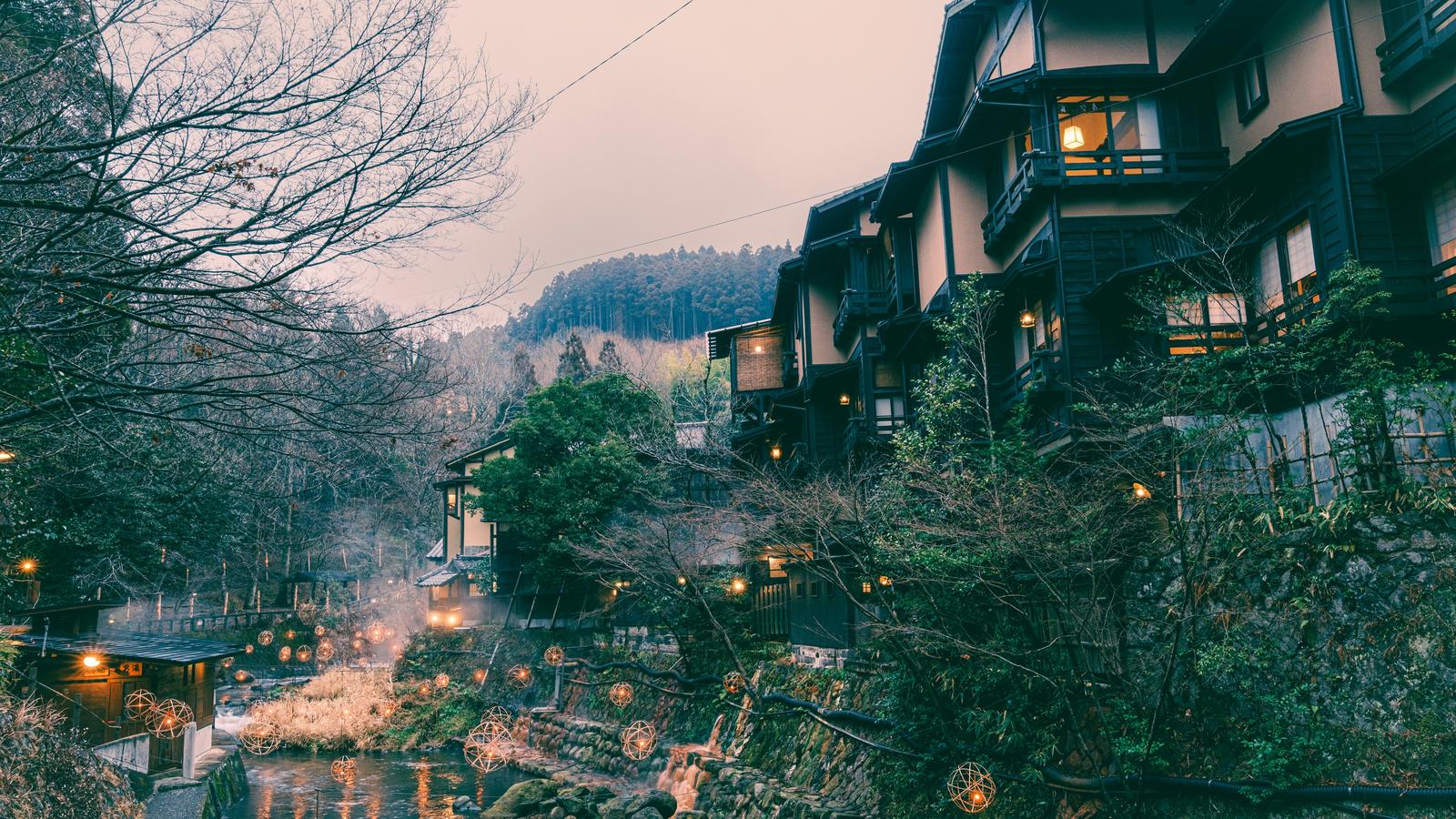
Singapore has no seasons and little open countryside, and its travellers go abroad to find both. The Japan National Tourism Organization makes that point in its 2025 market handbook, and adds what it hears from Singapore about hot springs: guests often want at least one night at an onsen ryokan, and some would rather bathe in a private bath, at ease and away from the rules of a shared one. The same handbook names Yufuin in Oita and Kurokawa in Kumamoto among the places in Kyushu that Singapore rates most highly, and observes that the more often Singaporeans return to Japan, the better they know its regions.
This article is for that return visit: two hot spring towns in the hills of Kyushu, the inns where the bath belongs to your room, and the road between them. On November 5, 2026 we read the official pages of the inns, the Kurokawa Onsen ryokan cooperative, JR Kyushu, Singapore Airlines, JNTO and the Japan Meteorological Agency, and contacted none of them; the sources are listed at the end. The wider island, from Fukuoka to Nagasaki, is in Kyushu: Where to Go After Tokyo and Kyoto, and how to read a ryokan's room categories is in How to Choose a Ryokan in Japan.
Key points
- Singapore Airlines flies non-stop to Fukuoka in about six hours, seven times a week by JNTO's count. From Hakata, the morning Yufuin no Mori reaches Yufuin in 2 hours 14 minutes.
- All 17 rooms at Kamenoi Bessou in Yufuin have their own hot spring bath, and eight of its eleven garden cottages have an open-air bath.
- Sansou Murata has twelve detached villas, each with its own spring bath, and no shared bath at all.
- In Kurokawa, 30 inns treat the whole village as one inn. The ¥1,500 bath pass, created in 1986, opens three of 25 open-air baths and stays valid for six months.
- On the Japan Meteorological Agency's averages, August nights in Yufuin and in Minamioguni, Kurokawa's town, fall to about 20°C, five degrees cooler than in Fukuoka.
LET US SHAPE YOUR KYUSHU ONSEN JOURNEY →
WHY THESE HILLS SUIT A RETURN VISIT
JNTO describes Kyushu tours as a staple of Singapore's travel companies, helped by Singapore Airlines' daily flights to Fukuoka and years of promotion by the Kyushu prefectures. Most of those guests stay in the city. In the Japan Tourism Agency's 2023 lodging figures, quoted in the handbook, Fukuoka Prefecture held 2.2% of the nights Singaporeans spent in Japan, Kumamoto 0.7% and Oita 0.5%. The hill towns are known by name and still lightly visited, which is the balance a returning traveller looks for.
The handbook adds two details that shape how we plan for Singapore. Many in Singapore consider Japan for a honeymoon or an anniversary, and more guests now prefer to reach restaurants and other businesses by WhatsApp than by telephone or email. Yufuin and Kurokawa answer the wish for a private bath in two different ways. Yufuin's finest inns are gardens of cottages, each with its own spring. Kurokawa adds rooms with their own baths to a village where walking between open-air pools in a yukata is the evening itself.
FROM SINGAPORE TO THE HILLS
Singapore Airlines flies from Singapore to Fukuoka non-stop in about six hours, with a Boeing 787-10, and JNTO's 2025 handbook counts seven flights a week. With a morning arrival, the hills are within reach on the day you land.
From Hakata Station, JR Kyushu's Yufuin no Mori was built around the idea that Yufuin begins when you board. The first set entered service in 1989, with raised floors and wide windows for the view. On the timetable of March 14, 2026, the 9:17 from Hakata arrives in Yufuin at 11:31 and the 14:38 at 16:50; every seat is reserved, and JR Kyushu will publish the running days after March 2027 around mid-January 2027. For families with luggage, or for guests who would rather go straight from the aircraft to the inn, we arrange a private car from Fukuoka Airport instead, and the train can wait for a later trip.
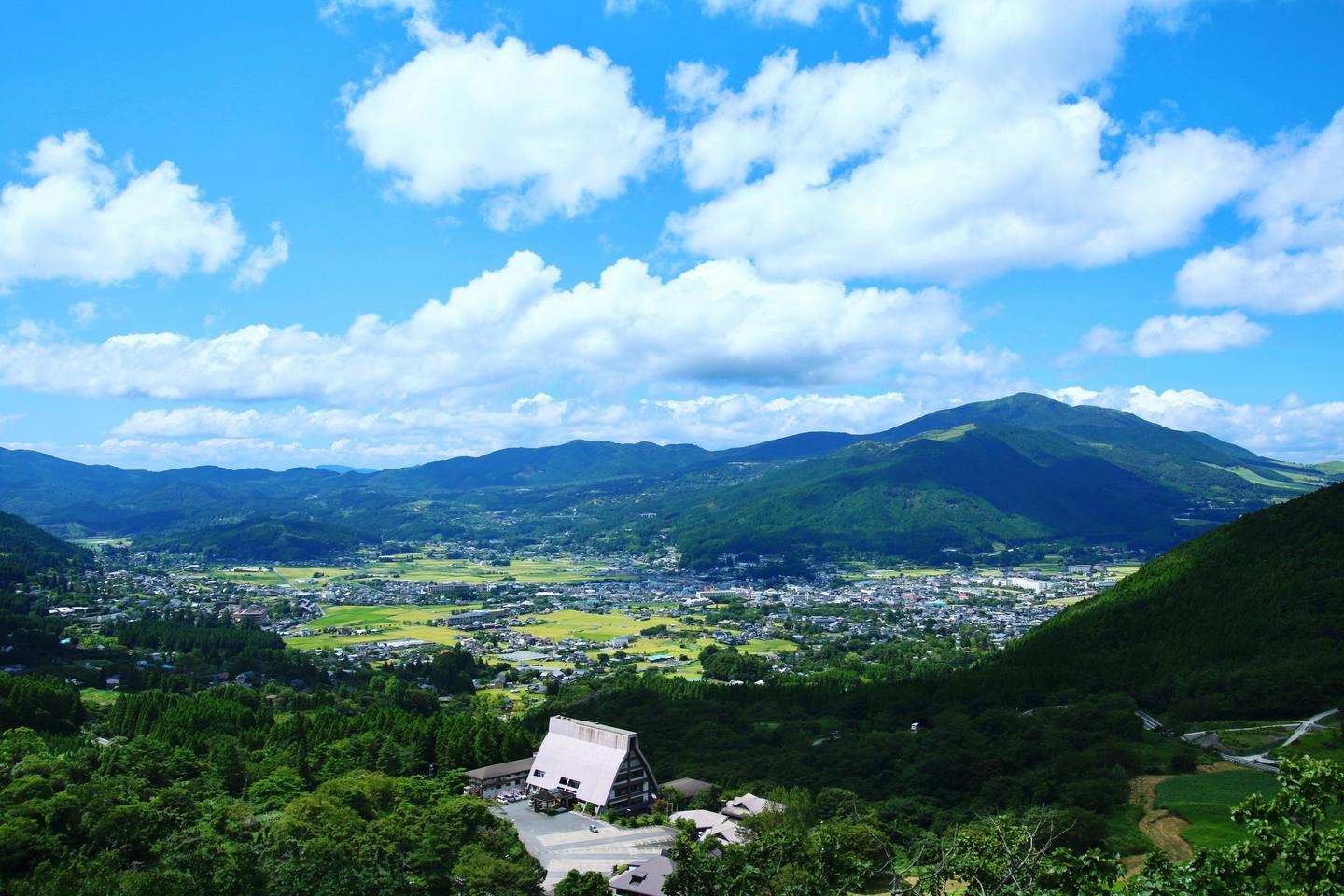
YUFUIN: GARDENS WITH A SPRING IN EVERY ROOM
Kamenoi Bessou stands on the shore of Lake Kinrin, in grounds of about 10,000 tsubo, roughly 33,000 m². It has eleven detached cottages and six Western-style rooms in the main building, and every room draws free-flowing water from the spring in the garden. Eight cottages have an open-air bath. Dinner in the cottages is a kaiseki carried to your room, and from the second night guests may choose a hot pot course instead. Cottage No. 7, renewed in March 2025, is the inn's answer for two couples or a family: about 140 m², a living and dining room facing a private garden, two twin bedrooms on either side, a new open-air bath and an indoor bath made entirely of hinoki, both fed by the spring. The inn lists it from ¥84,000 per person for four, with dinner and breakfast and service, before tax. Within the garden, the counter at Jubankan serves kappo dinners from Tuesday to Thursday for three parties a day, and Bar Yamaneko keeps the evening going.
Sansou Murata takes privacy one step further. All twelve rooms are detached villas, six for two to four guests and six larger ones for five to eight gathered around an irori hearth, and each has a hot spring bath of its own; the inn has no shared bath at all. Tan's Bar, the Artegio museum of sound and the restaurant Saryo Saihido, open to staying guests only, sit in the same grounds. Yufuin Tamanoyu, with 16 cottage rooms in a wood, each with a wooden bath of spring water, completes the town's best-known trio; its history and rates are in our Kyushu guide.
KUROKAWA: A VILLAGE RUN AS ONE INN
Kurokawa was a bathing place in the Edo period, near the border of the Hosokawa domain, and served as an okyakuya, a place where the domain's officials came to stay. Its life as a resort began in 1961, when six inns formed a cooperative around the idea of a town of open-air baths. The Yamanami Highway opened in 1964 and brought a brief rush of visitors, then years of quiet. The cooperative writes that the village was so remote that it did not appear on the local newspaper's map of Kumamoto until 2000.
The change came from the inns' second and third generations, who came back to the village or married into its inns in the 1970s. In 1986 the cooperative reorganized into a signage team, an environment team and a planning team. The first removed some 200 mismatched signs and replaced them with shared ones; the second pruned and planted to turn bare cedar slopes into a landscape worth looking at. In the 1990s the inns gave their idea a name, Kurokawa Onsen Ichi-Ryokan: the 30 inns and the countryside around them form one inn, each inn a detached room and the lanes its corridors. The visitor feels it at once, in the shared signs and the planting along the river.
THE BATH PASS AND THE OPEN-AIR POOLS
The planning team's idea was the nyuto tegata, a wooden pass created in 1986 to help two inns whose land was too tight for an open-air bath. Today one pass costs ¥1,500 for an adult and opens three of 25 open-air baths across the village, or two baths and one café or shop. It is valid for six months from purchase, the baths admit pass holders from 8:30 to 21:00, and each inn stamps the pass with its own seal, so the wood becomes a record of the walk. Photography in the baths is not allowed, as a rule. The cooperative returns 1% of pass sales to the landscape and to protecting the springs, and the passes are cut from thinned cedar and cypress of the Oguni district.
For the pass's 40th year, a special design is on sale from July 1, 2026 until around March 2027, limited to 50,000 passes. Shared baths in Kurokawa follow each inn's own rules. For a guest who would rather not use them, the room's own bath is the answer, and we read each inn's written policy before we arrange anything; the wider question of tattoos is in Tattoo Friendly Onsen in Japan.
KUROKAWA INNS WITH A BATH OF YOUR OWN
Ryokan Sanga lies in a forest about five minutes by car beyond the village, beside a mountain stream. Its 16 rooms include rooms with their own baths and detached cottages, and the finest, the cottage Nemunoki, pairs a ten-mat room and a bedroom with a cut-stone bath and an open-air bath. Two springs of the inn's own feed seven baths on about 3,000 tsubo of grounds, 100% free-flowing, among them three private baths that are arranged at the front desk on the day. The kitchen cooks kaiseki from the Oguni district with Aso's akaushi beef, and asks guests to tell it of dietary needs well ahead.
In the heart of the village, Oyado Noshiyu has eleven rooms built with beams more than 200 years old. Some have their own bath: Azami, a cottage with a tea room and an inner garden, and Kiri, with a semi-open-air bath and a terrace. Five private baths include a standing bath 120 cm deep, and dinner is a single seasonal course paced to the table. Yamamizuki, on a mountain stream outside the centre, has rooms with indoor baths and a wooden deck facing the water, and open-air baths beside the river. Okyakuya, whose name recalls the village's old role, says it has kept an inn here for three hundred years.
OVER THE YAMANAMI HIGHWAY AND THROUGH THE SEASONS
From Yufuin, the Kurokawa cooperative directs drivers along the Yamanami Highway toward Aso as far as Senomoto, then down to the village; the cross-Kyushu bus from Yufuin Station takes 1 hour 37 minutes. We arrange a private car for the transfer, so the route can stop where the view asks for it and the luggage goes ahead to the inn.
The weather stations of both towns stand at about 440 m. On the Meteorological Agency's normals for 1991 to 2020, August nights fall to 20.4°C in Yufuin and 20.3°C in Minamioguni, against 25.4°C in Fukuoka, and the cooperative says Kurokawa has had a single tropical night in ten years. November averages 9.4°C and 9.0°C, the season of autumn colour, and January nights average −2.2°C and −2.8°C, when an outdoor bath in frosty air is at its best. June is the wettest month, with 518.2 mm of rain in Minamioguni. Each winter since 2012, Kurokawa has lit its river with about 300 bamboo ball lanterns, the Yuakari, from 17:00 to 21:30; last season they burned from December 20, 2025 to March 31, 2026.
A WEEK SHAPED FOR 2027
A first shape: land in Fukuoka in the morning, take the train or a car to Yufuin, and stay three nights at Kamenoi Bessou or Sansou Murata. Cross the Yamanami Highway to Kurokawa for two or three nights, walk the village with the pass in the late afternoon, and return to Fukuoka for a final night before the flight home. A November journey brings the colour and the cool, a January one the frost and the lanterns, and the anniversary pass is on sale until around March 2027.
Within Signature, our planning for journeys of 7 to 21 days, the two hill towns often take five or six nights beside Fukuoka, or beside Tokyo and Kyoto on a longer trip. We arrange the cottages and villas, the train seats and the cars, ask each kitchen in writing about halal, vegetarian or other needs, and settle each in the simplest way available, usually on your hotel bill or on the day. During the journey we stay in touch by WhatsApp. For a private bath in the city, see Kyoto Ryokan with Private Onsen.
SOURCES AND HOW WE CHECKED
We read the pages below on November 5, 2026. Travel times are taken from the operators' timetables. We did not contact any inn, airline, railway, cooperative or other body.
- JNTO, Visit Japan market handbook 2025, Singapore (Japanese): no seasons, private baths, Yufuin and Kurokawa, seven weekly flights to Fukuoka, 2023 lodging shares, WhatsApp, repeaters and regions, honeymoons
- Singapore Airlines, flights to Fukuoka: non-stop, about six hours, Boeing 787-10
- JR Kyushu, Yufuin no Mori (Japanese): 1989, timetable of March 14, 2026, all seats reserved, running days after March 2027
- Kamenoi Bessou, rooms (Japanese): grounds, eleven cottages and six rooms, spring water in every room, cottage sizes and baths
- Kamenoi Bessou, Cottage No. 7 (Japanese): 140 m², two bedrooms, hinoki and open-air baths, rate
- Kamenoi Bessou, official site (Japanese) and cuisine (Japanese): Jubankan, Bar Yamaneko, meals in the cottages
- Sansou Murata, official site (Japanese): twelve villas, own spring in each, no shared bath, Tan's Bar, Artegio, Saryo Saihido
- Yufuin Tamanoyu, rooms (Japanese): 16 cottage rooms, wooden spring baths
- Kurokawa Onsen ryokan cooperative, about Kurokawa (Japanese): history from the Edo period, 1961, 1964, 1986 teams, 200 signs, Ichi-Ryokan, 30 inns, the 2000 map
- Kurokawa Onsen, the bath pass (Japanese): price, 25 baths, six months, hours, stamps, 1% of sales, local wood
- Kurokawa Onsen, 40th anniversary of the pass (Japanese): special design to around March 2027, 50,000 passes, one tropical night in ten years
- Kurokawa Onsen, Yuakari (Japanese): since 2012, about 300 lanterns, hours and last season's dates
- Kurokawa Onsen, access (Japanese): Yamanami Highway to Senomoto, bus from Yufuin Station
- Ryokan Sanga, rooms (Japanese), hot springs (Japanese) and English page: 16 rooms, Nemunoki, two springs, seven baths, dietary needs
- Oyado Noshiyu, official site (Japanese): eleven rooms, old beams, rooms with baths, five private baths, one dinner course
- Yamamizuki, rooms (Japanese) and baths (Japanese): rooms with indoor baths on the stream, riverside open-air baths
- Okyakuya, official site (Japanese): three hundred years in Kurokawa
- Japan Meteorological Agency, normals for Yufuin (Japanese) and for Minamioguni (Japanese): temperatures and rainfall by month
- Japan Meteorological Agency, normals for Fukuoka (Japanese): August temperatures
QUESTIONS TRAVELLERS ASK
Which Yufuin ryokan have a hot spring bath in every room?
All 17 rooms at Kamenoi Bessou have one, and eight of its eleven cottages have an open-air bath. Each of Sansou Murata's twelve villas has its own spring bath, and Yufuin Tamanoyu gives each of its 16 rooms a wooden bath of spring water.
What is the Kurokawa Onsen bath pass?
The nyuto tegata is a wooden pass sold by every inn and by the cooperative for ¥1,500. It opens three of 25 open-air baths, or two baths and one café or shop, from 8:30 to 21:00, and stays valid for six months.
How do we travel from Singapore to Yufuin?
Singapore Airlines flies non-stop to Fukuoka in about six hours. From Hakata Station, the morning Yufuin no Mori reaches Yufuin in 2 hours 14 minutes, or we arrange a private car from the airport.
How long is the drive from Yufuin to Kurokawa?
The route follows the Yamanami Highway toward Aso. The cross-Kyushu bus takes 1 hour 37 minutes from Yufuin Station; we arrange a private car so the journey can pause on the way.
When is the best time for Yufuin and Kurokawa?
November for autumn colour, with averages of about 9°C, and January for frosty nights and the Yuakari lanterns. In August, nights fall to about 20°C, five degrees cooler than Fukuoka.
ASK US TO SHAPE YOUR KYUSHU ONSEN JOURNEY
Tell us when you would like to travel, who is coming and how private you would like the baths to be. We will set out the inns in Yufuin and Kurokawa with the reasons for each, so that you can choose the shape of the week.
Begin planning →We reply within 24 hours, in writing
Some of the restaurants and bars we arrange seat guests only by introduction or membership. We ask on your behalf; the table and the evening are the house's decision. We do not publish their names.