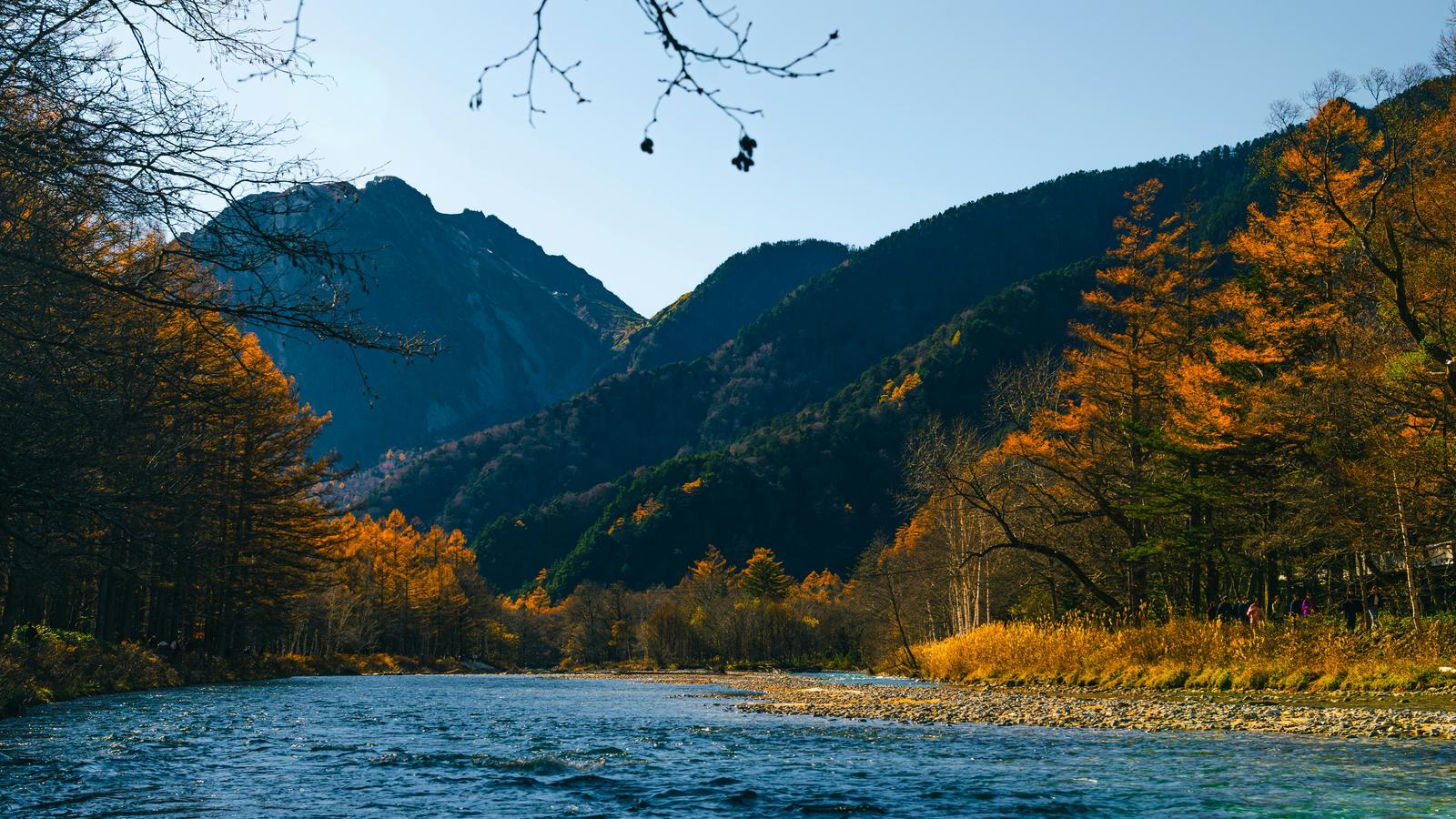
Kamikochi is a valley about 1,500 m up in the Northern Japan Alps, inside Chubu-Sangaku National Park, and it is open for one season a year. In 2026 the season ran from April 17 to November 15, and the buses stop on November 16. Private cars are banned on the road in all year, so everyone arrives by shuttle bus or taxi from the parking areas at Sawando, on the Matsumoto side, or Hirayu, on the Gifu side. From Tokyo the usual way in is the limited express Azusa from Shinjuku to Matsumoto: on JR East's November 2026 timetable, Azusa 1 leaves Shinjuku at 7:00 and reaches Matsumoto at 9:38.
This guide covers the trains, buses and road rules, the walk from Taisho Pond past Kappa Bridge to Myojin Pond, when the leaves turn and when the valley closes, the two hotels that let you stay overnight inside it, the castle town of Matsumoto, and the hot spring villages nearby. We read every time, fare and date on the official pages on November 2, 2026, and the sources are listed at the end. If you plan to cross the mountains further north as well, the Tateyama Kurobe Alpine Route starts about an hour and a half from Matsumoto by train and bus.
Key points
- Kamikochi's 2026 season ran from April 17 to November 15. The 2027 dates were not yet published when we checked; the 2026 pattern is mid-April to mid-November.
- Private cars and motorcycles are banned all year. Alpico's shuttle from Sawando takes about 30 minutes and costs ¥1,600 one way or ¥3,000 return; a taxi from Matsumoto Station to Kamikochi is a fixed ¥19,900 on Alpico Taxi's table.
- The Kamikochi Imperial Hotel (74 rooms, opened in 1933) and the Gosenjaku Hotel beside Kappa Bridge both open from late April to early November. In 2026 the last night at both was November 14.
- The official Kamikochi diary puts peak maple colour around October 20 in the centre of the valley, with the larches turning gold in late October and early November.
- Matsumoto Castle is a National Treasure; Matsumoto City dates its main keep to 1593–1594. It is open 8:30 to 17:00, and a timed electronic ticket costs ¥1,200.
LET US ARRANGE YOUR DAYS IN KAMIKOCHI AND MATSUMOTO →
GETTING THERE FROM TOKYO AND MATSUMOTO
Matsumoto is the natural base. The Kamikochi official site gives two and a half to three hours from Shinjuku to Matsumoto by JR, and three to three and a half hours by expressway bus.
The Azusa from Shinjuku
JR East's limited express Azusa runs from Shinjuku on the Chuo Line through Tachikawa, Hachioji, Kofu, Kobuchizawa, Chino, Kami-Suwa and Shiojiri to Matsumoto. On the timetable for November 2026, Azusa 1 leaves Shinjuku at 7:00 and arrives in Matsumoto at 9:38. All ordinary seats can be reserved, and there is a Green Car. You buy the tickets yourself, at the station or on JR East's site.
From Matsumoto into the valley
- Train and bus. The Alpico Kamikochi Line runs from Matsumoto to Shin-Shimashima in about 30 minutes, and a bus continues to Kamikochi in about 60 minutes. The Kamikochi official site says the buses from Kamikochi back to Shin-Shimashima and Matsumoto, and the direct bus from Matsumoto, must be reserved.
- Taxi. Alpico Taxi lists a fixed fare of ¥19,900 between Matsumoto Station and Kamikochi, and ¥20,300 from Matsumoto Airport. Taxis may use the restricted road.
- The last bus out. The last Sawando shuttle leaves Kamikochi at 17:30, and the official site notes that the last departures from the valley are around 18:00. Missing them can mean a long taxi ride over the mountains.
The road rules
Private cars and motorcycles have been banned on the road into Kamikochi since 1975, according to the Gosenjaku Lodge, and the official site says the ban runs all year to protect the environment. Drivers leave the car at Sawando, about 60 minutes from the Matsumoto interchange (around ¥700 a day), or at Hirayu in Gifu (around ¥600), and continue by bus or taxi in 20 to 30 minutes. From Tokyo, the drive from Chofu to the Matsumoto interchange takes about three hours.
- The Sawando shuttle. Alpico's bus runs only during the open season, takes about 30 minutes and stops at Taisho Pond and the Imperial Hotel before the Kamikochi bus terminal. Adults pay ¥1,600 one way or ¥3,000 return, and the return half is valid for seven days. Seats cannot be reserved; tickets are sold on the day and the queue decides who boards.
- Taxis from the parking areas. On Alpico Taxi's table, Sawando to the Kamikochi bus terminal is ¥5,400 or ¥6,000 depending on the zone, and the Hirayu zone is ¥5,700 plus the Abo Tunnel toll.
- Late arrivals. The Gosenjaku Lodge tells guests that no vehicles may enter Kamikochi after 19:00, or 20:00 in summer.
What a driver costs for the day from Tokyo, or for the run from Matsumoto to Sawando, is set out in Private driver in Japan cost.
TAISHO POND, KAPPA BRIDGE AND MYOJIN POND
The valley follows the Azusa River upstream, and the classic walk follows it too. The walking times below are from the Kamikochi official site.
- Taisho Pond. On June 6, 1915, an eruption of Mount Yake sent a mudflow across the Azusa River and dammed it, and the lake that formed is Taisho Pond, according to the Japan Meteorological Agency. A survey that July found it more than twice its present size. The water drowned the trees along the river, and Mount Yake and the Hotaka peaks are reflected in it on still days.
- Taisho Pond to Kappa Bridge. About 75 minutes and 3.8 km on the right bank, or 80 minutes and 4 km on the left. Taking the bus to Taisho Pond and walking back to Kappa Bridge halves the round trip.
- Kappa Bridge. The bridge is the centre of the valley, about six minutes on foot from the bus terminal, with the Hotaka range upstream. Nippon.com notes that visitors meet monkeys here more often than the river spirits the bridge is named after.
- Kappa Bridge to Myojin. About 60 minutes and 3 km on the right bank, or 50 minutes and 2.5 km on the left; the official site puts the round trip at about two hours.
- Myojin Pond. The pond is the sacred ground of the Okumiya, the inner shrine of Hotaka Jinja, and it has two parts, Ichi-no-ike and Ni-no-ike. Visitors pay an entrance fee at the gate. Every October 8 the shrine holds its boat festival on the pond.
Beyond Myojin the path continues to Tokusawa, another hour each way; the official site puts the whole round trip from Kappa Bridge at four to five hours.
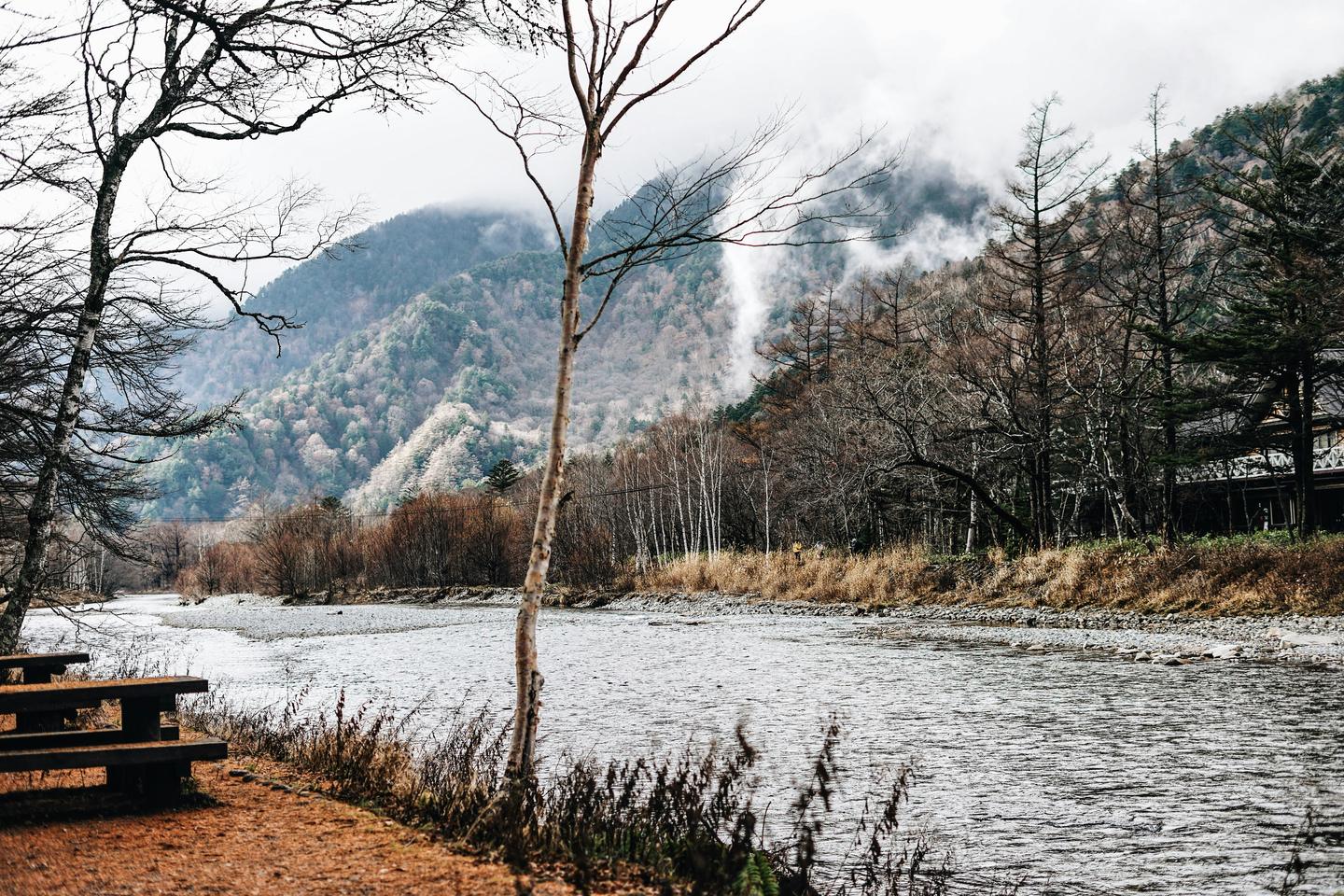
THE VALLEY IN THE EARLY MORNING
Day visitors come and go with the buses. The last shuttle leaves for Sawando at 17:30, and on every day from August to October the first one leaves Sawando at 5:00 and reaches the valley around 5:30. The hours before and after belong to the people who stayed.
A morning in the valley might go like this. The river is loud in the dark, and the air is cold enough to see your breath. By the time the light reaches the tops of the Hotaka peaks, the path along the right bank toward Taisho Pond is empty, apart from the sound of the water and a bear bell borrowed from the front desk. Mist sits on the pond, and steam rises from Mount Yake behind it. On the way back, the bridge has a few early walkers and nothing else. Breakfast is waiting, and the first buses are only now coming up the road.
The practical details are simple: the Gosenjaku Lodge lends bear bells at its front desk, notes that bears are more active in the early morning and at night, and the lodge's large bath opens at 6:00. A late-afternoon walk works the same way in reverse, once the last buses have gone down.
THE SEASON AND THE AUTUMN COLOUR
Kamikochi opens in mid-April and closes in mid-November. In 2026 the season ran from April 17 to November 15, with a grand opening on April 27, and the shuttle buses do not run from November 16 to April 16. The 2027 dates had not been published on November 2, 2026; expect the same pattern.
When the leaves turn
The official Kamikochi diary for September 2026 describes the order: the maples turn first and reach their peak in central Kamikochi around October 20, staying bright for about a week. The larches follow once the maples have fallen and are at their best in late October and the first days of November. The same post noted that the 2026 colour was running behind after weeks of rain, so the dates move by a week or so from year to year.
The close of the season
Facilities close in stages before the last day. On the official closing plan for 2026, the last night at the Imperial Hotel and the Gosenjaku Hotel was November 14, the Hotaka Jinja inner shrine at Myojin closed on November 14, and several lodges further up the valley closed in the first days of November. Kamikochi itself stayed open on November 15, and the information and visitor centres closed at 17:00 that day.
Nippon.com notes that the valley is known for its cool summers as well as its autumn colour. How Kamikochi's autumn compares with the rest of Japan is in Cherry blossom vs autumn leaves.
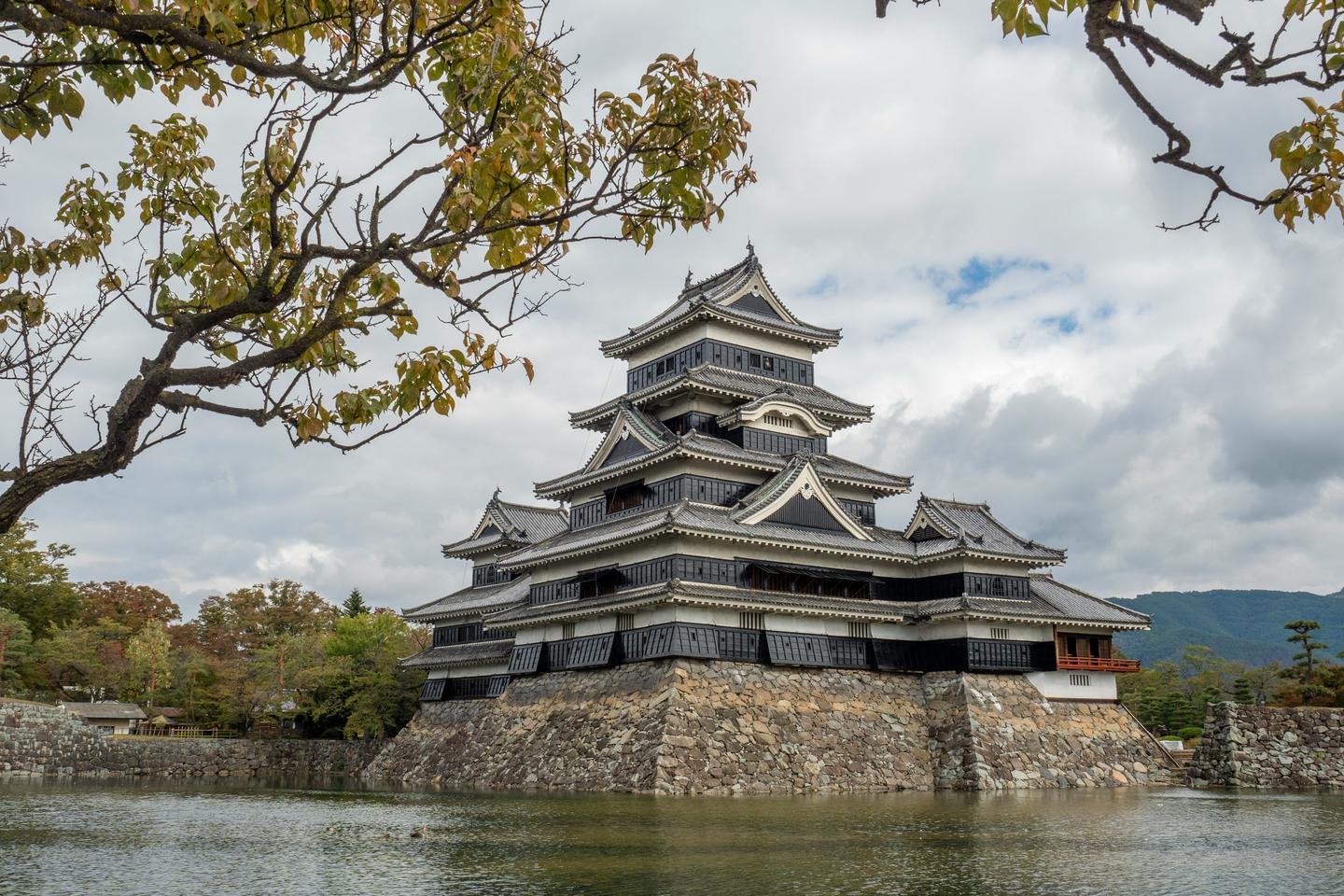
MATSUMOTO: THE CASTLE, CRAFTS AND MUSIC
Matsumoto is worth a night of its own, before or after the valley.
Matsumoto Castle
The castle is a National Treasure, and the official site calls it the oldest surviving castle of five structures and six floors. Matsumoto City's view is that the main keep, the small Inui keep and the Watari tower were built in 1593–1594, and that the Tatsumi tower and the Tsukimi tower, a turret for viewing the moon, were added about forty years later, at the start of the Edo period.
- Hours. 8:30 to 17:00, with last entry at 16:30. It closes only from December 29 to 31.
- Tickets. An adult electronic ticket with a timed entry costs ¥1,200; a paper ticket for the same day costs ¥1,300 and has no timed entry. Electronic tickets cannot be cancelled or changed.
- Crowds. The castle says Golden Week and the summer Obon holiday are very crowded, and it shows the current wait to the keep entrance on its site.
Crafts
Crafts Fair Matsumoto is held at Agatanomori Park at the end of May; 2026 was the 42nd fair, on May 30 and 31. Around it, Crafts May, a programme run by a local committee, gives the month to crafts across the town, and the committee announced events for autumn and winter 2026 as well. A day in the town can be built around a few workshops and galleries chosen in advance.
Music
Conductor Seiji Ozawa founded the Seiji Ozawa Matsumoto Festival in 1992, and the Saito Kinen Orchestra is at its centre. The 2026 festival ran from August 16 to September 2, and the organisers have announced August 15 to September 2 for 2027. The concerts are at the Kissei Bunka Hall, the Matsumoto Performing Arts Centre, the Harmony Hall and Agata no Mori Bunka Kaikan.
WHERE TO STAY
In the valley
- Kamikochi Imperial Hotel. Opened in 1933, with 74 lodge-style rooms finished in wood, and open from late April to early November. Some rooms have balconies facing the Hotaka range, and there are suites with sitting rooms. Check-in is from 14:00 and check-out at 11:00. On Ikyu on November 2, 2026, with no date selected, room-only rates started at ¥50,700 for two in a 24.8 m² Twin A.
- Gosenjaku Hotel Kamikochi. Beside Kappa Bridge, founded in 1918 as a small inn, open from late April to early November. Rooms on the upper floors have balconies, and dinner is French, in the GRAND dining room.
- Gosenjaku Lodge. A short walk across Kappa Bridge, with check-in from 15:00 and a large bath open in the early morning.
One night in the valley gives you the evening and the morning; two give you a full day for the walk to Myojin and back without watching the clock.
Hot springs near Matsumoto
- Utsukushigahara Onsen and Asama Onsen. About 15 minutes by car from the centre of Matsumoto. Visit Matsumoto writes that Utsukushigahara Onsen goes back to the Nara period and appears in the Nihon Shoki as Tsukuma no On'yu.
- Shirahone Onsen. In the mountains of Matsumoto City, with water that is clear at the source and turns milky white over time. The Nagano Tourism Organization gives a history of over 400 years and about 55 minutes by bus from Shin-Shimashima. From September 2026 Alpico also ran connecting buses from Kamikochi toward Shirahone and Norikura.
- Okuhida Onsengo. On the Gifu side, in Takayama City, five hot spring villages including Hirayu, Shinhotaka and Tochio. Hirayu is the Gifu-side gateway to Kamikochi, and Takayama itself, covered in our Shirakawa-go guide, is beyond.
How to choose between ryokan, and what the night includes, is in How to choose a ryokan in Japan.
HOW WE ARRANGE KAMIKOCHI AND MATSUMOTO
We plan the days around the season, the bus times and the hotel dates above, and arrange the parts in your name.
- The train. We tell you which Azusa fits the plan and which seats to choose. You buy the tickets yourself, at the station or on JR East's site.
- The car. A car with a driver from your Tokyo hotel, or from Matsumoto Station to the taxi rank at Sawando, with your luggage taken care of. Inside the valley, the taxi or the shuttle covers the last stretch.
- The nights. A night in Matsumoto, one or two in the valley, and a ryokan at Utsukushigahara, Shirahone or Okuhida. We arrange each in your name and you pay it directly.
- A guide. A guide who knows the valley for the walk to Myojin, or a morning in Matsumoto with the castle and a few workshops.
If you are also walking the old post road through the Kiso Valley, south of Matsumoto, see Magome to Tsumago.
SOURCES AND HOW WE CHECKED
Read on November 2, 2026. Prices include tax and are for one adult unless stated.
- Kamikochi Official Website, home and announcements, By car and By public transportation: 2026 season dates, car ban, parking fees, transfer times, routes from Matsumoto and Tokyo, reservation rule, last departures
- Kamikochi Official Website, popular walking routes and diary, A hint of autumn in the air: walking times and distances, autumn colour timing
- Kamikochi Official Website, 2026 closing plan for each facility: last nights at the hotels, inner shrine closing, last day
- Alpico Group, Sawando to Kamikochi shuttle and Alpico Kotsu, Sawando–Kamikochi route bus (Japanese): fares, ticket rules, stops, first and last buses, connecting buses
- Alpico Taxi, fares around Kamikochi (Japanese): fixed taxi fares from Matsumoto, Sawando and Hirayu
- JR East, timetable for limited express Azusa 1 (Japanese): Shinjuku 7:00, Matsumoto 9:38, stops, seats
- Japan Meteorological Agency, Nagano, the 1915 eruption of Mount Yake that formed Taisho Pond (Japanese): date, mudflow, size of the pond in 1915
- Nippon Tabi Magazine, Myojin Pond (Japanese): Hotaka Jinja Okumiya, the two ponds, entrance fee, October 8 festival
- Nippon.com, Kamikochi: Natural Beauty Among the Japan Alps: altitude, Kappabashi, wildlife, car restrictions
- Kamikochi Imperial Hotel, facility overview and greetings from the general manager: rooms, operating period, 1933
- Ikyu, Kamikochi Imperial Hotel (Japanese): room types and room-only rates shown with no date selected, check-in and check-out
- Gosenjaku Hotel Kamikochi (Japanese) and Gosenjaku Lodge, questions: location by Kappa Bridge, 1918, rooms, dining, 1975 car ban, entry hours, bears, bath hours
- Matsumoto Castle, visiting information (Japanese) and the keep and its structure: hours, tickets, closing days, construction dates
- Seiji Ozawa Matsumoto Festival, 2026 programme announcement and Visit Matsumoto, festival listing: 2026 and 2027 dates, venues, 1992
- Matsumoto Craft Promotion Association, Crafts Fair Matsumoto (Japanese) and Crafts May (Japanese): 42nd fair, venue, dates, autumn and winter events
- Visit Matsumoto, guide to Matsumoto's hot springs, Nagano Tourism Organization, Shirahone Onsen and Okuhida Onsengo Tourism Association: locations, history, water, bus time
QUESTIONS GUESTS ASK
When is Kamikochi open?
Kamikochi is open from mid-April to mid-November. In 2026 the season ran from April 17 to November 15, and the shuttle buses do not run from November 16 to April 16. The 2027 dates had not been published when we checked on November 2, 2026.
Can I drive to Kamikochi?
No. Private cars and motorcycles are banned all year. Leave the car at Sawando or Hirayu and take the shuttle bus or a taxi, which takes 20 to 30 minutes. From Sawando the shuttle costs ¥1,600 one way or ¥3,000 return.
How long does it take from Tokyo to Kamikochi?
The limited express Azusa takes about two and a half hours from Shinjuku to Matsumoto; Azusa 1 leaves at 7:00 and arrives at 9:38. From Matsumoto it is about 30 minutes by train to Shin-Shimashima and about 60 minutes by bus, or a taxi at a fixed ¥19,900.
When are the autumn leaves at their best in Kamikochi?
The official Kamikochi diary puts peak maple colour in the centre of the valley around October 20, with the larches at their best in late October and the first days of November. The timing moves by about a week from year to year.
Can I stay overnight inside Kamikochi?
Yes. The Kamikochi Imperial Hotel and the Gosenjaku Hotel by Kappa Bridge are open from late April to early November; in 2026 the last night at both was November 14. Staying gives you the evening after the last bus and the early morning before the first.
LET US ARRANGE YOUR DAYS IN KAMIKOCHI AND MATSUMOTO
Send us your dates and where you will be before and after. We will come back with a plan for Matsumoto and the valley built around the season and the bus times, with two or three hotels or ryokan and their published rates, and we arrange the car, the guide and the nights you choose.
Begin planning →We reply within 24 hours, in writing
Some of the restaurants, bars and private places we arrange take guests only by introduction or membership. We do not publish their names.