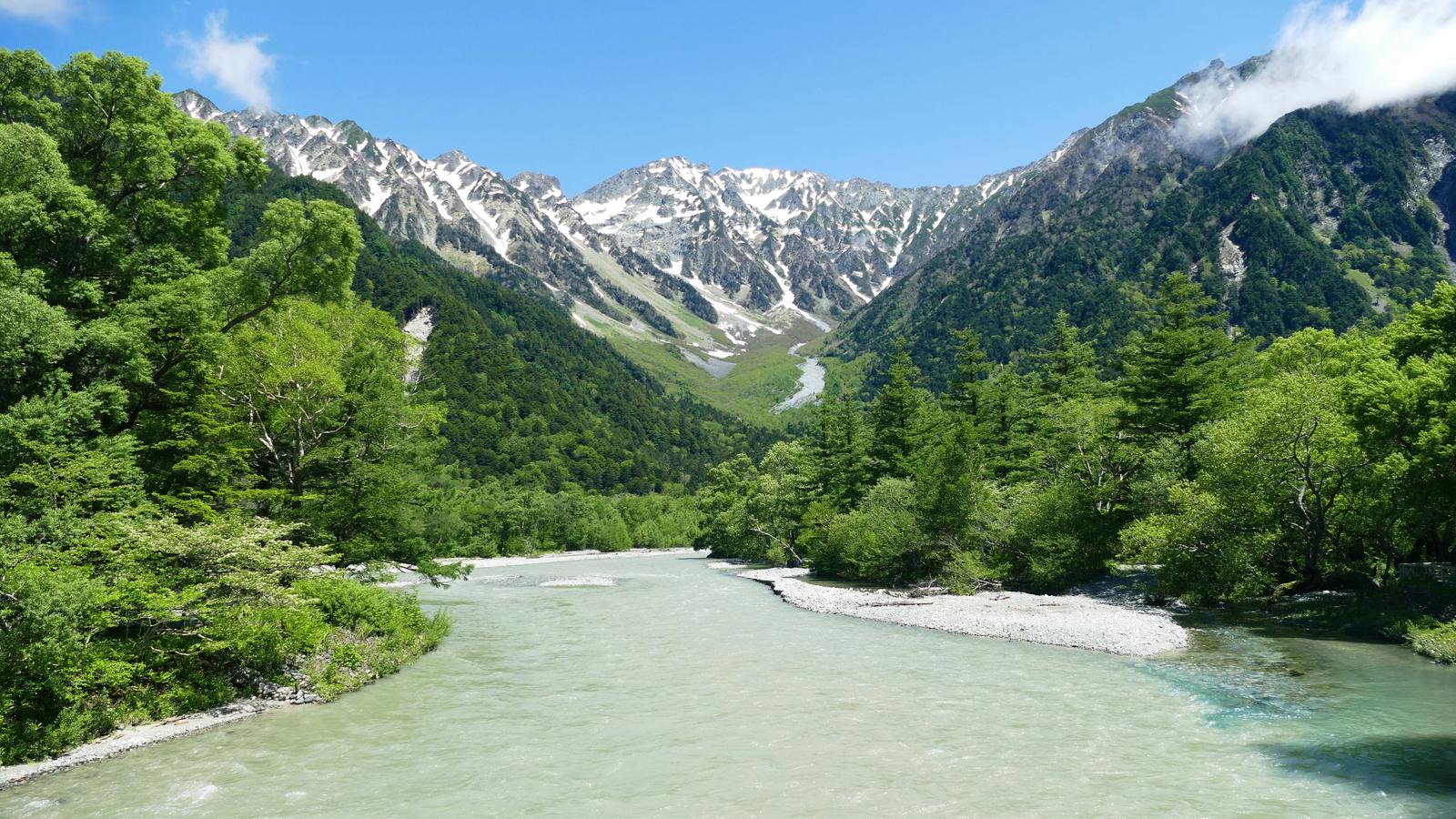
For travellers from Sweden, Denmark, Norway and Finland, the long summer holiday is the natural time for a distant journey. JNTO's market handbook notes that a month off in summer is not unusual, that long-haul trips last two weeks or more and that summer trips run to about three. It also notes that the humid heat of lowland Japan around August is hard for many Nordic visitors to bear. Inside Japan, the answer is altitude. This article sets out one week in the mountains of Nagano: two nights inside Kamikochi with the walk upstream to Tokusawa, then the Kiso Valley, with Narai, the lacquer village of Kiso-Hirasawa, the hinoki forest of Akasawa and the old road to Tsumago.
We read the official pages of the Kamikochi site, the hotels, the Japan Meteorological Agency, Nagano Prefecture, the Forestry Agency, JR Central and the airlines on November 5, 2026, and contacted none of them; the sources are listed at the end. Buses, taxis and the season in Kamikochi are set out in Kamikochi and Matsumoto: The Northern Alps Valley, the Castle Town and the Onsen →, and the trail, luggage service and buses between the two post towns in Magome to Tsumago: Walking the Nakasendo Trail in 2026 →. This article adds what lies between and around them.
Key points
- Tokyo averages 26.9°C in August, with nights of 23.5°C. Kiso-Fukushima in the valley averages 23.2°C with nights of 18.8°C, and the Kamikochi Visitor Center recorded August 2022 averages of 21.7°C by day and 15.4°C at night.
- Finnair plans up to 32 weekly flights to Japan in summer 2027, with an extra Narita frequency from May 12 to August 14, 2027. ANA flies non-stop between Haneda and Stockholm.
- From Kappa Bridge, Tokusawa is a little over two hours on foot up the Azusa River, by way of Myojin. Yokoo is another 70 minutes beyond.
- In Narai, 12 of the 16 rooms at BYAKU Narai have an open-air or semi-open-air bath of their own, which settles the question of tattoos and shared baths.
- Six nights make the week: two in Kamikochi, three in Narai and one in Tsumago, then on to Kyoto by way of Nagoya.
LET US ARRANGE YOUR MOUNTAIN WEEK →
WHY THE MOUNTAINS IN JULY AND AUGUST
The numbers explain the route. Over 1991 to 2020, the Japan Meteorological Agency's normals give Tokyo an August mean of 26.9°C, a mean daily high of 31.3°C and humidity of 74%, with nights averaging 23.5°C. Matsumoto, the gateway to the Northern Alps, is no cooler by day, with an August high of 31.4°C, though its nights fall to 20.5°C. The relief begins higher up. Kiso-Fukushima, at 750 metres in the Kiso Valley, averages 23.2°C in August with nights of 18.8°C. Kamikochi lies at about 1,500 metres; its visitor centre recorded average August highs of 21.7°C and lows of 15.4°C in 2022, and the official site suggests a long-sleeved shirt and a windbreaker even in summer.
So in July and August we keep Matsumoto to a passing afternoon and give the nights to the valleys. The flights suit the season. Finnair plans up to three daily flights between Helsinki and Tokyo at the peak of summer 2027, with a second Narita frequency from May 12 to August 14, 2027, and up to 32 weekly flights to Japan in all; ANA has flown non-stop between Haneda and Stockholm Arlanda since January 31, 2025. A mountain week sits naturally between the first days in Tokyo and the last in Kyoto. JNTO's handbook lists Danish tours of 14 to 20 days that already pass through Matsumoto, Kamikochi, Kiso, Tsumago and Magome.
TWO NIGHTS INSIDE KAMIKOCHI
Kamikochi lies within Chubu-Sangaku National Park, designated in 1934, and in 1952 it was made a Special Place of Scenic Beauty and a Special Natural Monument, a rank the official site likens to a national treasure. The English missionary Walter Weston introduced the Hotaka range to the world in a book of 1896. JNTO observes that Nordic travellers who know the valley rate its well-kept paths highly, yet few have heard of it.
Day visitors leave with the last buses, and a night inside the valley gives the hours before and after them. The Imperial Hotel, Kamikochi has 74 rooms and opens from late April to early November. For a stay of two nights we look to the rooms with a balcony: the Twin with Verandah of 37 m² on the Hotaka side, the Deluxe Twin of 42 m² facing Mount Yake or the Hotaka range, the Suite of 72 m² and the Two-Bedroom Suite of 105 m², with a living room between its bedrooms. Check-in is from 14:00, and the hotel asks guests to arrive before 18:00, because the gate at the Kama Tunnel closes at night. There is a French dining room, Azusa-an for Japanese cuisine, the Alpenrose for lighter meals, a lounge and a bar. Two nights leave one whole day for walking, and that day is the reason to come.
THE WALK UPSTREAM TO TOKUSAWA
Most visitors turn back at Myojin. The valley goes on. On the official walking times, Kappa Bridge to Myojin takes about 50 minutes on the left bank or 60 on the right, where the path passes the Dakesawa marsh and its view of the Maehotaka peaks. From Myojin to Tokusawa is another 60 minutes and 3 km beside the Azusa River. The official site puts Kappa Bridge to Tokusawa at a little over two hours one way, before any stops.
Tokusawa was a mountain pasture until 1934. When the national park was designated, the pasture closed and the herder's hut became a lodge. That lodge, Tokusawaen, is the Tokusawa hut of Yasushi Inoue's novel Hyoheki, and it looks up at the east face of Maehotaka. In season its dining room and café serve from 7:30 until a last order at 15:00, which makes it the natural place for lunch before the walk back. Walkers who want more can go on to Yokoo, 70 minutes and 3.5 km further. Leave early, and a day to Tokusawa and back is long, unhurried, and shows the valley as the early mountaineers knew it.
NARAI AND THE LACQUER VILLAGE
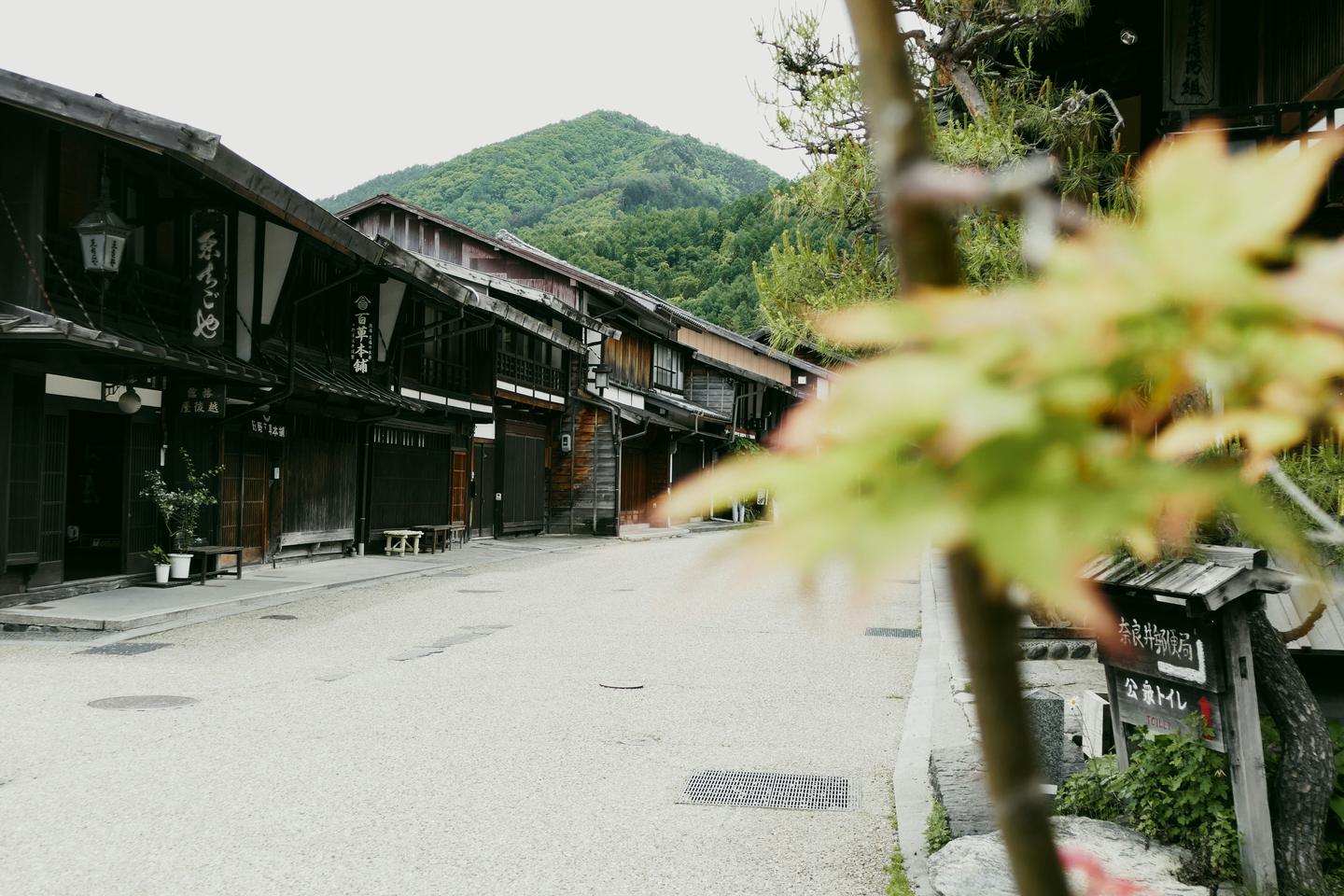
The Kiso Valley runs south from Matsumoto, and the old Nakasendo road between Edo and Kyoto passed through eleven post towns along it. Narai is the highest of them, according to the Shiojiri City Tourism Association, and its street runs for almost exactly a kilometre, the longest preserved post-town street in Japan by the count of the regional guide Japan Alps. It was designated a national Important Preservation District for Groups of Traditional Buildings on May 31, 1978.
In the evening, once the day visitors have gone, Narai is very quiet, and that is when we like to be there. BYAKU Narai opened on August 4, 2021, in the buildings of Suginomori, a sake brewery founded in 1793, together with a former lacquerware shop and old houses on the street. It has 16 rooms in four buildings. Its restaurant, kura, in the brewery's old storehouse, serves new local cuisine from seasonal and regional ingredients, with dinner starting between 18:00 and 19:30 and lasting two to three hours. The brewery itself, dormant from 2012, began making sake again in 2021.
Just north of Narai is Kiso-Hirasawa, the home of Kiso lacquerware, which the national government designated a traditional craft on February 17, 1975, with its main area in Shiojiri. For travellers who live among Nordic wood and design, the workshops are the heart of the valley: local wood, layer upon layer of urushi lacquer, objects made to be used every day. We arrange a visit with a craftsman at a time that suits the workshop.
THE TORII PASS AND THE HINOKI FOREST
For a second walking day, the old road leaves Narai over the Torii Pass, a mountain road of about 6 km to Yabuhara. The Shiojiri City Tourism Association describes it as one of the hard sections of the Nakasendo in the Edo period and a popular trekking route today, on the watershed between the Shinano and Kiso rivers, with a grove of horse chestnut trees. Japan Alps gives the pass as 1,197 metres and the walk as two to three hours at a moderate pace. A car can wait at Yabuhara.
Further down the valley, in Agematsu, the Akasawa Natural Recreation Forest holds Kiso hinoki more than 300 years old. The Forestry Agency calls it the birthplace of forest bathing; it was designated Japan's first natural recreation forest in 1969. A small forest railway runs into the woods, and the forest is open from late April to early November. Kiso-Fukushima, between the two, kept one of the four checkpoints on the Nakasendo in the Edo period, now a museum, and Nagano Prefecture's tourism site says Kozenji temple there has the largest dry rock garden in Asia.
THE OLD ROAD TO TSUMAGO
The week ends on the best-known stretch of the road, the walk from Magome over the pass to Tsumago. In our plan it comes on the last day in the valley: a car from Narai down the valley to Magome, the walk with a day bag, and a night in Tsumago once the visitors have left. The next morning the Limited Express Shinano runs from Nagiso to Nagoya, and the Shinkansen continues to Kyoto.
The inns of Tsumago are simple, with shared baths and set meal times. For guests who prefer more comfort, the walk ends in Tsumago in the early afternoon and a car continues to Nagoya, or to the train for Kyoto.
BATHS, TATTOOS AND THE TABLE
JNTO notes that many Nordic travellers have tattoos and need to know in advance whether a hotel's large bath is open to them. At the top level the room answers the question. The rooms at the Imperial Hotel, Kamikochi have their own bathrooms. At BYAKU Narai, 12 of the 16 rooms have an open-air or semi-open-air bath of their own, and the large bath, SAN-SEN, is filled with natural spring water. Where a shared bath is the only bath, as at many post-town inns, we ask the house in advance and give you the answer before you choose. How the rules work across Japan is in Tattoo Friendly Onsen in Japan: Where You Can Bathe →.
Food works the same way. JNTO notes that vegetarians and vegans are common in the Nordic countries; in Finland, about 10% of people, by a survey it cites. Mountain kitchens cook from the valley, and a menu without meat or fish needs notice. We ask each house before confirming the stay and give you its answer in writing. Vegetarian kaiseki elsewhere in Japan is in Vegetarian Kaiseki and Vegan Fine Dining in Japan →.
HOW THE WEEK FITS A LONGER JOURNEY
This is the shape we usually draw:
- Day 1. Shinjuku to Matsumoto by the limited express Azusa, a car into Kamikochi, two nights at the Imperial Hotel.
- Day 2. The walk to Tokusawa and back, with lunch at Tokusawaen.
- Day 3. An early walk to Taisho Pond, then a car to Narai and three nights at BYAKU Narai.
- Day 4. Kiso-Hirasawa and a lacquer workshop, dinner at kura.
- Day 5. The Torii Pass, or the Akasawa forest and Kiso-Fukushima.
- Day 6. A car to Magome, the walk to Tsumago, a night in Tsumago.
- Day 7. The train from Nagiso to Nagoya and on to Kyoto.
Over three weeks, this leaves a week for Tokyo before and a week for Kyoto and the west after, as set out in 14 Days vs 21 Days in Japan: Is the Extra Week Worth It? →. Large suitcases go ahead to Kyoto by courier, and you travel the mountains with a small bag; see Luggage Forwarding in Japan: Sending Bags Between Hotels and the Airport →.
Within Signature, our planning for journeys of 7 to 21 days, we arrange the hotel in the valley, the inns, the cars between the valleys, guides for the walks and the workshop visits, and settle each of them in the simplest way available, usually at the property or on the day.
SOURCES AND HOW WE CHECKED
We read the pages below on November 5, 2026. Temperatures are the published averages; walking times exclude stops. We did not contact any hotel, inn, railway, airline or other body.
- Japan Meteorological Agency, normals for Tokyo (Japanese): July and August mean, high, low and humidity, 1991 to 2020
- Japan Meteorological Agency, normals for Kiso-Fukushima (Japanese): August mean 23.2°C, low 18.8°C; Matsumoto from the same tables
- Kamikochi Official Website, seasons and clothing (Japanese): altitude of 1,500 m, 2022 summer averages, what to wear
- Kamikochi Official Website, walking (Japanese): times and distances to Myojin, Tokusawa and Yokoo
- Kamikochi Official Website, Tokusawaen (Japanese): 1934, the novel Hyoheki, dining hours
- Kamikochi Official Website, about Kamikochi (Japanese): national park in 1934, designations in 1952, Walter Weston
- Imperial Hotel, Kamikochi, guest rooms and overview: 74 rooms, season, room sizes and views, restaurants
- Imperial Hotel, Kamikochi, accommodation FAQ: check-in, arrival before 18:00, in-room bath amenities
- BYAKU Narai, official site: 16 rooms, baths by room, kura, the 1793 brewery
- Impress Travel Watch, May 27, 2021 (Japanese): opening on August 4, 2021
- Shiojiri City Tourism Association, Torii Pass, October 7, 2024 (Japanese): about 6 km, watershed, highest of the Kiso post towns
- Japan Cultural Properties Information Site, Narai-juku: designation on May 31, 1978
- Japan Alps, Narai: a street of almost exactly 1 km, the pass at 1,197 m, two to three hours
- Nagano Prefecture, traditional crafts (Japanese): Kiso lacquerware designated February 17, 1975
- Forestry Agency, Akasawa Natural Recreation Forest (Japanese): hinoki over 300 years, 1969, forest railway, season
- Go Nagano, Kiso Fukushima: the checkpoint and Kozenji
- JR Central, the Nakasendo and Matsumoto itinerary: the Limited Express Shinano through the Kiso Valley
- Travel News Nordic, September 24, 2026: Finnair's summer 2027 flights to Japan
- newstodate.aero, July 2024: ANA Haneda to Stockholm from January 31, 2025
- JNTO, inbound handbook 2024, Nordic countries (Japanese): holidays, heat, tattoos, vegetarians, Kamikochi, Danish tours
QUESTIONS TRAVELLERS ASK
Is Kamikochi too hot to walk in August?
No. The Kamikochi Visitor Center recorded average August highs of 21.7°C and lows of 15.4°C in 2022, against a normal August high of 31.3°C in Tokyo. Mornings can be cool, and the official site suggests a long-sleeved layer and a windbreaker.
How long is the walk from Kappa Bridge to Tokusawa?
A little over two hours one way on the official times, by way of Myojin, before any stops. Yokoo is about 70 minutes further.
Where can I bathe privately in the Kiso Valley if I have tattoos?
In a room with its own bath. At BYAKU Narai, 12 of the 16 rooms have an open-air or semi-open-air bath. Where an inn has only a shared bath, we ask the house in advance.
How many nights does a mountain week need?
Six works well: two inside Kamikochi, three in Narai and one in Tsumago, then the train to Kyoto by way of Nagoya.
Are there direct flights from the Nordic countries to Tokyo in summer 2027?
Yes. Finnair plans up to three daily flights between Helsinki and Tokyo at the peak of summer 2027, and ANA flies non-stop between Haneda and Stockholm.
LET US ARRANGE YOUR MOUNTAIN WEEK
Send us your summer dates and how far you like to walk. We will draw the week with the nights, the walks and the cars side by side, with the reasons, and fit it into the rest of your journey.
Begin planning →We reply within 24 hours, in writing
Some of the restaurants and bars we arrange seat guests only by introduction or membership. We ask on your behalf; the table and the evening are the house's decision. We do not publish their names.