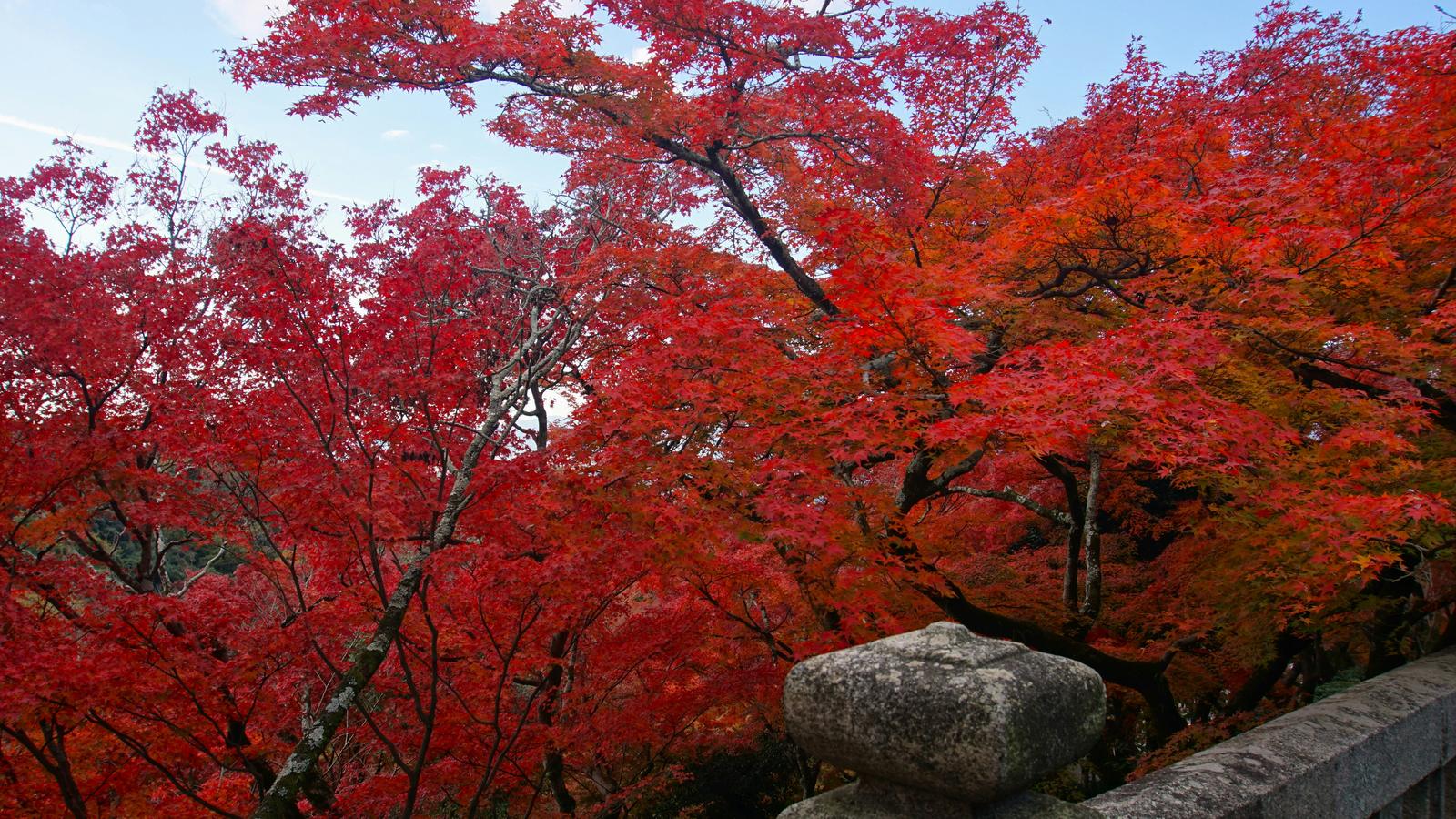
Singapore's long school holiday begins on Saturday, November 20, 2027, the day after the Ministry of Education's fourth term ends. In Kyoto that is the start of the season's best fortnight. The Japan Meteorological Agency's normals put the turning of Kyoto's maples on December 5 and its ginkgo on November 24, and a family that lands in the first days of the holiday arrives as the colour deepens toward its fullest.
This article is for travellers from Singapore who already know Japan and want the autumn at its finest: the right city on the right days, the gardens that open early, the evenings when temples light their maples, a room close enough to walk out at dawn, and Tokyo's ginkgo avenues as a second act. We read the official pages of the Ministry of Education, the Japan National Tourism Organization, the Meteorological Agency, six Kyoto temples, three hotels and two Tokyo parks on November 5, 2026, and contacted none of them. Every programme below is published by the temple or park itself; dates are for autumn 2026 and are announced again each year. The general choice between spring and autumn is in Cherry Blossom vs Autumn Leaves in Japan.
Key points
- Singapore's 2027 year-end school holiday runs from November 20 to December 31 for primary and secondary schools, as published by the Ministry of Education on July 14, 2026.
- The Meteorological Agency's normals (1991 to 2020) give the maple turning date as November 21 in Nara, November 28 in Tokyo, December 1 in Osaka and December 5 in Kyoto. Ginkgo turns on November 18 in Nara, November 23 in Tokyo and November 24 in Kyoto.
- The order that follows the colour: Nara in the first days of the holiday, Kyoto in the last week of November and the first days of December, Tokyo's ginkgo on either side.
- Kiyomizu-dera opens its gate at 6:00. In autumn 2026 Tenryu-ji opened its garden at 7:30 from November 14 to 30, and Tofuku-ji opened Tsutenkyo at 8:30 from November 14 to December 6.
- Night openings in 2026: Kodai-ji from October 23 to December 13, Eikando from November 20 to December 6, Kiyomizu-dera from November 21 to 30.
LET US SHAPE YOUR AUTUMN WEEK IN JAPAN →
WHEN THE SINGAPORE HOLIDAY MEETS THE MAPLES
On July 14, 2026 the Ministry of Education published the 2027 calendar. Term 4 for primary and secondary schools and MOE kindergartens runs from September 13 to Friday, November 19, and the year-end holiday follows from Saturday, November 20 to Friday, December 31. Junior college students in their first year start a week later, on November 27.
JNTO's market handbook for Singapore describes the pattern behind those dates. The school winter break usually runs from mid-November to late December, and fares on flights to Japan rise in those weeks. When visitors to the NATAS Holidays fair in August 2024 were asked what they wanted to experience in Japan, autumn leaves came second, after cherry blossom and ahead of hot springs, Japanese food and winter scenery. JNTO adds that questions about where to find autumn colour forecasts reached its Singapore office in both 2023 and 2024. November and December are also the wettest months at home, with close to 20 days of rain a month.
Most Singapore guests have been to Japan before, and JNTO notes that the more often they return, the more they look beyond the cities they already know. For a repeat visitor, late November is a chance to see Kyoto in its most celebrated weeks at the hours when it is quiet. A family planning the whole school break can read One School-Holiday Week in Japan, 2027 alongside this piece.
WHERE THE COLOUR STANDS IN LATE NOVEMBER
The Meteorological Agency watches a sample tree at each observatory. Its maple date is the first day on which most of the leaves of that tree, viewed as a whole, have turned red; the ginkgo date is the same for yellow. The maple observed is chiefly the iroha-kaede, the Japanese maple planted in temple gardens. The normals, averaged over 1991 to 2020, set out the late autumn in order: ginkgo in Nara on November 18, Tokyo on November 23 and Kyoto on November 24; maples in Nara on November 21, Tokyo on November 28, Osaka on December 1 and Kyoto on December 5.
The dates move from year to year. In 2025 Kyoto's maple turned on December 10, five days after its normal, while Nara's turned on November 14, seven days early, and Tokyo's on November 23. In the agency's records, Kyoto's maple has turned as early as November 10, in 1976, and as late as December 20, in 2024. A garden in the hills, or a tree in shade, keeps its own time. For that reason we hold the order of the week loosely until early November, when the season shows its hand.
Read together, the normals give a natural shape to the first ten days of the holiday. Nara and its ginkgo come first, Kyoto deepens through the last week of November and holds into December, and Tokyo's ginkgo, a little ahead of Kyoto's, can open or close the journey.
KYOTO BEFORE THE GATES FILL
The quietest hour in Kyoto in late November is the first one. Kiyomizu-dera opens its gate at 6:00 throughout the year, and in the half-light the stage looks out over the maples of the valley below before the slopes of Higashiyama fill. Tenryu-ji in Arashiyama usually opens its garden at 8:30; in 2026 it published a special early-morning visit to the Sogenchi garden from 7:30 between November 14 and 30, for the garden only. At Tofuku-ji, the wooden Tsutenkyo bridge over a ravine of maples opens at 8:30 from November 14 to December 6, half an hour before the abbot's garden.
Each temple asks for patience in return. Tofuku-ji writes that photography on the Tsutenkyo and Gaun bridges may be declined during the autumn weeks and that tripods are not allowed, and re-entry is not permitted. We plan these mornings with a car waiting at the gate, breakfast afterwards, and the rest of the morning in a quieter garden nearby. A day at the pace of the temples also suits a sitting of zazen, set out in Zen Meditation in Kyoto.
KYOTO AFTER DARK
In the evening several temples light their maples. In 2026 Kodai-ji, below Higashiyama, ran its autumn night opening from October 23 to December 13, with the lights on from 17:00 and last entry at 21:30. Eikando, in the east of the city, lit its garden from November 20 to December 6, with entry from 17:30 to 20:30 for ¥1,000. Kiyomizu-dera held its night viewing from November 21 to 30, from 17:30 until 21:00, with no reservation needed.
None of these sells a private hour, and we do not promise one. What makes the difference is the order: an early dinner, then the gate at the moment it opens, or the last half hour when the paths begin to empty. The fuller list of evening openings, with fees, is in Romantic Things to Do in Kyoto for Couples.
QUIET GARDENS AND A ROOM CLOSE BY
At the peak, the value of a hotel lies in how close it puts you to the first hour. In Arashiyama, Hogon-in, a sub-temple of Tenryu-ji, opened its Shishiku garden, which borrows the hills of Arashiyama as its backdrop, for a special autumn season from October 3 to December 6, 2026. Upstream, Hoshinoya Kyoto has 25 rooms on the river in the Rankyo gorge and is reached by its own boat from a landing in Arashiyama, reserved in advance, with the first boat at 14:30 and the last at 17:45; when the river is high, a car takes guests instead. From there, Tenryu-ji's early garden and Hogon-in are close at hand.
In the north of the city, Aman Kyoto sits in a forest garden in Takagamine, within walking distance of Kinkaku-ji, in the district where Honami Koetsu, founder of the Rinpa school, settled some 400 years ago and an artists' village grew around him. Guests from Singapore often ask for a bath of their own; rooms and ryokan with private hot spring baths are compared in Kyoto Ryokan with Private Onsen, and the wider choice of area in Where to Stay in Kyoto.
NARA A FEW DAYS AHEAD
Nara turns earlier than Kyoto. Its ginkgo normal is November 18 and its maple normal November 21, so the first days of the Singapore holiday find Nara Park close to its best while Kyoto is still coming up. Nara Hotel, founded in 1909, stands beside the park, and a night there puts the deer and the temple paths at your door before the day visitors arrive from Kyoto and Osaka.
Nara rewards the same early start as Kyoto. The hours of Todai-ji and Kasuga Taisha, the rules for the deer and the order of a day are set out in A Day in Nara from Kyoto; in late November we would simply add one night, so that the morning in the park comes first.
TOKYO'S GINKGO AS A SECOND ACT
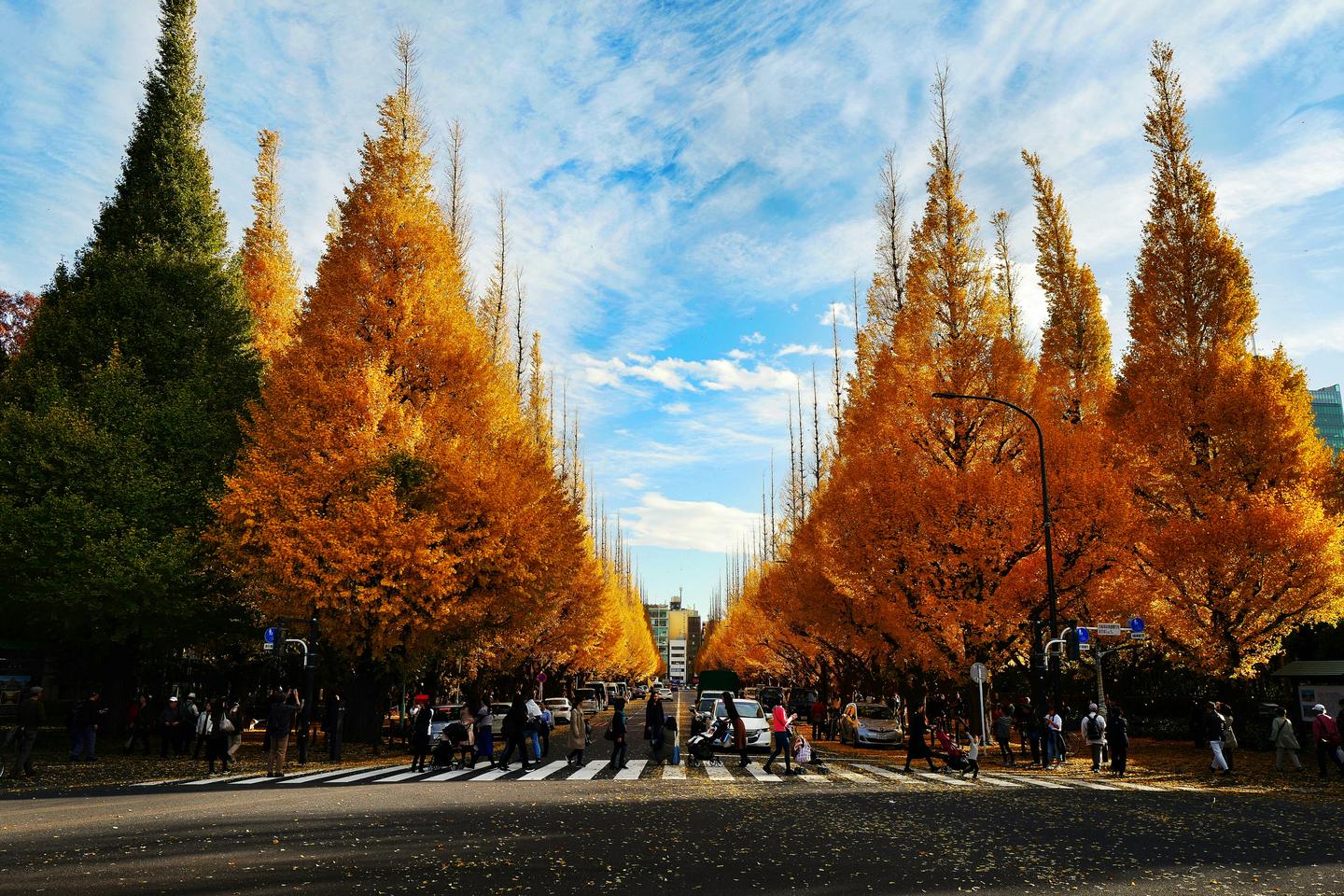
Tokyo's ginkgo normal is November 23, close to Kyoto's, and its maples follow on November 28. The best-known avenue is in the Meiji Jingu Gaien, where four rows of ginkgo run from the Aoyama-dori entrance to the circular road around the central plaza. On a weekday morning in the yellow week, before the city is awake, it is one of the finest walks in Tokyo.
For more space, Showa Kinen Park in Tachikawa held its ginkgo and autumn leaves festival with evening walks from October 29 to November 29, 2026, and its Canal is lined with ginkgo. Tokyo's stroll gardens, including the night openings of Rikugien and Koishikawa Korakuen, are covered in Japanese Gardens in Tokyo. About seven in ten flights from Singapore to Japan land at Narita or Haneda, JNTO notes, so Tokyo is often the natural first or last stop.
SHAPING THE WEEK IN 2027
For a family flying out on November 20, 2027, the shape we would suggest begins with Tokyo's ginkgo or one night in Nara, then four or five nights in Kyoto from around November 24, split between Arashiyama and a quieter base in the east or north of the city, with the early gardens on the mornings when they open and one evening light-up. If the season runs late, as it did in 2025, Kyoto moves to the end of the journey; if it runs early, Nara and Tokyo carry the colour.
Within Signature, our planning for journeys of 7 to 21 days, we arrange the hotels, the order of the gardens, the cars and the guides, and settle each in the simplest way available, usually on your hotel bill or on the day. Temples publish their autumn dates afresh each year, and we confirm each one when it appears. JNTO notes that many travellers from Singapore would rather write on WhatsApp than call or email, and we are glad to plan that way. For the year's other crowded weeks, see How to Avoid the Crowds in Japan.
SOURCES AND HOW WE CHECKED
We read the pages below on November 5, 2026. Normal dates are the Meteorological Agency's averages for 1991 to 2020. We did not contact any temple, hotel, park or other body.
- Ministry of Education Singapore, school terms and holidays for 2027: Term 4 ends November 19, year-end holiday November 20 to December 31
- JNTO, Visit Japan market handbook 2025, Singapore (Japanese): school winter break, airfares, NATAS survey, autumn forecast questions, rainfall, flights to Tokyo, repeaters, WhatsApp
- Japan Meteorological Agency, maple turning dates by year (Japanese): normals, earliest and latest dates
- Japan Meteorological Agency, ginkgo turning dates by year (Japanese): normals
- Japan Meteorological Agency, maple turning, recent observations (Japanese): 2025 dates and differences from normal
- Japan Meteorological Agency, how the maple is observed (Japanese): definition, iroha-kaede
- Japan Meteorological Agency, how the ginkgo is observed (Japanese): definition
- Kiyomizu-dera, opening hours (Japanese): gate opens at 6:00
- Kiyomizu-dera, autumn night viewing 2026 (Japanese): November 21 to 30, 17:30 to 21:00, no reservation
- Tenryu-ji, visiting (Japanese): garden hours and early-morning visit from 7:30, November 14 to 30, 2026
- Tenryu-ji, special openings and events 2026 (Japanese): Sogenchi garden early-morning visit
- Tofuku-ji, visitor guide (Japanese): Tsutenkyo from 8:30, November 14 to December 6, photography and tripod rules
- Kodai-ji, events (Japanese): autumn night opening October 23 to December 13, 2026, lights from 17:00, last entry 21:30
- Eikando, autumn 2026 (Japanese): night opening November 20 to December 6, entry 17:30 to 20:30, ¥1,000
- Hogon-in, official site (Japanese): sub-temple of Tenryu-ji, Shishiku garden autumn opening October 3 to December 6, 2026
- Hoshinoya Kyoto, official site: 25 rooms, Arashiyama
- Hoshinoya Kyoto, access: private boat by reservation, 14:30 to 17:45, car when the river is high
- Aman Kyoto, official site (Japanese): Takagamine, forest garden, walking distance of Kinkaku-ji, Honami Koetsu
- Nara Hotel, official site (Japanese): founded 1909, beside Nara Park
- Meiji Jingu Gaien, sights (Japanese): four rows of ginkgo from the Aoyama-dori entrance
- Showa Kinen Park, official site (Japanese): ginkgo and autumn leaves festival, October 29 to November 29, 2026
QUESTIONS TRAVELLERS ASK
Is late November the best time for autumn leaves in Kyoto?
It is the start of the best weeks. The Meteorological Agency's normal date for Kyoto's maples is December 5 and for its ginkgo November 24, so the last week of November and the first days of December usually show the most colour.
When does Singapore's school holiday start in 2027?
On Saturday, November 20, 2027, for primary and secondary schools and MOE kindergartens, and it runs to December 31. Junior college first-year students start on November 27.
How can we see Kyoto's temples without the crowds in autumn?
Go at the first hour. Kiyomizu-dera opens at 6:00, and in 2026 Tenryu-ji opened its garden at 7:30 from November 14 to 30. We plan the mornings with a car waiting and keep the busiest hours for quieter gardens.
Should we go to Nara or Tokyo first?
Nara turns first, with maples normally on November 21, so it suits the first days of the holiday. Tokyo's ginkgo normally turns on November 23 and can open or close the journey.
Can STAYGO arrange a private visit to a temple after hours?
We arrange only the programmes that temples publish, such as early garden openings and evening light-ups. We do not promise private access.
ASK US TO SHAPE YOUR AUTUMN WEEK
Tell us your dates, who is travelling and whether you prefer early mornings or evenings. We will set out the order of Nara, Kyoto and Tokyo with the reasons, and keep it ready to move with the season.
Begin planning →We reply within 24 hours, in writing
Some of the restaurants and bars we arrange seat guests only by introduction or membership. We ask on your behalf; the table and the evening are the house's decision. We do not publish their names.