There is a version of Japan that most travelers never reach, not because it is remote, but because the standard itinerary runs out of days before it gets there. Kanazawa is that city. Two and a half hours from Tokyo on the Hokuriku Shinkansen, it is entirely plausible as a three-night extension, and it is the kind of place that makes serious Japan travelers wonder why they waited.
Kanazawa was the seat of the Maeda clan, second only to the Tokugawa shogunate in wealth during the Edo period. That wealth built gardens, Noh theatres, gold leaf workshops, and an artisan culture of extraordinary depth. Unlike Nagasaki or Sendai, it was not bombed during the Second World War. What remains is intact, and still largely alive, not preserved behind glass.
Key points
- Kanazawa is about two and a half hours from Tokyo on the fastest Kagayaki trains of the Hokuriku Shinkansen, which makes it a natural three-night extension.
- Arrive at Higashi Chaya before 9am. Kenroku-en is at its most striking in winter, when the pines carry yukitsuri rope supports from the beginning of November.
- Snow crab is in season from October to March, so November through February is the best overlap of garden and table.
- Kanazawa produces about 99 percent of Japan's gold leaf. A half-day of craft workshops, gold leaf, lacquerware and ceramics, is the part of a visit that cannot be repeated elsewhere in Japan.
- The article's suggested close is a night at Beniya Mukayu in Yamashiro Onsen, about an hour away by car.
WHY KANAZAWA NOW
The Hokuriku Shinkansen was extended to Tsuruga in March 2024, completing the route that connects Tokyo directly to Kanazawa and beyond. The fastest Kagayaki trains make the journey in about two and a half hours. Kanazawa is now, in practical terms, a day trip from Tokyo, and a two-night stay from Kyoto.
What the Shinkansen has not done is overrun the city. The tourist infrastructure that has stretched to breaking point in Kyoto has not replicated itself in Kanazawa. The Higashi Chaya geisha district, the finest preserved in Japan, does not have barriers and photography rules. Kenroku-en, one of Japan's three great gardens, is visited by a fraction of the crowds that descend on Arashiyama. This is the window. It will not stay open indefinitely.
"Kanazawa is what Kyoto was twenty years ago, before the world arrived and turned it into a queue."
HIGASHI CHAYA: THE GEISHA DISTRICT THAT GION USED TO BE
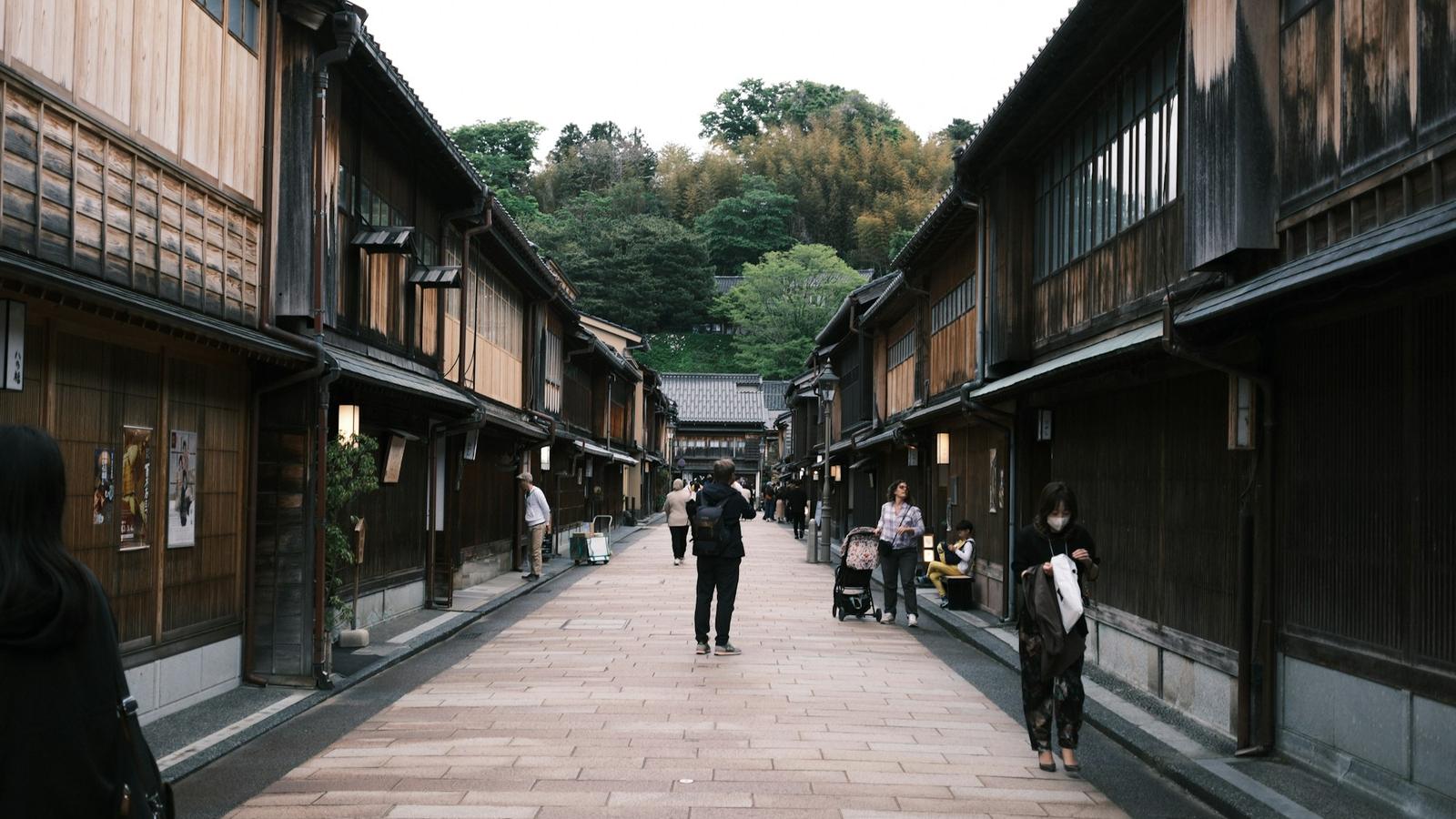
The Higashi Chaya district, literally the "eastern teahouse district", is the most intact geisha quarter in Japan. Where Gion in Kyoto has become a destination photographed by thousands of tourists daily, Higashi Chaya remains a working neighborhood. The okiya (geisha houses) are still active. The ochaya (teahouses where entertainment takes place) still operate for a clientele of local business patrons who have used them for generations.
The wooden machiya buildings line narrow streets that have changed very little since the Edo period. The district is walkable in twenty minutes, but that is not the point. The point is to arrive early, before 9am, and walk without a plan. The smell of wood, the sound of shamisen practice from behind closed shutters, the lacquered signs above the ochaya, these details accumulate into something that Gion, with its crowds and its barriers, can no longer reliably provide.
Kanazawa produces 99% of Japan's gold leaf. The workshops in and around Higashi Chaya offer private experiences in which a craftsman demonstrates the beating process, gold hammered to a thickness of 0.1 microns, and guests apply gold leaf to lacquerware or ceramics. These are not tourist-facing performances. The studios are small, the craftsmen are working practitioners, and the level of access is genuine. STAYGO arranges private sessions for clients who want more than the standard walk-through demonstration.
Kanazawa's craft culture extends well beyond gold leaf. Wajima-nuri lacquerware, produced in the nearby Noto Peninsula, is among the finest in Japan, its production running to more than a hundred individual steps. Kutani ceramics, with their bold red, green, and gold painted patterns, are produced in studios that accept private visitors. A half-day dedicated to Kanazawa's craft workshops (gold leaf, lacquerware, and ceramics in sequence) is the kind of itinerary element that cannot be replicated anywhere else in Japan.
KENROKU-EN AND THE KEY SIGHTS
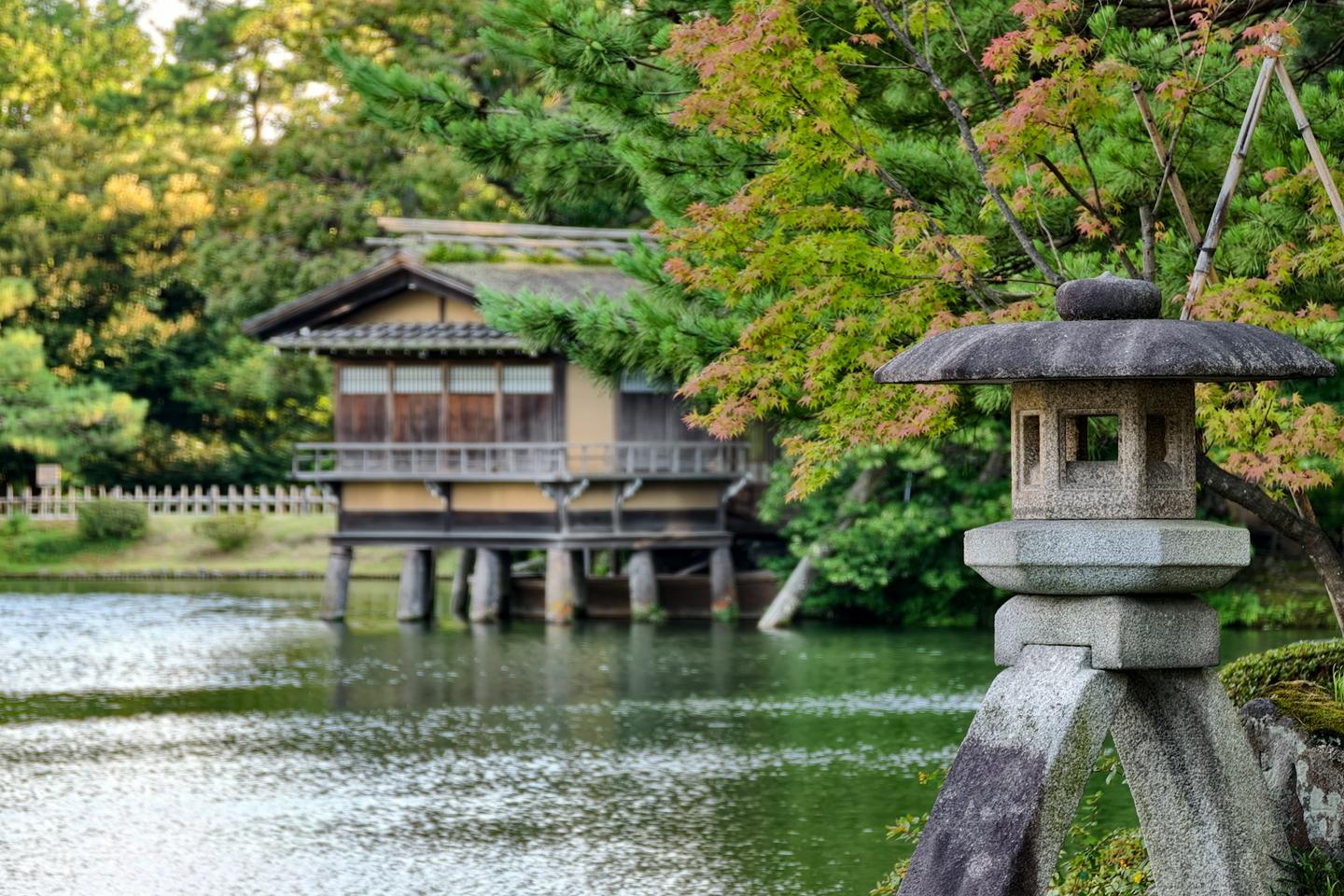
Kenroku-en, "the garden of six attributes", is listed alongside Kairaku-en in Mito and Koraku-en in Okayama as one of Japan's three great landscape gardens. It was developed over two centuries by the Maeda clan and opened to the public in the Meiji era. The name refers to the six qualities that the ideal garden should possess, as defined in a Chinese landscape treatise: spaciousness, seclusion, artifice, antiquity, water, and panoramic views.
The garden is at its most extraordinary in winter. From the beginning of November, the park's pine trees are fitted with yukitsuri, conical rope supports radiating from a central pole that protect the branches from the weight of snow. The image of Kenroku-en in deep winter, with snow covering the garden and the yukitsuri silhouetted against the white, is one of the defining photographs of Japanese winter. It is also largely empty of tourists, which makes it the best argument for timing a Kanazawa visit between December and February.
Adjacent to the garden, Kanazawa Castle has been partially restored. The Ishikawa-mon gate and the Hishi Yagura tower turret are original Edo-period structures. The 21st Century Museum of Contemporary Art (free to enter the outer courtyard, ticketed for the main galleries) is one of Japan's finest contemporary art venues. James Turrell's permanent installation "Blue Planet Sky," a skyspace in which a square opening in the ceiling frames the sky above, is worth planning the visit around.
OMICHO MARKET
Omicho is Kanazawa's covered seafood market, 170 shops under one roof, operating continuously since the Edo period. It is the domestic supply point for the city's restaurants and the place where the serious eating of a Kanazawa visit should begin. The market opens at dawn and is at its most animated by 8am, when the stalls are fully stocked and the sushi restaurants inside have begun service.
The star of the market from October through March is the kano crab, the female snow crab, considerably smaller than the male but prized for its dense, sweet interior roe. Kanazawa is one of the best places in Japan to eat it. The sushi restaurants inside the market (straightforward counter operations with no reservations, no English menus, and prices that reflect local rather than tourist economics) are the correct venue. Arrive before 11am before the lunch crowd fills them.
"Snow crab season runs October to March. Kenroku-en in winter under yukitsuri. The overlap, November through February, is the best time to be in Kanazawa."
KAGA YUZEN AND THE ARTISAN CULTURE
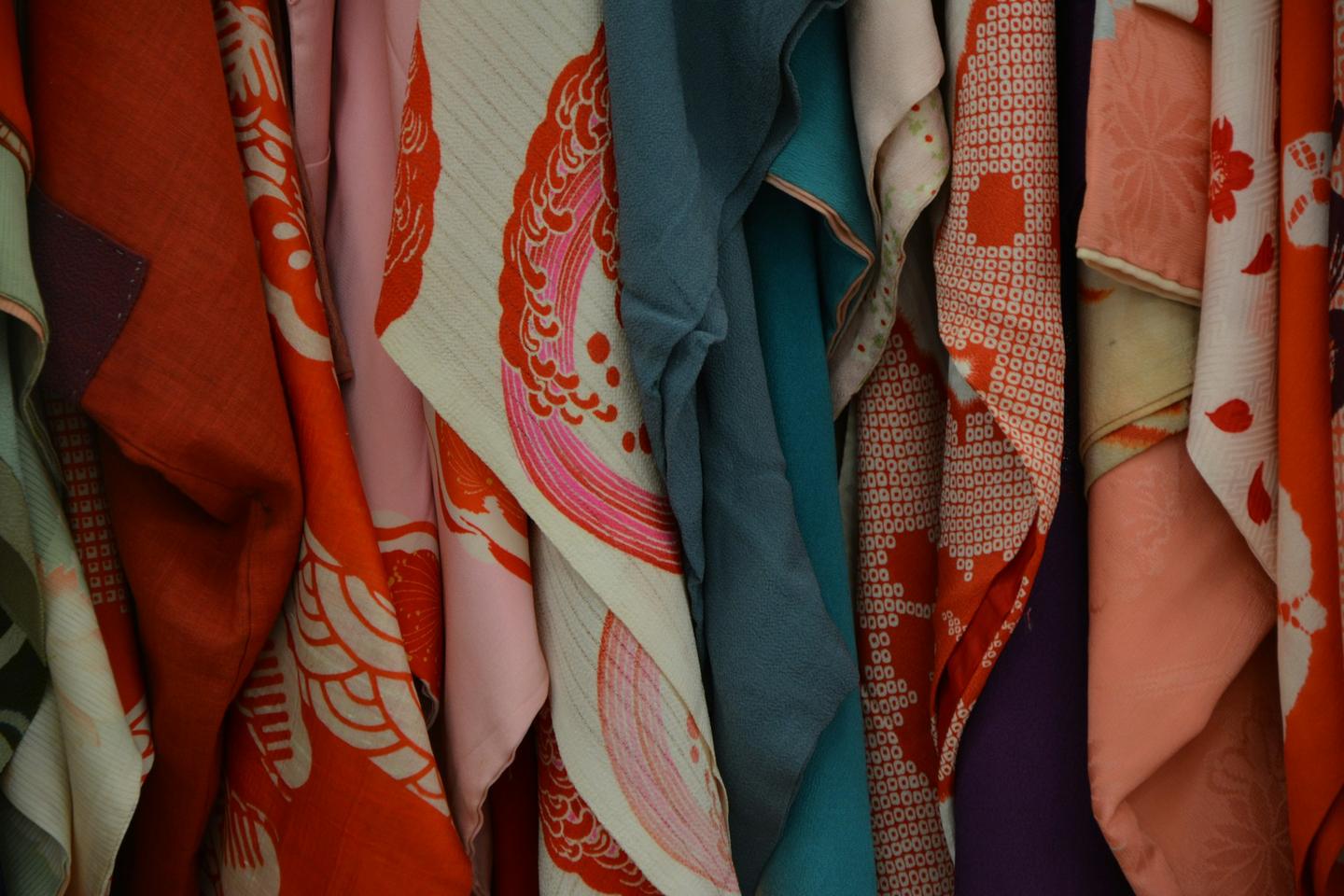
Kaga Yuzen is the traditional silk dyeing technique of Kanazawa, distinct from the Kyoto Yuzen in its preference for natural dyes, realistic pictorial motifs, and a characteristic outline technique called sasa-ashi (bamboo grass edging) in which the outer edge of each motif fades from deep color to white. It is a living tradition. There are still licensed practitioners in Kanazawa producing Kaga Yuzen garments for the domestic luxury market.
Private workshop experiences are available, typically two to three hours, working with a licensed dyer on a piece that guests take home. This is not a demonstration: it involves actual use of the resist-dyeing technique, the application of natural dye, and the fixing process. It is the kind of hands-on artisan encounter that has become almost impossible to find in Tokyo and is growing harder to arrange in Kyoto. In Kanazawa, it remains genuine and accessible with the right arrangement.
Kanazawa also has the highest density of Noh stages of any city in Japan. The Maeda clan were patrons of Noh during the Edo period and the tradition persists: Kanazawa has active Noh schools, regular performances open to the public, and a dedicated Noh theatre (the Ishikawa Prefectural Noh Theatre) that stages performances throughout the year. For travelers with an interest in classical Japanese performing arts, Kanazawa offers access that Tokyo, despite its scale, does not replicate.
BENIYA MUKAYU: THE RYOKAN EXTENSION
Yamashiro Onsen is a hot spring town in Kaga, approximately one hour from Kanazawa by car. It is the location of Beniya Mukayu, consistently cited among Japan's two or three finest ryokan, and the property that most STAYGO clients choose as the closing night of a Kanazawa extension.
Beniya Mukayu is not a traditional ryokan. The architecture is contemporary minimalist, restrained, precise, and undecorated in the way that the best Japanese design achieves quiet luxury. Every room has a private open-air rotenburo (outdoor hot spring bath) fed by the Yamashiro spring water. The kaiseki dinner uses ingredients from the Noto Peninsula, a coastline of exceptional marine produce, and changes with the season to a degree that makes the menu unrecognizable between visits made a month apart.
This is the correct end to a Kanazawa itinerary: two nights in the city, a half-day in the market and Higashi Chaya, Kenroku-en in the morning, a private craft workshop in the afternoon, and then the hour south to Yamashiro Onsen for a night that justifies the entire extension.
Within Kanazawa itself, the most considered option is a machiya townhouse rental. Several have been converted to private accommodation in the Higashi Chaya and Kazuemachi districts. The Kanazawa Hakuchoro Hotel Sanraku is the city's most refined hotel property. For travelers who prefer a full-service hotel with traditional elements, the Hotel Nikko Kanazawa offers the most reliable standard in the city centre. STAYGO advises on which option suits the itinerary structure. City hotel followed by Beniya Mukayu is the sequence most clients find optimal.
WHY KANAZAWA OVER KYOTO FOR THE REPEAT VISITOR
The comparison is not perfectly fair (Kyoto and Kanazawa are different in scale and character), but it is the relevant one for travelers who have already done Kyoto and are considering where to spend additional days in Japan. The case for Kanazawa over a second Kyoto visit is straightforward: less crowded, more authentic daily life visible, and a craft culture that has no equivalent anywhere else in the country.
The gold leaf culture alone (the workshops, the markets, the application of gold to lacquerware and ceramics and temple interiors) is a reason to come. Add Kenroku-en in winter, Omicho market at dawn with snow crab, a Kaga Yuzen private workshop, the intact streets of Higashi Chaya before the tour buses arrive, and one night at Beniya Mukayu: this is a Japan extension that serious travelers will not regret. It is the other version of Japan, the one that has been there all along, waiting for the itinerary to reach it.
SOURCES AND HOW WE CHECKED
The craft and market figures and the yukitsuri date on this page come from desk research. We read the pages below on October 5, 2026, and did not contact the workshops, the market or the garden.
- Kanazawa City Tourism Association, Kanazawa gold leaf (Japanese): about 99 percent of the gold leaf made in Japan
- Wajima Lacquerware Cooperative (Japanese): the 124 steps of Wajima-nuri
- Omicho Market (Japanese): about 170 shops and some 300 years of history
- Kanazawa City Tourism Association, Kenroku-en yukitsuri (Japanese): work begins on November 1 and runs to mid-December
QUESTIONS, ANSWERED
How do you get from Tokyo to Kanazawa?
The Hokuriku Shinkansen now connects Tokyo and Kanazawa directly. The journey takes approximately 2.5 hours on the Kagayaki or Hakutaka services. The line was extended through to Tsuruga in March 2024, making Kanazawa significantly more accessible. The JR Pass covers this route.
What is Beniya Mukayu and why is it considered one of Japan's best ryokan?
Beniya Mukayu is a contemporary minimalist ryokan located in Yamashiro Onsen, approximately one hour from Kanazawa. It is widely regarded as one of Japan's finest ryokan for its architecture, the quality of its kaiseki cuisine using Noto Peninsula ingredients, and its private open-air baths (rotenburo) in every room.
Is Kanazawa better than Kyoto for travelers who have already been to Japan?
For repeat visitors specifically, Kanazawa offers something Kyoto cannot: genuine daily life visible alongside the cultural sites, significantly fewer tourists, and an artisan culture (gold leaf, Kutani ceramics, Kaga Yuzen dyeing, Noh theatre) that has no parallel in Tokyo or Kyoto. Kenroku-en is arguably a finer garden than anything in Kyoto's standard circuit. The Higashi Chaya geisha district is better preserved than Gion.
When is the best time to visit Kanazawa?
Kanazawa is exceptional in winter (December to February) when snow covers Kenroku-en's pine trees. The yukitsuri (rope supports) used to protect the branches from snow weight create a distinctive silhouette. Autumn (October to November) is also outstanding for the garden and the surrounding countryside. Snow crab season runs October to March, making winter visits particularly rewarding for dining.
ADD KANAZAWA TO YOUR JAPAN ITINERARY
STAYGO designs Kanazawa extensions that include gold leaf workshops, private craft experiences, Omicho market access, and Beniya Mukayu, the ryokan that justifies the detour.
Start planning →