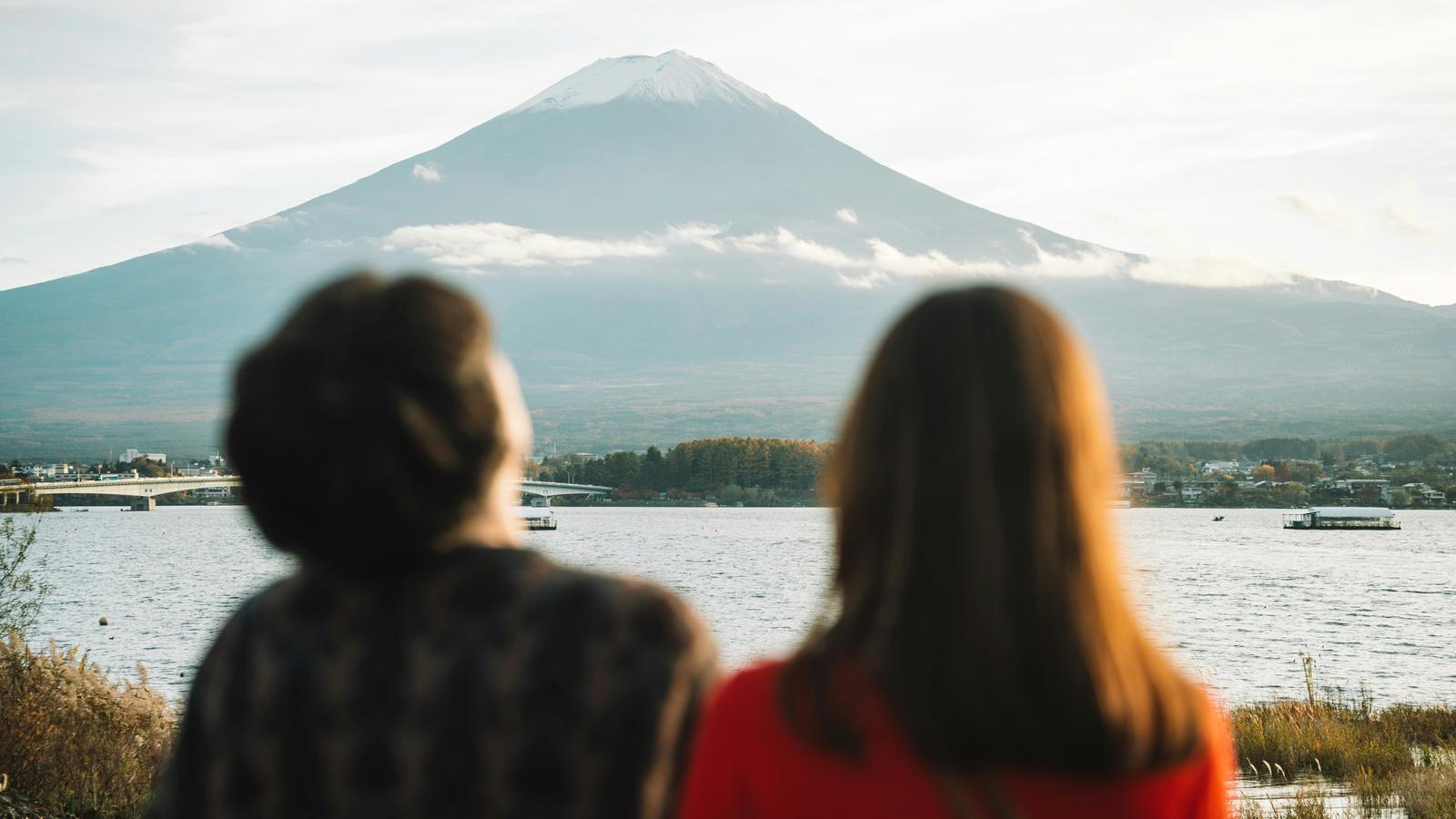
Italian couples are among Japan's most attentive visitors. They come for a long stay, they travel as two, and many come on their honeymoon. They also bring habits Japan does not always expect: dinner after eight, an espresso in the morning, a bed to sleep in. A honeymoon here goes best when those habits are planned for from the start.
This article sets out what Japan's tourism authorities record about Italian travellers, how fifteen days of marriage leave can be shaped, which season to choose, where to sleep, how to keep Italian meal hours and where to see art. We read the market strategy and handbook of the Japan National Tourism Organization, the statistics of the Japan Tourism Agency and ISTAT, the Japan Meteorological Agency, and the pages of the inns and the art site, and contacted none of them; the sources are at the end. For honeymoon planning in general, see Planning a Japan Honeymoon With a Specialist →.
Key points
- In 2025, 306,949 Italians visited Japan, 34.0% more than in 2024. They stayed 13.7 nights on average and spent 357,002 yen each, according to the Japan Tourism Agency.
- JNTO's strategy for Italy, dated April 2026, notes that couples make up an especially high share of Italian travel to Japan and that honeymoon demand is high.
- Italian employees are entitled to 15 days of special leave when they marry, and some Italian honeymoon packages pair Japan with the Maldives, Thailand, Tahiti or New Zealand, according to JNTO's 2024 handbook.
- Italians marry in their thirties: in 2024 the average age at first marriage was 34.8 for men and 32.8 for women (ISTAT).
- At Asaba in Shuzenji, six of the ten rooms have two queen beds, every room has its own wooden bath, and dinner is served in the room between 18:00 and 19:00.
LET US SHAPE YOUR HONEYMOON IN JAPAN →
WHAT JAPAN KNOWS ABOUT ITALIAN COUPLES
The Japan Tourism Agency's survey for 2025 counts 306,949 visitors from Italy, up 34.0% on 2024. They stayed 13.7 nights on average and spent 357,002 yen per person, about 109.6 billion yen in all. For Italians, close to two weeks in Japan is the norm.
The Japan National Tourism Organization, JNTO, published its strategy for the Italian market in April 2026. It notes that the share of trips made by couples and partners is especially high, and that demand for honeymoons is high too. One of its four target groups is couples over forty who have not yet been to Japan and whose household disposable income is in the top 30%, above 60,000 euros a year. Its 2024 handbook describes the wealthiest fifth of Italian travellers: local food and cooking, art museums and contemporary art, landscapes, gardens and flowers, and a strong interest in regions such as Hokkaido and Tohoku.
Italy's statistics office, ISTAT, counted 173,272 marriages in 2024, 61.3% of them civil. The average age at first marriage was 34.8 for men and 32.8 for women. Our reading is that many Italian honeymooners already travel well and know what they expect of a hotel. For them the honeymoon is the chance to see one country properly, together.
FIFTEEN DAYS AND HOW TO SPEND THEM
JNTO's handbook notes that Italian employees have 28 days of paid leave a year and the right to 15 days of special leave when they marry. Italian tour operators most often sell Japan in packages of 10 to 14 days on the Golden Route and the areas around it. For honeymooners, some packages combine Japan with a beach: the Maldives, Thailand, French Polynesia or New Zealand.
Fifteen days allow two good shapes. The first is Japan alone, with twelve or thirteen nights in four or five places. The second is about nine nights in Japan, then the sea. If you choose the second, we suggest Japan first: the inns, the cities and the art ask for energy, and the beach is where the long flights are forgotten. Each place deserves at least two nights, so that every move is followed by a full day without luggage.
A thirteen-night shape we often start from: three nights in Tokyo, two in a ryokan in Izu, four in Kyoto, two on Naoshima and two near the airport you leave from. We plan the Japan days around your flights, so that the last night is close to the departure and the morning is not rushed.
THE SEASON AFTER THE WEDDING
The handbook describes summer as the Italian holiday that matters most, centred on mid-August and running from July to September. In August 2023 about 24,100 Italians arrived in Japan, a monthly record at the time. More Italians now take their holidays in September to avoid the August peak.
Japan's summer is not Italy's. According to the Japan Meteorological Agency's 1991 to 2020 normals, the average daily high in Kyoto is 33.7°C in August and 29.2°C in September, and September brings 178.5 mm of rain. In October the average high falls to 23.4°C, and in November to 17.3°C, with 73.9 mm of rain. For a couple who marry in June or July, waiting until October or November gives Kyoto at its most comfortable, with the autumn colour at the end. Spring is the other good window, with an average high of 20.1°C in April. For each month in detail, see Best Time for a Honeymoon in Japan: Month by Month (2027) →.
A BED FOR TWO AND A BATH OF ONE'S OWN
The handbook lists what disappoints Italian travellers in Japanese hotels: small rooms and bathrooms, few rooms that offer a double bed, breakfasts with no choice beyond Japanese food, and the smell of grilled fish at a ryokan breakfast. It advises a single night in a ryokan for Italians who are new to Japan, because taking off shoes and resting on tatami are so far from home. For a honeymoon we suggest something else: two nights in one exceptional inn that has beds, and hotels in the cities.
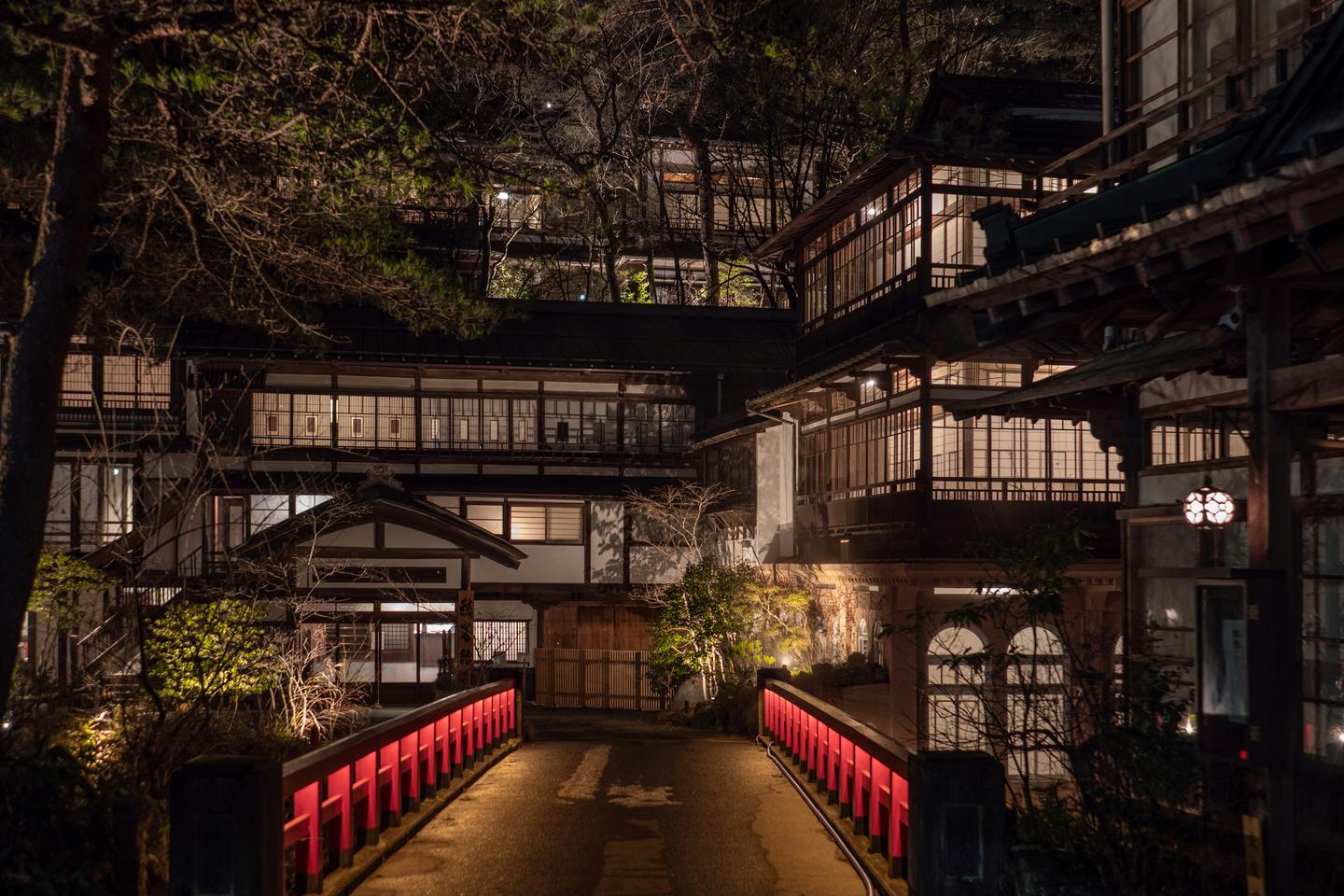
Asaba in Shuzenji, on the Izu peninsula, traces its history to 1484, when Asaba Yakuro Yukitada came to Shuzenji, and is a member of Relais & Châteaux. It has ten rooms. Six have two queen beds and four have futons. Every room has its own wooden bath; Villa Tenko, 220 square metres, adds an outdoor bath in stone, and Hagoromo, 126 square metres, looks onto the pond and the Noh stage and has a half-open bath on the veranda. The stage, Gekkeiden, was moved here from Tokyo in the late Meiji period, and the inn presents Noh, Kyogen, Shinnai and Bunraku through the seasons. Breakfast is a Japanese or a Western course. The limited express Odoriko reaches Shuzenji from Tokyo Station in about 120 minutes, and the inn is about seven minutes from the station by taxi.
Kyoto has inns with private hot spring baths as well; we compare them in Kyoto Ryokan with Private Onsen: Where to Find Them →. Before we propose any ryokan, we ask how its rooms are made up, beds or futons, and say so in the proposal.
ARRIVING IN KYOTO BY BOAT
HOSHINOYA Kyoto stands in Arashiyama beside the Rankyo gorge, with 25 rooms. Guests reach the pavilions on the inn's own boat from its waiting house in Arashiyama, reserved in advance; the first boat leaves at 14:30 and the last at 17:45, and when the river does not allow it, a car takes over. Check-in is at 15:00 and check-out at 12:00, a noon departure that suits couples who like a slow morning. The inn can prepare a cake or flowers for an anniversary on request.
We often place two nights here at the start of the Kyoto stay, arriving on a late-afternoon boat, and then two nights in the centre of the city, where the evenings out are a short walk away. For the Kyoto days themselves, see Romantic Things to Do in Kyoto for Couples (2026) →.
THE TABLE AT ITALIAN HOURS
The handbook is precise about meal times: Italians prefer to eat late, lunch after 13:00 and dinner after 20:00. It adds a preference for a sweet breakfast, espresso or a morning cappuccino, drinks served without ice, and a table with chairs at meals.
A ryokan dinner comes earlier. At Asaba it is served between 18:00 and 19:00, in the room. On those nights we suggest a light lunch at 13:00 and dinner at 19:00, the latest start, which leaves a long evening between the bath and the garden. In the cities, eight o'clock is easier. Where a restaurant has a later sitting, we ask for it, and a kaiseki lunch at 13:00 is a fine way to know a great Kyoto house and keep the evening free. We tell each inn in advance about the Western breakfast, the coffee, the ice and the chairs, so that none of it has to be asked for at the table.
ART AND A NIGHT INSIDE THE MUSEUM
JNTO's handbook puts art museums and contemporary art among the interests of Italian couples over forty and of the wealthiest Italian travellers. On Naoshima, in the Seto Inland Sea, Benesse House lets guests sleep with the art. Its Museum building has ten rooms, inside the museum itself. Oval, by the architect Tadao Ando, has six rooms, reached by monorail from the museum, and only Oval's guests may enter. Some of its rooms carry works by artists such as David Tremlett and Richard Long, and the windows open onto the sea.
Two nights on the island leave a day for the museums and an evening when the day visitors have gone. For the other islands and the museums by day, see Beyond Naoshima: Seto Inland Sea Art Trail →.
HOW WE SHAPE IT
In a Signature journey of 7 to 21 days, we arrange the inns with the beds confirmed, the boat time in Arashiyama, the tables at the hours you keep, and the nights on Naoshima. If a beach follows, we place the last Japanese night near the departure airport. You receive everything in writing, each choice with its reason, before you leave Italy.
SOURCES AND HOW WE CHECKED
We read the pages below on November 5, 2026. Travel times are those given by the inns. We did not contact any inn, museum or other body.
- Japan Tourism Agency, International Visitor Survey, 2025 report (Japanese): 306,949 Italian visitors, 34.0% up; 13.7 nights; 357,002 yen per person; 109.6 billion yen in total
- JNTO, Italy market strategy, April 2026 (Japanese): high share of couples, high honeymoon demand, couples over forty in the top 30% of household income (60,000 euros a year or more)
- JNTO, Inbound travel handbook 2024, Italy (Japanese): 28 days of paid leave and 15 days for marriage; packages of 10 to 14 days; honeymoon combinations; the summer holiday and September; August 2023 arrivals; meal times; breakfast and coffee; complaints about rooms; one ryokan night; interests by income
- JNTO Italy, Un indimenticabile viaggio di nozze (Italian): how JNTO presents Japan to Italian honeymooners
- ISTAT, Matrimoni, unioni civili, separazioni e divorzi, anno 2024 (Italian): 173,272 marriages, 61.3% civil, average age at first marriage 34.8 and 32.8
- Japan Meteorological Agency, Kyoto normals 1991 to 2020 (Japanese): average daily highs and rainfall by month
- Asaba, official site: history from 1484, the Noh stage moved from Tokyo, the seasonal performances
- Asaba, official site (Japanese): the Noh stage Gekkeiden and its Japanese name
- Asaba, rooms: ten rooms, sizes, queen beds or futons, the baths of each room
- Asaba, dining: dinner in the room between 18:00 and 19:00, Japanese or Western breakfast
- Asaba, access: Odoriko from Tokyo Station in about 120 minutes, about seven minutes by taxi
- Relais & Châteaux, Asaba: membership, family-run ryokan by the Katsura River
- HOSHINOYA Kyoto, official page: 25 rooms, the Rankyo gorge, check-in 15:00 and check-out 12:00, anniversary cake and flowers
- HOSHINOYA Kyoto, access (Japanese): the inn's boat by reservation, first at 14:30 and last at 17:45, a car when the boat does not run
- Benesse Art Site Naoshima, Benesse House Oval: six rooms, monorail from the museum, access for Oval guests only, works in the rooms, Tadao Ando
- Benesse Art Site Naoshima, Benesse House Museum: ten rooms inside the museum
QUESTIONS COUPLES ASK
How long should an Italian honeymoon in Japan be?
With fifteen days of marriage leave, twelve or thirteen nights in Japan alone, or about nine if a beach follows. Italians stayed 13.7 nights on average in 2025.
When should we go after a summer wedding?
October or November, or the following spring. Kyoto's average daily high is 33.7°C in August, 23.4°C in October and 17.3°C in November.
Can we have a real bed in a ryokan?
In some of the finest inns, yes. At Asaba, six of the ten rooms have two queen beds. Before proposing any ryokan, we ask how its rooms are made up.
Can we have dinner at eight in Japan?
In the cities, often, where a restaurant has a later sitting, and we ask for it. A ryokan dinner is earlier; at Asaba it begins between 18:00 and 19:00.
Can a Japan honeymoon be combined with the Maldives?
Yes. Some Italian honeymoon packages pair the two. We suggest Japan first, about nine nights, and plan the Japan days around your flights so the last night is near the departure airport.
LET US SHAPE YOUR HONEYMOON IN JAPAN
Tell us your wedding date, how many days you have and whether a beach will follow. We will set out the season, the inns with their beds, the hours of the tables and the nights with the art, side by side with the reasons, so that you can choose together.
Begin planning →We reply within 24 hours, in writing
Some of the restaurants and bars we arrange seat guests only by introduction or membership. We ask on your behalf; the table and the evening are the house's decision. We do not publish their names.