For Tokyo and Kyoto, the averages point to May and November for a honeymoon in Japan. On the Japan Meteorological Agency's 1991 to 2020 averages, May is 18.8°C in Tokyo and 19.5°C in Kyoto with about 180 hours of sunshine, and November is 12.5°C in both, with rain on 7.4 and 6.3 days. June is the rainy season and August the hottest month, when Kyoto reaches 35°C on 11.6 days. If your wedding fixes the month, let the region follow it: Hokkaido in June and July, Okinawa from late June, Sapporo in February for the snow, and Tokyo in winter, when January is its sunniest month.
Below, month by month, are the averages for Tokyo and Kyoto, what each month does well, the region that suits it, and the holidays and closures to plan around in 2026 and 2027. We checked each figure and date on October 18, 2026 on the official pages of the agency, the Cabinet Office, JR Central and the hotels, museums and operators named; the sources are listed at the end. For the route itself, day by day, see the luxury Japan honeymoon itinerary.
Key points
- May averages 18.8°C in Tokyo and 19.5°C in Kyoto with about 180 hours of sunshine. November averages 12.5°C in both, with rain on 7.4 and 6.3 days.
- The rainy season averages about June 7 to July 19 around Tokyo and June 6 to July 19 around Kyoto. Okinawa's ends around June 21, and Hokkaido is not counted as having one.
- In an average August and September, 3.3 typhoons a month come within 300 km of a weather station in Japan. Okinawa has the most, 2.2 and 1.9.
- Golden Week 2027 is Thursday, April 29 and Saturday, May 1 to Wednesday, May 5. June and December have no national holidays.
- Hoshinoya hotels take bookings 18 months ahead and Gora Kadan six months ahead. JR Central runs every Nozomi reserved-only between December 25, 2026 and January 5, 2027.
THE YEAR AT A GLANCE
Each row gives the agency's 1991 to 2020 averages for the month, mean temperature and total rainfall, for Tokyo and then Kyoto. The last two columns are our reading of them and of the dates below.
| Month | Tokyo and Kyoto, average | Good for | Watch for |
|---|---|---|---|
| January | Tokyo 5.4°C, 59.7 mm; Kyoto 4.8°C, 53.3 mm | Tokyo's sunniest month; Okinawa at 17.3°C | New Year closures until January 4 |
| February | Tokyo 6.1°C, 56.5 mm; Kyoto 5.4°C, 65.1 mm | The Sapporo Snow Festival; drift ice off Abashiri | Holidays on February 11 and 23 |
| March | Tokyo 9.4°C, 116.0 mm; Kyoto 8.8°C, 106.2 mm | Cherry blossom from about March 24 | Cold evenings; a holiday weekend, March 20 to 22, 2027 |
| April | Tokyo 14.3°C, 133.7 mm; Kyoto 14.4°C, 117.0 mm | Full bloom around March 31 to April 4; days near 20°C | Golden Week from April 29 |
| May | Tokyo 18.8°C, 139.7 mm; Kyoto 19.5°C, 151.4 mm | About 180 hours of sunshine; blossom in Hokkaido | Golden Week until May 5; Okinawa's rainy season |
| June | Tokyo 21.9°C, 167.8 mm; Kyoto 23.3°C, 199.7 mm | Hokkaido; Okinawa after about June 21 | The rainy season; Tokyo's least sunshine |
| July | Tokyo 25.7°C, 156.2 mm; Kyoto 27.3°C, 223.6 mm | Lavender in Hokkaido; Naha's sunniest month | The rainy season until about July 19; Kyoto's wettest month |
| August | Tokyo 26.9°C, 154.7 mm; Kyoto 28.5°C, 153.8 mm | Hokkaido, at 22.3°C in Sapporo | The hottest month; typhoons; Obon |
| September | Tokyo 23.3°C, 224.9 mm; Kyoto 24.4°C, 178.5 mm | Hokkaido, at 18.6°C in Sapporo | The most typhoon landfalls of the year |
| October | Tokyo 18.0°C, 234.8 mm; Kyoto 18.4°C, 143.2 mm | Mild days; maples in Hokkaido | Tokyo's wettest month |
| November | Tokyo 12.5°C, 96.3 mm; Kyoto 12.5°C, 73.9 mm | Few rain days; maples late in the month | A holiday weekend, November 21 to 23, 2026 |
| December | Tokyo 7.7°C, 57.9 mm; Kyoto 7.2°C, 57.3 mm | Kyoto's last maples; Tokyo's winter sun | New Year closures from December 26 |
JANUARY AND FEBRUARY
Winter on the Pacific side is dry and bright. Tokyo has 192.6 hours of sunshine in an average January, its most of any month, and rain of 1 mm or more on only 4.5 days, at a mean of 5.4°C. Kyoto is colder and greyer, at 4.8°C with about 120 hours of sunshine in each of the two months. It is the season to give more nights to a ryokan room with its own open-air bath; Kyoto ryokan with a private onsen lists rooms that have one. The New Year runs into the first week, and the Kyoto Imperial Palace is closed until January 4.
February is the month for the north. The 2027 Sapporo Snow Festival is held between February 4 and 11, when Sapporo averages minus 2.7°C. The icebreaker Aurora sails from Abashiri between January 20 and March 31, an hour on its large boat for ¥7,000 (about US$40) per adult, tax included. Its operator says the ice is most likely between mid-February and early March and has been reaching the coast later, and that with no ice within reach the trip becomes a cruise to Cape Notoro. More is in our Hokkaido honeymoon guide.
Okinawa is mild, with Naha at 17.3°C in January, though January and February are its least sunny months, at 93.1 hours each. Naha's hikanzakura cherries open around January 16 in an average year; the islands are in our Okinawa honeymoon guide.
MARCH AND APRIL
In an average year, the cherry trees the agency observes open around March 24 in Tokyo and March 26 in Kyoto, and reach full bloom around March 31 and April 4. In 2026 full bloom came early, on March 28 and March 30. Since Kyoto's average is four days later, a honeymoon that starts in Tokyo and ends in Kyoto travels with the blossom. How we plan around the moving dates is in the anniversary trip guide, and the choice of season in cherry blossom against autumn leaves.
The days are mild, with April highs of 19.4°C in Tokyo and 20.1°C in Kyoto, but March nights average lows of 5.0°C in Tokyo and 4.3°C in Kyoto, and rain comes on about nine days a month. Vernal Equinox Day is Sunday, March 21, 2027, so Monday, March 22 is a holiday too, and JR Central runs every Nozomi on the Tokaido Shinkansen reserved-only between March 20 and 22.
MAY
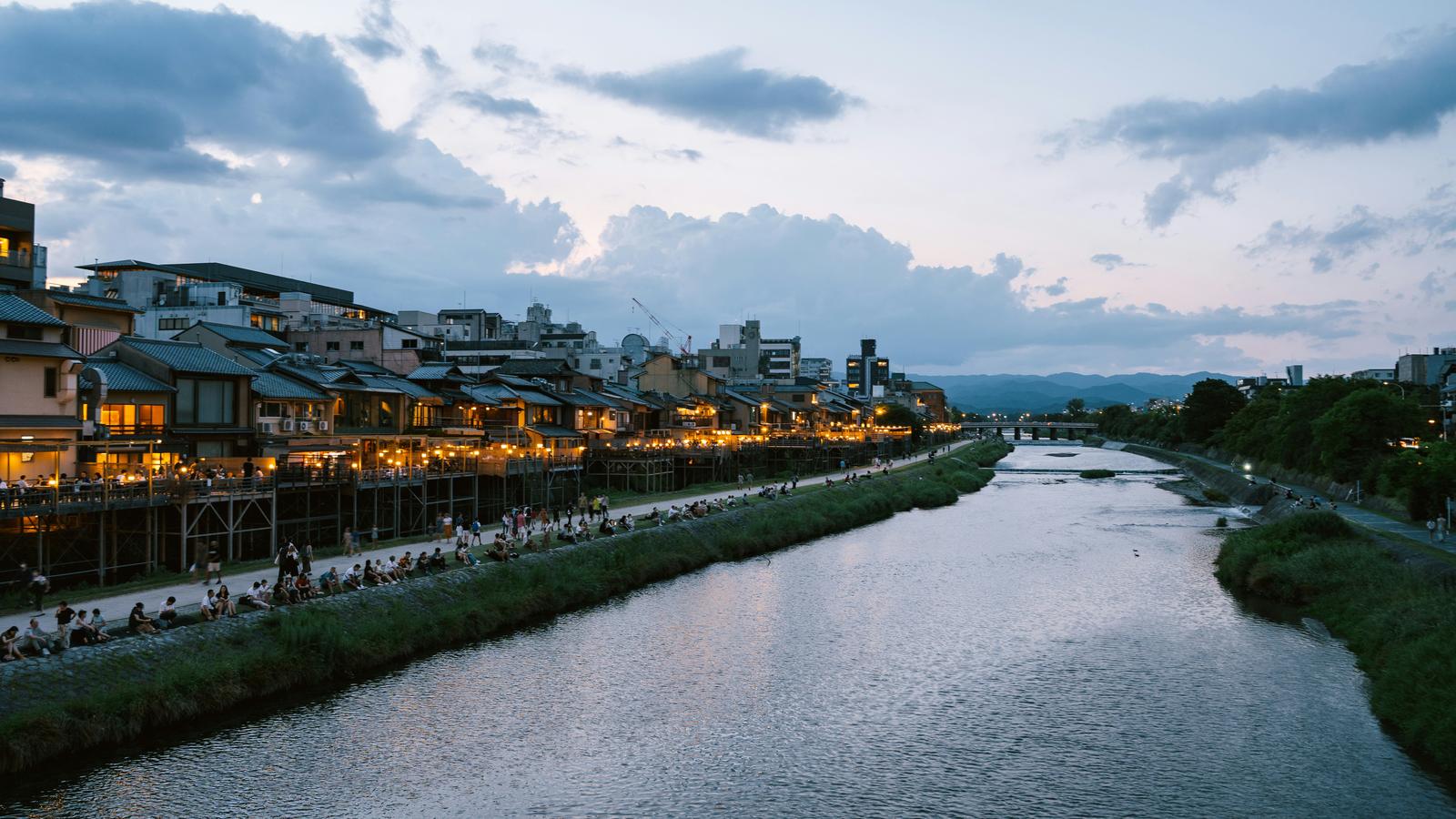
With a free choice of dates, we would put Tokyo and Kyoto in May: means of 18.8°C and 19.5°C, highs of 23.6°C and 25.1°C, about 180 hours of sunshine and rain on about ten days. In 2026 the Kamo River platforms in Kyoto served dinner between May 1 and October 15; romantic things to do in Kyoto covers them.
Golden Week comes first. In 2027 it is Showa Day on Thursday, April 29, then, after an ordinary Friday, the five days between Saturday, May 1 and Wednesday, May 5. In 2026 JR Central ran every Nozomi reserved-only between April 24 and May 6, and Gora Kadan's FAQ says stricter cancellation terms may apply in Golden Week, Obon and the New Year. A May honeymoon that starts after the 5th misses the holidays.
Spring reaches Hokkaido in May. Sapporo's cherries reach full bloom around May 6 in an average year, and May is its sunniest month, at 200.4 hours. Okinawa's rainy season normally begins around May 10.
JUNE AND JULY
The rainy season, tsuyu, is the agency's name for the weeks of late spring and early summer when rainy and cloudy days are frequent. Its average dates are about June 7 to July 19 in Kanto-Koshin, around Tokyo, and June 6 to July 19 in Kinki, around Kyoto. In 2026 it began around June 2 in both and ended around July 9 in Kinki and July 19 in Kanto-Koshin.
It does not rain every day: Tokyo averages 11.6 days of 1 mm or more in June, and Kyoto 11.5. The light is what changes, with 124.2 hours of sunshine in Tokyo, the least of the year. A June honeymoon in the two cities works with more time under a roof, at a ryokan with a bath of your own or over a long lunch. June has no national holiday. In July, Kyoto has its wettest month, 223.6 mm, with highs of 32.0°C, and Marine Day makes July 17 to 19, 2027 a three-day weekend.
Hokkaido in June and July
The agency does not count a rainy season in Hokkaido: the rain front often fades there, and the wet spells vary too much between years. Sapporo averages 7.5 days of rain in June, its fewest, at 17.0°C. The Traditional Lavender Field at Farm Tomita in Nakafurano is at its best in early to mid July, the farm says.
Okinawa after the rain
Okinawa's rainy season normally ends around June 21, and ended around June 29 in 2026. July is Naha's sunniest month, with 227.0 hours at 29.1°C, and typhoon approaches there rise from 0.6 in June to 1.5 in July.
AUGUST AND SEPTEMBER
August is the hottest month in both cities, at 26.9°C in Tokyo and 28.5°C in Kyoto. Kyoto's daily high averages 33.7°C and reaches 35°C on 11.6 days, and the daily low stays at 25°C or above on 15.4 days, so we plan the time outdoors for early mornings and evenings. Sapporo, at 22.3°C, is the cool choice.
Typhoons are the other factor. Of the 11.7 that come within 300 km of a weather station in Japan in an average year, 3.3 come in August and 3.3 in September, and September has the most landfalls, 1.0 of the 3.0 a year. By region, an average September brings 1.2 to Kanto-Koshin, 1.1 to Kinki and 1.9 to Okinawa, which has 2.2 in August. In these months we keep a free day before the flight home.
Obon, in August, has no national holiday of its own; the holiday is Mountain Day, the 11th. JR Central says Obon and the New Year bring many travellers onto the Shinkansen for trips home and holidays, and it ran every Nozomi reserved-only between August 7 and 16 in 2026.
September stays warm, with 30°C on 13.3 days in Kyoto and 224.9 mm of rain in Tokyo. In 2027 Respect for the Aged Day gives a three-day weekend, September 18 to 20, and the Autumnal Equinox falls on Thursday, September 23; in 2026 the two made five days off in a row, September 19 to 23.
OCTOBER AND NOVEMBER
October brings the mean down to 18.0°C in Tokyo and 18.4°C in Kyoto. Tokyo's rain is the catch: 234.8 mm, its wettest month on the averages, with 129.4 hours of sunshine. Kyoto is drier, at 143.2 mm. Autumn reaches Hokkaido first, and the maple the agency observes in Sapporo turns around October 28 in an average year. Sports Day makes October 9 to 11, 2027 a three-day weekend.
November is the month we would choose for an autumn honeymoon. Both cities average 12.5°C, with rain on 7.4 days in Tokyo and 6.3 in Kyoto, fewer than in April, May or October. The maples turn around November 28 in Tokyo and December 5 in Kyoto on the averages, and turned on November 23 and December 10 in 2025. Labour Thanksgiving Day, Monday, November 23, 2026, gives a three-day weekend that JR Central treats as a peak.
DECEMBER
December is dry, with 57.9 mm of rain in Tokyo and 57.3 mm in Kyoto, and Tokyo keeps its winter sun, 174.4 hours at 7.7°C. In Kyoto the maples can last into the month. There is no national holiday until New Year's Day.
The year-end changes the picture. JR Central runs every Nozomi reserved-only between December 25, 2026 and January 5, 2027. The Tokyo National Museum closes December 26 to 31 and reopens on New Year's Day at 12:00; Nijo Castle in Kyoto closes December 29 to 31, and the Kyoto Imperial Palace December 28 to January 4. Restaurants set their own New Year closing days, so we check each one for your dates.
HOLIDAYS TO PLAN AROUND
These are Japan's national holidays between November 2026 and the end of 2027, from the Cabinet Office's list, with the days of the week checked. Where JR Central names the dates as a peak, when every Nozomi is reserved-only and travellers without a reserved seat cannot sit, the table says so. Its current list runs to March 22, 2027.
| Holiday | Dates | Worth knowing |
|---|---|---|
| Culture Day; Labour Thanksgiving Day | Tuesday, November 3 and Monday, November 23, 2026 | Nozomi reserved-only November 21 to 23 |
| New Year's Day | Friday, January 1, 2027 | Nozomi reserved-only December 25, 2026 to January 5, 2027 |
| Coming of Age Day | Monday, January 11, 2027 | Nozomi reserved-only January 9 to 11 |
| National Foundation Day; the Emperor's Birthday | Thursday, February 11 and Tuesday, February 23, 2027 | Single days off |
| Vernal Equinox Day | Sunday, March 21, 2027, with Monday, March 22 off | Nozomi reserved-only March 20 to 22 |
| Golden Week | Thursday, April 29; Saturday, May 1 to Wednesday, May 5, 2027 | Nozomi reserved-only April 24 to May 6 in 2026 |
| Marine Day | Monday, July 19, 2027 | A three-day weekend |
| Mountain Day | Wednesday, August 11, 2027 | Obon has no holiday; Nozomi reserved-only August 7 to 16 in 2026 |
| Respect for the Aged Day; Autumnal Equinox Day | Monday, September 20 and Thursday, September 23, 2027 | Five days off in a row in 2026 |
| Sports Day | Monday, October 11, 2027 | A three-day weekend |
| Culture Day; Labour Thanksgiving Day | Wednesday, November 3 and Tuesday, November 23, 2027 | Single days off |
June and December have no national holidays, and the Cabinet Office publishes the 2028 holidays in February 2027. More on these weeks is in Japan's holiday blackouts.
IF YOUR WEDDING DATE IS FIXED
With a fixed date, choose the part of Japan for the month first, then the order of the bases, then the rooms. These are the starting points we would use.
Spring. Tokyo, then Kyoto, where full bloom averages four days later, and Hokkaido from early May.
June or July. Hokkaido, or Okinawa after about June 21, keeping the Tokyo and Kyoto nights for a ryokan and long dinners.
August or September. Hokkaido, or the two cities with the days arranged around the heat and a free day before the flight home.
October or November. Follow the leaves south: Hokkaido in October, Tokyo and Kyoto late in November.
December to February. Tokyo's winter sun and a ryokan, then Sapporo in February or Okinawa at about 17°C.
HOW FAR AHEAD TO BOOK
Rooms open first. Hoshino Resorts takes bookings a year ahead, and 18 months ahead at its Hoshinoya hotels, including Hoshinoya Tokyo and Hoshinoya Kyoto. Gora Kadan in Hakone opens each month's rooms at 9:00 Japan time on the 1st of the month six months before, and its New Year nights, December 31 to January 3, on September 1. A private evening at Murin-an in Kyoto can be requested between 180 days and one month ahead.
Trains come later. JR Central sells part of the reserved seats on each Tokaido Shinkansen train up to a year ahead, and the rest from 10:00 one month before the day of travel. The order to book everything in is set out in how far ahead to plan a Japan trip.
WHERE STAYGO COMES IN
STAYGO plans private trips across Japan from Tokyo. For a honeymoon we start from your wedding date, choose the region and the order for that month with you, and send the requests for rooms, tables and private evenings as each one opens. We arrange everything in your names, and you pay the hotels, ryokan, restaurants and hosts directly at their own rates, with no commission or markup from us. The Signature plan is USD 3,500 for the two of you, for a trip of 7 to 14 days; longer or more complex trips are quoted as Bespoke.
SOURCES AND HOW WE CHECKED
We read the Japan Meteorological Agency's climate, rainy season, typhoon and phenology pages, the Cabinet Office's holiday list and the official pages below on October 18, 2026. The climate and typhoon figures are the agency's 1991 to 2020 averages; the maple averages are worked out from its 2025 dates and their difference from the average. We did not contact any of the organisations, and we did not use figures from booking sites, guidebooks or press coverage. Dates and conditions are those shown on October 18, 2026, and can change. Dollar amounts are a guide only, at ¥158 to US$1 (October 2026); every hotel, ryokan and restaurant charges in yen.
- Japan Meteorological Agency, climate normals for Tokyo: temperature, rainfall and sunshine
- Japan Meteorological Agency, Tokyo days with rain: days of 1 mm or more
- Japan Meteorological Agency, climate normals for Kyoto: temperature, rainfall and sunshine
- Japan Meteorological Agency, Kyoto days with rain: days of 1 mm or more
- Japan Meteorological Agency, Kyoto days by temperature: days of 30°C and 35°C, and lows of 25°C
- Japan Meteorological Agency, climate normals for Sapporo: temperature and sunshine
- Japan Meteorological Agency, Sapporo days with rain: days of 1 mm or more
- Japan Meteorological Agency, climate normals for Naha: temperature and sunshine
- Japan Meteorological Agency, rainy season dates: the 1991 to 2020 averages
- Japan Meteorological Agency, rainy season in Kanto-Koshin: average and 2026 dates
- Japan Meteorological Agency, rainy season in Kinki: average and 2026 dates
- Japan Meteorological Agency, rainy season in Okinawa: average and 2026 dates
- Japan Meteorological Agency, questions about the rainy season: its definition and why Hokkaido has none
- Japan Meteorological Agency, typhoon averages: approaches and landfalls by month and region
- Japan Meteorological Agency, typhoon approaches: the 300 km definition
- Japan Meteorological Agency, cherry blossom flowering dates: averages for Tokyo, Kyoto and Naha
- Japan Meteorological Agency, cherry blossom full bloom dates: averages and 2026 dates
- Japan Meteorological Agency, maple leaf colouring: 2025 dates and difference from the average
- Cabinet Office, national holidays: 2026 and 2027 dates
- JR Central, reserved-only Nozomi in peak periods: peak dates and seat sales
- Hoshino Resorts, booking FAQ: how far ahead bookings open
- Gora Kadan, FAQ: when bookings open and peak-period cancellation
- Murin-an, night private plan: when requests are accepted
- Kyoto Kamogawa Noryo-yuka association: the 2026 season
- Sapporo Snow Festival, 2027 outline: festival dates
- Abashiri icebreaker Aurora, fares and times: season, fare and cruises without ice
- Abashiri icebreaker Aurora, FAQ: when the ice is most likely
- Farm Tomita, Traditional Lavender Field: best viewing season
- Tokyo National Museum, visitor information: year-end closure
- Nijo-jo Castle: closed days
- Imperial Household Agency, Kyoto Imperial Palace: closed days
QUESTIONS COUPLES ASK
What is the best month for a honeymoon in Japan?
If your dates can move, May or November. On the Japan Meteorological Agency's 1991 to 2020 averages, May is about 19°C in Tokyo and Kyoto with about 180 hours of sunshine, and November is 12.5°C in both, with rain on 7.4 and 6.3 days. Golden Week takes up May 1 to 5 in 2027, so we would start a May trip on the 6th or later.
Is June a good time for a honeymoon in Japan?
June is the rainy season in Tokyo and Kyoto, which averages about June 6 or 7 to July 19, and Tokyo has its least sunshine of the year. The agency does not count a rainy season in Hokkaido, where Sapporo averages 7.5 days of rain in June, and Okinawa's normally ends around June 21.
Is December a good month for a Japan honeymoon?
December is dry and often sunny in Tokyo, with 57.9 mm of rain and 174.4 hours of sunshine on the averages, and Kyoto's maples turn around December 5 in an average year. Over the New Year, the Tokyo National Museum closes December 26 to 31, 2026, and the Kyoto Imperial Palace December 28 to January 4.
When is typhoon season in Japan?
Typhoons come close to Japan mostly between July and October, most often in August and September, with 3.3 approaches in each month on the 1991 to 2020 averages, out of 11.7 a year. Okinawa has the most, 2.2 in August and 1.9 in September.
Which holidays should we plan around in 2027?
Golden Week, which in 2027 is Thursday, April 29 and Saturday, May 1 to Wednesday, May 5, and the New Year, when JR Central runs every Nozomi reserved-only between December 25, 2026 and January 5, 2027. Obon in August has no national holiday, and JR Central treated August 7 to 16 as a peak in 2026.
TELL US YOUR WEDDING DATE
Send us the date of your wedding and how many days you have for the trip. We will come back with the part of Japan we would use for that month, the order of the stops and the rooms we would ask for first.
Begin planning →