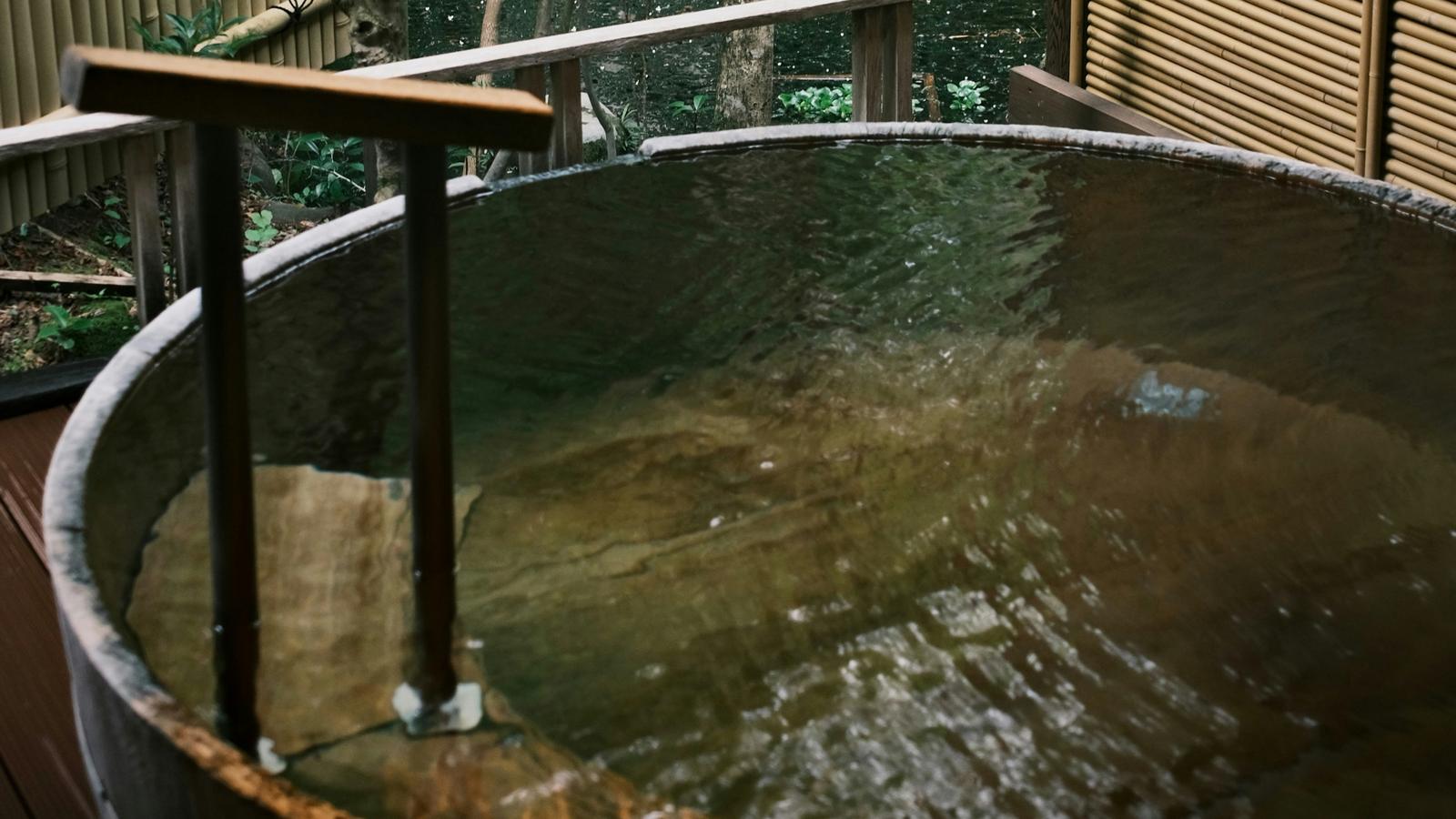
Families from the Gulf often arrive in Japan curious about the hot springs and certain of one thing: they will not bathe in a shared hall. The answer has been in Japan for a long time. A small number of ryokan give a family its own hot-spring bath, its own rooms around it and its own table for dinner, so that grandparents, parents and children can spend the evening as they would at home, only in a cedar bath under the trees.
This article is about finding those rooms for a family of four to ten: which ryokan have suites with their own open-air hot-spring bath for four to six guests, how a larger family takes several of them, which ages each house accepts, and what to ask about the water and the dinner. We read the ryokan's own pages, the Japan National Tourism Organization's statements on travellers from the Gulf, a Japanese trade paper and a long-standing travel guide, and contacted none of them; the sources are listed at the end. For ryokan near Kyoto and Tokyo, see Kyoto Ryokan with Private Onsen: Where to Find Them → and Ryokan With Private Onsen Near Tokyo: 2026 Guide →.
Key points
- The Japan National Tourism Organization's Dubai office says Gulf travellers are interested in onsen but, valuing privacy, ask for an open-air bath in the room over the large shared bath.
- The largest ryokan rooms now hold six: the Bettei Suite Shinonome at Gora Kadan in Hakone is 254 m² with its own open-air hot-spring bath and a private chef's kitchen.
- A family of eight to twelve usually takes two or three suites in the same house; at Beniya Mukayu in Kaga each of the larger suites holds four and has its own open-air hot-spring bath.
- Age rules differ: Beniya Mukayu accepts children from seven, Nishimuraya Honkan in Kinosaki from ten.
- A private bath is not always spring water. Nishimuraya Honkan states that the cypress bath of its largest suite uses heated water; Zaborin in Hokkaido fills both baths of every villa from its own spring.
ASK US ABOUT A RYOKAN FOR YOUR FAMILY →
WHY THE BATH COMES INTO THE ROOM
Daisuke Kobayashi, who heads the Japan National Tourism Organization's office in Dubai, put it plainly in an interview with the Jalan Research Center: travellers from the region are interested in onsen, but because they value privacy they ask for an open-air bath in their own room over the large shared bath. In the same conversation he noted that international luxury hotels are popular with them, that there is also real demand for ryokan, and that high-end ryokan with attentive service and generous rooms suit them well.
The shared bath is the norm the family is stepping around. As the long-standing guide japan-guide.com notes, the vast majority of hot-spring baths in Japan are separated by gender, and some upscale ryokan offer private onsen baths in their guest rooms. A bath in the room changes everything for a family: the mother and daughters can bathe when they wish, the grandparents at their own pace, and no one needs to meet a stranger in the corridor in a yukata.
ROOMS THAT HOLD SIX
Ryokan rooms are mostly made for two. The rooms that take a whole family are few, and they are the ones we look for first.
Gora Kadan, Hakone. The Bettei Suite Shinonome, opened in August 2025, is 254 m² for up to six guests. It has an eleven-mat bedroom with twin beds and futon, a tea room, a dining room of twenty-five mats, a veranda lounge, a study, a dry sauna of its own and a private chef's kitchen. Its bath is a panoramic open-air hot-spring bath, a mildly alkaline spring, looking over a stone garden toward Mount Daimonji. Check-in is at 15:00 and check-out at 11:00. For a family that wants the ryokan's quiet without sharing a single room with other guests, this is close to a house of its own.
Nishimuraya Honkan, Kinosaki. The inn dates from the Ansei era of the Edo period, in a hot-spring town the inn describes as receiving travellers for more than 1,300 years. Its Honjin Suite, the largest room in the main building, is about 124 m² for one to six guests: a fifteen-mat room, a six-mat sleeping room, a dining room where dinner is served privately, and an open-air cypress bath facing the mountainside. It is the only room on the third floor and is reached by stairs, which matters with grandparents.
TAKING SEVERAL SUITES IN ONE HOUSE
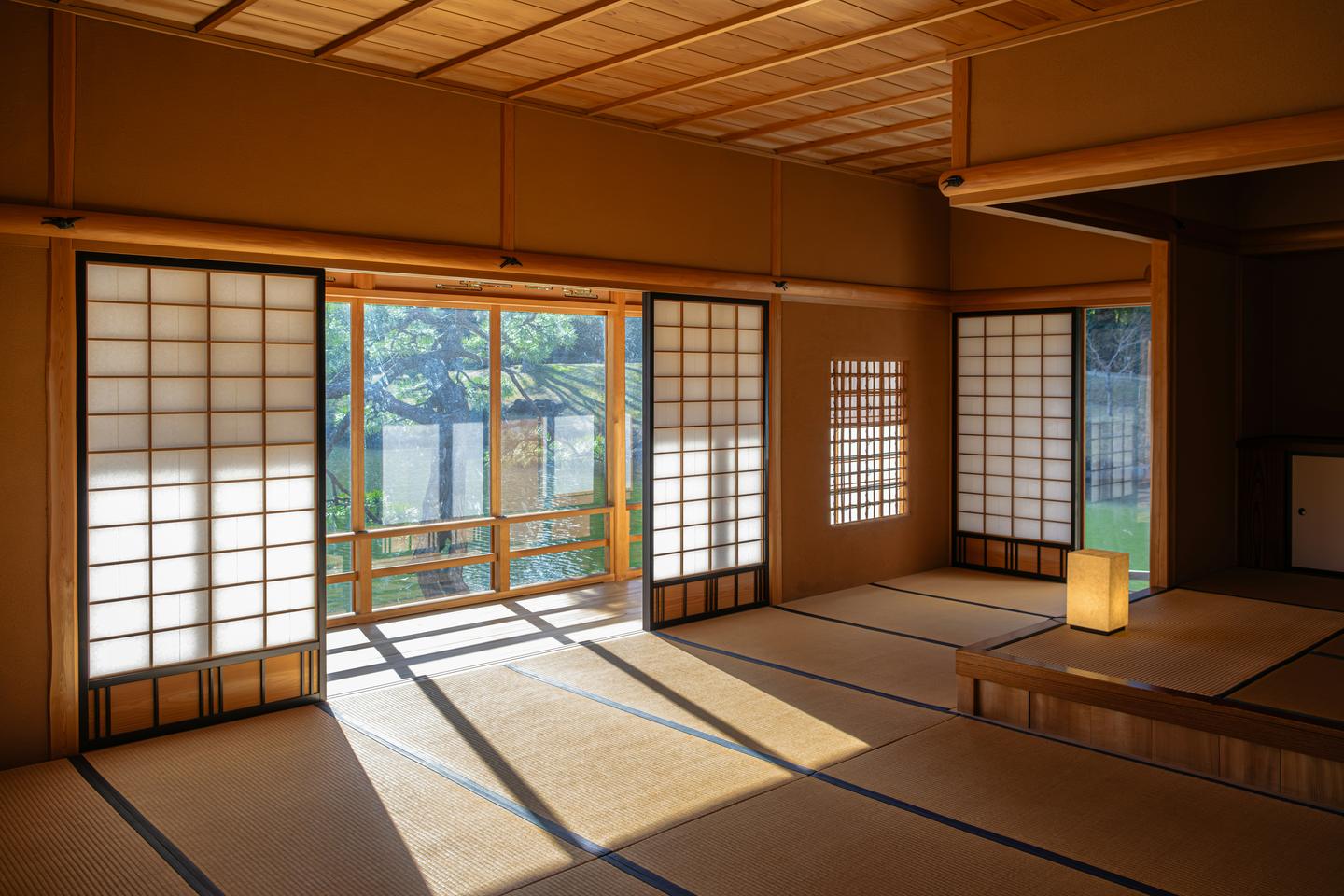
For a family of eight or more, the better answer is usually two or three suites in the same small ryokan, ideally along the same corridor, with dinner laid in one of them.
Beniya Mukayu, Yamashiro Onsen in Kaga. The inn has sixteen rooms, and every room type it lists has its own open-air hot-spring bath. The six Zen Style Executive Suites are 95 to 100 m² for up to four guests each; the Wakamurasaki Suite is 120 m² and the Byakuroku Terrace Suite 110 m², each also for four. Three of these suites hold a family of twelve, each family branch with its own bath. Kaga sits close to Kanazawa, so the stay pairs well with the city's gardens and crafts.
Zaborin, Hanazono in Hokkaido. All fifteen rooms are separate villas, and every villa has two private baths, one indoor and one open-air, filled with natural spring water. Some villas add a twelve-square-metre tatami room that can serve as a second, smaller room for a family. Dinner is Kita Kaiseki, the northern kaiseki of chef Yoshihiro Seno. Three or four villas side by side in the forest give a large family both closeness and space.
Gora Kadan Fuji. The house at the foot of Mount Fuji, in Oyama in Shizuoka, has forty-two suites, and each suite has a private bath of its own. Its three Villa Suites are 363, 260 and 241 m², and two Garden Suites with an open-air big-stone bath are 199 and 215 m². It also keeps four dining rooms on one floor, kaiseki, kappo, sushi and teppanyaki, which helps when generations want different things at dinner.
CHILDREN, GRANDPARENTS AND THE RULES OF EACH HOUSE
Ryokan set their own age rules, and they are part of the quiet guests pay for. Beniya Mukayu does not accept children under seven, welcomes children of seven to twelve at a children's rate, and treats those over twelve as adults. Nishimuraya Honkan accepts guests from the age of ten. A family travelling with small children therefore starts from a different list from one travelling with teenagers, and we draw that list first.
For grandparents the questions are practical: stairs, the height of the bath step, beds or futon, and the distance from the car to the room. A room with twin beds and futon, like Shinonome, lets each generation sleep as it prefers. A third-floor suite reached by stairs may be wrong for a grandmother however beautiful it is.
DINNER AT THE FAMILY'S OWN TABLE
Dinner in the room is the other half of a ryokan's privacy. At Nishimuraya Honkan, dinner in the Honjin Suite is served in the room's own dining area. In a house like Shinonome, the private kitchen means the chef can cook for the family alone.
For the menu, Mr Kobayashi described the basic standard: dishes without pork-derived ingredients and without alcohol are essential, and beyond that the ingredients should be clear so that guests can choose. A Japanese trade paper, Travel Voice, quoted him in 2025 saying that many travellers from the region are flexible once pork and alcohol are removed. Mirin and sake are in many Japanese sauces, so we ask each kitchen in writing how it will prepare the family's meals. The details, including halal kaiseki and halal wagyu, are in Halal Fine Dining in Japan: Halal Wagyu, Kaiseki, Prayer Rooms →.
WHAT WE ASK BEFORE WE REQUEST THE ROOMS
Is the room bath hot-spring water? Not always. Nishimuraya Honkan states that the Honjin Suite's cypress bath is regular heated water, while Zaborin fills its villa baths from its own spring.
How many guests per room, and do children count? We confirm the maximum per room and how the house counts children before we plan the number of rooms.
Can the rooms be side by side? We ask for suites on the same floor or villas next to each other, and where the family can dine together.
Can the family keep its own hours? Late dinners, early prayers and the time of breakfast are easier to arrange in advance than on the night.
Within Signature, our planning for journeys of 7 to 21 days, we propose the ryokan night with the reasons for each house, then arrange the rooms, the meals and the car. The stay is settled with the ryokan in the simplest way available, usually on the day.
SOURCES AND HOW WE CHECKED
We read the pages below on November 5, 2026. We did not contact any ryokan or other body.
- Jalan Research Center, interview with JNTO's Dubai office (Japanese): private in-room open-air baths over the large bath, demand for ryokan, pork and alcohol
- Travel Voice, on travellers from the Middle East (Japanese): families, ten days to two weeks, flexibility once pork and alcohol are removed
- Japan National Tourism Organization, memorandum with Emirates (Japanese): visitors from the GCC in 2025 about double 2019
- japan-guide.com, Types of hot spring baths: gender-separated baths, private baths, in-room baths at upscale ryokan
- Gora Kadan, Bettei Suite Shinonome: 254 m², up to six guests, open-air hot-spring bath, private chef's kitchen, opened August 2025
- Gora Kadan Hakone, Rooms: suites and rooms with open-air baths
- Gora Kadan Fuji, Stay: 42 suites, villa and garden suite sizes
- Gora Kadan Fuji, official site: a private bath in each suite, four dining rooms
- Beniya Mukayu, Rooms: sixteen rooms, sizes, maximum guests, open-air hot-spring baths, children's ages
- Nishimuraya Honkan, official site: history, rooms with open-air baths, minimum age of ten
- Nishimuraya Honkan, Honjin Suite: about 124 m², one to six guests, heated-water cypress bath, dinner in the room
- Zaborin, Guest villas: fifteen villas, indoor and open-air spring baths in each, extra tatami room
QUESTIONS FAMILIES ASK
Can a whole family stay in one ryokan room with a private onsen?
Up to about six, in a few rooms. Gora Kadan's Bettei Suite Shinonome in Hakone and the Honjin Suite at Nishimuraya Honkan in Kinosaki each take up to six guests with their own open-air bath.
What if we are more than six?
Take two or three suites in the same ryokan. At Beniya Mukayu the larger suites hold four each, all with an open-air hot-spring bath, and Zaborin's villas each have two private spring baths.
Do ryokan accept young children?
It depends on the house. Beniya Mukayu accepts children from seven and Nishimuraya Honkan from ten, so the age of the youngest child shapes the choice.
Is the private bath in the room always hot-spring water?
No. Some in-room baths use heated tap water. Nishimuraya Honkan states this for its Honjin Suite, while Zaborin fills its villa baths from its own spring. We ask before requesting a room.
Can the ryokan prepare dinner without pork and alcohol?
Many high-end ryokan can adjust when asked in advance. We ask each kitchen in writing which ingredients and seasonings it will use, including mirin and sake.
ASK US ABOUT A RYOKAN FOR YOUR FAMILY
Tell us who is travelling, the ages of the children and the dates. We will propose ryokan whose rooms and baths fit your family, with the reasons for each.
Begin planning →We reply within 24 hours, in writing
Some of the restaurants and bars we arrange seat guests only by introduction or membership. We ask on your behalf; the table and the evening are the house's decision. We do not publish their names.