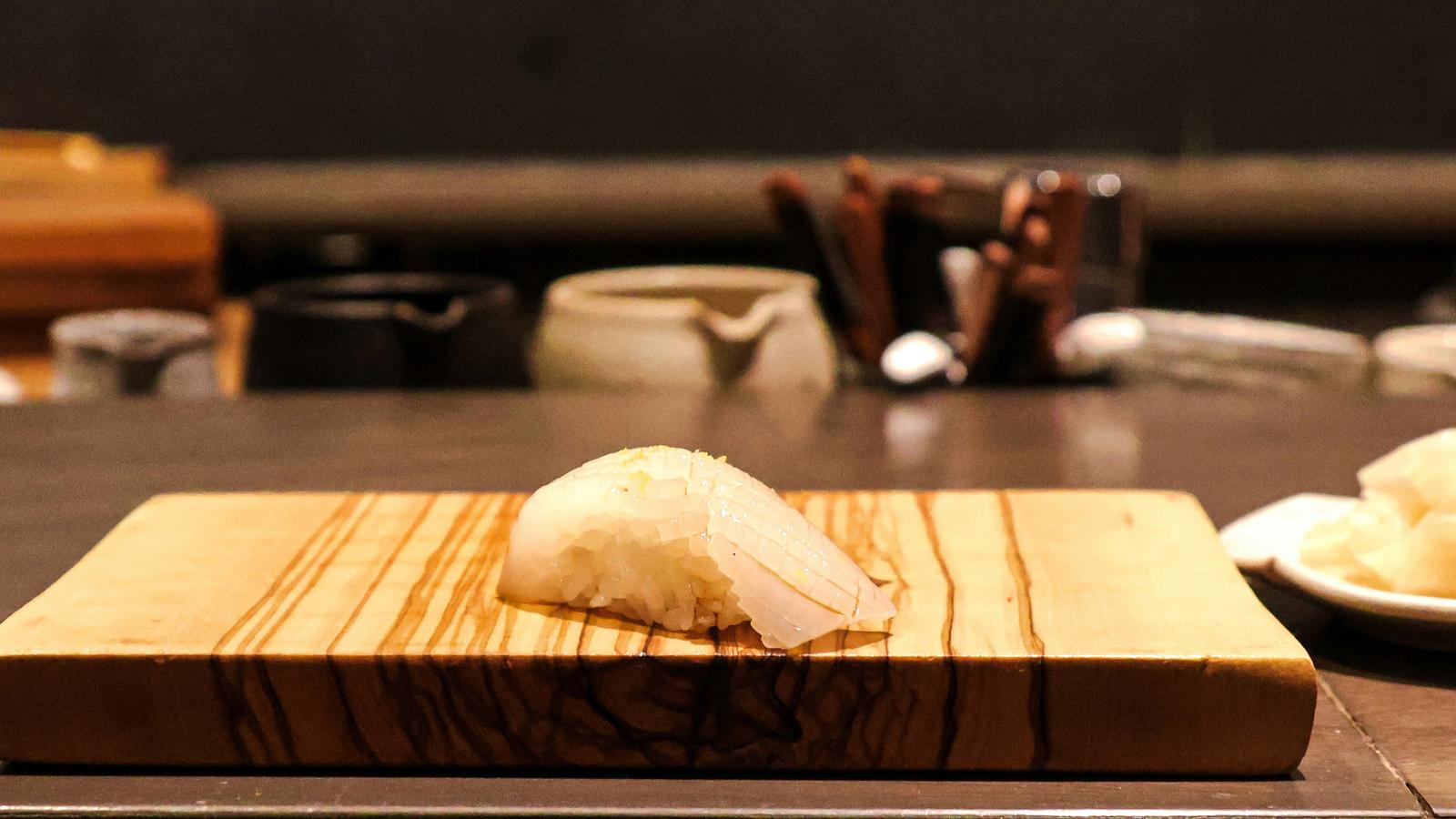
Nigiri began in Edo as quick food from a street stall, and at a Tokyo sushi counter today it is still served one piece at a time, the moment it is made. What has grown around it is the work. Before a piece of gizzard shad or tuna reaches you, it has usually been salted, cured, marinated, simmered or left to rest, and the rice has been timed to the minute. That preparation is what the word Edomae means at the counter, and it is the reason to sit at one of the few places in Tokyo that still do all of it by hand.
This article is about the counter itself: the work, the season, the market and four counters the MICHELIN Guide places at two and three stars in 2026. We read the pages of the MICHELIN Guide, Japan's Ministry of Agriculture, Handa City, the Tokyo tourism board, Minato City, Sukiyabashi Jiro, OMAKASE and Nippon.com on November 5, 2026, and contacted none of them; the sources are listed at the end. How the most sought-after seats in Tokyo are given out is covered in How Tokyo's Most Sought-After Tables Actually Work, and the custom of the introduction in How to Get Into Introduction-Only Restaurants in Japan.
Key points
- Edomae sushi is defined by preparation: fish cured in salt and vinegar, marinated in soy as zuke, pressed in kelp, simmered or steamed, over rice seasoned with red vinegar.
- Hanaya Yohei, credited with the nigiri form, moved from a street stall to a full shop in Ryogoku in 1824.
- In the MICHELIN Guide Tokyo 2026, Harutaka in Ginza holds three stars; Sushi Kanesaka, Sukiyabashi Jiro Roppongiten and Nishiazabu Sushi Shin hold two.
- Toyosu Market, open since October 11, 2018, lets visitors watch the tuna auction from a corridor, or more closely from a deck that must be applied for in advance.
- Counters set their own rules on children, dietary limits and who may make a reservation, and these differ from house to house.
ASK US ABOUT A TOKYO SUSHI COUNTER →
WHAT EDOMAE MEANS AT THE COUNTER
Japan's Ministry of Agriculture describes Edomae sushi as rice seasoned with red vinegar, topped with fish such as kohada and mackerel that have been cured, with prawn and conger eel that have been cooked, and with a rolled omelette. Each topping has been simmered, steamed, boiled, marinated as zuke, pressed in kombu or rinsed in vinegar first. The same page notes that zuke, the soy marinade, came to Edo from the Izu Islands, where it kept fish fresh in a warm climate.
The form is about two hundred years old. Nippon.com, writing on the history of Edo food, credits Hanaya Yohei with nigiri; he began with a street stall and opened a full shop in Ryogoku in 1824. The red vinegar has its own story. Handa City, home of the vinegar maker Mizkan, records that its founder Nakano Matazaemon met the new fast sushi on a visit to Edo in 1804 and began making vinegar from sake lees for the city's sushi shops. Fermented from lees, it had sweetness and savour, cost less than rice vinegar at a time when rice was dear, and became a staple of the Edo counter.
THE WORK BEFORE THE FISH REACHES YOU
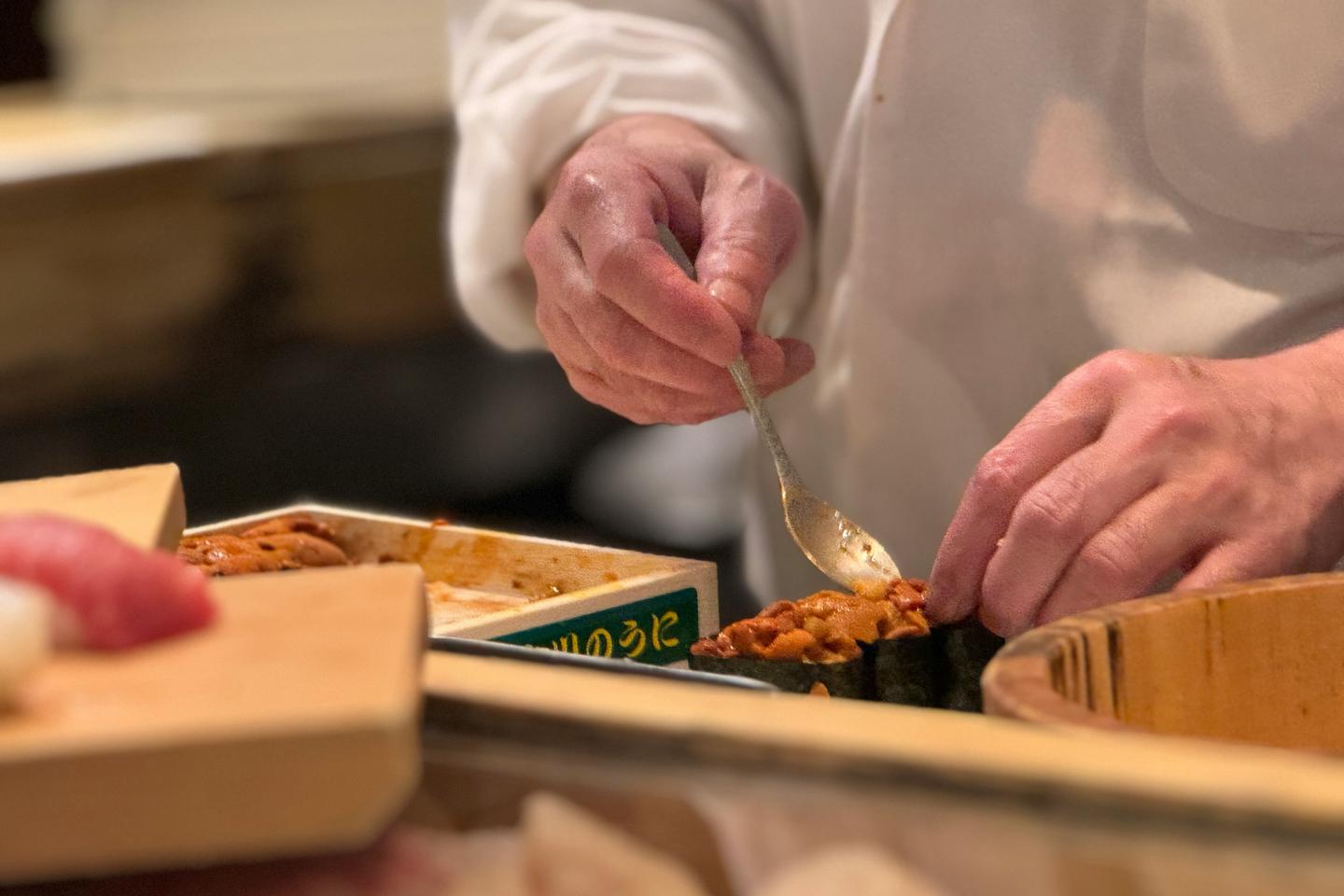
Sukiyabashi Jiro calls the techniques applied to fish shigoto, the work. On its own pages the house explains that kohada, the small silver gizzard shad, is hard to judge: the salt and the vinegar change with its size, the thickness of the flesh and its fat, and the cook decides the time at the moment the fish is opened. Shinko, the young fish of the same species, is smaller still and is judged in seconds. The rice is cooked to be ready twenty minutes before each reservation time and brought to the warmth of the skin.
Two glazes finish many pieces. Since the stalls of Edo, the house writes, the chef has brushed nikiri soy or nitsume onto each piece before setting it down. Jiro's guidance to diners is simple: the brush has already been used, so the piece goes straight into the mouth, in one bite, without being turned over into soy. Resting fish is part of the work too. In a 2021 feature, MICHELIN inspectors in Japan described the chef at Harutaka leaving toro unmarinated and letting it rest to bring out its fat. When you sit at the counter, it is worth asking what each piece has been through. Most chefs are glad to tell you, and it changes how the meal tastes.
THE SEASON AND THE MARKET
A counter follows the fish of the moment. Sukiyabashi Jiro publishes an example of a winter omakase, which changes with what the market offers: flounder, hard clam, medium toro, ark shell, geoduck, young yellowtail, mackerel, fatty toro, sea urchin, conger eel, octopus, kohada, prawn, small scallop, omelette, halfbeak, lean tuna, cuttlefish and salmon roe. Its omakase runs to about twenty pieces, from ¥88,000 including tax. In winter the list leans to white fish, shellfish and the silver-skinned fish, and we find it a rewarding season to sit at a Tokyo counter.
Most of that fish passes through Toyosu, the Tokyo Metropolitan Central Wholesale Market, which opened on October 11, 2018. The Tokyo tourism board explains that visitors can walk the observation corridors and watch the tuna auction from above, or apply in advance for a deck that sits closer to the floor. Uogashi Yokocho holds about 70 shops for ingredients, cooking goods and knives, and the market is closed on Wednesdays, Sundays and public holidays. To walk the market with a chef who buys there, and then stand behind his counter, see our Toyosu morning with a sushi chef.
FOUR COUNTERS IN THE MICHELIN GUIDE
The MICHELIN Guide Tokyo 2026 lists four sushi restaurants at two or three stars. Harutaka, on the sixth floor of a building in Ginza, holds three. The guide notes that Harutaka Takahashi trained at Sukiyabashi Jiro and describes his sushi building towards a close in sweetness, sourness and temperature. Sushi Kanesaka, also in Ginza, holds two stars; Shinji Kanesaka's watchword, the guide writes, is iki, a word that can mean living, fresh or stylish. Sukiyabashi Jiro Roppongiten, run by Takashi Ono in Roppongi Hills, holds two. Nishiazabu Sushi Shin holds two, promoted from one this year; Minato City's page on the restaurant notes eighteen consecutive years at one star before that, and that the meal is omakase.
Our view: Harutaka suits a guest who wants the rhythm of one sitting built to a close; Sushi Kanesaka a guest who wants Ginza and the spirit of iki; Jiro Roppongiten a guest who wants the line of Jiro's teaching close to the hotels of Roppongi; and Sushi Shin a guest who likes a quieter street and a chef who, as the city's page puts it, keeps judging what tastes good right now. At each, whom it seats is the house's decision.
SEATS, CHILDREN AND WHAT YOU DO NOT EAT
Counters write their own rules, and it helps to know them early. The main Sukiyabashi Jiro in Ginza states that it takes guests from overseas only through their hotel concierge, does not accept reservations made by agents, and may ask for photo identification. For that house we work alongside your hotel's concierge, as the house asks. Yamazato Sushi Kanesaka at The Okura Tokyo, which has 13 counter seats and 8 at tables, lists on OMAKASE that children under 10 are not seated at its counter, that it cannot accept guests who avoid a wide range of ingredients, and that it asks guests to keep perfume light. Nishiazabu Sushi Shin, according to Minato City, adjusts the quantity of food and leaves out ingredients a guest does not eat.
For a severe allergy or a strict diet, the request should reach the counter in Japanese and in writing; our guide to food allergies in Japan explains why. Cancellation terms are in How Restaurant Cancellation Policies Work in Japan. Within Signature, our planning for journeys of 7 to 21 days at USD 3,500 for your group, we ask the counters that suit you on your behalf, send your dietary notes ahead, and settle each meal in the simplest way available, usually on the day. The seat and the evening are the house's decision.
SOURCES AND HOW WE CHECKED
We read the pages below on November 5, 2026. We did not contact any restaurant, market, agency or other body. Star ratings are those shown in the MICHELIN Guide on that date.
- MICHELIN Guide, Harutaka: three stars (2026), Ginza, chef trained at Sukiyabashi Jiro
- MICHELIN Guide, Sushi Kanesaka: two stars (2026), Ginza, the word iki
- MICHELIN Guide, Sukiyabashi Jiro Roppongiten: two stars (2026), Roppongi Hills, chef Takashi Ono
- MICHELIN Guide, Nishiazabu Sushi Shin: two stars (2026), Nishiazabu
- MICHELIN Guide, Edomae Sushi (2021): preserving fish in salt and vinegar, toro left to rest at Harutaka
- Ministry of Agriculture, Forestry and Fisheries, regional cuisine of Tokyo (Japanese): red vinegar, cured and cooked toppings, zuke from the Izu Islands
- Handa City, Mizkan room (Japanese): Nakano Matazaemon in Edo in 1804, vinegar from sake lees for sushi
- Nippon.com, When Sushi Became a New Fast Food in Edo: Hanaya Yohei, the shop in Ryogoku in 1824
- GO TOKYO, Toyosu Market (Japanese): opened October 11, 2018, corridors and the tuna auction deck, about 70 shops, closed days
- Sukiyabashi Jiro, technique (Japanese): shigoto, curing kohada and shinko, rice ready 20 minutes before the reservation
- Sukiyabashi Jiro, how to eat sushi (Japanese): nikiri and nitsume, the Edo stall, one bite
- Sukiyabashi Jiro, menu (Japanese): about twenty pieces from ¥88,000, an example winter omakase
- Sukiyabashi Jiro, shops (Japanese): overseas guests through the hotel concierge only, no reservations by agents, photo identification
- OMAKASE, Yamazato Sushi Kanesaka: 13 counter and 8 table seats, children under 10 not at the counter, dietary limits, fragrance
- Minato City, Nishiazabu Sushi Shin (Japanese): omakase, eighteen years at one star then two in 2026, portions adjusted and ingredients left out
QUESTIONS TRAVELLERS ASK
What makes sushi Edomae?
The preparation. Fish is cured in salt and vinegar, marinated in soy, pressed in kelp, simmered or steamed before it is formed, and the rice is seasoned with red vinegar, which in Edo was made from sake lees.
Should we dip the sushi in soy sauce?
At an Edomae counter the chef usually brushes nikiri or nitsume on each piece. Eat it as it is served, in one bite, by hand or with chopsticks.
Can children sit at a sushi counter in Tokyo?
It depends on the house. Yamazato Sushi Kanesaka, for example, does not seat children under 10 at its counter. We check each counter's own rule before suggesting it for a family.
Can a sushi counter cater to dietary restrictions?
Some can leave out an ingredient or two, and some cannot accept guests who avoid a wide range of fish or shellfish. The request should go in Japanese and in writing, well ahead.
Is it worth visiting Toyosu Market before a sushi dinner?
For a guest curious about the fish, yes. The market opens at 5:00, and walking the market with a chef who buys there shows where the evening's pieces begin.
ASK US ABOUT A TOKYO SUSHI COUNTER
Tell us when you are in Tokyo, who is travelling and what each of you eats. We will suggest the counters that suit you, with the reasons, and ask them on your behalf.
Begin planning →We reply within 24 hours, in writing
Some of the restaurants and bars we arrange seat guests only by introduction or membership. We ask on your behalf; the table and the evening are the house's decision. We do not publish their names.