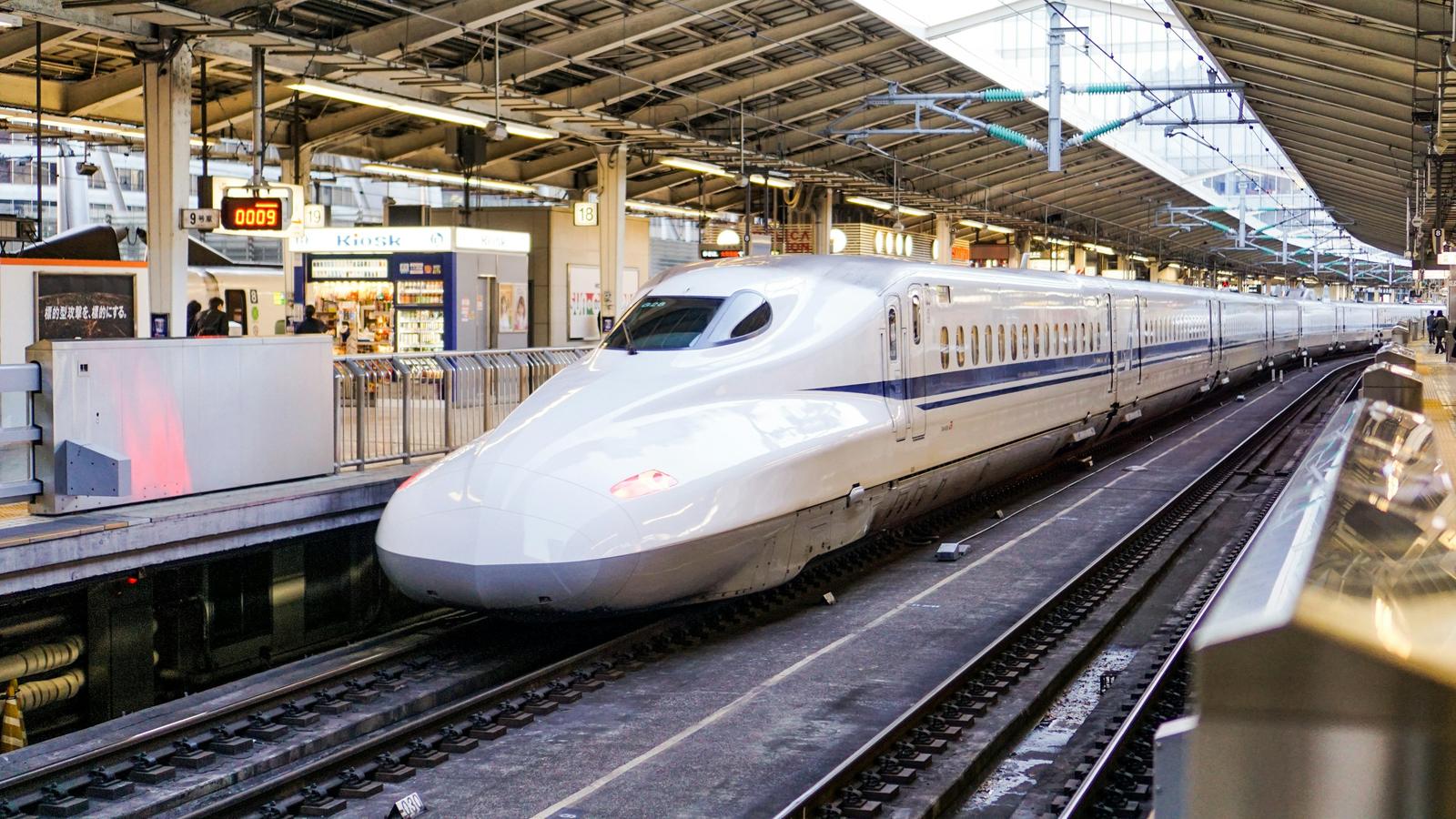
On the Shinkansen there are three ways to sit: an ordinary reserved seat, a seat in the Green Car, and, on some lines only, a seat in GranClass. Price is one difference. The others are how many people sit across the car, how much room there is for a suitcase, whether someone brings you a meal, and whether the class exists on your route at all. For a journey through Japan with several long train days, choosing well makes the travel days part of the pleasure.
This guide compares the three classes as they stand in November 2026: what each one offers, what they cost on the busiest route, which lines have GranClass, how large luggage is handled, and what changes on the Tokaido Shinkansen in 2027. We read the railways' own pages, their joint press release of October 16, 2026, the Japan Rail Pass price list and a press report, and contacted none of them; the sources are listed at the end. For the wider picture of moving around Japan, see How Luxury Travelers Move Around Japan →.
Key points
- On the Tokaido Shinkansen, ordinary cars seat five across and the Green Car, in cars 8 to 10, four across, with a power outlet and reading light at every Green seat.
- From Tokyo to Shin-Osaka by Nozomi, an adult one-way fare in the regular season is ¥14,720 in an ordinary reserved seat and ¥19,590 in the Green Car.
- GranClass runs only on JR East lines, the routes north from Tokyo and to Kanazawa. Each car has 18 seats, three across.
- Some GranClass trains include an attendant, a light meal and drinks; others sell the seat only. The difference is set by train, and it is worth checking before you choose.
- A suitcase with total dimensions of 161 to 250 cm needs a reserved seat with an oversized baggage area on the Tokaido, Sanyo and Kyushu Shinkansen.
ASK US ABOUT YOUR TRAIN DAYS →
THE ORDINARY RESERVED SEAT
The ordinary car is comfortable by any standard of rail travel, and on short legs it is all most people need. On the Tokaido Shinkansen, which links Tokyo, Kyoto and Osaka, the ordinary car is laid out with three seats on one side of the aisle, A, B and C, and two on the other, D and E. A and E are the window seats. Travelling from Tokyo towards Kyoto or back, Mount Fuji appears on the E side.
The layout suits families of five particularly well, since one row holds the whole party. For two people, the D and E pair keeps them together without a stranger at the window. The limit is space: the seats are narrower than in the Green Car, the car is fuller, and the overhead rack is the only place for anything larger than a handbag unless you have reserved the oversized baggage area described below.
THE GREEN CAR
The Green Car is Japan's first class on most trains. On the Tokaido Shinkansen it occupies cars 8, 9 and 10, four seats across, two on each side of the aisle. JR Central's own travel company describes the seats as wider than in the ordinary car, with a power outlet and reading light at every seat, and a footrest and leg warmer. On the Green side, the Fuji view is from seat D.
On the main route the difference in price is modest for what it buys. JR Central and JR West give the regular-season adult one-way fare from Tokyo to Shin-Osaka by Nozomi as ¥14,720 in an ordinary reserved seat and ¥19,590 in the Green Car, each figure being the base fare and charges together. Tokyo to Shin-Osaka takes about two hours and twenty minutes on the fastest trains. For a journey of that length, with a suitcase, a quieter car and room to work or sleep, we usually suggest the Green Car.
WHAT CHANGES ON THE TOKAIDO LINE IN 2027
On October 16, 2026, JR Central and JR West announced two revisions. For tickets bought from July 1, 2027, the Nozomi reserved seat from Tokyo to Shin-Osaka rises to ¥15,420. For travel from December 15, 2027, the Green Car fare on the same journey rises to ¥23,290.
The Green Car changes with it. From December 15, 2027, the railways plan two kinds of Green seat on N700A and N700S trains: seats with a multi-function armrest in cars 8 and 9, and seats with a partition in car 10. The recline is being adjusted from 123 to 116 degrees and the footrest changed to a fold-up type. Lounges for Green Car passengers inside the ticket gates are planned from the same date at Shinagawa, Shin-Yokohama, Kyoto, Kokura and Hakata, with Tokyo and Shin-Osaka to follow in fiscal 2028. For trips in 2027 and after, it is worth checking which fare applies to your date of purchase and date of travel.
GRANCLASS
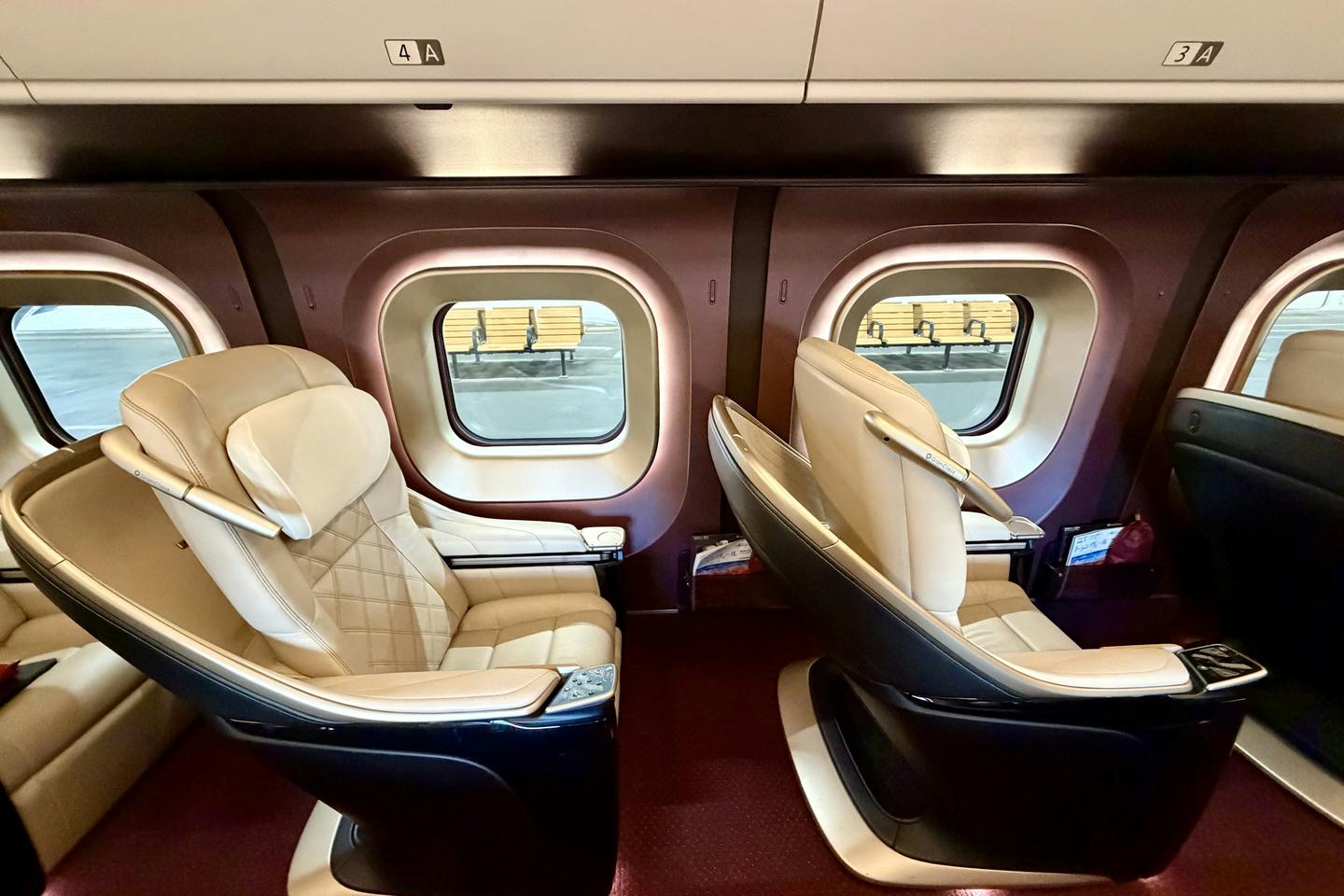
GranClass is a class above the Green Car, and it exists only on JR East's Shinkansen: the Tohoku and Hokkaido Shinkansen with E5 and H5 trains, the Hokuriku Shinkansen with E7 and W7 trains, and the Joetsu Shinkansen with E7 trains. In practice this means the routes from Tokyo north to Sendai, Morioka, Aomori and Hakodate, and west to Kanazawa. The Tokaido line to Kyoto and Osaka has no GranClass.
Each GranClass car has 18 seats, three across, one on one side of the aisle and two on the other. The seats are of the shell type, so reclining does not take space from the person behind, and they recline to a maximum of 45 degrees, with the backrest, seat, legrest and footrest moving together. The interior uses leather, wool and dark wood, with indirect lighting.
The service depends on the train. On trains sold as GranClass with drinks and light meals, an attendant is on board, offers a choice of a Western or Japanese light meal that changes with the season, and serves drinks. On trains sold as seat only, there is no attendant and no meal, drinks or hand towels. JR East lists the seat-only trains as all Nasuno, Hayate and Yamabiko, the Hayabusa trains between Tokyo and Sendai, the Hayabusa trains running between Shin-Aomori, Morioka or Sendai and Shin-Hakodate-Hokuto, all Hakutaka and Asama on the Hokuriku line, and all E7 Toki and Tanigawa on the Joetsu line. Its explanation is simple: on routes where most passengers travel a shorter distance, the service is reduced and the price lowered.
That leaves the Kagayaki between Tokyo and Kanazawa and the long-distance Hayabusa from Tokyo to the far north as the trains where GranClass is at its fullest. On those journeys it is worth considering, especially for two travelling as a couple who would like the single seat and the pair across the aisle to themselves.
LUGGAGE ON THE SHINKANSEN
Large suitcases need a plan on the Tokaido, Sanyo and Kyushu Shinkansen. JR Central's rules are precise. Bags with total dimensions up to 160 cm need no reservation. Bags from 161 to 250 cm need a reserved seat with an oversized baggage area, which is the space behind the last row of some cars; the five seats in that row share it. The seat costs the same as any ordinary or Green reserved seat. A passenger who boards with such a bag without a reservation is charged a ¥1,000 fee. Bags over 250 cm cannot be brought on board, and each passenger may carry two pieces of up to 30 kg each.
For most of our guests the simpler answer is to send the large suitcases ahead by courier and travel with a small bag; see Luggage Forwarding in Japan: Sending Bags Between Hotels and the Airport →. When the bags must travel with you, we reserve the back row, in the Green Car if possible.
THE JAPAN RAIL PASS
The Japan Rail Pass comes in ordinary and Green versions. Bought online, the 7-day pass costs ¥50,000 for an adult in the ordinary class and ¥70,000 in the Green class; 14 days cost ¥80,000 and ¥110,000; 21 days cost ¥100,000 and ¥140,000. On the Tokaido, Sanyo and Kyushu Shinkansen, the pass alone does not cover a seat on the Nozomi or Mizuho; holders need a special additional ticket. Whether a pass pays for itself depends on the route, and we compare it with single tickets when we plan the journey.
HOW WE USUALLY CHOOSE
For short legs, under about an hour, an ordinary reserved seat is usually enough, and a family of five fits in one row. For Tokyo to Kyoto or Osaka, the Green Car is our usual suggestion: a little over two hours pass quickly in a quieter car with room for a bag. For Tokyo to Kanazawa on the Kagayaki, or to Aomori and Hakodate on a Hayabusa that includes the service, GranClass turns a long transfer into a quiet lunch above the countryside. On any route, the choice of side matters as much as the class, and on the Tokaido line we reserve the Fuji side when the weather is clear.
Within Signature, our planning for journeys of 7 to 21 days, we propose the class for each leg with the reason, and our travel partner arranges the seats; the tickets themselves are at the railway's price.
SOURCES AND HOW WE CHECKED
We read the pages below on November 4, 2026. Fares are adult, one-way, regular season. We did not contact any railway or other body.
- JR Central and JR West, joint press release of October 16, 2026 (Japanese): current and revised Nozomi reserved and Green fares, new Green seats, Green lounges
- JR Central, Luggage information: 160 cm, 161 to 250 cm with a reserved seat, ¥1,000 fee, two pieces of up to 30 kg
- JR Central, Shinkansen guide: Tokyo to Shin-Osaka in about 2 hours 21 minutes, power outlets in the Green Car
- JR Central, Accommodations of trains: power outlets at every N700S seat
- JR Central Tours, seat guide for the Tokaido Shinkansen (Japanese): ABC and DE layout, Green Car in cars 8 to 10, Green amenities, Fuji side
- JR East, GranClass: lines and train series, 18 seats, seat-only trains without an attendant
- JR East, GranClass seat: shell-type seat, recline to 45 degrees
- JR East, GranClass interior: three seats across, leather, wool and dark wood
- JR East, GranClass refreshments: Western or Japanese light meal by season, served by the attendant
- JR East, GranClass trains without drinks or light meals: the list of seat-only trains
- JR East, frequently asked questions (Japanese): why some trains offer the seat only
- Japan Rail Pass, Types and prices: ordinary and Green passes for 7, 14 and 21 days, special ticket for Nozomi and Mizuho
- Aviation Wire, October 17, 2026 (Japanese): report of the Green fare revision and the new lounges
QUESTIONS TRAVELLERS ASK
Is the Green Car worth it from Tokyo to Kyoto?
For most travellers, yes. From Tokyo to Shin-Osaka by Nozomi the regular-season fare is ¥19,590 in the Green Car against ¥14,720 in an ordinary reserved seat, for a wider seat, four across, with a power outlet and reading light at every seat.
Is there GranClass between Tokyo and Kyoto?
No. GranClass runs only on JR East's Shinkansen: the Tohoku and Hokkaido, Hokuriku and Joetsu lines. The Tokaido Shinkansen to Kyoto and Osaka has ordinary and Green cars.
Does every GranClass seat include a meal?
No. Some trains include an attendant, a light meal and drinks, while others sell the seat only. JR East lists the seat-only trains, among them all Hakutaka and Asama and the Hayabusa between Tokyo and Sendai.
Can I bring a large suitcase on the Shinkansen?
On the Tokaido, Sanyo and Kyushu Shinkansen, bags of 161 to 250 cm in total need a reserved seat with an oversized baggage area. Without it, a ¥1,000 fee applies. Many travellers send large bags ahead by courier instead.
Will Shinkansen fares change in 2027?
Yes, on the Tokaido and Sanyo lines. Nozomi reserved seats rise for tickets bought from July 1, 2027, and Green fares for travel from December 15, 2027; Tokyo to Shin-Osaka in the Green Car becomes ¥23,290.
ASK US ABOUT YOUR TRAIN DAYS
Send us your route and dates. We will suggest the class for each leg with the reason, the side of the train for the view, and how the luggage travels, so that the train days are as easy as the rest.
Begin planning →We reply within 24 hours, in writing
Some of the restaurants and bars we arrange seat guests only by introduction or membership. We ask on your behalf; the table and the evening are the house's decision. We do not publish their names.