Nikko works as a day trip from Tokyo if you keep to the shrines and temples: Tobu Railway's Spacia X leaves Asakusa at 7:50 and reaches Tobu-Nikko at 9:39, for ¥3,340 one way in a standard seat on normal-season days. Lake Chuzenji and Kegon Falls add about 50 minutes each way by bus from the station, so seeing both the shrines and the lake in one day leaves very little slack, and a night in Nikko or at the lake makes the day easier. Admission to Toshogu is ¥1,600 for an adult, and Rinno-ji's ticket for its main hall and the Taiyuin mausoleum is ¥900.
This guide covers the trains from Tokyo, the three World Heritage sites of Toshogu, Rinno-ji and Futarasan Jinja, Kegon Falls and Lake Chuzenji, when the autumn colour reaches each part of Nikko, and how to decide between a long day and an overnight stay. We read every rule and price on the official pages on October 28, 2026, and the sources are listed at the end. If you are still choosing where to go after Tokyo and Kyoto, Beyond Tokyo and Kyoto sets Nikko beside the other options.
Key points
- Spacia X from Asakusa to Tobu-Nikko takes about 1 hour 50 minutes. On Tobu's normal-season table the fare is ¥1,400 plus a ¥1,940 standard seat charge, or ¥2,520 for a Premium Seat; on busy-season days the seat charges rise to ¥2,140 and ¥2,720.
- JR's limited express Nikko runs from Shinjuku via Ikebukuro and Omiya onto Tobu tracks to Tobu-Nikko, so travellers based in west Tokyo do not need to cross to Asakusa.
- Toshogu is open 9:00 to 17:00 from April to October and 9:00 to 16:00 from November to March, with entry closing 30 minutes earlier. Rinno-ji opens at 8:00, an hour before Toshogu.
- Kegon Falls drops 97 m. The elevator to the lower viewing platform costs ¥600 return and runs 8:00 to 17:00 from March to November.
- Nikko's autumn colour moves downhill: the city tourism association gives early to mid-October for Ryuzu Falls, mid-October to early November for Lake Chuzenji, and early to mid-November for the shrines and temples.
LET US ARRANGE YOUR DAYS IN NIKKO →
GETTING THERE FROM TOKYO
There are three practical ways to reach Nikko from central Tokyo: Tobu Railway from Asakusa, the JR and Tobu through train from Shinjuku, or a car with a driver.
Spacia X from Asakusa
The timetable. Tobu's Spacia X runs from Asakusa with stops at Tokyo Skytree, Kita-Senju, Kasukabe, Tochigi, Shin-Kanuma and Shimo-Imaichi. On the timetable we read, three morning trains go through to Tobu-Nikko: Spacia X 1 leaves Asakusa at 7:50 and arrives at 9:39, Spacia X 3 leaves at 9:00 and arrives at 10:50, and Spacia X 5 leaves at 10:00 and arrives at 11:49. Later trains run to Kinugawa Onsen instead. For the return, Spacia X 12 leaves Tobu-Nikko at 17:44 and reaches Asakusa at 19:35. Tobu adds extra trains on some dates, such as a 15:26 departure from Tobu-Nikko, and marks them on its operating calendar.
The fare. Tobu prices the seat charge by season, with normal, busy and quiet periods on its calendar. From Asakusa to Tobu-Nikko the base fare is ¥1,400. The standard seat charge is ¥1,940 in the normal season and ¥2,140 on busy days; the Premium Seat charge is ¥2,520 and ¥2,720. That puts a standard seat at ¥3,340 one way on a normal day. In October 2026 Tobu's calendar marked the weekends as busy days.
The private rooms. Car 6 has the Cockpit Suite, an 11 m² room at the front of the train for up to seven people, at ¥18,000 per room, and Compartments for up to four at ¥8,000 per room. These room charges come on top of the fare and the standard seat charge for each passenger. Car 1 has the Cockpit Lounge with sofa seats and a café counter. Tickets are sold on Tobu's own site for overseas visitors, TOBU Japan Trip Tickets, and at Tobu stations.
JR from Shinjuku
JR East runs the limited expresses Nikko and Kinugawa from Shinjuku. They stop at Ikebukuro and Omiya, then move onto Tobu Railway tracks and continue via Shimo-Imaichi to Tobu-Nikko, or to Kinugawa Onsen. For a hotel in Shinjuku or Shibuya this avoids the cross-town ride to Asakusa. JR East's page for the train lists the JR EAST PASS (5 days, ¥35,000 for an adult) among its recommended passes. We could not open a current JR timetable or fare table for this train on an official page, so we do not quote times here.
By car
A car is the one option that links the shrines, Kegon Falls and the lake without waiting for buses, and it lets you leave Tokyo before the first train. What a driver costs for a day out of Tokyo is set out in Private driver in Japan cost.
TOSHOGU
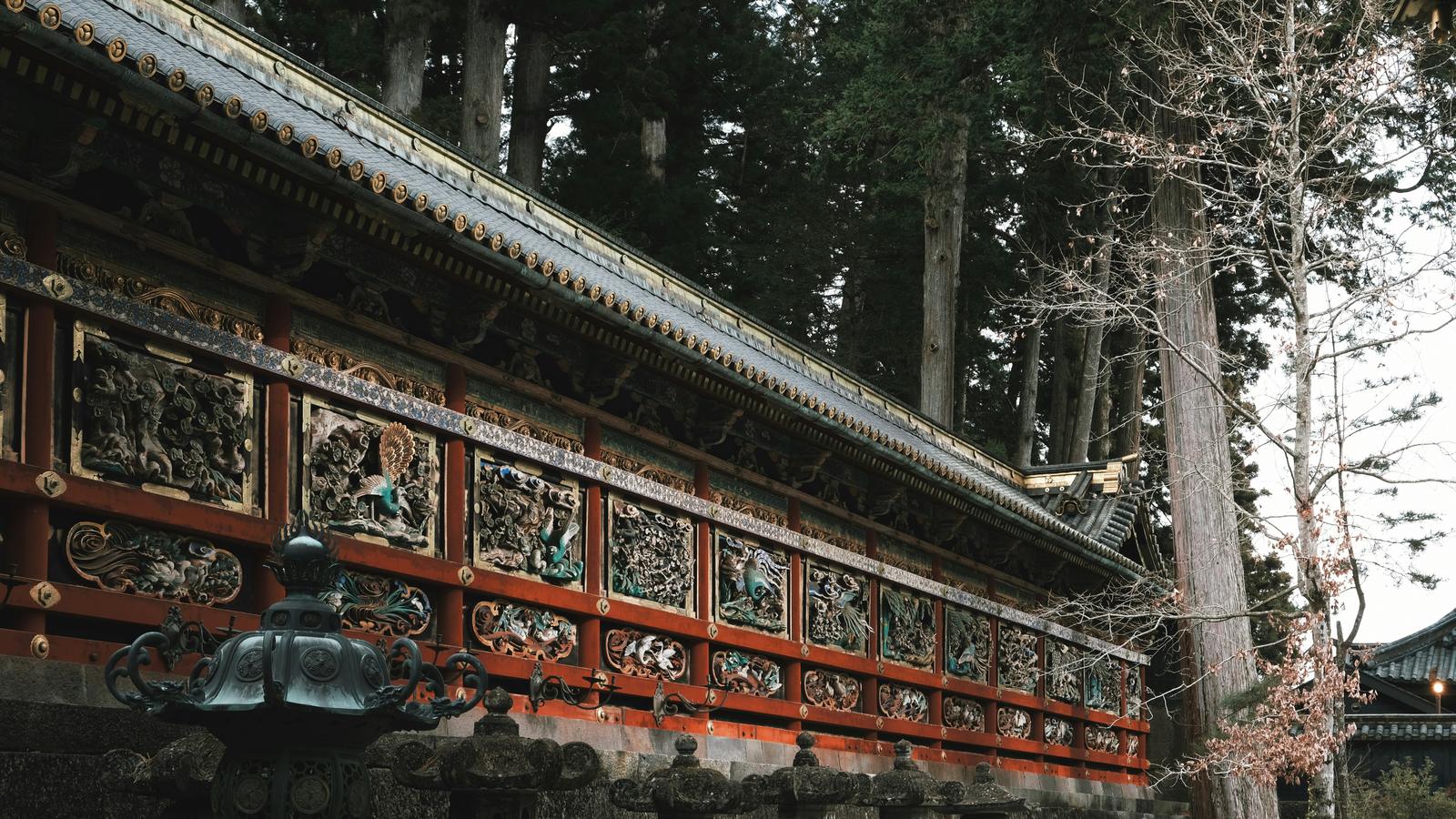
Toshogu enshrines Tokugawa Ieyasu, the first Tokugawa shogun. It was founded in 1617, and most of what you see was rebuilt in 1636 under the third shogun, Iemitsu. UNESCO inscribed the Shrines and Temples of Nikko as a World Heritage Site in 1999: 103 buildings across Toshogu (42), Rinno-ji (38) and Futarasan Jinja (23), nine of them National Treasures.
- Yomeimon. The shrine says this gate carries more than 500 carvings, and it is known as the Higurashi-no-mon, the gate you could look at until sunset.
- The three monkeys. See no evil, speak no evil, hear no evil is one of eight monkey carvings on the sacred stable, and the best known.
- Nemuri-neko. The sleeping cat, attributed to the carver Hidari Jingoro, marks the passage that leads up to the Okumiya, the inner precinct around Ieyasu's tomb.
- Honjido. The hall of the Nakiryu, the crying dragon, is included in the admission area.
Hours and fees. From April 1 to October 31 the shrine is open 9:00 to 17:00, and from November 1 to March 31 9:00 to 16:00; entry closes 30 minutes before. Admission is ¥1,600 for adults and high school students and ¥550 for children. The ticket covers the area from the front gate through Yomeimon, the main hall, the corridor with the sleeping cat, the Okumiya and Honjido. The Treasure House is ¥1,000 on its own, or ¥2,400 with shrine admission. An audio guide in Japanese, English or Chinese is ¥500 a day. Some areas can be closed for ceremonies or repairs, which the shrine asks visitors to check ahead.
RINNO-JI AND FUTARASAN JINJA
Rinno-ji. Nikko's Buddhist history begins with the monk Shodo Shonin, who founded the first temple here in 766, according to Rinno-ji. Its main hall, the Sanbutsudo, is the largest wooden building in Nikko and, the temple says, in eastern Japan. The Taiyuin is the mausoleum of Iemitsu, the shogun who rebuilt Toshogu, with 22 National Treasures and Important Cultural Properties and 315 stone lanterns.
- Hours. 8:00 to 17:00 from April to October and 8:00 to 16:00 from November to March, with entry closing 30 minutes before.
- Fees for adults. Sanbutsudo ¥400, Taiyuin ¥550, or both for ¥900. A set with the Treasure House is ¥1,000. The Treasure House with the Shoyoen garden, a small Edo-period stroll garden, is ¥300.
- Closures. The Treasure House and Shoyoen close on about ten set days a year, and parts of the Sanbutsudo and Taiyuin are restricted on some days.
Futarasan Jinja. The shrine's object of worship is Mount Nantai, 2,486 m, and it has three sites: the main shrine in the Sannai area near Toshogu, the Chugushi on the shore of Lake Chuzenji, and the Okumiya on the summit. The shrine writes that its grounds cover 3,400 hectares, including Kegon Falls and the Shinkyo bridge. The climbing season on Mount Nantai runs from April 25 to November 11; the gate at the Chugushi opens at 6:00, the climbing fee is ¥1,000 in cash, and the shrine puts the round trip at six to seven hours. The treasure hall at the Chugushi is closed on Tuesdays and Wednesdays. We could not find the fees for the main shrine's garden on the shrine's own site, so we leave them out.
KEGON FALLS AND LAKE CHUZENJI
Lake Chuzenji was formed about 20,000 years ago, when lava from Mount Nantai dammed the Daiya River, according to the Japan Tourism Agency's multilingual descriptions. The water leaves the lake at Kegon Falls and drops 97 m into the gorge below.
- Getting there. The Nikko City Tourism Association gives about 50 minutes by bus from Tobu-Nikko Station to the Chuzenji Onsen stop, then about five minutes on foot to the falls.
- The elevator. It descends about 100 m to a platform facing the falls. It runs 8:00 to 17:00 from March 1 to November 30 and 9:00 to 16:30 from December to February, with last entry 20 minutes before closing. The return ride is ¥600 for adults and ¥400 for elementary school children. It can stop without notice in bad weather.
- The free viewpoint. A viewing area at the top needs no ticket; the access ramp is steep.
- The embassy villas. On the south shore of the lake, Tochigi Prefecture runs the Italian Embassy Villa Memorial Park and the British Embassy Villa Memorial Park. Both are open from April 1 to November 30, 9:00 to 16:00, and to 17:00 from May 1 to November 10. Each is ¥300 for an adult, or ¥450 for both.
The Chugushi of Futarasan Jinja stands on the north shore, so a lake afternoon can take in the shrine, the falls and one of the villas without hurrying.
WHEN THE LEAVES TURN
Nikko spans a large range of altitude, and the Nikko City Tourism Association says autumn colour can be seen somewhere in the city from early September to late November. It starts high on the plateau and moves down to the town. These are the association's forecast windows for each area:
| Area | Forecast window |
|---|---|
| Ryuzu Falls, Okunikko | Early to mid-October |
| Senjogahara marsh, Okunikko | Mid to late October |
| Lake Chuzenji and Kegon Falls | Mid-October to early November |
| Irohazaka road | Mid-October to early November |
| Kirifuri Falls | Late October to early November |
| The shrines and temples, Nikko town | Early to mid-November |
On October 26, 2026 the association reported the Lake Chuzenji area at its peak, the upper Irohazaka just reaching it, and the shrines and temples only beginning to colour. Futarasan Jinja's own diary for October 27 also described the lakeside colour as at its best. The practical point is that one autumn date rarely shows both the lake and the shrines at their peak: in mid to late October go up to the lake, and in early to mid-November stay in the town.
Autumn weekends are also the busiest days on the trains, which Tobu prices as its busy season, and on the road up to the lake. A weekday in the same window is noticeably calmer. Other seasons are compared in The best time to visit Japan by season.
A DAY TRIP OR A NIGHT
A day trip works for the World Heritage sites alone. Arriving at 9:39 on the first Spacia X, you can reach Toshogu as it opens, see Rinno-ji and Futarasan Jinja, have lunch in town, and be back on the 17:44 train. That is a full day with time to stand in front of the carvings.
The lake changes the arithmetic. Adding Kegon Falls and Lake Chuzenji means about 100 minutes of bus travel on top, and the elevator and the shrines both close by 17:00 or earlier. A car helps, but even then a day that takes in both the shrines and the lake ends late in Tokyo.
What a night gives you. The town is quietest before the day trains arrive: Rinno-ji opens at 8:00 and Toshogu at 9:00, both earlier than the first Spacia X can bring you there. Staying also lets you give the lake its own half day, or walk at Senjogahara in October.
Where to stay, by area. The Nikko City Tourism Association groups lodging into six areas. Three suit most first visits:
- Nikko town. Hotels and inns within reach of the shrines, for an early start at Toshogu and Rinno-ji.
- Okunikko. The higher area around Lake Chuzenji and beyond, with lakeside hotels and hot spring inns; it suits the October colour and a slower pace.
- Kinugawa and Kawaji. The hot spring towns on the Kinugawa River, served directly by Spacia X trains from Asakusa; better for a ryokan stay than for an early start at the shrines.
How to choose among inns, and what a ryokan night includes, is in How to choose a ryokan in Japan.
HOW WE ARRANGE A DAY IN NIKKO
We plan the day around the hours above and arrange the parts in your name.
- The train. We tell you which Spacia X or JR train fits the plan and which seat type to choose. You buy the tickets yourself, on Tobu's site or at the station.
- A car and driver. For a day that includes the lake, or for a start before the first train, we arrange a car with a driver from your Tokyo hotel or from Tobu-Nikko Station.
- A guide. A licensed guide who knows the carvings, the Taiyuin and the story of the Tokugawa shoguns explains what you are looking at as you go.
- The night. If you stay, we arrange the hotel or ryokan in your name and you pay it directly.
SOURCES AND HOW WE CHECKED
Read on October 28, 2026. Prices include tax and are for one adult unless stated.
- Tobu Railway, Spacia X boarding guide: timetable, operating calendar, seasonal fare tables, room charges, where tickets are sold
- Tobu Railway, Spacia X seats: Cockpit Suite size and capacity, Compartment, Cockpit Lounge
- JR East, limited express Nikko and Kinugawa: route from Shinjuku, stops, JR EAST PASS price
- Nikko Toshogu, hours and fees, history and buildings: hours, admission area, fees, audio guide, 1617 and 1636, Yomeimon, the monkeys, the sleeping cat
- Rinno-ji, visiting information and temple grounds: hours, fees, closures, Sanbutsudo, Taiyuin, Shodo Shonin
- Nikko Futarasan Jinja and its history page: three sites, Mount Nantai, grounds, climbing season and fee, treasure hall closing days, October 27 lakeside report
- UNESCO World Heritage Centre, Shrines and Temples of Nikko: 1999 inscription, 103 buildings by site, National Treasures
- Nikko City Tourism Association, Kegon Falls and Kegon Falls Elevator, hours and fees: height, bus time, elevator hours and fares
- Nikko City Tourism Association, autumn leaves: forecast windows by area and the October 26 status
- Nikko City Tourism Association, accommodation: lodging areas
- Japan Tourism Agency, multilingual descriptions: Lake Chuzenji and Kegon Falls: how the lake formed
- Tochigi Prefecture, embassy villa memorial parks: season, hours, fees
QUESTIONS GUESTS ASK
Can I visit Nikko as a day trip from Tokyo?
Yes, for the shrines and temples. The 7:50 Spacia X from Asakusa reaches Tobu-Nikko at 9:39, and the 17:44 train is back in Asakusa at 19:35, which leaves a full day for Toshogu, Rinno-ji and Futarasan Jinja. Adding Lake Chuzenji and Kegon Falls in the same day is possible by car, but tight.
How much is the train from Tokyo to Nikko?
On Tobu's tables we read on October 28, 2026, Asakusa to Tobu-Nikko on Spacia X is ¥3,340 one way in a standard seat on normal-season days: a ¥1,400 fare and a ¥1,940 seat charge. On busy-season days the seat charge is ¥2,140, and a Premium Seat costs ¥2,520 or ¥2,720.
How much does it cost to enter Toshogu?
¥1,600 for adults and high school students and ¥550 for children. With the Treasure House it is ¥2,400. Rinno-ji is separate: ¥900 for the Sanbutsudo and the Taiyuin together.
When is the best time to see autumn leaves in Nikko?
It depends on the altitude. The Nikko City Tourism Association forecasts mid-October to early November for Lake Chuzenji and Kegon Falls, and early to mid-November for the shrines and temples in town. Ryuzu Falls and Senjogahara come earlier, in October.
Should I stay at Lake Chuzenji or in Nikko town?
Stay in town if the shrines are the priority and you want to be at Rinno-ji at 8:00 and Toshogu at 9:00. Stay at the lake in October, when the colour is up there, or if you want a slower day by the water and the falls.
LET US ARRANGE YOUR DAYS IN NIKKO
Send us your dates and where you are staying in Tokyo. We will come back with a plan for Nikko built around the opening hours and the season, the train or car that fits it, and, if you stay the night, two or three hotels or inns with their published rates, and we arrange the guide, the car and the stay you choose.
Begin planning →We reply within 24 hours, in writing